
From Headlines to Strategy: How to Decode Competitor Moves Through Media Mentions
Media mentions offer a powerful lens into competitor strategy that goes beyond official announcements. While press releases showcase what competitors want you to know, media coverage reveals what they're actually doing and how they're perceived. This distinction is crucial: direct competitor statements are carefully crafted, while third-party media analysis often uncovers unspoken priorities and market positioning.
For example, when a competitor receives coverage for a specific product feature or partnership, it signals where they're investing resources and how they're differentiating themselves. Media mentions frequently highlight strategic shifts before they appear in official communications, giving you early warning signals.
Practical tip: Create a media monitoring checklist:
- Track which publications cover your competitors
- Note the frequency and sentiment of coverage
- Identify recurring themes and positioning language
- Compare media narratives with official messaging
- Look for gaps between stated strategy and media portrayal
This approach helps you understand not just what competitors say, but what they're actually prioritizing and how the market perceives their moves. Media mentions become strategic intelligence when analyzed systematically rather than consumed passively.
Decoding Strategic Pivots Through Executive Interviews
Executive media interviews are strategic goldmines for competitor intelligence. When a competitor's CEO discusses 'pivoting to AI-first solutions' in a major publication, they're signaling more than just a product update—they're revealing a fundamental strategic shift. These carefully crafted narratives expose new market priorities, technology adoption timelines, and response strategies to industry disruptions.
Insights from executive discussions are invaluable as they can reveal the rationale behind major strategic overhauls. For instance, RivalSense captured a moment where LexisNexis Technology's leadership openly discussed a complete strategic pivot triggered by a market disruption. This insight provides direct access to a competitor's adaptation playbook.
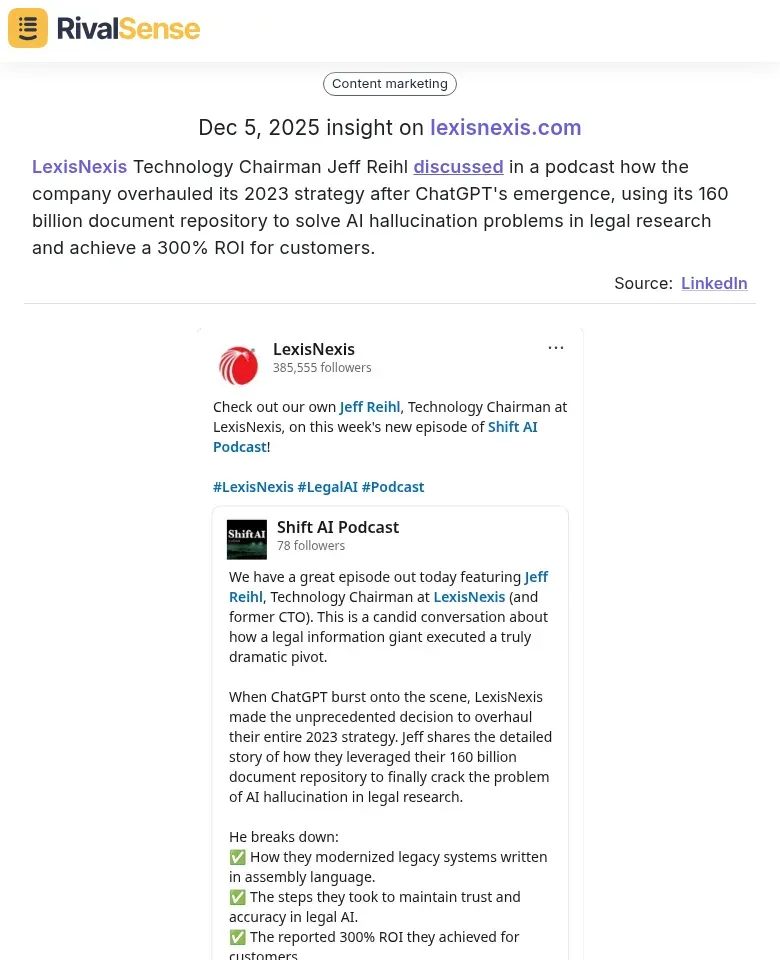
Capturing a leadership interview where LexisNexis Technology Chairman Jeff Reihl discussed overhauling its 2023 strategy after ChatGPT's emergence is a perfect example. He revealed how the company leveraged its unique 160-billion-document repository to tackle AI hallucination problems in legal research, aiming for a 300% ROI for customers. This type of insight shows exactly how a competitor is leveraging its assets to respond to a market-shaking event, allowing you to anticipate their future moves and refine your own strategic response.
Practical Analysis Framework:
- Track executive interview patterns across business publications (Forbes, TechCrunch, WSJ) to identify recurring themes
- Analyze language evolution—note when terms like 'generative AI,' 'sustainability,' or 'vertical integration' emerge in leadership narratives
- Map timeline correlations between interview statements and subsequent product launches or market expansions
- Identify competitive responses to technological shifts—how quickly do competitors publicly acknowledge and adapt to innovations?
Key Insight: When multiple competitors' executives simultaneously discuss similar emerging technologies (like edge computing or quantum readiness), you're witnessing industry-wide strategic alignment. Monitor these consensus signals to anticipate market movements before they materialize in product catalogs.
Analyzing Technology Positioning and Innovation Narratives
Technology positioning in media reveals strategic bets. When competitors consistently mention specific technologies (like "AI-powered analytics" or "blockchain verification"), they're signaling investment areas. Tracking these narratives is critical because they indicate where a company believes the future market value lies and how they plan to capture it.
For example, a competitor repeatedly discussing blockchain in international commerce contexts isn't just sharing an opinion—they're signaling a business priority. RivalSense tracked an interview with Block's head of business that offered a clear window into their strategic focus.
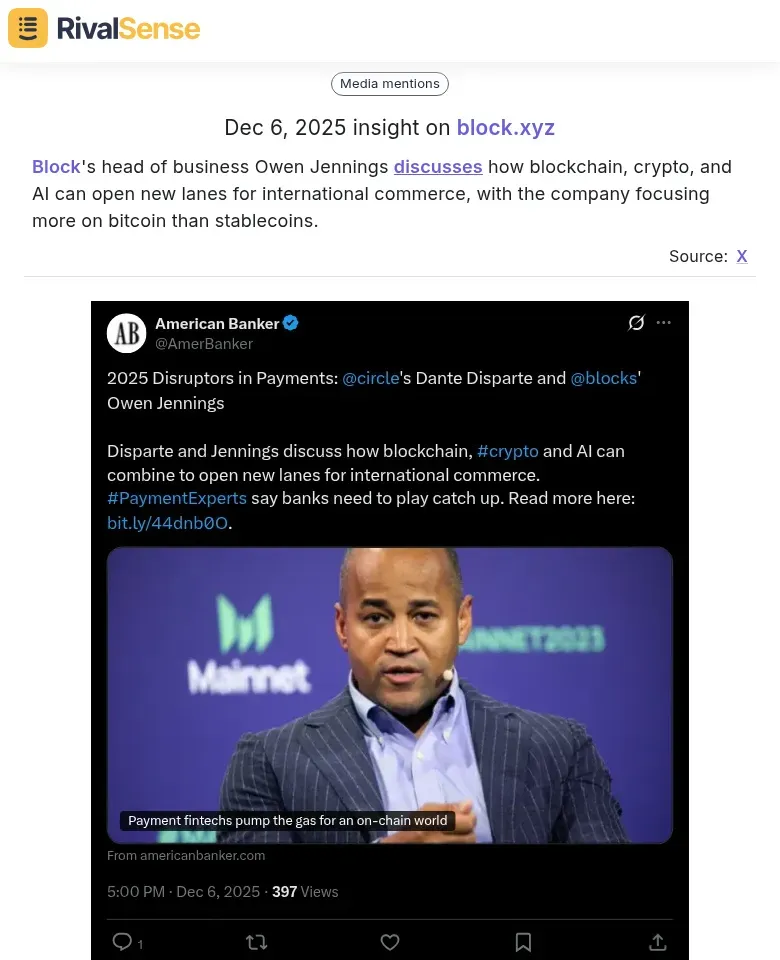
In this insight, Block's head of business, Owen Jennings, discusses how blockchain, crypto, and AI can open new lanes for international commerce, emphasizing a focus on bitcoin over stablecoins. For a competitor or a business in the fintech space, this reveals a clear directional bet on specific technologies and assets, allowing you to anticipate product developments and partnership strategies.
Practical steps:
- Use media monitoring tools to track competitor mentions in tech publications.
- Create a matrix: list competitors vs. technologies mentioned, noting frequency and context.
- Identify gaps—if no one discusses "data privacy compliance," it's an opportunity.
- Analyze proprietary claims: verify if unique capabilities (e.g., "patented algorithm") are substantiated in product updates.
- Map narratives over time to spot shifts, like moving from "AI-assisted" to "fully autonomous."
Tip: Media often exaggerates; correlate mentions with actual product releases or hiring trends in tech roles.
Extracting Content Strategy Insights from Award Recognition
When competitors announce awards, they're revealing strategic priorities. Look beyond the celebration to extract actionable insights about their content strategy. Awards are not just trophies; they are carefully selected validation points that a company wants to amplify through its marketing and content channels.
Monitoring award wins provides direct insight into a competitor's desired brand image and the social or market segments they are targeting. For instance, an award focusing on health leadership or social impact clearly informs their Corporate Social Responsibility (CSR) content themes for the coming quarters.
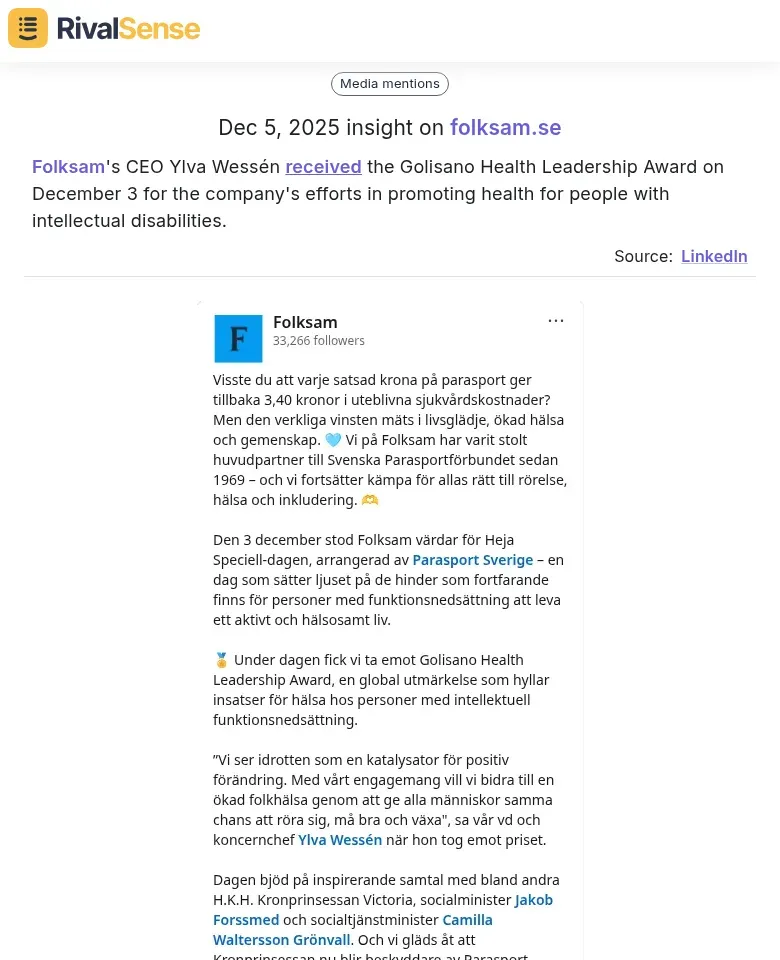
RivalSense tracked Folksam's CEO Ylva Wessén receiving the Golisano Health Leadership Award for promoting health for people with intellectual disabilities. This insight is valuable because it immediately highlights a key pillar of the company's social responsibility positioning. Competitors can anticipate a wave of content around inclusivity, community health, and corporate citizenship, and can assess how to differentiate their own ESG narratives.
Market Segment Focus: Awards often target specific verticals or customer segments. If a competitor wins "Best SaaS Solution for Healthcare," they're signaling healthcare as a priority market. Their content will likely emphasize healthcare compliance, patient data security, and industry-specific workflows.
Practical Checklist:
- Monitor industry awards and competitor press releases
- Analyze award categories to identify target segments
- Note key messaging in award announcements
- Track subsequent content aligning with award themes
- Compare their positioning against your own content strategy
Practical Framework for Media Mention Analysis
To transform media mentions into strategic insights, implement this 3-step framework. Moving from random observations to structured analysis is what separates useful intelligence from noise. A consistent framework ensures you capture trends and translate them into actions.
1. Systematic Tracking & Categorization: Use automated tools to monitor competitor coverage across publications. Create a spreadsheet with columns for: publication tier (tier 1-3), article type (news, feature, interview), key messages, spokespeople, and strategic themes (product launches, funding, partnerships). Tag each mention with relevant business objectives.
2. Pattern Analysis: Look for patterns in three areas:
- Placement Strategy: Are competitors targeting industry-specific or mainstream outlets? What's their tier distribution?
- Messaging Consistency: Do their key messages align across different publications? Note any strategic shifts over time.
- Spokesperson Selection: Who speaks for what topics? CEO for vision, CTO for technical depth, etc.
3. Actionable Adjustments: Based on findings:
- Gap Identification: If competitors dominate certain publication types, develop targeted outreach.
- Message Refinement: Adapt successful messaging patterns to your content.
- Spokesperson Strategy: Match spokesperson expertise to media opportunities.
Pro Tip: Create a quarterly media mention dashboard comparing your coverage vs. competitors across key metrics to track strategic progress.
Conclusion: Turning Media Intelligence into Competitive Advantage
To turn media intelligence into sustainable competitive advantage, integrate mention analysis into your regular competitive intelligence cadence. Set up automated alerts for competitor media coverage and schedule monthly reviews to identify patterns and positioning shifts.
Develop proactive content strategies by analyzing gaps in competitor media narratives. If competitors dominate coverage in specific verticals or topics, create counter-positioning content that addresses underserved angles. For example, if a rival consistently gets featured for "enterprise security," develop content around "SMB security challenges" they're overlooking.
Practical checklist:
- Set up automated media monitoring for your top 5 competitors
- Create a monthly review template analyzing coverage volume, sentiment, and themes
- Identify 2-3 content gaps in competitor narratives each quarter
- Develop "prepared response" content for common competitor announcements
- Share insights weekly with marketing and product teams
By transforming media mentions from passive information into actionable intelligence, you can anticipate market moves and position your content strategically before competitors define the narrative.
Manually scouring the internet for these competitor insights is time-consuming and inefficient. RivalSense automates this process, tracking competitor product launches, pricing updates, event participations, partnerships, regulatory news, management changes, and media mentions—delivering a concise weekly report directly to your inbox.
Stop guessing and start knowing. Try RivalSense for free today and get your first competitor report to see what strategic moves you've been missing.
📚 Read more
👉 DHL's Tesla Semi Trial: A Competitor Analysis Case Study
👉 How a Key Account Tracking API Works to Monitor Your Most Important Competitors
👉 Advanced Tactics: Monitor Fintech Competitor Product Launches for B2B Payments
👉 How Roblox's SLIM and $50K Tournament Revealed Competitors' Next Moves
👉 Optimize Twitter Monitoring for Competitor Industry Award Insights