
Data Processing Competitive Advantage Cheat Sheet: Outsmart Rivals
In today's hyper-competitive landscape, data processing has evolved from a backend function to your ultimate competitive weapon. While traditional competitor analysis methods—like manual website reviews or sporadic market reports—offer limited snapshots, they're no longer sufficient against rivals leveraging real-time data processing. The strategic importance lies in transforming raw data into actionable intelligence that drives faster, smarter decisions.
Data-driven insights create sustainable competitive advantages by enabling predictive analytics, personalized customer experiences, and operational efficiencies that competitors can't easily replicate. For instance, processing social media sentiment data can reveal competitor weaknesses before they impact market share, while analyzing pricing trends can inform dynamic pricing strategies.
Practical steps to start:
- Audit your current data sources (website analytics, CRM, social media)
- Identify key competitor metrics to track (pricing changes, feature launches, content engagement)
- Implement automated data collection tools
- Establish regular analysis cadences
- Translate insights into tactical adjustments
💡 Tip: Focus on processing speed—the faster you can analyze competitor data, the quicker you can respond to market shifts.
The Data Processing Advantage Framework: Four Pillars of Competitive Edge
The Data Processing Advantage Framework consists of four strategic pillars that transform raw competitor data into actionable intelligence. First, real-time data collection and monitoring capabilities enable you to track competitor moves as they happen. Practical tip: Set up automated website monitoring with tools like RivalSense to detect pricing changes, feature releases, and content updates within minutes.
Second, advanced analytics and pattern recognition techniques help identify hidden trends. Checklist: Implement ETL pipelines for data cleaning, use clustering algorithms to group competitor behaviors, and create interactive dashboards for visualization.
Third, predictive modeling anticipates competitor moves before they happen. Actionable step: Deploy time-series forecasting models to predict pricing strategies, product launches, and market shifts based on historical patterns.
Fourth, prescriptive intelligence provides specific counter-strategies. Example: When your model predicts a competitor's price drop, your system automatically recommends optimal pricing adjustments and marketing responses. This framework creates a continuous intelligence loop where each pillar reinforces the others, giving you a sustainable competitive edge through data-driven decision making.
Competitor Intelligence Gathering: Turning Data into Actionable Insights
Competitor intelligence gathering transforms raw data into strategic advantages. By systematically tracking and analyzing competitor activities, you can uncover opportunities and threats that inform your business decisions. Start by tracking these key metrics: market share growth, customer acquisition costs, churn rates, pricing elasticity, and feature adoption patterns.
Practical Checklist:
- Map competitor pricing tiers and discount strategies
- Analyze their content marketing themes and SEO keywords
- Monitor social media engagement and customer sentiment
- Track feature releases and product roadmap signals
- Identify underserved customer segments they're ignoring
Actionable Insight Framework:
- Weakness Analysis: Look for customer complaints, support gaps, and negative reviews
- Positioning Gaps: Identify where competitors over-serve or under-serve specific needs
- Strategic Opportunities: Spot pricing windows, feature gaps, and messaging vulnerabilities
For example, tracking competitor promotional campaigns can reveal pricing strategies. Recently, RivalSense detected that Supliful launched Black Friday deals with up to 80% off on Branded Customer Support plans, including a Starter plan at $36/month, Standard plan at $70/month, and Hourly plan at $7/hour, with the discount applying for the first 3 months.
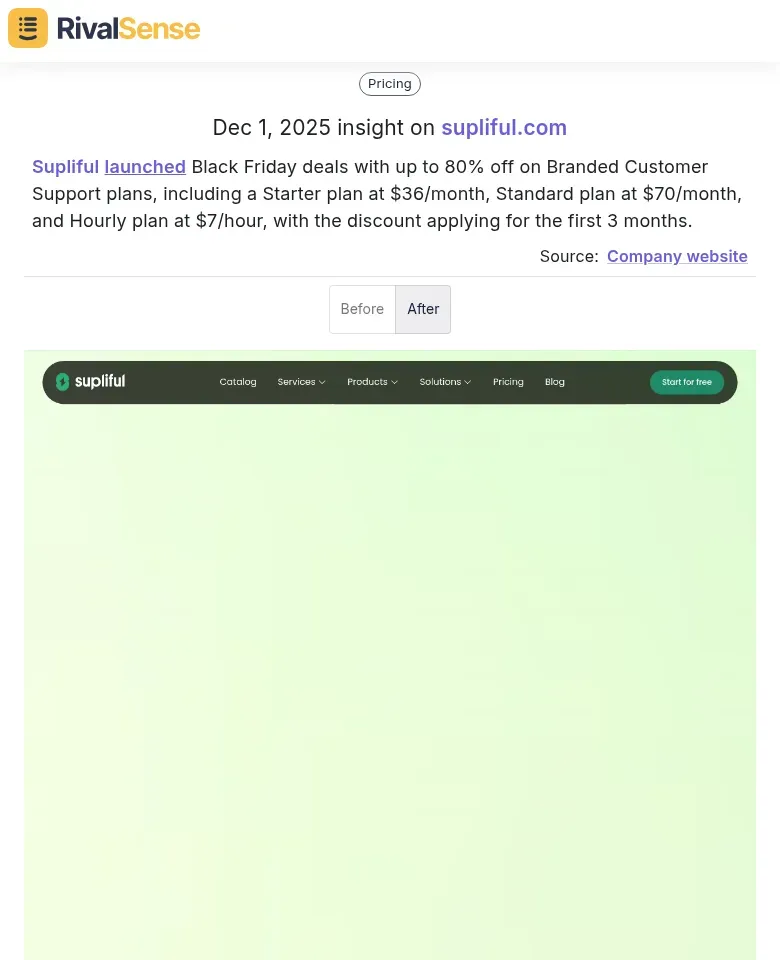
This type of insight is valuable for adjusting your own pricing and promotional strategies to stay competitive during key sales periods, ensuring you don't lose market share to aggressive discounts.
Convert insights into action by creating a competitive response matrix. For each competitor weakness identified, develop a counter-strategy: undercut pricing, highlight missing features, or target their dissatisfied customers. Remember, the goal isn't just data collection—it's creating decisive competitive advantages through informed strategic moves.
Strategic Decision-Making: Using Data to Outmaneuver Rivals
Strategic decision-making transforms raw competitor data into actionable advantage. It enables you to anticipate competitor moves and craft proactive responses. Here’s how to outmaneuver rivals systematically:
Market Timing Mastery:
- Track competitor expansion patterns, funding rounds, and hiring spikes to identify optimal entry windows
- Use competitor product launch timelines to schedule your releases strategically (launch 2-3 weeks before or after major competitors)
- Monitor competitor geographic expansion to identify underserved markets or saturated regions to avoid
Monitoring competitor event participations can signal strategic partnerships and market focus. For example, RivalSense tracked that Databricks will showcase its Data Intelligence Platform and host sessions and a party at AWS re:Invent in Las Vegas in December.

This insight is valuable for understanding competitor investment in industry events and identifying potential collaboration or competitive opportunities, helping you plan your own event strategies and partnerships.
Pricing Optimization Framework:
- Create a competitive pricing matrix comparing features, tiers, and value propositions
- Implement dynamic pricing triggers based on competitor price changes (set alerts for ±10% price movements)
- Test price elasticity in markets where competitors are weakest
Counter-Strategy Development:
- Identify competitor's core strengths and develop targeted workarounds (if they excel in enterprise features, focus on SMB usability)
- Create "competitive response playbooks" for common scenarios (price wars, feature matching, market entry)
- Exploit competitor weaknesses by analyzing customer complaints and churn patterns
Actionable Checklist:
- [ ] Set up automated competitor tracking for pricing, features, and market moves
- [ ] Conduct quarterly competitive SWOT analysis
- [ ] Establish clear decision thresholds (e.g., "If 3+ competitors enter a market, we accelerate our timeline")
- [ ] Create a competitive intelligence dashboard accessible to all decision-makers
🚀 Pro tip: The most effective strategies combine real-time competitor monitoring with your unique market insights—don’t just react, anticipate.
Implementation Cheat Sheet: Practical Steps for Immediate Advantage
Implementing a data-driven competitive intelligence system requires the right tools, team, and processes. Here are practical steps to gain an immediate advantage.
Essential Tools & Technologies Stack:
- Core CI Platforms: RivalSense for automated competitor tracking, SEMrush/Ahrefs for digital presence analysis, Crayon/Klue for comprehensive market intelligence
- Data Processing: Python/R for analysis, SQL databases for storage, Tableau/Power BI for visualization
- Automation Tools: Zapier/Make for workflow automation, custom web scrapers, API integrations
Building Your Data-Driven CI Team:
- Core Roles: CI Manager (strategic oversight), Data Analyst (quantitative insights), Market Researcher (qualitative context), Technical Specialist (automation setup)
- Key Skills: Data storytelling, SQL proficiency, competitive analysis frameworks, business acumen
- Quick Start: Begin with 2-3 cross-functional team members, establish clear KPIs, implement weekly intelligence briefings
Automated Monitoring System Setup:
- Define Critical Triggers: Price changes, feature launches, leadership moves, funding announcements
- Configure Alerts: Set up email/Slack notifications for immediate awareness
- Dashboard Creation: Build real-time competitor dashboards with key metrics
- Weekly Automation: Schedule automated competitor reports for leadership review
Immediate Action Checklist:
- [x] Identify top 3-5 competitors to monitor
- [x] Set up basic price/product change alerts
- [x] Create competitor dashboard template
- [x] Schedule weekly competitive review meeting
- [x] Document competitor response protocols
💡 Pro Tip: Start with 80/20 automation - focus on automating the most critical 20% of competitor activities that drive 80% of your strategic decisions. Use RivalSense's automated tracking to eliminate manual monitoring overhead.
Sustaining Your Competitive Edge: Continuous Improvement and Adaptation
Sustaining competitive advantage requires systematic processes, not one-time analysis. It involves ongoing monitoring and adaptation to stay ahead of rivals. Implement these practical steps:
Establish Ongoing Monitoring Processes:
- Set up automated alerts for competitor website changes, pricing updates, and product announcements using tools like RivalSense or Ahrefs
- Create a weekly review cadence to analyze competitor social media performance, content themes, and engagement metrics
- Monitor customer sentiment across review platforms (G2, Google) and forums (Reddit, industry communities)
- Track organizational changes (leadership hires, funding rounds) that signal strategic shifts
Tracking competitor expansions and new service launches can reveal growth strategies. For instance, RivalSense reported that inDrive accelerates its expansion in Colombia with its inDrive Money microcredit service, which has already benefited over 15,000 drivers in the country by offering loans of up to $1 million.
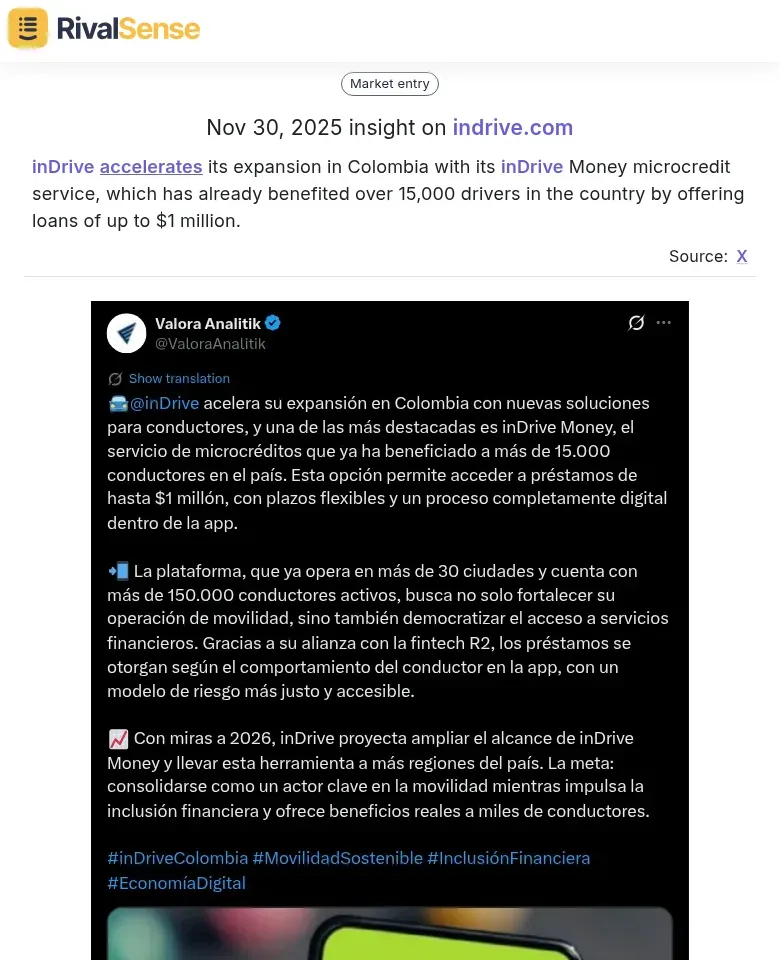
This insight is valuable for identifying new market opportunities and assessing competitive threats in emerging services, allowing you to adjust your expansion plans accordingly.
Adapt Strategies Based on Evolving Landscapes:
- Use competitive intelligence to identify gaps in competitor offerings and messaging
- When competitors pivot positioning, quickly adjust your value proposition to highlight differentiators
- Benchmark against top-performing competitor content to refine your own posting strategy
- Implement a quarterly competitive landscape review to identify emerging threats and opportunities
Measure and Optimize Over Time:
- Track key metrics: market share changes, customer acquisition cost relative to competitors, feature adoption rates
- Establish competitive advantage scorecards with weighted factors (product differentiation, pricing, customer satisfaction)
- Conduct quarterly win/loss analysis to understand why deals go to competitors
- Use A/B testing to validate competitive response strategies before full implementation
Practical Checklist:
- [ ] Weekly: Review competitor social media and content updates
- [ ] Monthly: Analyze pricing changes and promotional patterns
- [ ] Quarterly: Update competitive positioning maps and SWOT analyses
- [ ] Bi-annually: Reassess competitor list and identify new market entrants
Continuous improvement requires treating competitor intelligence as an operational process, not a research project. The most successful companies institutionalize monitoring, create feedback loops between intelligence and strategy teams, and measure competitive advantage as a key performance indicator.
Ready to Transform Your Competitor Intelligence?
To effectively implement the strategies discussed, you need reliable and automated competitor tracking. Try RivalSense for free at https://rivalsense.co/ to get started with automated competitor reports. Get your first competitor report today and start outsmarting your rivals with data-driven insights.
📚 Read more
👉 How Bright Data's Price Cut Revealed Competitor Growth Strategy
👉 Case Study: API-Driven Competitor Insights for Key Account Tracking
👉 Data-Driven Key Account Health Dashboard Insights for Sales
👉 How Competitor Product Insights Boost Key Account Management Success