
Data-Driven Key Account Strategies: Actionable Competitive Intelligence
Key account management is essential for sustaining revenue and fostering growth in B2B environments. However, traditional methods often fall short because they operate in isolation from competitive realities. Without integrating competitive intelligence, you're essentially flying blind—making strategic decisions based on internal data while competitors actively poach your most valuable clients. The reality is that 68% of key account losses occur due to competitive pressure, not client dissatisfaction.
Data-driven key account strategies transform this dynamic by providing actionable competitive insights. By integrating competitor tracking with account data, you can identify threats before they materialize and uncover opportunities competitors are missing. For example, when a competitor launches a new feature targeting your key accounts, real-time intelligence allows you to proactively address client concerns rather than reacting to defections.
Practical steps to bridge the gap:
- Map competitor activity against your key account portfolio weekly – Identify overlaps and vulnerabilities.
- Set up alerts for competitor announcements targeting your top 20 accounts – Stay ahead of direct threats.
- Create a competitive threat assessment for each key account quarterly – Document risks and response plans.
- Track competitor pricing changes and correlate with account renewal dates – Time your interventions strategically.
- Monitor competitor case studies and testimonials in your key verticals – Understand their messaging and gaps.
This approach transforms account management from reactive relationship maintenance to proactive strategic defense and growth. The most successful companies don't just manage key accounts—they protect and expand them using competitive intelligence as their strategic shield.
Building Your Competitive Intelligence Framework for Key Accounts
Establishing a competitive intelligence framework is the first step toward safeguarding your key accounts. This systematic approach ensures you collect, analyze, and act on competitor data consistently. Start by identifying critical data sources that provide real-time insights into competitor movements.
Monitor competitor websites, press releases, job boards (like LinkedIn and Indeed), and industry publications for updates. Track their social media for product announcements and customer engagement patterns. Use tools like RivalSense to automate competitor website monitoring and alert you to changes, saving time and reducing manual effort.
Establish systematic monitoring of competitor hiring patterns to anticipate strategic shifts. Create alerts for key roles they're hiring, such as product managers, sales leaders, or technical specialists. Track organizational changes through LinkedIn company pages and executive announcements to reveal expansion plans or pivots.
Practical checklist for framework setup: ✅
- Set up automated alerts for competitor website changes – Ensure no update goes unnoticed.
- Create weekly reviews of competitor job postings – Spot hiring trends early.
- Maintain quarterly competitor product feature comparisons – Visualize competitive landscapes.
- Document pricing changes with date stamps – Track evolution over time.
- Schedule monthly competitive intelligence review meetings – Align teams on insights.
Tip: Focus on actionable insights—not just data collection. Always ask: "What does this mean for our key account strategy?" and "How should we respond?"
Actionable Insights from Competitor Organizational Intelligence
Competitor organizational intelligence offers a window into their strategic priorities and future moves. By analyzing hiring patterns, role expansions, and structural changes, you can decode their intentions and adjust your account strategies proactively. This intelligence helps you anticipate market shifts before they impact your clients.
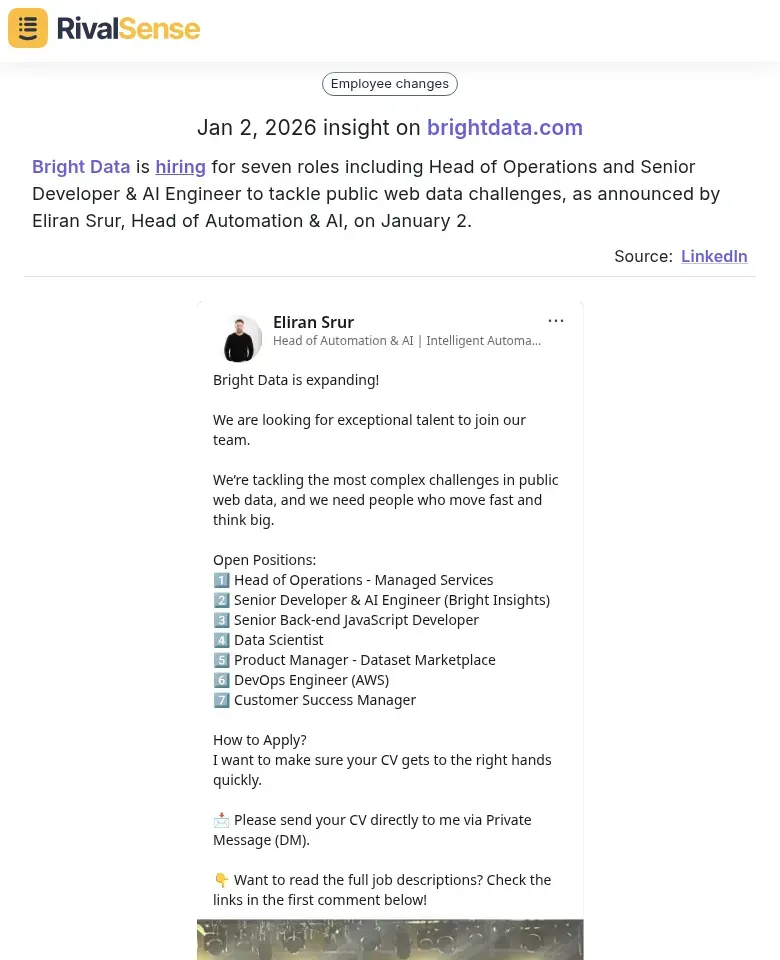
For instance, RivalSense recently tracked that Bright Data is hiring for seven roles including Head of Operations and Senior Developer & AI Engineer to tackle public web data challenges, as announced on January 2. This insight is valuable because it signals a strategic focus on AI and operations, hinting at future product developments or market expansions that could affect your key accounts. Monitoring such hiring patterns allows you to prepare counter-strategies or highlight your own strengths in these areas.
Interpreting Hiring Patterns:
- Track new roles in specific departments – e.g., multiple AI engineers may indicate an AI product push.
- Monitor senior leadership hires – Clues about strategic direction and market priorities.
- Identify capability gaps – When competitors hire for skills they lack, it reveals weaknesses you can exploit.
Analyzing Role Expansions:
- Watch for geographic expansions – New country managers often signal market entry plans.
- Note when niche roles become departments – e.g., sustainability evolving into an ESG division shows investment areas.
- Spot emerging opportunities – Before competitors fully capitalize, you can pivot your account offerings.
Using Organizational Changes:
- Map reporting structure shifts – Indicates investment priorities and resource allocation.
- Predict market positioning – New business unit formations reveal focus on specific segments.
- Anticipate competitive threats – Restructuring may precede aggressive moves against your accounts.
Pro Tip: Combine organizational data with financial metrics—rapid hiring without revenue growth may indicate strategic pivots or market desperation, offering opportunities for account poaching.
Leveraging Product and Pricing Intelligence for Account Strategy
Product and pricing intelligence turns raw competitor data into strategic insights for your key accounts. By tracking changes in competitor offerings and cost structures, you can adapt your value proposition and defend against competitive inroads. This intelligence is crucial for maintaining relevance and justifying your solution's worth to clients.
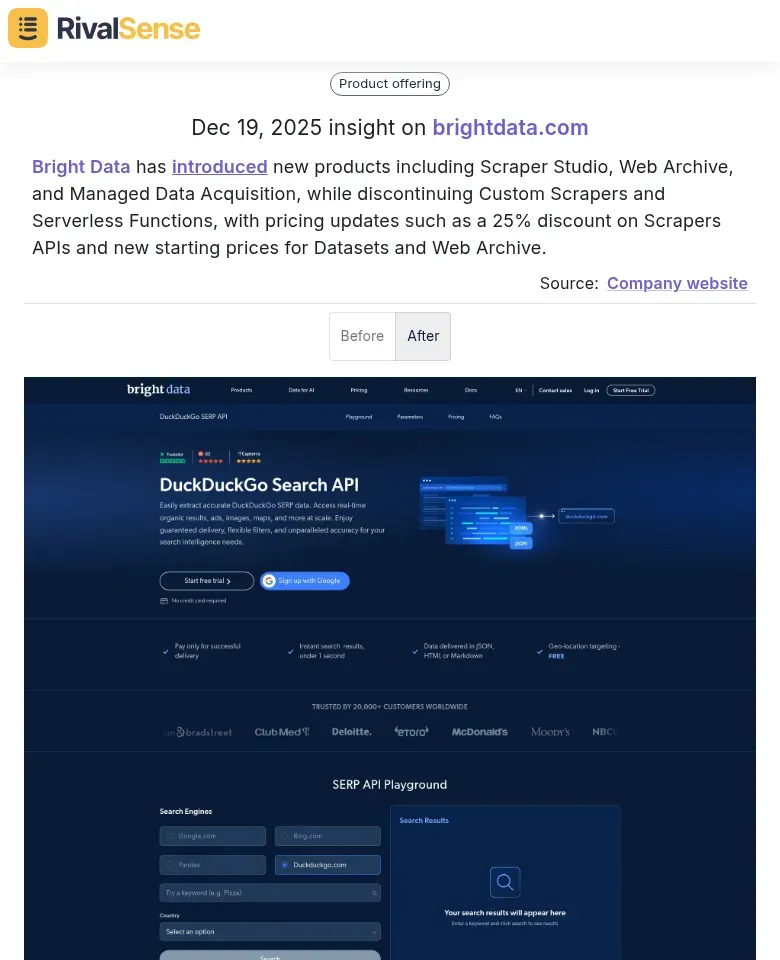
For example, RivalSense detected that Bright Data has introduced new products including Scraper Studio, Web Archive, and Managed Data Acquisition, while discontinuing Custom Scrapers and Serverless Functions, with pricing updates such as a 25% discount on Scrapers APIs. This type of insight is valuable because it reveals competitor focus areas and pricing strategies, helping you tailor your account responses—such as emphasizing your own product stability or matching discounts for at-risk accounts.
Start by tracking product portfolio changes: when competitors add features or launch new products, they reveal their focus areas and market gaps you can exploit. For instance, if a competitor adds AI capabilities to their CRM, they're targeting efficiency-focused accounts—position your solution accordingly to highlight complementary strengths.
Monitor pricing strategy shifts closely. Price increases often signal confidence in value proposition or targeting premium segments, while discounts may indicate market share battles. Create a pricing change tracker with columns for competitor, date, change type, and percentage to reveal patterns in their market positioning.
Product discontinuations are particularly telling—they expose market evolution and unmet customer needs. When a competitor sunsets a product, analyze why: Was adoption low? Did technology shift? This intelligence helps you anticipate account requirements before they surface and address them proactively.
Practical steps for product and pricing intelligence:
- Set up automated alerts for competitor product announcements and pricing changes – Use tools to stay informed in real-time.
- Create a quarterly competitive product matrix – Compare features, pricing tiers, and target segments visually.
- Interview customers who switched from discontinued competitor products – Understand pain points and refine your messaging.
- Map competitor pricing changes against their marketing messaging – Decode their value propositions for account discussions.
Remember: The goal isn't just to track changes, but to interpret what they mean for your key accounts' evolving needs and decision criteria.
Translating Competitive Intelligence into Account-Specific Actions
Translating competitive intelligence into account-specific actions is where strategy meets execution. It requires a systematic approach to customize insights for each key account, ensuring you address their unique pain points and opportunities. This process turns data into defensive shields and growth engines for your business.
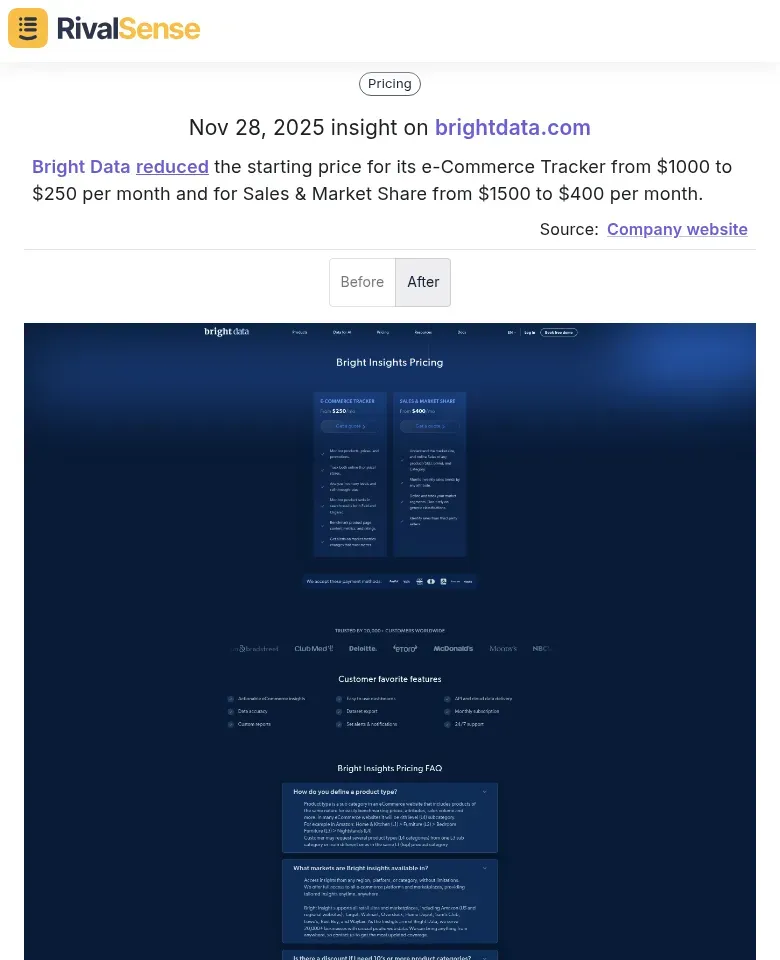
Consider how RivalSense tracked Bright Data reduced the starting price for its e-Commerce Tracker from $1000 to $250 per month and for Sales & Market Share from $1500 to $400 per month. Such pricing intelligence is invaluable for developing competitive offers or retention strategies for accounts that might be considering alternatives. It allows you to proactively adjust your pricing or highlight added value before clients even raise concerns.
Start by analyzing competitor weaknesses and gaps to develop customized value propositions. For each key account, identify where competitors fall short—whether in product features, customer support, or pricing flexibility—and tailor your messaging to highlight how you fill those gaps. Create a competitor gap analysis matrix for each account to visualize opportunities and align team efforts.
For account expansion, leverage competitor pricing and product intelligence. Track competitor pricing changes and feature releases to identify upsell opportunities. When a competitor raises prices, position your solution as a cost-effective alternative. When they launch new features, assess whether your existing features provide comparable value or if you need to accelerate your roadmap. Develop targeted expansion playbooks for each account type based on these insights.
Build proactive risk mitigation plans by monitoring competitive threats in real-time. Set up alerts for competitor announcements targeting your key accounts. Create "what-if" scenarios: What if a competitor launches a similar product at 20% lower cost? What if they hire your account manager? Develop contingency plans for each scenario, including retention offers, feature enhancements, or strategic partnerships. Maintain a competitive threat dashboard for each key account with quarterly review cycles.
Practical checklist for action translation: ✅
- Map competitor weaknesses to each account's pain points – Personalize your value proposition.
- Monitor competitor pricing changes monthly – Stay agile in your pricing strategies.
- Create account-specific risk mitigation playbooks – Prepare for competitive moves.
- Schedule quarterly competitive intelligence reviews with account teams – Ensure alignment and continuous learning.
- Document win/loss reasons – Refine intelligence collection and application over time.
Implementing and Measuring Your Data-Driven Account Strategy
Implementing and measuring your data-driven account strategy ensures that competitive intelligence translates into tangible business outcomes. It requires clear processes, metrics, and organizational buy-in to sustain success over time. Without measurement, you risk collecting data without driving account growth or retention.
Start by establishing clear KPIs that connect competitive intelligence to account performance. Track metrics like win rates against specific competitors, deal velocity improvements, and account expansion rates. Create a dashboard that monitors competitor activity frequency, share-of-voice in key accounts, and intelligence-driven opportunity conversion rates to visualize impact.
Build continuous feedback loops by conducting quarterly reviews where sales teams share intelligence gaps and successes. Implement a simple scoring system (e.g., 1-5) for intelligence quality and actionability. Use win/loss analysis to validate intelligence accuracy and refine collection methods, ensuring your data remains relevant and actionable.
Develop organizational capabilities through three key steps:
- Train account teams on intelligence interpretation – Host bi-monthly workshops to enhance skills.
- Create a centralized intelligence repository – Use tagging for easy retrieval and collaboration.
- Establish a competitive intelligence champion in each account team – Drive accountability and best practices.
Practical tip: Start with your top 5 accounts to pilot the program, then scale based on proven ROI. Use a 90-day review cycle to adjust KPIs and collection methods based on what's working, iterating for continuous improvement.
Conclusion: Putting It All Together
Data-driven key account management is no longer a luxury—it's a necessity in today's competitive B2B landscape. By integrating competitive intelligence into your strategy, you can proactively protect and grow your most valuable accounts. From monitoring organizational changes to tracking pricing shifts, each insight provides a lever to strengthen client relationships and outmaneuver competitors.
To streamline this process, consider leveraging tools like RivalSense. RivalSense automates competitor tracking by monitoring product launches, pricing updates, event participations, partnerships, regulatory aspects, management changes, and media mentions across websites, social media, and various registries. It delivers all this intelligence in a concise weekly email report, saving you time and ensuring you never miss a critical update.
Try RivalSense for free at https://rivalsense.co/ and get your first competitor report today! This hands-on experience will help you implement the actionable strategies discussed here, turning competitive intelligence into a powerful asset for your key account success.
📚 Read more
👉 Competitor Ad Analysis: Transforming Regulatory Compliance into Strategic Advantage
👉 Decoding Competitor Moves: Scrapingdog's API Enhancements and What They Mean
👉 How to Identify Key Accounts: A Practical Guide for B2B Leaders
👉 2026 Trend Analysis: Tracking Competitor Glassdoor Reviews for Branding Consultancies
👉 How Hubstaff's SCIM Move Forced Competitors to Accelerate Enterprise Security