
Data-Driven Insights: How Competitor Partnerships & Client Wins Reveal Hiring Strategies
Staying ahead in talent acquisition requires looking beyond traditional job boards. In competitive intelligence, the most revealing hiring signals often come from external data points that competitors can't hide. While job postings provide direct evidence, competitor partnerships and client wins offer more nuanced insights into future workforce needs. When companies announce strategic partnerships, they're signaling emerging skill requirements they lack internally. For example, if a SaaS competitor partners with an AI startup, they're likely preparing to build AI capabilities and will soon need machine learning engineers and data scientists.
Client wins serve as leading indicators for organizational growth. Each new enterprise client typically requires 1-2 dedicated support staff, while major contract wins often trigger department expansions. Track these wins systematically: create a spreadsheet monitoring competitor announcements, noting client size, industry, and contract value. Larger deals (especially in new verticals) usually precede hiring waves within 3-6 months.
📊 Practical Steps:
- Monitor partnership announcements in industry publications and press releases
- Analyze partnership types (technology, distribution, co-development) to predict specific skill needs
- Track client win frequency and size to forecast hiring timelines
- Cross-reference with job postings to validate your predictions
This data-driven approach gives you a 3-6 month head start on anticipating competitor talent acquisition, allowing you to proactively strengthen your own team or adjust recruitment strategies.
Decoding Partnership Announcements: What They Reveal About Talent Strategy
Partnership announcements are treasure troves for decoding competitor talent strategies. When analyzing technology partnerships, look beyond the press release buzzwords to understand the underlying talent gaps. For example, if a competitor announces an AI integration partnership, they're likely building or acquiring machine learning expertise, signaling upcoming hires for data scientists, ML engineers, and AI product managers.
Joint ventures reveal market expansion plans requiring specialized talent. A competitor entering a new geographic market through a joint venture will need local sales leaders, regulatory experts, and culturally-aware customer success teams. The partnership scope indicates team structure changes—broad strategic alliances suggest new leadership roles (VP of Partnerships), while technical integrations hint at engineering team expansions.
🤝 Real-World Insight from RivalSense:
Ionic uses Orca AI to reduce navigational safety events, improve operational efficiency, and lower fuel consumption by 3% across its fleet.
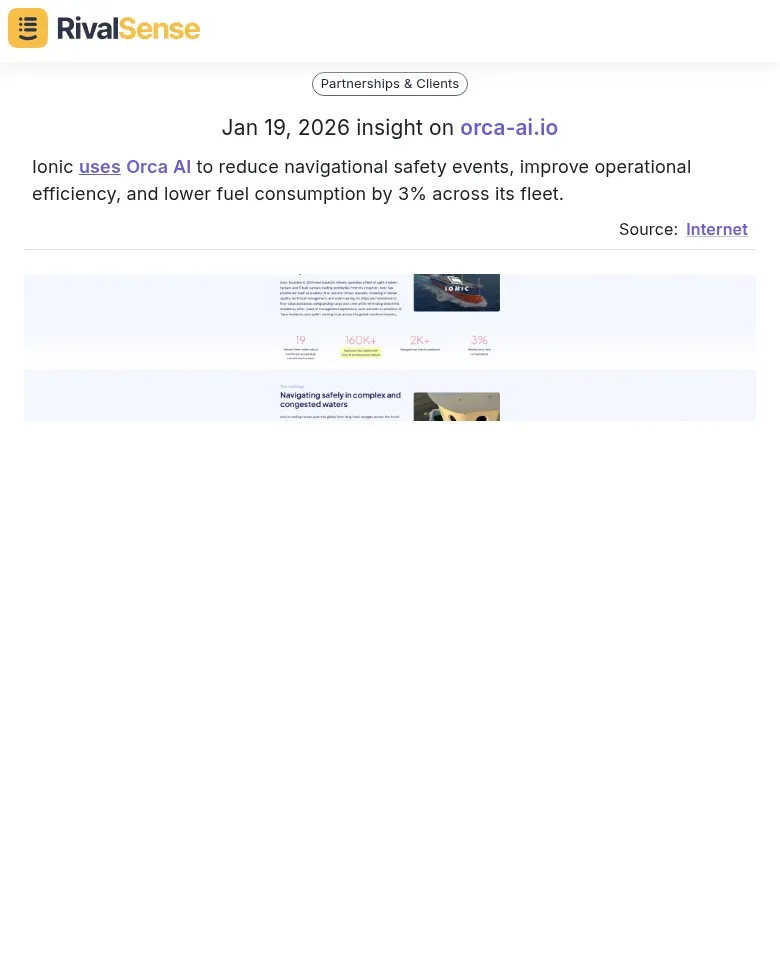
This type of technology partnership is valuable for business strategy because it shows Ionic's investment in AI-driven operational improvements, hinting at hires for AI specialists and data analysts. Monitoring such partnerships can alert you to competitor skill gaps before they're publicly advertised.
✅ Practical Steps for Analysis:
- Categorize partnerships by type (technology, market expansion, strategic)
- Map required competencies to specific roles
- Track partnership timelines to predict hiring waves
- Monitor leadership announcements following major partnerships
- Use partnership objectives to forecast team size changes
💡 Tip: Focus on the 'implementation' details rather than the partnership announcement itself. The specific technologies mentioned, integration timelines, and joint development areas reveal the actual talent gaps being filled.
Client Wins as Hiring Forecasts: Connecting Revenue Growth to Recruitment
Enterprise client wins signal imminent hiring needs for implementation and support teams. When competitors land major accounts, they typically need to scale customer success, technical support, and onboarding specialists within 60-90 days. Track these wins through press releases, case studies, and LinkedIn announcements to stay ahead of their recruitment cycles.
Analyze client use cases to identify domain expertise priorities. If a competitor wins healthcare clients, expect hiring for healthcare compliance specialists. Financial services wins indicate needs for fintech experts. Create a matrix mapping client industries to required skill sets for precise forecasting.
🌏 Real-World Insight from RivalSense:
Cisco partners with Syscom to launch Taiwan's first theater-grade immersive AI video conferencing experience center, powered by Cisco's AI collaboration solutions.
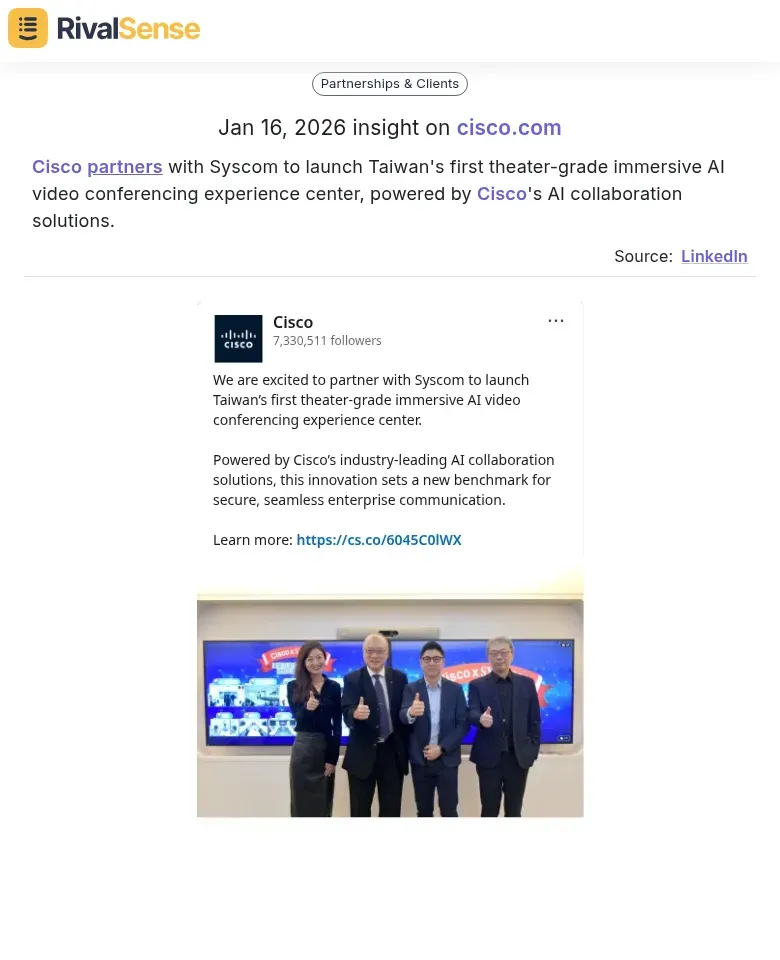
This geographic partnership insight is valuable for business strategy as it reveals Cisco's expansion into new markets, likely requiring local hires for sales, technical support, and cultural adaptation. Such data helps you anticipate regional hiring waves.
📈 Practical Steps:
- Track competitor client announcements monthly
- Map client industries to required expertise
- Monitor regional job postings in new client locations
- Set alerts for competitor office openings in expansion markets
This data reveals hiring timelines 3-6 months before public announcements, giving you a strategic edge.
Case Study Analysis: Extracting Hiring Intelligence from Real-World Examples
Let's examine how real-world competitor partnerships reveal hiring patterns through concrete examples. When Company A partners with a logistics optimization platform, they're signaling a need for data analytics specialists who can integrate systems and optimize operations. This isn't just about technology—it's about hiring people who can translate data into operational efficiency.
Multi-company collaborations reveal cross-functional needs. When three competitors jointly launch a sustainability initiative, they're likely hiring project managers with stakeholder coordination skills, plus specialists who can work across organizational boundaries. Look for these patterns in press releases and partnership announcements.
🔗 Real-World Insight from RivalSense:
Cisco, Pure Storage, and NVIDIA teamed up to deliver AI Factories for enterprises using the FlashStack Cisco Validated Design to help businesses transition from AI pilots to large-scale deployments.
This multi-company collaboration insight is valuable for business strategy because it highlights joint efforts to scale AI, indicating hires for AI engineers, project managers, and integration experts across all involved companies. Tracking such alliances can forecast industry-wide talent trends.
📋 Practical Steps:
- Track partnership announcements in your industry
- Categorize partnerships by type (operational, market expansion, innovation)
- Map partnership types to likely hiring needs
- Monitor LinkedIn for new hires at partner companies
- Set alerts for job postings matching partnership themes
💡 Tip: The most revealing insights come from partnerships that solve specific operational problems—these directly translate to hiring needs for specialized roles.
Building Your Competitive Hiring Intelligence Framework
To build a competitive hiring intelligence framework, start by creating systematic monitoring processes that capture all relevant data. Set up dedicated tracking for competitor partnership announcements across press releases, LinkedIn, and industry publications to ensure no signal is missed.
Develop metrics to quantify hiring implications from client acquisition data. Track metrics like: (1) Client win frequency by department, (2) Average team size needed per new client, (3) Time-to-hire patterns after major wins. For example, if a competitor wins 5 enterprise clients in Q1, calculate the likely 15-20 new hires needed across sales, implementation, and support teams.
🛠️ Practical Checklist:
- [ ] Map competitor partnership ecosystems
- [ ] Create client win-to-hire ratio formulas
- [ ] Set up automated monitoring workflows
- [ ] Establish baseline metrics for each competitor
- [ ] Create escalation protocols for significant shifts
💡 Tip: Focus on patterns rather than individual events – three partnership announcements in a month signals more about hiring strategy than one isolated deal.
Strategic Applications: Turning Insights into Competitive Advantage
Transform competitor intelligence into actionable workforce strategies with these practical applications. By leveraging insights from partnerships and client wins, you can proactively shape your talent acquisition and development plans.
🎯 Proactive Talent Acquisition:
- Actionable Step: When competitors announce new partnerships or client wins in specific verticals, immediately analyze the required skill sets. For example, if a competitor lands a major healthcare client, prioritize hiring healthcare compliance specialists and implementation experts.
- Checklist:
✓ Monitor competitor job postings for emerging roles
✓ Track partnership announcements for technical skill requirements
✓ Analyze client case studies for implementation team structures
📚 Curriculum Development Alignment:
- Practical Tip: Use competitor client success stories to identify market-demanded skills. If competitors consistently highlight AI integration successes in case studies, develop specialized AI implementation training modules for your team.
- Implementation Framework: Create quarterly training programs based on competitor ecosystem expansions—when competitors add new technology partners, develop certification programs for those integrations.
📊 Workforce Planning Optimization:
- Strategic Approach: Treat competitor hiring patterns as market validation signals. If three competitors simultaneously increase data science hires by 30%, validate this as a market trend rather than isolated moves.
- Actionable Insight: Use competitor partnership announcements to forecast team expansion needs 6-12 months ahead. When competitors form strategic alliances, anticipate the support teams they'll need and build your talent pipeline accordingly.
Key Metrics to Track:
| Metric | Why It Matters |
|---|---|
| Competitor hiring velocity by department | Identifies which areas are scaling fastest |
| Partnership announcement frequency by technology type | Reveals emerging tech investments |
| Client win patterns by industry vertical | Shows market expansion focus |
| Implementation team growth rates | Indicates customer acquisition pace |
💡 Pro Tip: Create a quarterly workforce planning dashboard that correlates competitor intelligence with your hiring strategy, ensuring you're always one step ahead in talent acquisition.
Ready to Uncover Competitor Hiring Signals?
Tracking partnerships and client wins manually can be time-consuming and prone to errors. Tools like RivalSense automate this process by monitoring competitor product launches, pricing updates, event participations, partnerships, regulatory aspects, management changes, and media mentions across websites, social media, and various registries. All insights are delivered in a weekly email report, giving you a consistent edge.
🚀 Take Action Today: Try RivalSense for free at https://rivalsense.co/ to start receiving data-driven competitor insights. Get your first competitor report today and turn hidden signals into strategic hiring advantages!
📚 Read more
👉 How to Leverage Competitor Executive Changes for Strategic Insights
👉 The Ultimate Guide to Key Account Health Dashboards in 2026: Practical Strategies for B2B Success
👉 A Practical Guide to Building a Key Account Management Framework for Software Development
👉 How Revolut's Virtual Card Designs Sparked Competitor Loyalty Program Innovation
👉 The Beginner's Guide to Tracking Competitor Website Changes for Key Account Success