
Data-Driven Gaming Edge: Uncovering Competitors' Strategic Advantages
The gaming industry is undergoing a data-driven revolution that's fundamentally reshaping competitive advantage. As Newzoo's 2025 PC & Console Gaming Report reveals, with $85.2B in software revenue forecasted and player growth plateauing, the market has become a zero-sum battle for attention. This environment demands a strategic shift from intuition-based decisions to evidence-based strategies powered by real-time competitor intelligence.
Practical steps to embrace this revolution:
- Establish real-time monitoring systems for competitor keyword strategies using tools like SEMrush or RivalSense
- Track 3-5 key competitors' top 50 ranking keywords monthly, with weekly monitoring of fluctuations
- Set up alerts for competitor brand + product launch keywords (e.g., "new game 2026")
- Analyze keyword difficulty changes to spot emerging competitive threats
Real-time insights are no longer optional—they're essential for market leadership. When competitors start ranking for new game genres or technology keywords, they're signaling development roadmaps 3-6 months in advance. By monitoring these signals, you can anticipate market shifts before they impact your market share and make strategic decisions based on data rather than guesswork.
Talent Acquisition Intelligence: Reading Between the Hiring Lines
In gaming's hyper-competitive landscape, competitor hiring patterns reveal strategic direction shifts before they become public. When rivals suddenly post multiple roles for "AI/ML engineers" or "metaverse specialists," they're signaling expansion into emerging technologies.
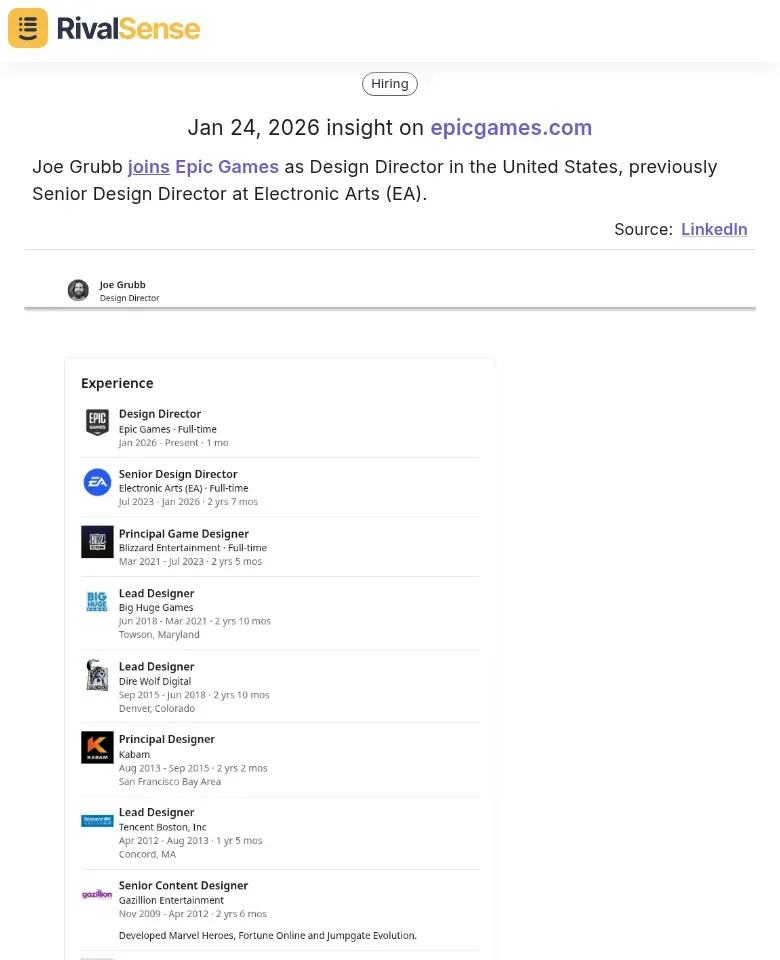
For example, RivalSense tracked that Joe Grubb joins Epic Games as Design Director in the United States, previously Senior Design Director at Electronic Arts (EA). This type of management change insight is valuable because it helps predict organizational priorities, innovation focuses, and potential shifts in design leadership that could impact future game development.
Key personnel moves—like a director from Google joining a gaming studio—indicate investments in specific areas like technical product management or live services scaling. Talent flow data predicts product innovations 3-6 months in advance. When competitors hire Unity3D developers and VR experience designers simultaneously, expect immersive gaming expansions.
Practical Steps:
- Set up alerts for competitor job postings using tools like RivalSense
- Categorize keywords by department (engineering, design, marketing)
- Track frequency changes over time to spot trends
- Compare your talent acquisition keywords against industry leaders
- Identify gaps where you need to recruit or upskill
Quick Checklist:
- ✅ Monitor competitor job postings weekly
- ✅ Analyze hiring keyword shifts around major industry events
- ✅ Track key personnel moves between companies
- ✅ Benchmark talent strategies against market leaders
- ✅ Identify emerging skill requirements before they become mainstream
This approach transforms hiring data into predictive intelligence, helping you anticipate market shifts before they impact your competitive position.
Product Launch Analytics: Timing and Feature Strategy
Analyze competitors' limited-time offerings (LTOs) to decode their market testing strategies. Track seasonal events, beta releases, and exclusive content drops—these reveal what features resonate before full-scale implementation.
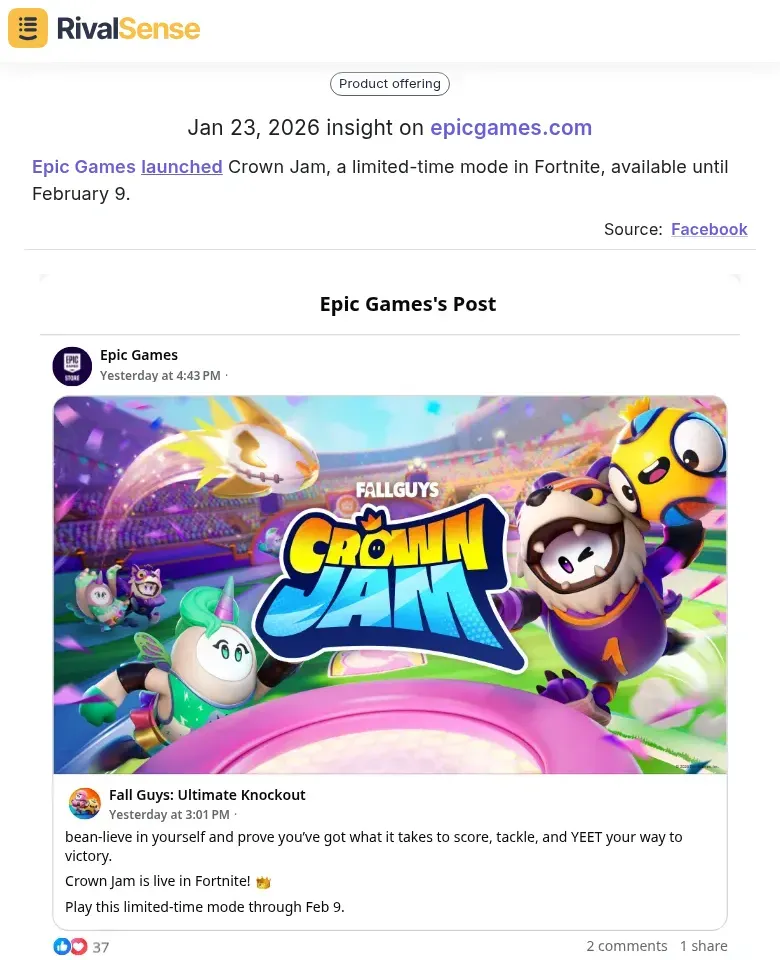
A practical example: RivalSense captured that Epic Games launched Crown Jam, a limited-time mode in Fortnite, available until February 9. Monitoring such product launches is valuable for understanding timing strategies, feature adoption rates, and how competitors engage players during specific periods.
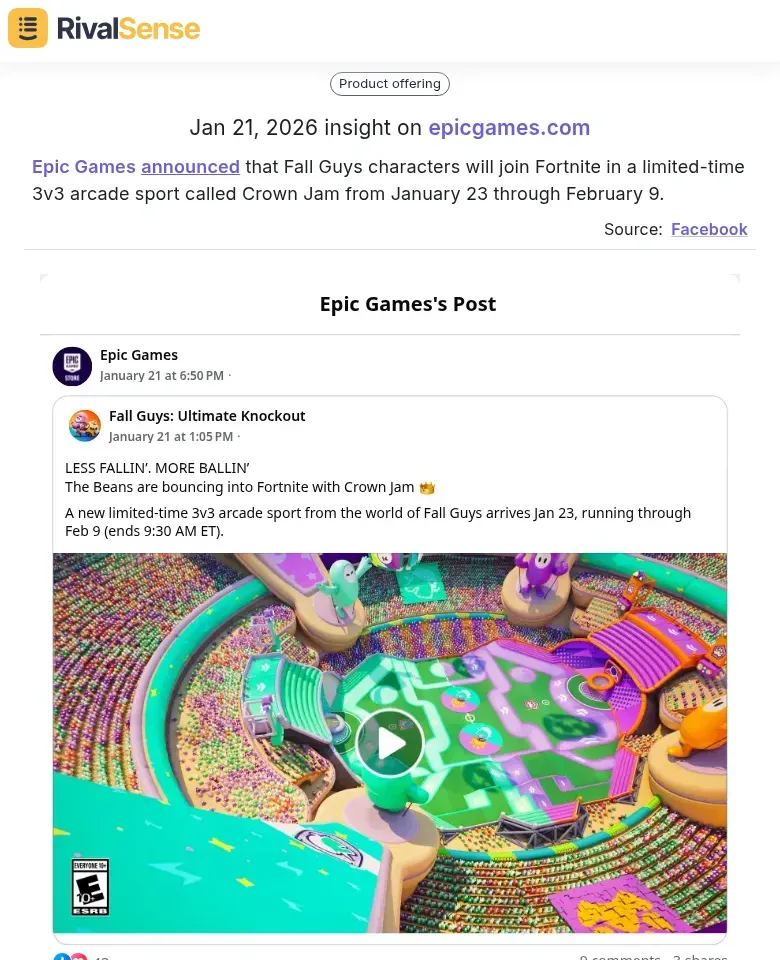
Cross-franchise collaborations signal strategic growth ambitions. When competitors partner across IPs, they're expanding audience reach and testing new monetization models. For instance, Epic Games announced that Fall Guys characters will join Fortnite in a limited-time 3v3 arcade sport called Crown Jam from January 23 through February 9. This insight into collaborations reveals how companies leverage existing IPs to drive engagement, cross-pollinate audiences, and test new gameplay mechanics.
Practical Checklist:
- Monitor competitor LTO duration, frequency, and performance metrics
- Map cross-franchise collaborations against quarterly growth targets
- Analyze launch timing patterns around major industry events
- Identify market gaps when competitors avoid certain release windows
- Benchmark feature adoption rates from beta to full release
Use launch timing data to identify optimal market entry windows. Historical analysis reveals patterns—avoid Q4 AAA releases unless you have differentiation. Instead, target Q1-Q2 when competition thins and player engagement remains high. Track competitor release calendars to spot crowded periods and identify strategic gaps for your launch.
Cross-Platform Integration Intelligence
Cross-platform integration intelligence reveals how competitors are consolidating market power through strategic ecosystem expansion. Track character and feature migrations between platforms using tools like RivalSense to monitor when games introduce cross-progression systems or unified accounts.
For example, Activision's unified ID system across Warzone and Warzone Mobile shows how major players are creating seamless user experiences. Analyze cross-platform strategies by examining player engagement metrics across devices. Research shows cross-platform players generate 570% more playtime and 375% higher monthly revenue per user.
Practical steps for competitive intelligence:
- Track cross-progression announcements and implementation timelines
- Monitor player migration patterns between platforms using engagement data
- Analyze monetization optimization per platform (mobile vs PC checkout flows)
- Identify technical partnerships and engine investments enabling cross-platform capabilities
- Watch for unified account systems as indicators of ecosystem consolidation
Integration patterns signal market consolidation when major players establish proprietary engines (like NetEase's Messiah) or unified backend architectures that create switching costs and lock-in effects. Chinese developers' heavy cross-platform investments demonstrate how technical excellence becomes a competitive moat in today's gaming landscape.
Real-Time Competitive Monitoring Systems
Real-time competitive monitoring systems transform raw data into actionable intelligence. Start by building automated tracking for competitor announcements using web scraping tools and RSS feeds to monitor press releases, blog updates, and social media channels. Set up keyword alerts for product launches, funding rounds, and strategic pivots.
Create alert systems for strategic personnel movements by monitoring LinkedIn updates, executive team changes, and key hires. Track partnership announcements through press releases and industry publications. Use Boolean search operators to filter relevant signals from noise.
Practical checklist:
- Identify 5-7 key competitors to monitor
- Set up automated alerts for funding announcements
- Track executive LinkedIn profiles for role changes
- Monitor patent filings and trademark registrations
- Create weekly competitive intelligence reports
- Visualize competitor feature matrices
- Set up price change notifications
- Track customer review sentiment shifts
Pro tip: Use webhook integrations to push critical alerts directly to Slack or Teams channels for immediate team awareness. Combine quantitative data with qualitative insights by analyzing competitor messaging and positioning changes over time.
Strategic Implementation: Turning Insights into Action
Translating competitor intelligence into proactive business strategies requires a systematic approach. Start by creating a competitive intelligence dashboard that tracks key metrics like competitor pricing, feature releases, and market positioning. Establish weekly review meetings where teams analyze competitor moves and identify strategic opportunities.
Building agile response frameworks involves creating decision protocols for common scenarios. Develop a 'playbook' with pre-approved responses for competitor price changes, product launches, or marketing campaigns. Assign clear ownership and response timelines—for instance, marketing must respond to competitor promotions within 24 hours, while product teams have 72 hours for feature parity decisions.
Practical Checklist:
- Set up automated competitor monitoring for real-time alerts
- Create a centralized intelligence repository accessible to all teams
- Establish clear escalation paths for urgent competitive threats
- Train teams on interpreting and acting on competitor data
- Measure the ROI of competitive intelligence initiatives quarterly
Foster a data-driven decision culture by integrating competitive insights into all planning processes. Use competitor data in quarterly planning, product roadmaps, and marketing strategies. Create a 'competitor intelligence scorecard' that measures your performance against key rivals across dimensions like market share, customer satisfaction, and innovation velocity.
Ready to Gain Your Competitive Edge?
In the fast-paced gaming industry, staying ahead requires constant vigilance and actionable insights. Tools like RivalSense automate competitor tracking across product launches, pricing updates, event participations, partnerships, regulatory aspects, management changes, and media mentions—delivering everything in a weekly email report.
Try RivalSense for free today at https://rivalsense.co/ and get your first competitor report to start uncovering strategic advantages. Transform data into your gaming edge!
📚 Read more
👉 Uncover Competitor Event Strategies for Enterprise Key Accounts
👉 How ProxyScrape's Free Trial Change Impacts Your Competitive Strategy
👉 The Ultimate Guide to Tracking Key Account Sentiment in 2026
👉 Mastering Key Account Lifecycles in Semiconductor Design: Actionable Strategies
👉 How BASF's €11B R&D Success Drives Competitor Innovation Acceleration