
Competitor Product Analysis Workflow: From Tracking to Strategic Insights
In today's hyper-competitive B2B landscape, systematic competitor product analysis has evolved from optional reconnaissance to essential strategic infrastructure. The difference between reactive monitoring and proactive intelligence workflows now determines market leadership.
🎯 Strategic Imperative: Regular competitor tracking isn't just about watching rivals—it's about understanding market gaps, anticipating customer needs, and identifying innovation opportunities before they become obvious. Companies that institutionalize competitor analysis grow 2.3x faster than those relying on ad-hoc research.
🚀 Actionable Intelligence Workflow: Move beyond basic monitoring with this practical framework:
- Systematic Tracking: Establish regular cadence (weekly/monthly) for reviewing competitor product updates, pricing changes, and feature releases
- Pattern Recognition: Document recurring themes in competitor positioning and customer pain points addressed
- Strategic Synthesis: Connect competitor moves to your product roadmap decisions and market positioning
- Insight Activation: Translate findings into specific product improvements, feature prioritization, and go-to-market adjustments
💡 Practical Tip: Start with 3-5 key competitors and track 3-5 specific product dimensions (features, pricing, integrations, user experience, support). Document findings in a centralized dashboard accessible to product, marketing, and leadership teams. This transforms scattered observations into collective strategic intelligence that drives informed product innovation and precise market positioning.
Phase 1: Establishing Your Competitor Tracking Framework
Before diving into analysis, build a systematic foundation. Start by mapping your competitive landscape across three categories: direct competitors (offering similar solutions), indirect competitors (solving the same problem differently), and potential market entrants (adjacent players who could pivot). Create a simple spreadsheet with columns for competitor name, category, core offering, and threat level.
Next, implement automated monitoring systems. Set up Google Alerts for competitor names and key executives. Use specialized tools like RivalSense to track product launches, pricing changes, and feature updates automatically. For SaaS companies, monitor review sites like G2 and Capterra for user feedback on competitor products.
Establish a centralized repository for all competitor intelligence. Create a shared folder structure organized by competitor, with subfolders for product specs, pricing sheets, marketing materials, and customer reviews. Use a collaborative platform like Notion or Confluence where team members can add findings and tag relevant stakeholders.
📋 Practical Checklist:
- ✅ Identify 5-7 direct competitors and 3-5 indirect competitors
- ✅ Set up weekly automated alerts for each competitor
- ✅ Create a standardized template for competitor profiles
- ✅ Schedule monthly review meetings to update the repository
- ✅ Assign ownership for monitoring specific competitors
🌟 Pro Tip: Don't just track features—document the underlying user problems competitors are solving. This reveals strategic gaps you can exploit.
Phase 2: Analyzing Product Positioning and Market Strategy
Decoding competitor rebranding requires tracking visual identity changes, messaging shifts, and target audience pivots. For example, when a SaaS company rebrands to specialize in financial services, analyze their new case studies, partnership announcements, and pricing page updates. Create a positioning matrix comparing their old vs. new messaging across website, social media, and press releases.
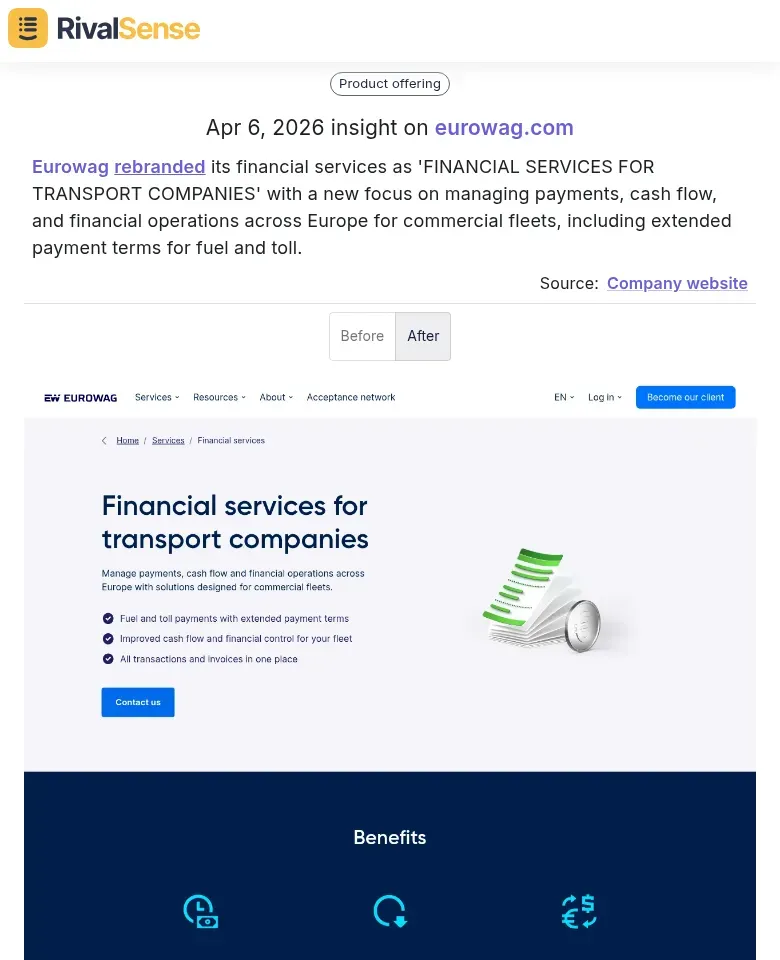
📊 Real-World Example: RivalSense tracked how Eurowag rebranded its financial services as 'FINANCIAL SERVICES FOR TRANSPORT COMPANIES' with a new focus on managing payments, cash flow, and financial operations across Europe for commercial fleets. This insight is valuable because it reveals strategic pivots and target market expansions, allowing you to adjust your positioning and identify new opportunities.
Analyze product launch strategies by documenting their timeline: pre-launch waitlist tactics, beta testing approach, launch event scale, and post-launch marketing intensity. Track whether they use scarcity tactics (limited access) or broad availability.
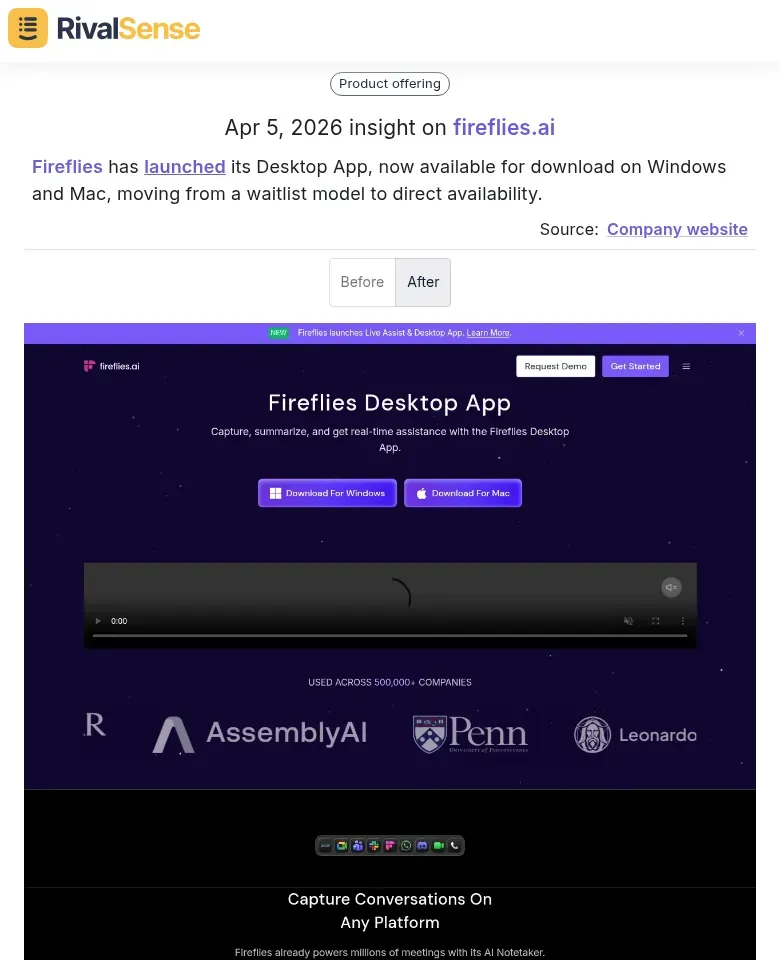
🚀 Product Launch Insight: Fireflies has launched its Desktop App, now available for download on Windows and Mac, moving from a waitlist model to direct availability. Monitoring such launches helps you understand market readiness and competitive timing, enabling you to plan your own releases strategically.
Monitor their customer acquisition channels post-launch - are they focusing on content marketing, paid ads, or partnership ecosystems? Evaluate feature differentiation by creating a competitive feature grid comparing your product against 3-5 key competitors. Identify their unique value propositions by analyzing customer testimonials, review site feedback, and their own marketing claims. Look for "unfair advantages" - features that would be difficult for you to replicate quickly.
💡 Practical Tip: Use tools like RivalSense to set up alerts for competitor feature announcements, pricing changes, and partnership deals to stay ahead of market shifts.
Phase 3: Extracting Strategic Insights from Competitor Moves
Phase 3 transforms raw data into actionable intelligence. Start by mapping competitor offerings against customer needs to identify market gaps. For example, if all competitors focus on enterprise clients, SMBs might be underserved. Create a checklist: 1) Compare feature sets across competitors, 2) Analyze customer reviews for unmet needs, 3) Identify segments competitors ignore.
Examine pricing models and packaging strategies. Are competitors using tiered pricing, freemium models, or bundling? Track how they position different packages to various audiences. Practical tip: Create a pricing matrix comparing features, price points, and target segments across competitors.
Analyze how competitors leverage technology advancements. Monitor AI integration in hardware products, API capabilities, or automation features. Look for patterns: Are competitors adding AI-powered analytics? Are they developing proprietary hardware? This reveals industry trends and potential differentiation opportunities.
🤖 Technology Advancement Example: Meta has launched new Ray-Ban Meta AI glasses with Blayzer and Scriber frames, featuring enhanced comfort, 3K Ultra HD video, and up to 8 hours of battery life. Tracking such insights is crucial for understanding how competitors are integrating AI into hardware, indicating broader industry trends that could impact your product development and innovation strategy.
Key insight: Competitor weaknesses are your opportunities. If competitors struggle with customer support, that's a gap. If they're slow to adopt new technologies, that's your advantage. Document these insights in a strategic opportunities matrix, ranking each by market potential and your capability to execute.
Phase 4: Translating Insights into Actionable Business Strategy
Now that you've gathered competitive intelligence, it's time to transform data into decisive action. This phase bridges analysis with execution, ensuring your insights drive tangible business outcomes.
Developing Counter-Strategies
Identify competitor weaknesses and market gaps through SWOT analysis. For example, if a rival lacks enterprise-grade security features, prioritize developing SOC 2 compliance and highlight this in your marketing. Create a counter-strategy matrix to organize your approach.
| Competitor Vulnerability | Your Strength | Action to Exploit |
|---|---|---|
| Lack of enterprise security | SOC 2 compliance | Highlight in marketing and sales pitches |
| Poor customer support | 24/7 live support | Use as key differentiator in campaigns |
| Limited integrations | Robust API ecosystem | Partner with complementary platforms |
Prioritizing Product Roadmap
Analyze competitor feature adoption rates and customer feedback. Use a scoring system: rate features by competitor adoption (high/medium/low), customer sentiment (positive/neutral/negative), and strategic alignment with your vision. Focus on high-adoption, positive-sentiment features that competitors execute poorly—these represent immediate wins. For instance, if competitors' AI tools receive praise for functionality but criticism for complexity, build a simpler, more intuitive version.
Optimizing Pricing & Packaging
Benchmark against 3-5 key competitors. Compare pricing tiers, feature inclusions, and perceived value. Conduct win/loss analysis: why did deals go to competitors? Adjust your pricing based on value metrics—if competitors charge per user but customers prefer per-project pricing, test a hybrid model. Package features into clear tiers (Basic, Pro, Enterprise) with differentiated value propositions.
📋 Action Checklist:
- ✅ Create counter-strategy matrix with specific initiatives
- ✅ Score competitor features using adoption/sentiment/alignment criteria
- ✅ Benchmark pricing across 3-5 competitors quarterly
- ✅ Test pricing changes in small markets before full rollout
- ✅ Align product roadmap with competitive gaps and customer pain points
Conclusion: Building a Sustainable Competitive Intelligence Workflow
Building a sustainable competitive intelligence workflow requires moving beyond one-time analysis to establish ongoing monitoring processes. Start by creating a competitor tracking dashboard with automated alerts for key changes—product launches, pricing updates, feature releases, and marketing campaigns. Schedule regular review meetings (monthly or quarterly) to analyze collected data and identify emerging patterns.
Integrate competitor insights into your strategic planning cycles by mapping competitive moves against your product roadmap and marketing calendar. Use competitive intelligence to inform quarterly planning sessions, ensuring your decisions account for market dynamics. Create a simple checklist: 1) Update competitor profiles monthly, 2) Track 3-5 key metrics per competitor, 3) Document strategic implications, 4) Share insights across teams.
Measure ROI by linking competitive intelligence to business outcomes. Track metrics like market share changes, win/loss rates against specific competitors, and customer acquisition costs. Compare your growth trajectory against competitors' to validate strategic decisions. Practical tip: Assign a competitive intelligence champion in each department to ensure insights translate into action.
Remember: Sustainable advantage comes from consistent monitoring, not sporadic analysis. Build processes that make competitive intelligence a regular business rhythm rather than a special project.
🎯 Ready to streamline your competitor analysis? Try RivalSense for free at https://rivalsense.co/ and get your
📚 Read more
👉 Decoding Competitor Moves: What Vanta's New Storytelling Hire Reveals
👉 The Ultimate Key Account Tracking Workflow: A Practical Guide for 2026
👉 Data-Driven Aviation Fuel Competitor App Review Tracking Strategies
👉 How Real-Time Competitor Intelligence Helped Capture Market Share from Foresters Financial
👉 Productivity Techniques: Track Competitor Website Changes for Key Account Insights