
Competitor Pricing Workflow: How to Leverage Insights for Content Strategy
Competitor pricing isn't just about numbers—it's a strategic signal revealing market positioning shifts and audience targeting changes. When competitors adjust prices, they're communicating value propositions, targeting new customer segments, or responding to market pressures. These changes directly impact content performance metrics like engagement rates, conversion funnels, and audience acquisition costs.
Establishing a systematic workflow is crucial for turning pricing data into actionable content strategies. By monitoring competitor pricing, you can anticipate market trends and align your content to capture emerging opportunities.
Practical Workflow Steps:
- Identify 3-5 key competitors and their pricing pages.
- Set up automated monitoring for price changes.
- Cross-reference pricing shifts with content performance data.
- Analyze patterns quarterly to spot trends.
Pro Tip: When competitors lower prices, analyze their content for increased educational materials targeting price-sensitive segments. When they raise prices, look for premium content positioning them as industry leaders.
Track these connections: Higher pricing often correlates with thought leadership content and case studies, while competitive pricing aligns with comparison guides and ROI calculators. Your content strategy should mirror these insights—if competitors are moving upmarket, shift your content toward enterprise-level solutions and executive decision-making content.
Setting Up Your Competitor Pricing Monitoring Framework
Setting up an effective competitor pricing monitoring framework requires a systematic approach. Start by identifying your top 5-7 direct competitors and mapping their pricing models across different tiers (freemium, basic, pro, enterprise). Create a spreadsheet documenting their base prices, feature inclusions, and any hidden fees or annual discounts.
For automated tracking, leverage tools that offer price change detection and alerts. Set up monitoring for competitor pricing pages, product URLs, and promotional sections. Configure alerts to trigger when prices drop by 5% or more, or when new pricing tiers are introduced.
Centralized Dashboard Creation:
- Use tools like Google Data Studio or Tableau to aggregate pricing data.
- Include real-time price comparisons, historical trends, and market positioning visualizations.
- Set up weekly review cadences to analyze pricing patterns.
- Implement webhook integrations for immediate notifications to your team's communication channels.
Actionable Tip: Regular monitoring helps you stay ahead of market shifts and adjust your content strategy proactively.
Analyzing Pricing Structure Changes: Volume Discounts and Tier Adjustments
When competitors shift from small to large volume plans with lower per-unit costs, they're signaling a strategic move toward enterprise clients. This pricing evolution reveals valuable insights: they've identified high-volume customers as more profitable long-term, and they're willing to sacrifice per-unit margins for customer lifetime value. Tracking these changes systematically can uncover opportunities for your own pricing strategy.
For example, RivalSense detected that ProxyRack updated its premium residential proxy pricing, replacing the 10GB plan at $1.5 per GB with a 100GB plan at $1.1 per GB, and the monthly price changed from $15.00 to $110.00. This insight shows a move towards volume-based pricing, which can indicate a focus on retaining high-usage customers or targeting enterprise segments. Understanding such changes helps you assess if you need to adjust your tiers or introduce similar discounts.
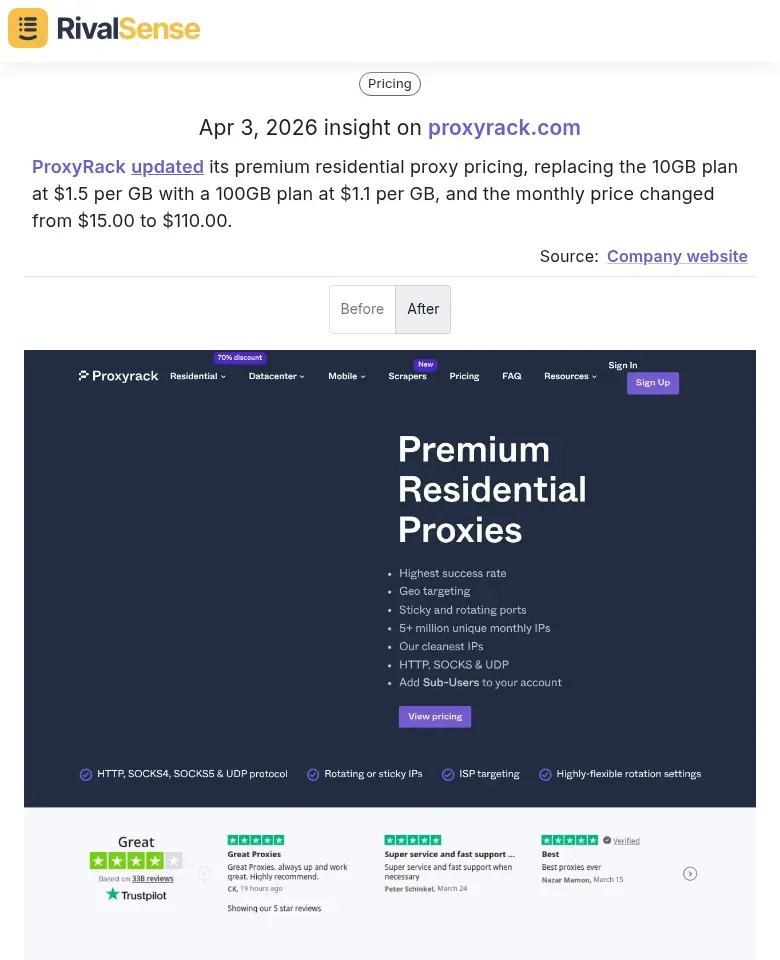
Why this insight is valuable: Monitoring pricing structure changes helps you identify market trends, such as a shift towards volume discounts, allowing you to adapt your offerings and content to match competitor positioning.
Practical Steps for Analysis:
- Quarterly competitor pricing audit checklist
- Feature-to-price ratio analysis across tiers
- Gap analysis: What features are competitors offering at price points you don't cover?
- Customer segment mapping based on tier changes
Use these insights to identify gaps in your own offerings. If competitors are successfully selling to enterprise clients with volume discounts, evaluate whether your product could support similar pricing structures.
Tracking Partner Program and Distribution Channel Updates
Tracking partner program and distribution channel updates reveals critical competitive intelligence. When competitors implement waitlists or modify application processes, they're signaling strategic shifts in market access and exclusivity. These changes can impact how you structure your own partnerships and content distribution.
For instance, RivalSense captured that Dust has updated its partner program, now requiring interested parties to join a waitlist and providing a new application form with different fields including LinkedIn URL and business model selection. This indicates a move towards more selective partnership criteria, which might aim to attract higher-quality partners or control growth.
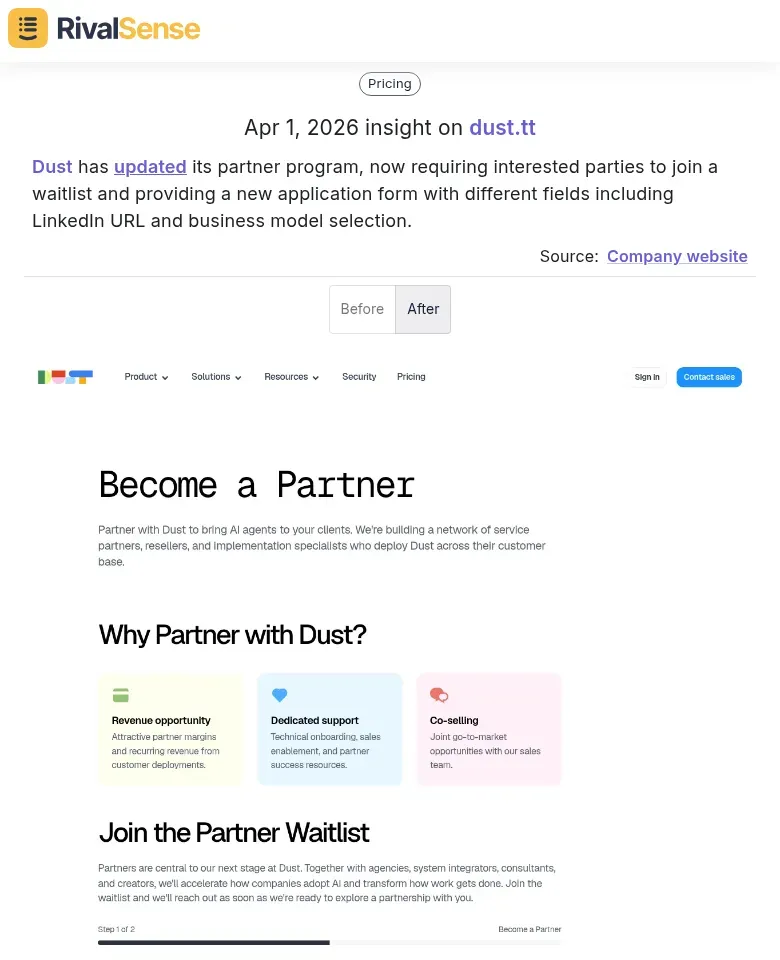
Why this insight is valuable: Insights into partner program changes help you understand competitor channel strategies, enabling you to refine your own partner recruitment and content distribution tactics.
Practical Checklist for Monitoring:
- ✅ Set up automated alerts for competitor partner program page changes
- ✅ Document waitlist implementation dates and application criteria changes
- ✅ Track partner tier modifications and commission structure updates
- ✅ Monitor distribution channel expansions or contractions
- ✅ Analyze how program changes affect competitor market reach
Actionable Tip: Create a partner program comparison matrix tracking key metrics like application approval time, commission rates, and channel breadth. Update quarterly to identify emerging trends.
Digital vs. Physical Pricing Strategies: Platform-Specific Insights
Digital vs. physical pricing strategies reveal crucial insights about customer behavior and platform dynamics. Competitors often price digital content lower than physical versions due to zero marginal costs, instant delivery, and global accessibility. Understanding these differences can guide your content pricing and packaging.
A relevant example from RivalSense: Nintendo announced on March 25, 2026 that it will price digital and physical versions of its Nintendo Switch 2 games differently, starting with Yoshi and the Mysterious Book in May, where the digital version costs $59.99 and the physical version costs $69.99. This highlights how companies leverage platform-specific pricing to maximize revenue and cater to different customer preferences.
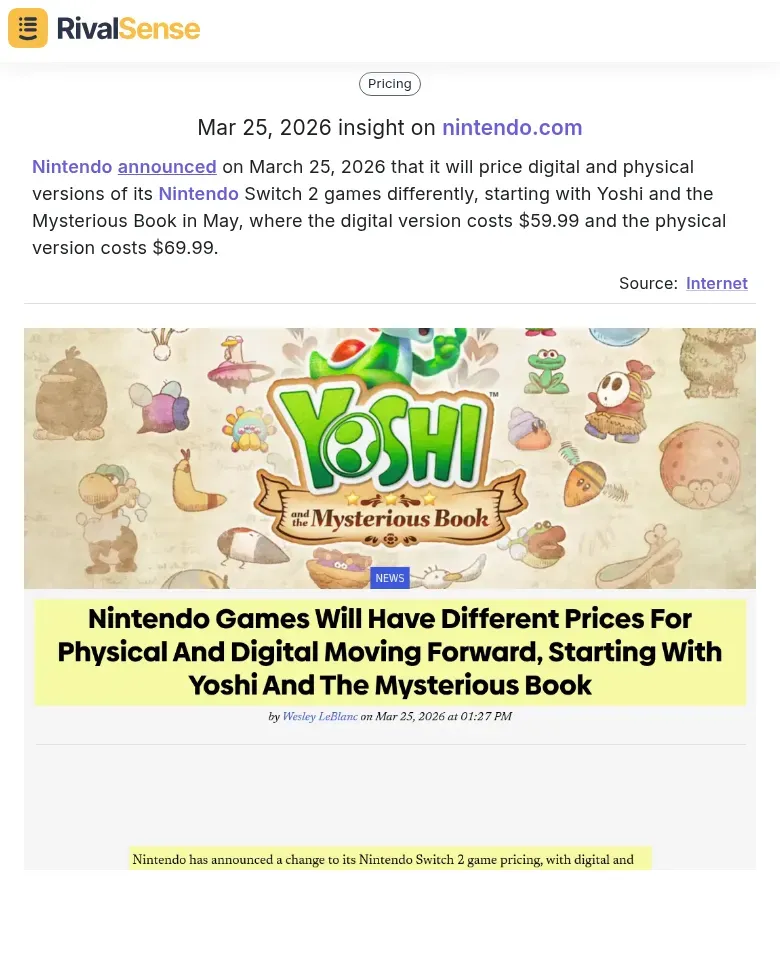
Why this insight is valuable: Insights into digital vs. physical pricing help you tailor your content offerings across platforms, optimizing for customer willingness-to-pay and delivery costs.
Platform-Specific Pricing Patterns:
- SaaS platforms: Show willingness-to-pay for convenience and integration
- E-commerce sites: Reveal price sensitivity for tangible goods
- Mobile app stores: Demonstrate impulse purchase thresholds
- Professional networks: Indicate value placed on industry-specific content
Practical Application Steps:
- Map competitor pricing across platforms (web, mobile, desktop)
- Track seasonal/demand-based price adjustments
- Analyze feature-tiered pricing for digital vs. physical bundles
- Monitor platform-specific promotions and discounts
Checklist for Implementation:
- ✓ Compare 3+ competitor platforms
- ✓ Track 6-month price history
- ✓ Analyze customer reviews for price mentions
- ✓ Test different price points per channel
Translating Pricing Insights into Content Performance Optimization
When competitors adjust pricing, they're signaling shifts in market positioning. Translating these insights into content optimization requires a structured approach to ensure your messaging resonates with target audiences and drives performance.
3-Step Workflow for Optimization:
-
Align Messaging with Pricing Positioning: When a competitor raises prices, they're claiming premium status. Create content highlighting your superior value at competitive rates. If they lower prices, emphasize your unique differentiators beyond cost.
- Example: If a SaaS competitor introduces enterprise pricing tiers, develop case studies showcasing your platform's enterprise-grade features at mid-market pricing.
-
Inform Content Topics with Pricing Intelligence: Analyze competitor pricing pages for value proposition language. Use these insights to create content addressing gaps they're not covering.
- Checklist:
- Map competitor pricing changes to feature emphasis
- Identify underserved customer segments in their pricing structure
- Create content targeting those segments with tailored value propositions
- Checklist:
-
Measure Content Performance Improvements: Track how content informed by pricing insights performs against baseline metrics.
- Monitor:
- Conversion rates on pricing comparison pages
- Engagement with value-focused content
- Lead quality from competitor-aware content
- Monitor:
Tip: Use A/B testing to compare content versions with and without competitor pricing insights. The winning version often reveals market gaps you can exploit through strategic content positioning.
Putting It All Together: Streamline Your Competitor Tracking
By integrating competitor pricing insights into your content strategy, you can make data-driven decisions that enhance performance and competitive advantage. However, manually tracking all these changes across multiple competitors and platforms can be time-consuming and prone to oversight.
To simplify this process, consider using a dedicated competitor tracking tool like RivalSense. It automates the monitoring of competitor product launches, pricing updates, event participations, partnerships, regulatory aspects, management changes, and media mentions across websites, social media, and various registries. All insights are delivered in a weekly email report, saving you valuable time.
Ready to take your competitor analysis to the next level? Try out RivalSense for free at https://rivalsense.co/ and get your first competitor report today to start leveraging these insights for your business strategy.
📚 Read more
👉 Decoding Competitor Strategy Through Hires: Lessons from Adobe's New Appointment
👉 How to Track Key Account Renewal Dates: A Strategic Guide for 2026
👉 IT Asset Management Competitor Benefits Cheat Sheet: Turn Insights into Advantage
👉 How Proactive Competitive Intelligence Counters Rivals' Market Moves
👉 Instagram Competitor Insights Cheat Sheet: Track Like Backlinks