
Competitor Brand Perception Mastery: The Ultimate Internet Insights Guide
In today's digital landscape, understanding how customers perceive your competitors versus your own brand isn't just market research—it's strategic intelligence. This perception directly influences customer acquisition, retention, and overall market share. While you may know your product's features inside out, customers form perceptions based on online reviews, social media conversations, and search patterns that reveal deeper market truths.
Monitoring competitor brand positioning provides three key advantages: First, it uncovers gaps in their messaging that you can exploit. Second, it reveals customer pain points they're failing to address. Third, it helps you anticipate market shifts before they impact your business.
Internet insights transform abstract perceptions into actionable data. By analyzing review sentiment, social media mentions, and search trends, you can identify emerging opportunities (like underserved customer segments) and threats (like negative sentiment spikes) in real-time.
Practical starting point: Begin with a simple 3-step audit:
- Track 3-5 key competitors' review ratings across platforms
- Monitor social media sentiment using basic tools
- Analyze search volume for competitor-related keywords
This baseline reveals immediate perception gaps and informs your competitive positioning strategy.
Section 1: Monitoring Competitor Expansion and Market Penetration
Monitoring competitor expansion reveals strategic intent and growth trajectories. By tracking physical locations, new market entries, and geographic patterns, you can understand where they're investing and why. This insight helps you anticipate competitive moves and identify potential market opportunities or threats.
For example, RivalSense recently tracked that Mikro Kapital's MK Kredit IFN SA opened its 14th national agency in Braşov on February 17, 2026, with the CEO stating it aims to support local businesses with flexible financial solutions.
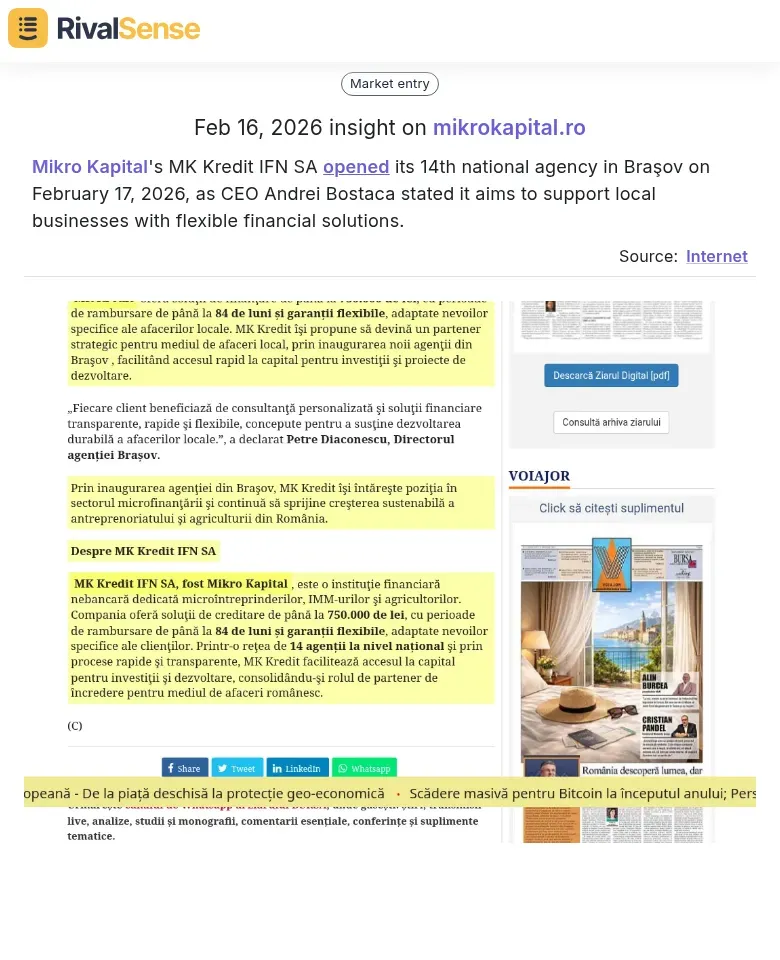
This type of expansion insight is valuable because it shows geographic targeting and strategic priorities, allowing you to assess market saturation or identify regions for your own expansion. Early movers in emerging markets gain first-mover advantages, while late entrants often target underserved niches.
Practical steps:
- 🗺️ Map all competitor locations over time using Google Maps and business directories
- 📅 Analyze expansion timing relative to economic cycles and industry events
- 👥 Identify which customer segments they're targeting through location choices (e.g., urban vs. suburban, business districts vs. residential areas)
- 🔍 Note any regional specialization patterns that suggest market testing
Key insights: Expansion into affluent neighborhoods indicates premium positioning, while suburban sprawl suggests mass-market focus. Watch for expansion pauses—these may signal strategy shifts or resource constraints.
Checklist:
- [ ] Document all physical locations and opening dates
- [ ] Identify geographic concentration patterns
- [ ] Analyze timing relative to market conditions
- [ ] Match locations to customer segment profiles
- [ ] Track expansion velocity (slow/steady vs. aggressive)
Tip: Use satellite imagery and local business news to verify expansion before official announcements. Expansion patterns often reveal unstated strategic priorities before marketing materials do.
Section 2: Analyzing Financial Performance and Funding Strategies
Financial performance and funding activities are critical indicators of a competitor's health and strategic direction. By monitoring capital raising, profitability, and financial stability, you can gauge their market confidence and growth potential. This analysis helps you benchmark your own performance and anticipate competitive pressures.
Monitoring Capital Raising Activities & Investor Confidence
Track competitor funding rounds via Crunchbase, PitchBook, or SEC filings. Note investor quality (top-tier VCs signal confidence), round size trends (increasing amounts indicate growth validation), and valuation multiples. Create alerts for new funding announcements to understand strategic priorities.
Consider this insight from RivalSense: Eleving Group secures Mogo Kenya's two-year bond programme, which aims to raise Sh1.5 billion to expand operations in Kenya.
Tracking such financial activities is valuable because it reveals how competitors are fueling growth, their access to capital, and investor sentiment, which can influence market dynamics and your funding strategies.
Assessing Profitability & Operational Efficiency
Analyze financial statements for gross/net margins, EBITDA trends, and cash flow patterns. Use tools like RivalSense to monitor pricing changes, discounting frequency, and customer acquisition cost (CAC) trends. Benchmark against industry averages—declining margins may signal competitive pressure or inefficiency.
Evaluating Financial Stability & Growth Investment Patterns
Review balance sheets for debt-to-equity ratios and cash reserves. Track capital expenditure (CapEx) in R&D, marketing, or infrastructure—aggressive spending often precedes market expansion. Monitor hiring patterns (LinkedIn data) for investment in key growth areas.
Practical Checklist:
- 🔔 Set up alerts for competitor funding announcements
- 📊 Quarterly review of margin trends vs. industry benchmarks
- 💰 Track pricing and discounting frequency monthly
- 👥 Analyze hiring spikes in strategic departments
- 📜 Monitor patent filings and R&D investment disclosures
Key Insight: Consistent funding without proportional revenue growth may indicate investor patience for long-term plays, while profitability improvements during expansion signal operational excellence.
Section 3: Assessing Operational Strategy and Market Positioning
Operational strategy and market positioning decisions reveal how competitors are building sustainable advantages. By analyzing their technology adoption, supply chain innovations, and talent strategies, you can identify their core competencies and vulnerabilities. This understanding allows you to position your brand more effectively in the market.
Identifying Competitive Advantages Through Operational Decisions
Operational decisions reveal where competitors invest for sustainable advantage. Track their:
- Technology adoption: Are they implementing AI, automation, or new software platforms?
- Supply chain innovations: Do they have exclusive partnerships or logistics improvements?
- Talent strategies: Are they hiring specialists in emerging areas like sustainability or data science?
Practical tip: Create a quarterly review of competitor job postings, patent filings, and technology partnerships to spot operational investments before they impact the market.
Analyzing Route or Service Expansion as Market Positioning Signals
Expansion patterns indicate strategic priorities. Monitor:
- Geographic expansion: Which regions are they entering or exiting?
- Service line additions: Are they moving upmarket or downmarket?
- Product bundling: How are they combining services to create new value propositions?
Checklist item: Map competitor expansion against market growth rates to identify whether they're following demand or creating new markets.
Monitoring Cost Management Strategies and Efficiency Improvements
Cost structures reveal operational maturity. Watch for:
- Pricing model changes: Are they shifting from per-user to consumption-based pricing?
- Operational efficiency announcements: Look for mentions of "cost reduction," "automation," or "process optimization" in earnings calls
- Partnership rationalization: Are they consolidating vendors or forming strategic alliances?
For instance, RivalSense tracked that Jeju Air reported an operating profit of 18.6 billion won in the fourth quarter of last year, becoming the only low-cost carrier in South Korea to turn a profit, driven by expanding Japanese routes and reducing fuel costs.
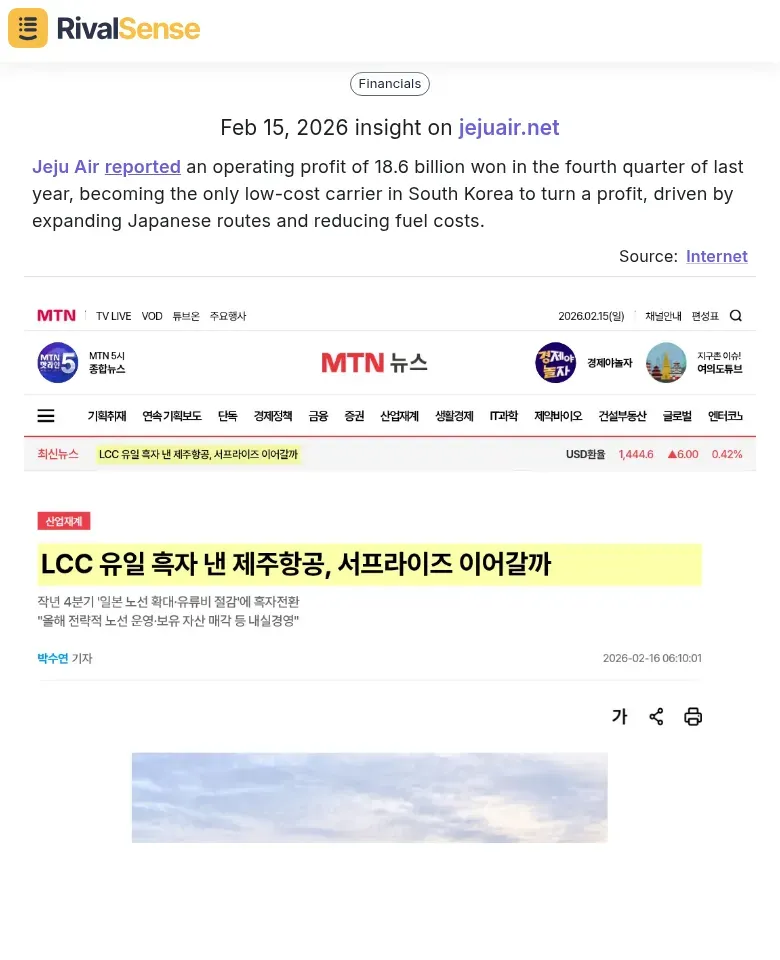
This operational insight is valuable because it highlights how efficiency improvements and route expansion can lead to profitability, offering lessons for your own cost management and market expansion strategies.
Actionable step: Set up alerts for competitor financial reports and executive interviews to catch efficiency initiatives early. Compare their cost structure improvements against industry benchmarks to gauge relative competitiveness.
Section 4: Gathering Internet Insights: Tools and Techniques
Effective competitor monitoring requires the right tools and techniques to gather accurate and timely internet insights. By leveraging news monitoring, social media analysis, and financial data tracking, you can build a comprehensive view of competitor activities. This systematic approach ensures you don't miss critical signals that could impact your business.
To implement this, consider these practical tools and techniques:
-
News Monitoring for Competitor Announcements & PR:
- Set up Google Alerts for competitor names, key executives, and product launches
- Use tools like Mention or Brand24 to track media coverage across 100+ sources
- Create a spreadsheet to log major announcements and analyze messaging patterns
- 💡 Tip: Monitor industry publications for third-party validation of competitor claims
-
Social Media Analysis for Customer Sentiment:
- Track competitor mentions on Twitter, LinkedIn, and industry forums
- Use sentiment analysis tools (Hootsuite Insights, Brandwatch) to gauge customer emotions
- Create a sentiment scoring system (positive/negative/neutral) for consistent tracking
- ✅ Checklist: Monitor complaint patterns, feature requests, and brand advocacy mentions
-
Financial Data Tracking for Performance Benchmarking:
- Subscribe to competitor earnings calls and quarterly reports
- Use platforms like Yahoo Finance or Bloomberg for stock performance analysis
- Track key metrics: revenue growth, customer acquisition costs, market share
- 🛠️ Practical step: Create a quarterly competitor financial dashboard for leadership review
Pro tip: Combine these insights to identify gaps between competitor messaging (PR), customer perception (social), and actual performance (financial data). This triangulation reveals authentic brand positioning versus marketed claims.
Section 5: The Complete Competitor Brand Perception Checklist
Implementing a systematic framework is essential for consistent competitor brand perception monitoring. This checklist ensures you cover all critical aspects, from data collection to actionable insights, helping you stay ahead in the competitive landscape. By following these steps, you can translate observations into strategic advantages for your business.
Step 1: Establish Monitoring Infrastructure
- Set up alerts for competitor mentions across social media, review sites, and news outlets
- Use tools like RivalSense to automate data collection from 50+ sources
- Create a centralized dashboard for real-time tracking
Step 2: Track Key Metrics Across Three Dimensions
Expansion Metrics: Market share growth, geographic expansion, new product launches
Financial Indicators: Pricing changes, discount patterns, funding announcements
Operational Signals: Hiring trends, partnership announcements, technology stack updates
Step 3: Analyze Sentiment & Perception Patterns
- Categorize mentions as positive, negative, or neutral
- Identify recurring themes in customer feedback
- Track sentiment shifts around major announcements
Step 4: Translate Insights into Action
- Compare your brand perception against competitors' weaknesses
- Identify market gaps where competitors are underperforming
- Adjust your messaging to highlight your unique strengths
- Time your announcements to counter competitor moves
Pro Tip: Schedule quarterly deep-dive analyses to spot long-term trends. Focus on 3-5 key competitors maximum to maintain actionable insights. Document findings in a shared competitive intelligence report for team alignment.
Take Your Competitor Intelligence to the Next Level
Manually tracking all these aspects can be time-consuming and prone to gaps. Tools like RivalSense automate the process by tracking competitor product launches, pricing updates, event participations, partnerships, regulatory changes, management shifts, and media mentions across company websites, social media, and various registries. It delivers consolidated insights in a weekly email report, saving you hours of research.
Ready to gain a competitive edge? Try RivalSense for free today at https://rivalsense.co/ and get your first competitor report to start making data-driven decisions immediately.
📚 Read more
👉 Mastering Key Account Management in Kazakhstan's Auto Lending Sector: A Practical Guide
👉 How to Track Competitor Pricing for Key Account Success: A Step-by-Step Guide
👉 Turning Competitor Events into Your Strategic Edge
👉 SEO Agency Benchmarking: Track Key Account Interactions for Growth