
Case Study: How Project Governance Unlocks Competitor Pricing Advantages
Most companies approach competitor pricing reactively—scraping data when a threat emerges, then scrambling to respond. This creates a critical gap: without systematic governance, pricing intelligence remains fragmented, inconsistent, and disconnected from strategic decision-making. The hidden connection between project governance and pricing strategy lies in transforming this reactive approach into a sustainable competitive advantage.
Project governance provides the framework to institutionalize competitor tracking. By establishing clear processes, roles, and accountability, companies move from ad-hoc price monitoring to systematic intelligence gathering. This governance structure ensures pricing data flows consistently to decision-makers, enabling proactive rather than reactive responses.
Practical steps to implement: 🛠️
- Assign clear ownership of competitor pricing intelligence
- Establish regular review cadences (weekly/monthly)
- Create standardized reporting templates
- Define escalation protocols for significant price changes
- Integrate pricing insights into strategic planning cycles
The impact is measurable: companies with strong governance frameworks achieve 28-32% better pricing outcomes through faster response times, more accurate positioning, and reduced price erosion. This case study reveals how governance unlocks the true potential of competitor intelligence—transforming data into decisive advantage.
Understanding Project Governance in Competitive Intelligence Context
Effective project governance transforms competitor pricing intelligence from reactive observations to strategic advantages. At its core, three components create this competitive edge: 1) Clear decision rights that define who approves pricing changes based on competitor moves, 2) Structured workflows that standardize how competitor data flows from monitoring to action, and 3) Performance metrics that track how pricing decisions impact market position against rivals.
Structured decision-making frameworks prevent pricing paralysis. Implement a tiered approval system: frontline teams can respond to minor competitor price changes within 24 hours, while strategic pricing shifts require executive review. Create a "pricing playbook" with pre-approved responses for common competitor scenarios—when a rival undercuts by 5%, when they bundle products, or when they launch aggressive promotions.
Governance ensures consistent monitoring through standardized protocols. Establish weekly competitor pricing reviews using automated tracking tools. Implement escalation triggers: when a competitor's price drops 10% below yours, or when three competitors simultaneously change pricing in a segment. Create response checklists: verify market impact, calculate margin implications, assess customer perception, then execute approved countermeasures.
But governance shouldn't stop at pricing. Tracking broader competitor moves, like management changes, can provide early warnings of strategic shifts. For example, when Rob Minton left Geotab as Associate Vice President - Connected Car Business Development, it signaled potential changes in their market approach. Monitoring such moves helps anticipate pricing strategy adjustments.
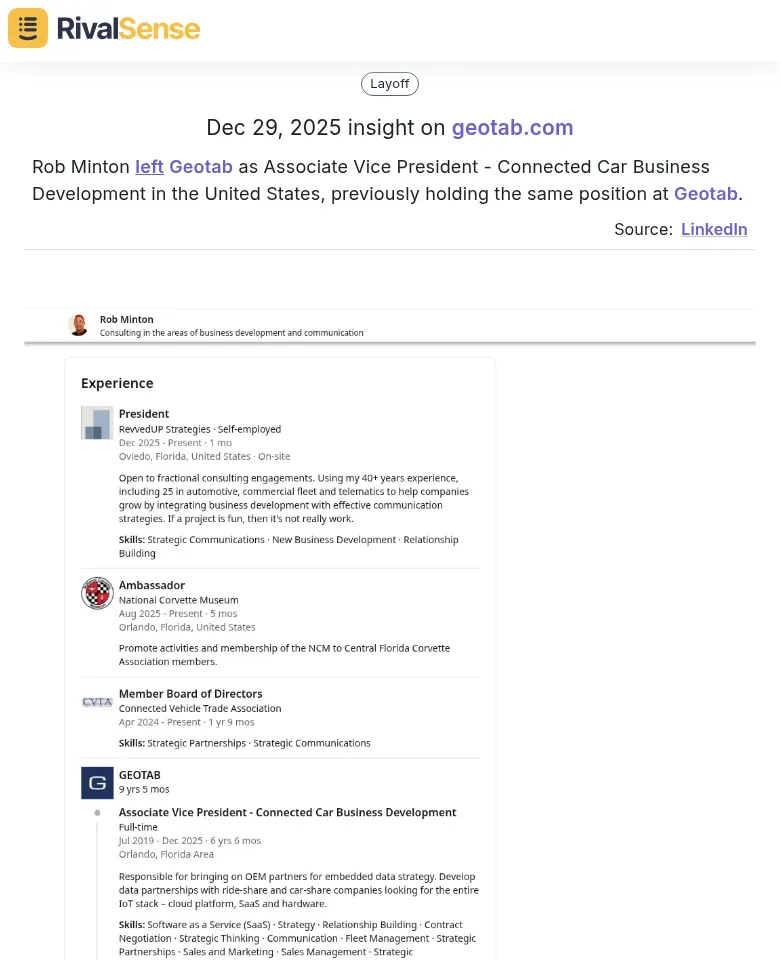
Why this matters: Executive departures can indicate internal turmoil or strategic pivots, allowing you to adjust your pricing governance to capitalize on competitor vulnerabilities.
Practical tip: Start with a simple governance framework—define one decision-maker, establish weekly review cadence, and create three pre-approved response scenarios. This structure prevents analysis paralysis while maintaining competitive responsiveness.
Case Study Analysis: Governance-Driven Pricing Success Stories
Case studies demonstrate how governance frameworks drive pricing success across industries. These real-world examples show the tangible benefits of systematic competitor intelligence. By learning from these scenarios, you can adapt best practices to your own business context.
Example 1: B2B SaaS Company's Premium Pricing Governance
A leading enterprise SaaS provider established a pricing governance committee that maintained their premium position despite aggressive discounting from competitors. Their governance framework included: 1) Weekly competitor price monitoring, 2) Value-based pricing justification templates, 3) Quarterly pricing strategy reviews. Practical tip: Create a pricing decision matrix that requires documented competitor analysis before any discount approval.
Example 2: Manufacturing Firm's Dynamic Pricing Governance
An industrial equipment manufacturer implemented a governance structure enabling real-time pricing adjustments based on competitor moves. Their system featured: 1) Automated competitor price tracking, 2) Pre-approved pricing bands for different market conditions, 3) Escalation protocols for major price changes. Checklist item: Establish clear authority levels - what pricing changes can frontline sales make vs. what requires executive approval?
Example 3: Service Provider's Strategic Promotion Matching
A professional services firm used governance to selectively match competitor promotions without eroding margins. Their approach included: 1) Promotion impact analysis before matching, 2) Time-limited matching windows, 3) Value-add bundling instead of pure price cuts. Key insight: Governance prevents knee-jerk reactions - analyze whether matching a promotion actually wins profitable business or just starts a price war.
Governance Implementation Steps: 📋
- Define pricing decision rights and approval workflows
- Establish competitor monitoring protocols
- Create pricing change documentation requirements
- Set regular governance review cadence
- Train teams on governance processes
Pro tip: Start with a pilot program for one product line before full implementation to refine your governance framework.
The Governance-Pricing Advantage Framework
The Governance-Pricing Advantage Framework transforms reactive pricing into a strategic advantage through three systematic steps. This framework ensures that competitor intelligence is consistently applied to pricing decisions, creating a sustainable edge in the market.
Step 1: Establish Pricing Intelligence Collection Protocols
Create standardized processes for gathering competitor pricing data. Use automated tools like web scrapers for transparent markets and implement secret shopper programs for opaque B2B sectors. Practical tip: Assign specific team members to monitor 3-5 key competitors weekly, documenting price changes, promotions, and packaging strategies in a centralized dashboard.
Step 2: Create Cross-Functional Pricing Decision Committees
Form a committee with representatives from sales, marketing, finance, and product teams. This ensures pricing decisions consider market positioning, profitability, and customer value. Checklist: Include quarterly pricing reviews, establish decision-making authority levels, and create escalation paths for urgent competitor moves.
Step 3: Implement Systematic Competitor Response Workflows
Develop clear protocols for responding to competitor pricing changes. Create decision trees based on market share impact, margin thresholds, and strategic objectives. Key workflow: When a competitor cuts prices >10%, trigger immediate analysis of customer segment impact, followed by committee review within 48 hours to decide between matching, holding position, or value-based counter-moves.
Practical Implementation: Building Your Governance-Pricing System
To build an effective governance-pricing system, start with automated monitoring tools that track a wide range of competitor activities. Beyond pricing, changes in management can reveal strategic priorities that affect market dynamics. For instance, when Britt Williams joins PayPal as Chief Operations Officer for PayPal Bank, it signals a focus on banking operations, which may influence their service pricing and competitive positioning.
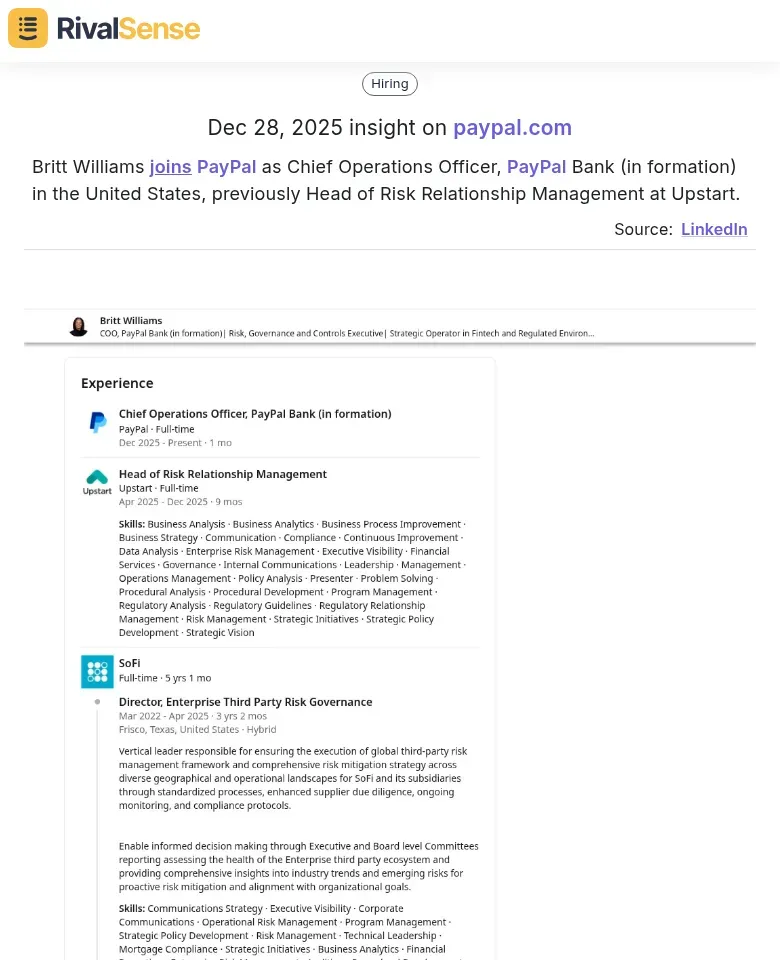
Why this matters: New executive appointments often precede product launches or pricing shifts, giving you a head start in adjusting your governance strategies.
Implement tools like RivalSense for real-time competitor tracking across websites, social media, and registries. This provides comprehensive insights into product launches, pricing updates, event participations, partnerships, regulatory aspects, and management changes—all delivered in weekly email reports.
Establish clear governance metrics using a centralized dashboard. Here's a table to track key performance indicators:
| Metric | Description | Target Frequency |
|---|---|---|
| Price Positioning Index | Your price vs. competitors' | Weekly |
| Competitive Response Time | Hours to match/beat pricing changes | Real-time alerts |
| Win/Loss Rate at Different Price Points | Analysis of sales outcomes | Monthly |
| Market Share Impact | Effect of pricing decisions on share | Quarterly |
Train teams with these protocols: Create a pricing decision matrix with clear escalation paths. For example: <5% price difference = team lead decision; 5-15% = department head approval; >15% = executive review. Conduct quarterly war-gaming sessions where teams respond to simulated competitor price moves. Develop a pricing playbook with pre-approved responses for common scenarios.
Practical checklist: ✅
- Set up automated alerts for competitor price changes
- Create a single source of truth pricing dashboard
- Define approval workflows and decision thresholds
- Schedule regular competitive pricing reviews
- Document all pricing decisions with rationale
- Train cross-functional teams on governance protocols
- Establish feedback loops from sales teams on competitor tactics
Future Trends: AI-Enhanced Governance for Next-Generation Pricing
AI is revolutionizing project governance from reactive oversight to predictive intelligence. By analyzing competitor pricing patterns, market signals, and internal constraints, AI-enhanced governance systems can forecast optimal price points and flag risks before they impact margins. For example, machine learning models can detect when a competitor's discounting strategy is unsustainable, enabling proactive adjustments.
Ethical considerations are paramount in automated pricing governance. Implement transparency protocols: document AI decision logic, establish human oversight checkpoints, and avoid discriminatory pricing algorithms. Create an ethics review board to audit automated pricing decisions quarterly.
AI can also analyze talent movements to predict competitor strategies. When Brent Wilson joined Broadcom as Account Director, moving from Intuit, it might indicate Broadcom's focus on expanding in specific market segments. Tracking such changes with AI tools can enhance predictive capabilities.
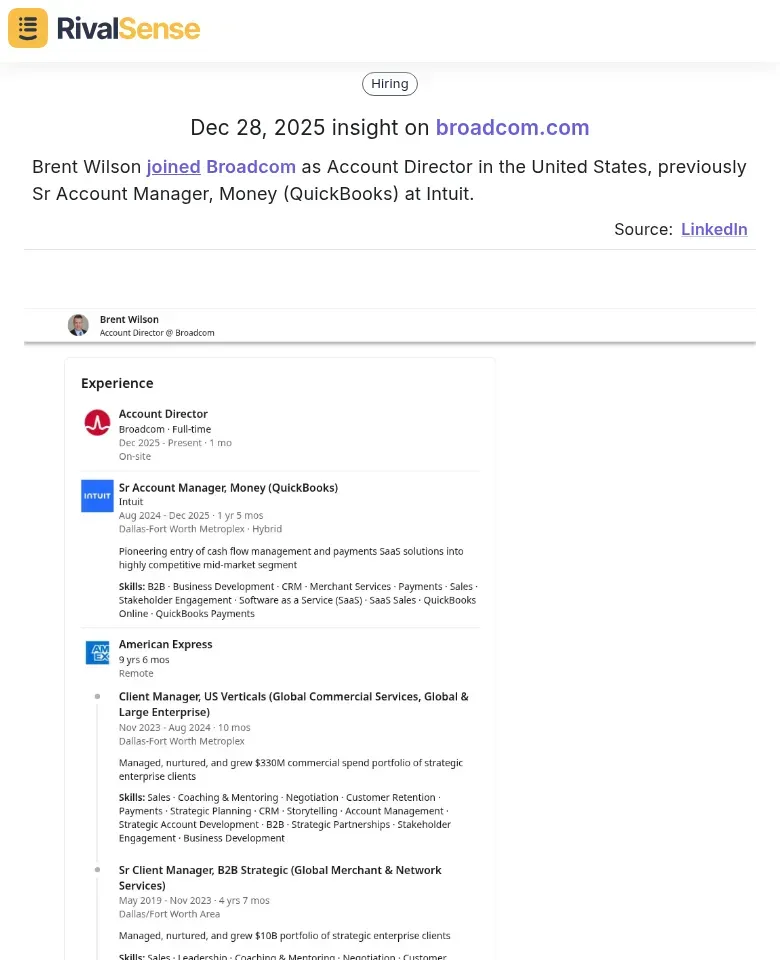
Why this matters: Talent acquisitions often correlate with strategic initiatives, allowing AI models to incorporate this data for more accurate pricing forecasts.
To prepare for real-time competitive pricing adjustments:
- Integrate competitor tracking APIs with your governance workflows
- Define clear escalation thresholds (e.g., "Alert when competitor price drops >15%")
- Establish governance-approved response playbooks for common scenarios
- Conduct monthly simulation exercises with cross-functional teams
Practical tip: Start with hybrid governance where AI recommends and humans approve pricing changes. This builds trust while developing institutional readiness for full automation. Monitor competitor price elasticity alongside your governance metrics to validate AI predictions against market reality.
Take Action: Implement Governance with the Right Tools
Transform your competitor pricing intelligence with a structured governance approach. By implementing the frameworks and practices outlined, you can move from reactive scrambling to proactive strategy. To streamline this process, consider leveraging automated tools like RivalSense, which tracks competitor product launches, pricing updates, event participations, partnerships, regulatory aspects, management changes, and media mentions across multiple sources.
Ready to gain a competitive edge? Try RivalSense for free at https://rivalsense.co/ and get your first competitor report today! This will help you apply the governance principles discussed and start unlocking pricing advantages immediately.
📚 Read more
👉 How Import.io's Managed Web Scraping Service Enables Competitor Innovation
👉 Uncover Competitor Innovation Advantages Through Twitter Intelligence
👉 VPN Key Account Management: A Process Optimization Guide for Cybersecurity Leaders
👉 Competitor Product Insights: A Strategic Guide for Key Account Management
👉 Decoding Competitor Strategy: How Safran's Air Show Move Reveals Innovation Priorities