
Beginner's Guide to Key Account Health Dashboards for Commercial Laundry Services
Managing B2B commercial laundry accounts at scale presents unique challenges: fluctuating linen volumes, complex service-level agreements, and diverse client needs across healthcare, hospitality, and industrial sectors. Traditional manual tracking systems—spreadsheets, paper logs, or basic CRM notes—fail modern providers by creating data silos, delayed insights, and reactive account management.
Poor account health visibility directly impacts retention and revenue. Without real-time monitoring, you might miss early warning signs like declining linen usage (indicating client dissatisfaction), frequent service complaints, or contract renewal risks. This leads to preventable churn and revenue leakage.
Practical steps to improve:
- Centralize key metrics: Track linen volume trends, service compliance rates, and client satisfaction scores 📊
- Set automated alerts for usage drops (e.g., >15% monthly decrease) 🔔
- Create client health scores combining usage, payment history, and service interactions
- Schedule quarterly account reviews using dashboard insights
💡 Tip: Start with your top 20% revenue-generating accounts—monitoring these closely yields the highest ROI. Implement weekly health checks to proactively address issues before they escalate into retention problems.
Core Components of an Effective Commercial Laundry Account Health Dashboard
An effective commercial laundry account health dashboard requires three core components: essential KPIs, integrated data sources, and proactive visualizations. By focusing on these elements, you can transform raw data into actionable insights that drive account retention and growth.
Essential KPIs: Track service utilization (percentage of machines used vs. available), equipment uptime (target 95%+), and billing accuracy (reconcile invoices with usage data). These metrics reveal revenue potential, operational reliability, and financial health.
Data Integration: Connect your laundry management system for transaction data, IoT sensors on machines for real-time status (e.g., cycles, errors), and customer feedback via surveys or support tickets. Use APIs or middleware to unify this data, ensuring a single source of truth.
Visual Dashboards: Design dashboards with color-coded alerts (red for downtime, yellow for underutilization), trend charts for usage patterns, and heat maps for issue frequency. Include a "top issues" widget to prioritize repairs or customer outreach.
🚀 Pro tip: Set up automated reports sent weekly to account managers, highlighting anomalies like sudden drops in utilization or recurring equipment faults.
Practical steps:
- Audit your current data sources,
- Define KPI targets with stakeholders,
- Use tools like Power BI or Tableau for visualization,
- Test dashboards with a pilot account, and
- Iterate based on feedback.
This approach prevents churn and boosts account value.
Implementation Strategy: Building Your Dashboard Step-by-Step
Building your key account health dashboard requires a systematic approach. Rushing into dashboard creation without proper planning can lead to data inconsistencies and ineffective monitoring. Start with data mapping: identify all relevant systems (route management software, billing platforms, IoT sensors on equipment, customer service logs) and create a unified data pipeline. Use APIs or middleware to integrate these disparate sources into a centralized data warehouse. For commercial laundry services, track metrics like equipment uptime, service response times, route efficiency, and billing accuracy.
Customize health scores by segmenting clients: tier clients by revenue (e.g., large hotels vs. small clinics) and service level agreements (SLAs). Assign weighted scores to metrics—for example, prioritize equipment reliability for high-value accounts. Use a simple formula: Health Score = (Uptime × 0.4) + (Service Response × 0.3) + (Billing Accuracy × 0.3). Adjust weights based on client feedback and business goals.
Train teams with hands-on workshops: teach staff to interpret dashboard alerts (e.g., color-coded red/yellow/green indicators) and establish response protocols. Create a checklist:
- Review daily health scores,
- Identify accounts below 70% threshold,
- Escalate to account managers,
- Document actions in CRM.
💡 Tip: Simulate scenarios (e.g., equipment failure) to practice rapid response. Regularly update protocols based on performance reviews to ensure continuous improvement.
Measuring Success: Quantifiable Business Impact and ROI
For commercial laundry services, quantifying the ROI of key account health dashboards starts with three measurable outcomes. Understanding the direct business impact helps justify the investment and guides continuous improvement efforts. First, reduce churn by 15-25% among high-value accounts by implementing automated alerts for declining usage patterns. Set up weekly checkpoints to review accounts showing 20%+ month-over-month usage drops, and create a proactive outreach checklist for at-risk clients.
Second, identify upsell opportunities through usage pattern analysis. Track peak usage times, equipment utilization rates, and service frequency to spot expansion potential. For example, if a hotel consistently hits 90%+ capacity during weekends, propose additional equipment or express service packages. Create a quarterly review process to analyze top 20% of accounts for upsell potential.
Third, improve operational efficiency by reducing manual account management time by 30-40%. Implement dashboard automation for routine monitoring tasks, freeing up 5-10 hours weekly for strategic relationship building. Use standardized reporting templates and set up automated alerts for service issues, payment delays, or contract renewals.
📈 Practical tip: Start with a 90-day pilot focusing on your top 10 accounts. Measure baseline metrics, implement dashboard monitoring, and track improvements in retention rates, upsell conversion, and time savings. This focused approach delivers quick wins while building the business case for broader implementation.
Competitive Intelligence Applications for Laundry Services
Your account health dashboard becomes a powerful competitive intelligence tool when you benchmark against industry rivals. Leveraging competitor data allows you to identify market opportunities and strengthen your competitive position. Start by tracking key metrics: Pounds Per Operator Hour (PPOH), rewash/reject rates (target <3%), labor cost per pound, water use intensity (≤2.0 gal/lb), and on-time delivery rates (≥98%).
Practical Steps:
- Create a competitor benchmarking matrix comparing your metrics against 3-5 local competitors. For example:
| Metric | Your Company | Competitor A | Competitor B | Industry Average |
|---|---|---|---|---|
| PPOH | 120 lbs | 115 lbs | 125 lbs | 118 lbs |
| Rewash Rate | 2.5% | 3.2% | 2.8% | 3.0% |
| On-time Delivery | 98.5% | 97.0% | 96.5% | 97.5% |
- Monitor competitor service gaps - track their customer complaints, delivery delays, and quality issues through online reviews and industry forums.
- Analyze pricing structures: Compare your per-pound rates, bundled services, and premium offerings against competitors.
- Identify retention weaknesses: Calculate competitor churn rates by monitoring their client turnover patterns.
Strategic Applications:
- Use competitor rewash rate data to highlight your quality advantage in marketing 🎯
- Adjust pricing tiers based on competitor service gaps you can exploit
- Develop targeted service packages addressing competitor weaknesses (e.g., faster turnaround times, specialized healthcare linen handling)
- Implement loyalty programs where competitors show high customer churn
🔍 Pro Tip: Set up automated alerts for competitor pricing changes and service announcements to maintain real-time competitive awareness.
How Competitor Tracking Tools Provide Valuable Insights
To stay ahead, consider using competitor intelligence platforms like RivalSense, which track product launches, pricing updates, management changes, and more. These insights can directly inform your business strategy. Here are real examples from RivalSense:
-
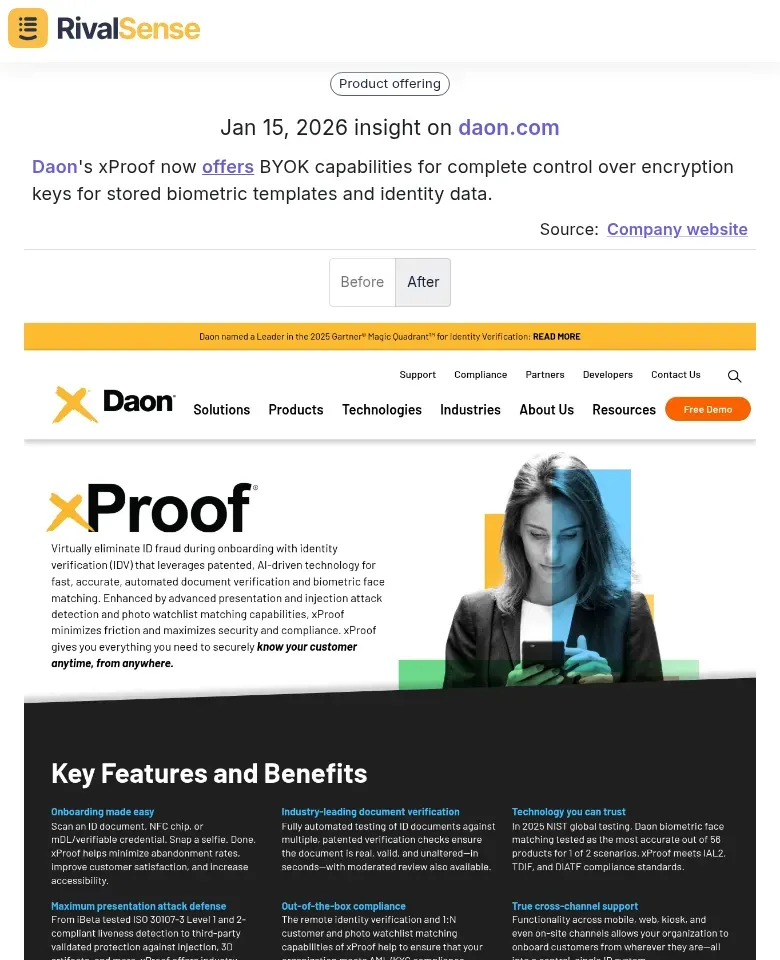
Product Update Insight: Daon's xProof now offers BYOK capabilities for complete control over encryption keys for stored biometric templates and identity data.
Why it's valuable: Tracking product updates helps you benchmark your own feature set and identify security or functionality gaps in your offerings. -
Management Change Insight: Daniel Sebes started as VP & GM, Betting and Gaming at SEON and will announce a major iGaming product at ICE Barcelona.

Why it's valuable: Monitoring management changes can signal strategic shifts or new market entries, allowing you to anticipate competitor moves and adjust your strategy. -
Customer Experience Insight: Riskified introduced Dynamic Returns to adapt return experiences in real time, rewarding trusted customers while preventing abuse, leading to a 30-point increase in customer satisfaction.
Why it's valuable: Insights into customer satisfaction initiatives inspire improvements in your own services and help you stay competitive in client retention.
By leveraging such insights, you can make data-driven decisions to outperform competitors.
Best Practices and Actionable Next Steps
Start with a Minimum Viable Dashboard (MVD) focused on 3-5 critical metrics. Adopting a phased approach ensures quick wins and allows for iterative refinement based on feedback. Track these weekly to establish baselines: 1) Equipment uptime percentage, 2) Service ticket resolution time, 3) Consumables reorder frequency, 4) Contract renewal timeline, and 5) Customer satisfaction score.
Establish automated alerts with tiered response protocols: Set thresholds for each metric (e.g., equipment downtime >8% triggers alert). Create Level 1 (automated email to account manager), Level 2 (phone call within 4 hours for critical issues), and Level 3 (executive escalation within 24 hours for contract risks).
Integrate insights into quarterly business reviews: Prepare a one-page dashboard summary showing metric trends, highlight accounts needing attention, and include action items. During strategic planning, use account health data to identify upsell opportunities (e.g., accounts with high uptime may need expanded service contracts) and churn risks (e.g., accounts with declining satisfaction scores).
✅ Actionable Checklist:
- [ ] Define your 3-5 critical metrics this week
- [ ] Set up automated alerts by month-end
- [ ] Schedule first quarterly review with 3 key accounts
- [ ] Create response protocol document for your team
- [ ] Identify one strategic opportunity from dashboard data next quarter
Take Your Competitor Intelligence to the Next Level
Implementing a key account health dashboard is crucial, but staying ahead requires real-time competitor insights. Tools like RivalSense track competitor product launches, pricing updates, event participations, partnerships, regulatory aspects, management changes, and media mentions across the web, delivering all in a weekly email report. This can help you benchmark your performance, anticipate market shifts, and identify opportunities.
👉 Try RivalSense for free today at https://rivalsense.co/ and get your first competitor report to start enhancing your business strategy.
📚 Read more
👉 How Bentley Systems Accelerated BIM Adoption by Learning from Autodesk's Content Catalog
👉 Competitor Benchmarking Mastery: Track Funding Signals for Strategic Insights
👉 Performance Marketing Competitor Analysis: A Beginner's Guide to Boosting ROI
👉 Optimizing Product Offerings with Win-Loss Analysis and Competitor Insights