
Beginner's Guide: Competitive Intelligence Software Benefits for IT Asset Management
Competitive intelligence software has evolved from a niche market research tool to a strategic business asset that provides real-time insights into competitor activities, market trends, and industry benchmarks. For IT asset management (ITAM) professionals, this represents a paradigm shift from reactive maintenance to proactive optimization. ITAM, traditionally focused on tracking hardware and software inventories, now intersects with competitive intelligence to deliver unprecedented strategic value.
Practical implementation starts with three key steps:
- Integrate CI data feeds into your existing ITAM platform
- Establish competitor benchmarks for software licensing, hardware refresh cycles, and cloud migration patterns
- Create automated alerts for competitor technology announcements and vendor partnerships
This convergence transforms ITAM from a cost center to a strategic advantage. Instead of merely reacting to hardware failures or software audits, you can now anticipate market shifts, optimize technology investments based on competitor successes, and identify emerging threats before they impact your operations. The result is a data-driven ITAM strategy that aligns with broader business objectives while maintaining operational efficiency.
Strategic Cost Optimization and Financial Benefits
Understanding how competitors manage their IT costs can directly impact your bottom line. Strategic cost optimization begins with leveraging competitive intelligence to uncover pricing strategies and procurement efficiencies. By analyzing competitor data, you can identify opportunities to reduce expenses and enhance financial performance.
Use competitive intelligence software to track how competitors structure their pricing for IT assets and software licenses—whether they offer volume discounts, enterprise agreements, or subscription models. This insight helps you negotiate better deals with vendors and avoid overpaying.
Optimize software license utilization through competitive benchmarking. Compare your license usage patterns against industry peers to identify underutilized licenses. For example, if competitors achieve 85% utilization of a specific software while you're at 60%, investigate why and adjust your deployment strategy.
Avoid redundant purchases by monitoring competitor technology stacks. When you see multiple competitors consolidating similar tools, it signals market consolidation opportunities. Create a checklist:
- 🔍 Track competitor software acquisitions and partnerships
- 📊 Monitor industry-standard tool adoption rates
- 🔎 Identify overlapping functionality in your current stack
- 💰 Calculate potential savings from consolidation
Practical tip: Set up alerts for competitor contract renewals and vendor negotiations. This timing intelligence helps you approach vendors when they're most motivated to offer favorable terms. Eliminate waste by identifying which IT assets competitors are retiring or upgrading—this prevents you from investing in soon-to-be-obsolete technology.
Enhanced Risk Management and Compliance Advantages
Proactive risk management is crucial in today's regulatory environment. Competitive intelligence software transforms IT asset management by providing insights into industry standards and emerging threats. By monitoring competitors' security practices and compliance frameworks, you gain visibility that helps mitigate risks before they escalate.
Practical Implementation:
- Track competitor security certifications (ISO 27001, SOC 2, GDPR compliance) to benchmark your own posture
- Monitor competitor security incidents and responses to identify vulnerabilities in similar IT environments
- Analyze competitor technology stacks for security gaps you can proactively address
Why Compliance Insights Matter: For instance, RivalSense tracked that Hyperproof launched AI Guided Experiences at RSA Conference 2026 to transform compliance operations by using AI to automate tasks and reduce manual work, as announced by CEO and Founder Craig Unger. 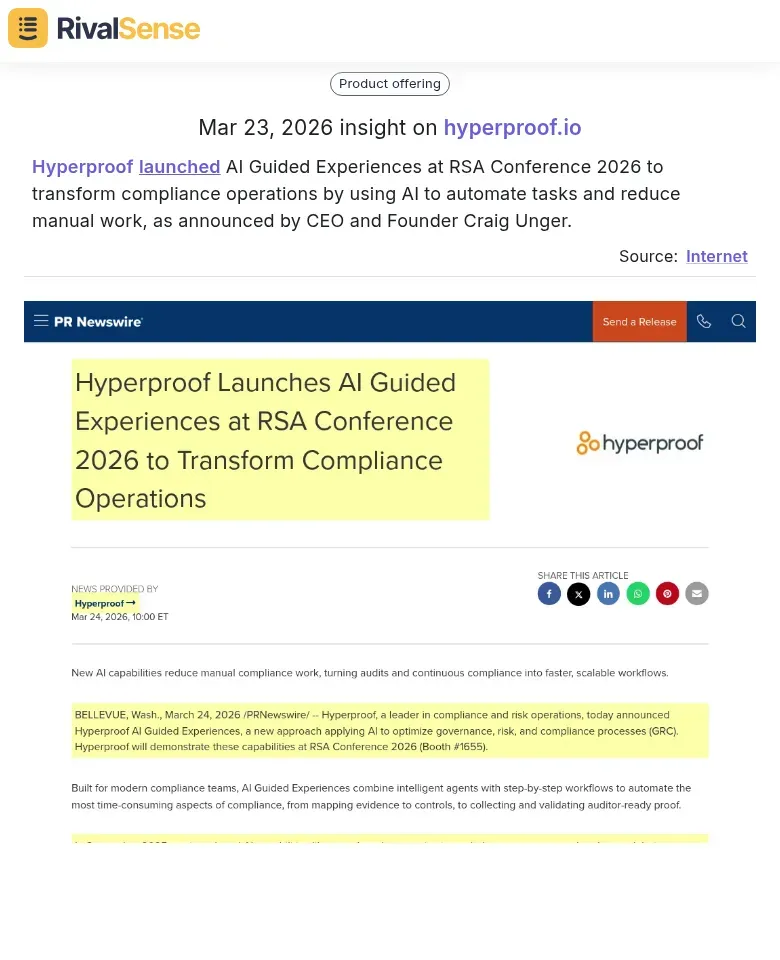
This type of insight is valuable because it shows how competitors are leveraging AI for compliance efficiency, signaling a trend you can adopt to stay ahead. Monitoring such product launches helps you anticipate regulatory changes and optimize your compliance strategies.
Key Benefits:
- 🛡️ Early threat detection through competitive landscape analysis
- 📜 Regulatory compliance optimization by learning from industry leaders
- ⏱️ Reduced audit preparation time by adopting proven compliance frameworks
Actionable Checklist:
- □ Set up alerts for competitor security announcements and compliance updates
- □ Map competitor security frameworks to your compliance requirements
- □ Identify 2-3 security practices from top performers to implement quarterly
- □ Create a risk matrix comparing your security posture against competitors'
Pro Tip: Focus on competitors in regulated industries (finance, healthcare) for the most stringent compliance insights. Their security practices often exceed minimum requirements, providing valuable benchmarks for your own risk management strategy.
Operational Efficiency and Performance Improvements
Improving operational efficiency requires benchmarking against industry leaders. Competitive intelligence software allows you to analyze competitor asset utilization and procurement patterns, leading to informed decisions that enhance performance.
Benchmarking IT asset utilization rates against industry competitors reveals optimization opportunities. For example, if competitors achieve 85% server utilization while yours is at 65%, you can investigate their virtualization strategies or workload distribution. Practical tip: Use competitive intelligence software to track metrics like CPU usage, storage efficiency, and network bandwidth across peer companies. Create a quarterly benchmarking report comparing your KPIs against top 3 competitors.
Learning from Product Updates: Consider how Keatech launched a new version of Keatech LIVE with an updated look matching its new brand and announced it will launch a new Keatech LIVE app next week. 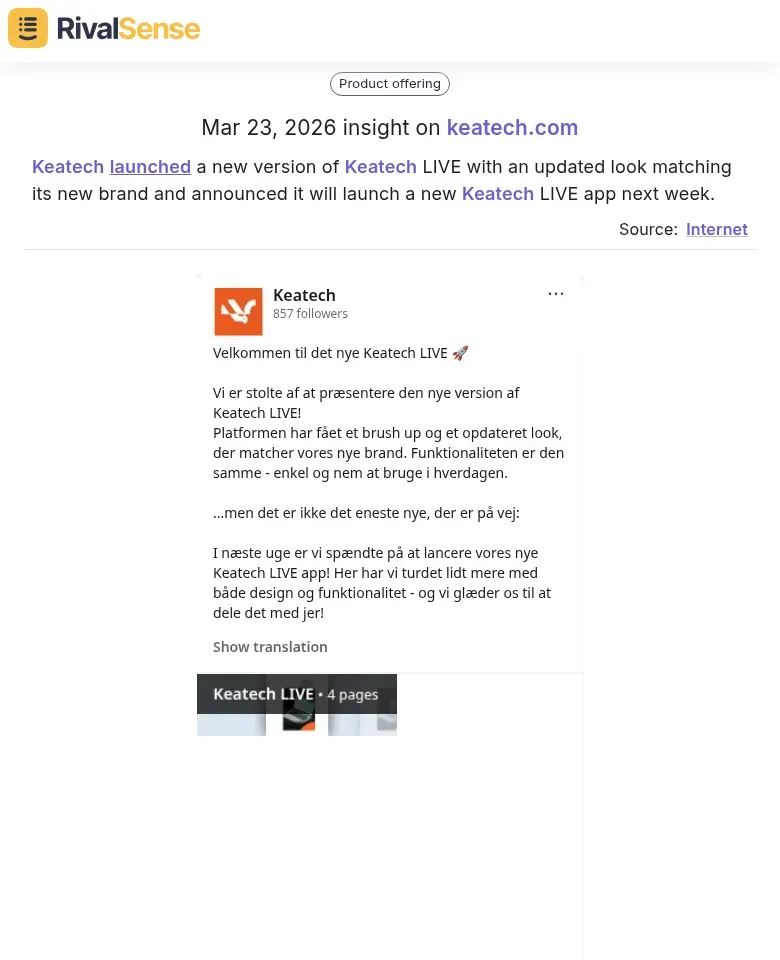
Tracking such product launches is valuable for business strategy as it indicates competitor focus areas and innovation cycles. You can assess if similar updates are needed in your IT assets to maintain competitiveness.
Streamline IT procurement by analyzing competitor purchasing patterns and vendor relationships. When competitors switch to cloud-first strategies or adopt specific hardware brands, you gain market insights for better negotiations. Checklist:
- 📅 Monitor competitor technology stack changes monthly
- 🤝 Identify preferred vendors and contract terms
- 💲 Compare pricing for similar asset acquisitions
This prevents overspending and ensures competitive procurement cycles.
Improve asset lifecycle management by studying competitor refresh cycles and disposal practices. If competitors extend laptop lifespans to 4 years through better maintenance protocols, implement similar preventive measures. Hint: Track competitor asset retirement schedules and sustainability initiatives. Steps: Analyze competitor depreciation schedules, evaluate their upgrade timing, and adopt best practices for end-of-life asset handling to reduce costs and environmental impact.
Competitive Advantage and Market Positioning
Gaining a competitive edge requires understanding where competitors are investing and how they position themselves. Competitive intelligence software transforms IT asset management from a reactive cost center to a strategic advantage by revealing competitor technology stacks and infrastructure investments.
By analyzing competitor data, you can benchmark your own technology portfolio and identify gaps or over-investments. This intelligence helps you anticipate market shifts and align your IT roadmap with proven approaches.
Example of Market Expansion: RivalSense identified that BoursoBank expands its Bourso Business offer for independent professionals and entrepreneurs with a business securities account that provides access to 2,600 investment vehicles, including the Bourso Liquidité money market fund for cash surplus placement. 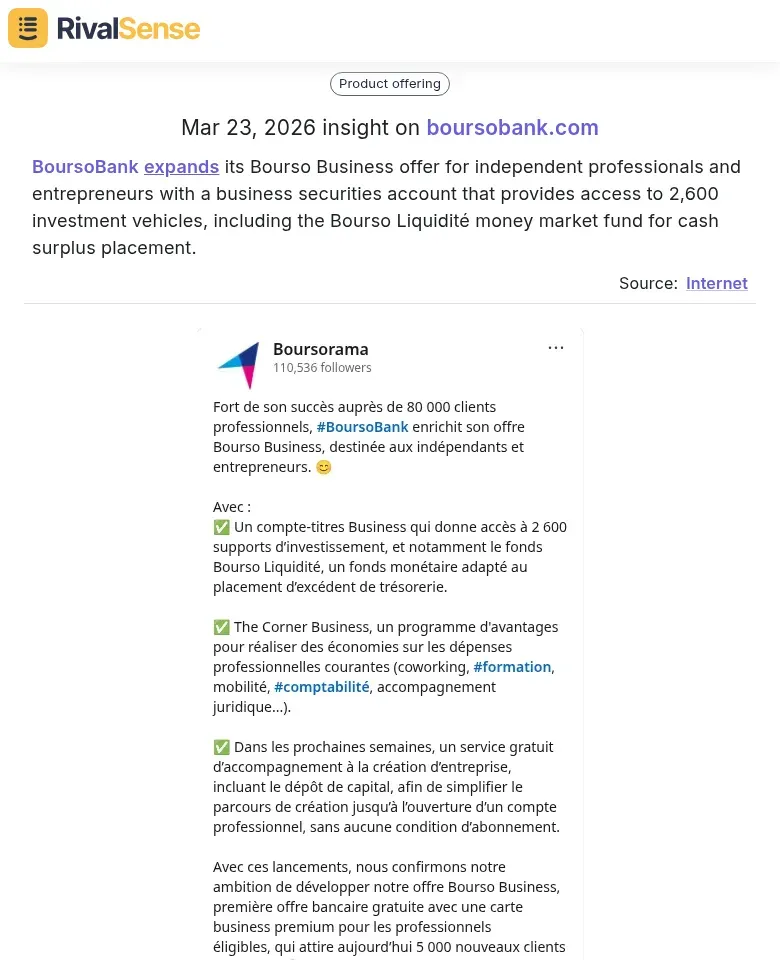
This insight is valuable for business strategy as it shows how competitors are expanding their services to capture new market segments. By monitoring such moves, you can identify opportunities for diversification or enhancement of your own IT asset offerings.
Practical steps to implement:
- 🔍 Monitor competitor job postings for technical roles to infer technology adoption
- 🤝 Track vendor partnerships and certifications mentioned in competitor announcements
- 📄 Analyze patent filings and technical publications for R&D direction
- 🗺️ Use competitive intelligence tools to map competitor technology ecosystems
Through continuous competitive monitoring, you can identify emerging IT trends before they become mainstream. When multiple competitors simultaneously invest in edge computing or AI infrastructure, it signals market validation. This early warning system allows you to develop strategic IT roadmaps that anticipate market shifts rather than react to them.
Key benefits:
- 🚀 Proactive technology planning based on market signals
- ⚠️ Risk mitigation by avoiding technology dead-ends competitors have abandoned
- 📊 Resource optimization by aligning investments with proven competitor approaches
- ⚡ Faster innovation cycles by learning from competitor successes and failures
Your competitive intelligence should feed directly into quarterly IT strategy reviews, ensuring your technology decisions are data-driven rather than speculative.
Implementation and Getting Started with Competitive Intelligence for ITAM
Implementing competitive intelligence for IT asset management requires a structured approach. Start by defining clear goals and selecting the right tools to integrate insights into your existing workflows.
When choosing competitive intelligence software, look for key features: automated competitor tracking for hardware/software pricing, contract terms, and vendor strategies; real-time alerts on competitor moves; and integration capabilities with your existing ITAM tools like ServiceNow, Flexera, or Snow Software. Opt for solutions that offer customizable dashboards and data export options for seamless workflow integration.
Integrate CI with your ITAM workflows by mapping competitor data to your asset lifecycle—from procurement to retirement. Use APIs or middleware to sync CI insights with your CMDB, enabling side-by-side comparisons of your asset costs versus competitors'. This helps optimize vendor negotiations and identify cost-saving opportunities.
Measure ROI by tracking metrics such as cost savings from improved vendor deals, reduced software license overages, and faster response to market changes. Set up a baseline before implementation and monitor quarterly. Practical tip: Create a checklist—define goals, select a CI tool with ITAM-specific features, train your team on data interpretation, and establish regular review cycles. Success hinges on aligning CI insights with ITAM objectives to drive strategic decisions.
Unlock Your Competitive Edge with RivalSense
To effectively implement the strategies discussed, you need reliable competitive intelligence. RivalSense tracks competitor product launches, pricing updates, event participations, partnerships, regulatory aspects, management changes, and media mentions across various sources, delivering all in a weekly email report.
By using RivalSense, you can gain insights like the examples shared above—from compliance innovations to market expansions and product updates—helping you stay ahead in IT asset management.
Try RivalSense for free today at https://rivalsense.co/ and get your first competitor report to start optimizing your IT asset strategy.
📚 Read more
👉 How Intel Countered NVIDIA's Visteon Deal with Edge AI Partnerships
👉 Best Practices: Analyzing Competitor Brand Perception on Facebook
👉 Advanced Tactics: Tracking Video Conferencing Leaders for Strategic Edge
👉 How Competitor Insights Solve Market Entry Challenges for Key Account Success
👉 Competitor Analysis in Action: Learning from Keatech's Partnership with EG