
Avoid These Regulatory Competitor Insight Mistakes That Are Hurting Your ROI
In today's hyper-regulated business landscape, poor regulatory competitor tracking isn't just an oversight—it's a direct threat to your bottom line. Companies that fail to monitor competitors' regulatory compliance miss critical market opportunities while exposing themselves to costly compliance failures. The quality of your regulatory intelligence directly impacts ROI: every missed regulatory change affecting competitors translates to lost competitive advantage and potential revenue.
Common misconceptions undermine competitive positioning. Many leaders assume regulatory monitoring is purely defensive, missing how competitors' compliance strategies reveal market opportunities. Others rely on outdated manual tracking methods that can't keep pace with regulatory changes across jurisdictions. Some mistakenly believe regulatory intelligence is only for large enterprises, when in reality, smaller companies face proportionally greater risks from compliance missteps.
Practical steps to avoid these mistakes:
- Implement automated tracking of competitors' regulatory filings and compliance status
- Map regulatory changes to specific business opportunities in your market
- Establish cross-functional review of regulatory intelligence (legal, strategy, operations)
- Benchmark your compliance timeline against competitors' public disclosures
- Create alerts for regulatory changes that affect your competitive landscape
Start by identifying the top 3 regulatory areas impacting your industry and track how your main competitors are responding. This proactive approach transforms regulatory intelligence from a cost center to a strategic advantage.
Mistake 1: Ignoring Early Regulatory Warning Signals
One of the most costly mistakes in competitive intelligence is overlooking early regulatory warning signals. Many companies focus on direct market moves while missing the subtle regulatory discussions that shape entire industries. For instance, when competitors participate in public transport council meetings or policy forums, they're not just complying—they're positioning for future regulatory changes that will impact everyone.
Example: RivalSense recently tracked that Autotransporta direkcija's Public Transport Council will hold a meeting on February 16 to discuss topics including the election of the chairperson and a pilot project for a unified ticket in public transport. 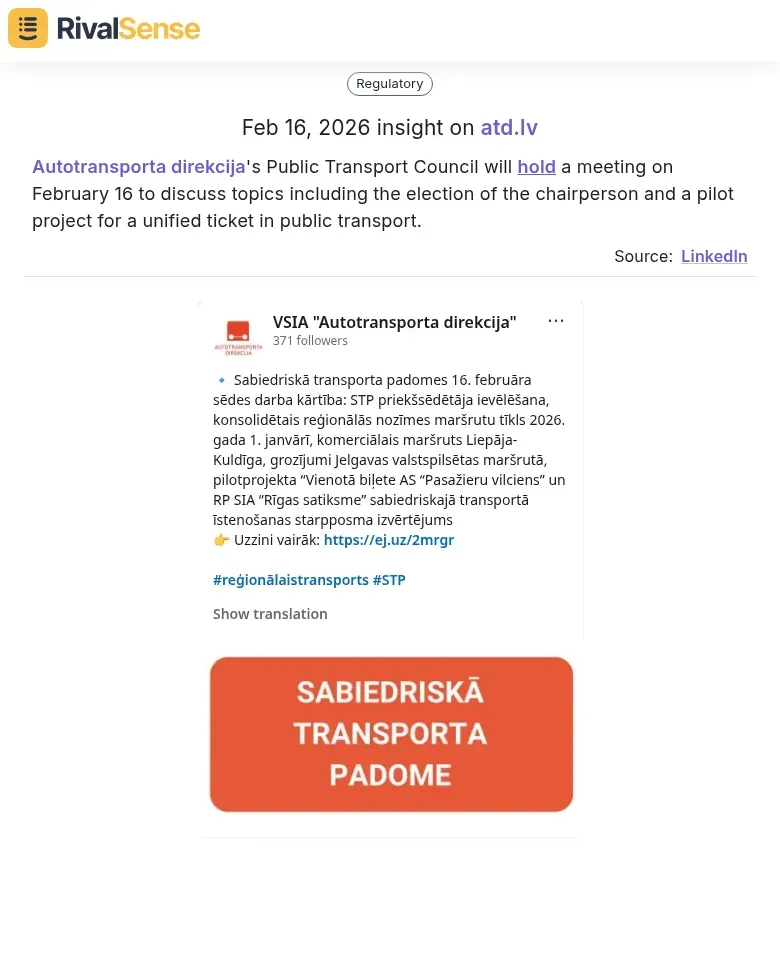 This type of insight is valuable because it provides early warning of regulatory discussions that could lead to industry-wide changes, allowing you to anticipate and prepare for new compliance requirements strategically.
Practical steps to avoid this mistake:
- Track competitor participation in regulatory bodies and industry associations
- Monitor public records of policy discussions and regulatory meetings
- Analyze how competitors are aligning internally for upcoming compliance changes
- Use regulatory challenges faced by competitors as early warning signals for industry-wide tightening
When a competitor faces regulatory scrutiny, it often signals broader compliance requirements coming to your sector. By tracking these early signals, you can prepare your compliance strategy months ahead of formal announcements, saving significant costs and avoiding last-minute scrambling. Create a simple checklist: document competitor regulatory engagements, note policy positions they advocate for, and track how they adapt internal processes to meet new requirements. This proactive approach transforms regulatory intelligence from a compliance burden into a strategic advantage.
Mistake 2: Reactive vs Proactive Regulatory Adaptation
Many companies wait for regulations to directly impact their operations before taking action, missing the opportunity to learn from competitors who prepare months in advance. This reactive approach leads to rushed implementations, higher compliance costs, and missed competitive advantages. Shifting to a proactive stance requires monitoring how competitors adjust their strategies well before deadlines.
Example: RivalSense captured that Adapundi's director Achmad Indrawan says the company is aligning internally and reviewing risk parameters to adapt to new regulations limiting borrower debt-to-income ratios to 30% starting 2026. 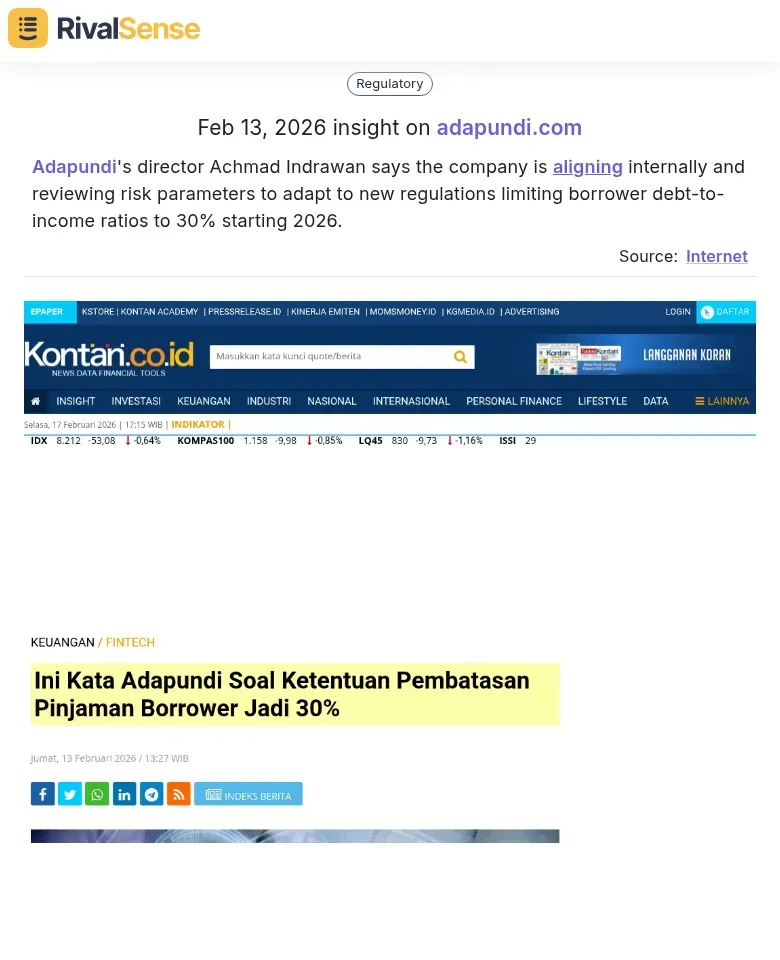 This insight is valuable because it reveals how competitors are proactively reviewing risk frameworks, giving you a benchmark to accelerate your own adaptation and avoid costly last-minute changes.
Practical Steps to Shift from Reactive to Proactive:
- Monitor Competitor Regulatory Preparation: Track how competitors adjust risk parameters, compliance frameworks, and operational processes 6-12 months before regulatory deadlines. Look for patterns in their public communications, hiring trends, and technology investments.
- Benchmark Compliance Maturity: Create a compliance maturity scorecard comparing your organization against competitors facing similar regulatory scrutiny. Assess areas like risk assessment methodologies, control frameworks, and monitoring capabilities.
- Analyze Risk Parameter Adjustments: Study how competitors modify their risk appetite, tolerance thresholds, and control effectiveness metrics in response to upcoming regulations. This reveals their interpretation of regulatory intent.
- Establish Early Warning Indicators: Set up alerts for competitor regulatory filings, compliance officer appointments, and technology partnerships that signal proactive adaptation strategies.
Checklist for Proactive Regulatory Intelligence:
- [ ] Identify 3-5 key competitors with similar regulatory exposure
- [ ] Track their compliance-related job postings and team expansions
- [ ] Monitor regulatory commentary in their earnings calls and investor presentations
- [ ] Analyze their technology stack changes for compliance tools
- [ ] Benchmark your compliance maturity against theirs quarterly
- [ ] Document competitor adaptation timelines for future regulatory changes
By learning from competitors' proactive approaches, you can transform regulatory compliance from a cost center into a competitive advantage, reducing implementation costs by 30-50% and avoiding last-minute operational disruptions.
Mistake 3: Overlooking Legal Challenges as Strategic Intelligence
When competitors face legal challenges or regulatory disputes, most companies see only compliance issues—missing the goldmine of market intelligence hidden within. These legal battles reveal where competitors are pushing boundaries, what regulatory bodies consider problematic, and which customer needs remain unmet. Extracting value from these insights can directly influence your business strategy.
Example: RivalSense tracked that Trulieve and other Florida medical marijuana companies challenge new state rules restricting advertising and promotions, alleging First Amendment violations. 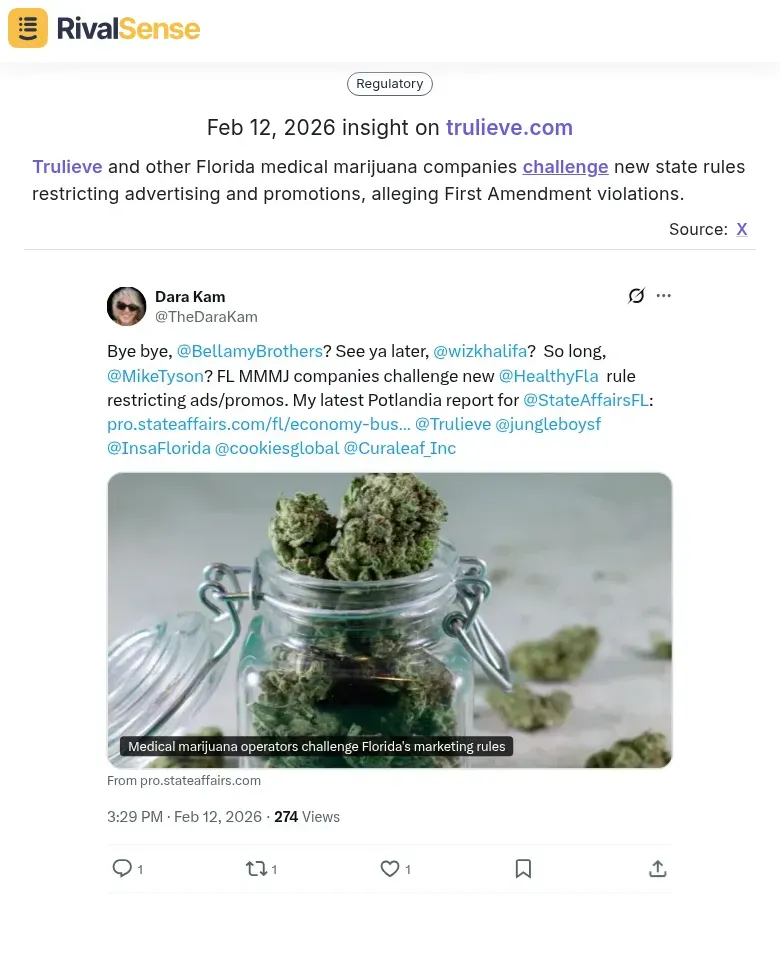 This insight is valuable because it highlights regulatory boundaries and customer concerns, allowing you to craft messaging or product features that address these gaps while staying compliant.
Practical Steps to Extract Value:
- Monitor Legal Databases & Regulatory Filings: Track competitor lawsuits, FTC complaints, and advertising challenges. When a competitor gets restricted from making certain claims, that's your opportunity to position your product with those exact benefits—legally.
- Analyze Advertising Restrictions: If a competitor can't claim "fastest" or "most secure" due to regulatory action, immediately test messaging around those attributes. Example: When a fintech competitor faced advertising restrictions around "guaranteed returns," savvy competitors emphasized "transparent performance metrics" instead.
- Map Regulatory Pushback to Customer Pain Points: Every regulatory challenge reveals what customers care about. When regulators challenge a competitor's data practices, it signals customer concerns about privacy—position your solution accordingly.
- Create a Regulatory Intelligence Dashboard: Track competitor legal challenges alongside market positioning opportunities. When Apple faced antitrust lawsuits over app store practices, competitors highlighted their more open ecosystems.
Quick Checklist:
- [ ] Monitor competitor legal filings weekly
- [ ] Document advertising restrictions and messaging gaps
- [ ] Map regulatory challenges to customer pain points
- [ ] Test positioning in restricted claim areas
- [ ] Update competitive intelligence with legal insights
Regulatory disputes aren't just legal problems—they're market signals revealing where competitors are vulnerable and what customers truly value.
Mistake 4: Siloed Regulatory Intelligence
Siloed regulatory intelligence is a costly mistake where compliance insights remain isolated from core business functions. When regulatory teams operate in a vacuum, they miss opportunities to translate competitor challenges into actionable sales wins, marketing angles, and product improvements. Breaking down these silos is essential for maximizing ROI from regulatory intelligence.
The problem is that regulatory insights about competitor struggles, such as licensing delays or compliance failures, aren't reaching sales teams who could use them to win deals. Marketing can't craft compelling "we're more compliant" messaging, and product teams miss chances to build features that address emerging regulatory gaps.
Practical Solutions:
- Create a Regulatory Intelligence Dashboard accessible to sales, marketing, and product teams
- Establish Weekly Syncs where regulatory experts share competitor compliance issues with sales leadership
- Develop a "Regulatory Risk Scorecard" for key competitors that sales can reference in client conversations
- Map Regulatory Challenges to Specific Accounts - identify which prospects are most affected by competitor compliance failures
- Integrate Regulatory Alerts into your competitive intelligence platform with automated notifications
Quick Checklist:
- [ ] Regulatory insights shared in sales team meetings
- [ ] Marketing has access to competitor compliance timelines
- [ ] Product roadmap includes regulatory advantage features
- [ ] Sales enablement materials reference competitor regulatory risks
- [ ] Cross-functional competitive intelligence reports include regulatory sections
Pro Tip: Assign a "Regulatory Intelligence Liaison" from your compliance team to work directly with sales on identifying accounts where competitor regulatory issues create immediate opportunities. This transforms abstract compliance data into concrete revenue potential.
Best Practices: Turning Regulatory Intelligence into ROI
Transform regulatory intelligence into measurable ROI with these best practices. By automating monitoring and integrating insights across functions, you can reduce risks and seize market opportunities ahead of competitors.
Automated Monitoring Systems:
- Implement AI-powered tools like RivalSense to track competitors' SEC filings, regulatory submissions, and legal disclosures automatically
- Set up threshold alerts for competitor litigation, compliance officer appointments, and restructuring announcements
- Monitor industry association participation and public comments on proposed regulations
Proactive Strategy Development:
- Create quarterly competitor compliance audits to benchmark against industry leaders
- Analyze how top performers leverage regulations for innovation opportunities
- Develop scenario planning based on competitor regulatory missteps and adaptations
- Map competitor violations to your risk matrix and update mitigation strategies quarterly
ROI Measurement Framework:
- Track compliance incident reduction rates (aim for 20-40% improvement)
- Measure innovation speed improvements from regulatory insights
- Monitor customer retention metrics linked to compliance advantages
- Calculate revenue growth from regulatory-driven market positioning
Practical Checklist:
✅ Establish automated monitoring of regulatory filings
✅ Conduct monthly competitor compliance analysis
✅ Benchmark your compliance speed against top 3 competitors
✅ Document competitor incidents and root causes quarterly
✅ Update training and procedures based on competitor insights
✅ Track ROI through compliance cost savings and revenue growth
Companies mastering this approach transform compliance from a cost center into a strategic advantage, achieving measurable ROI through reduced regulatory risks and accelerated market positioning.
Ready to avoid these mistakes and boost your ROI? Try RivalSense for free at https://rivalsense.co/ and get your first competitor report today!
📚 Read more
👉 Analyzing Harvey's Shared Spaces Launch: A Practical Competitor Insight
👉 The Ultimate Key Account Tracking Spreadsheet Template: A Practical Guide for B2B Leaders
👉 Predictive Analytics for Engineering Consulting Key Account Management: Free Trial Guide
👉 How Glean's AI Assistant Evolution Revealed Competitor Growth Opportunities
👉 Optimizing Competitor Website Monitoring for Influencer Partnership Insights