
Avoid These Media Mentions & Content Marketing Competitive Intelligence Mistakes
In today's hyper-competitive B2B landscape, media mentions and content marketing insights aren't just vanity metrics—they're critical intelligence for strategic decision-making. When you understand where competitors are being featured, what narratives they're pushing, and which content resonates with your shared audience, you gain a powerful advantage. Yet most companies approach competitor tracking with dangerous misconceptions that lead to flawed analysis. 🚨
Common mistakes include focusing only on volume metrics (how many mentions) rather than quality and context, tracking too few sources, and failing to connect media coverage to actual business outcomes. Many teams also make the error of reactive monitoring rather than proactive intelligence gathering. Intelligence failures in this area can result in missed partnership opportunities, late responses to market shifts, and competitive disadvantages that take months to recover from. When you don't see which journalists are covering your competitors or which content formats are gaining traction, you're essentially flying blind in a crowded market.
Practical tip: Create a competitor media tracking checklist that includes:
- ✅ Track both direct and indirect competitors across 10+ relevant publications
- ✅ Analyze sentiment and messaging themes, not just quantity
- ✅ Monitor content performance metrics (engagement, shares, backlinks)
- ✅ Connect media coverage to competitor product launches and funding announcements
- ✅ Set up alerts for sudden changes in competitor media presence
This post will guide you through avoiding key mistakes in media and content competitive intelligence, with actionable steps to enhance your strategy.
Mistake #1: Overlooking Emerging Talent & Partnership Opportunities
One of the most costly competitive intelligence mistakes is overlooking emerging talent and partnership opportunities revealed through competitor content. When you only track obvious metrics like product launches or pricing changes, you miss the strategic talent development and collaboration patterns that shape future market leadership. This oversight can lead to missed hiring opportunities or delayed responses to new alliances.
For instance, tracking talent programs can reveal how competitors are investing in future leaders. Consider this RivalSense insight: SiriusXM Media's #passthemic program features rising star Morgan James in her new podcast season 'Mentor Me'.
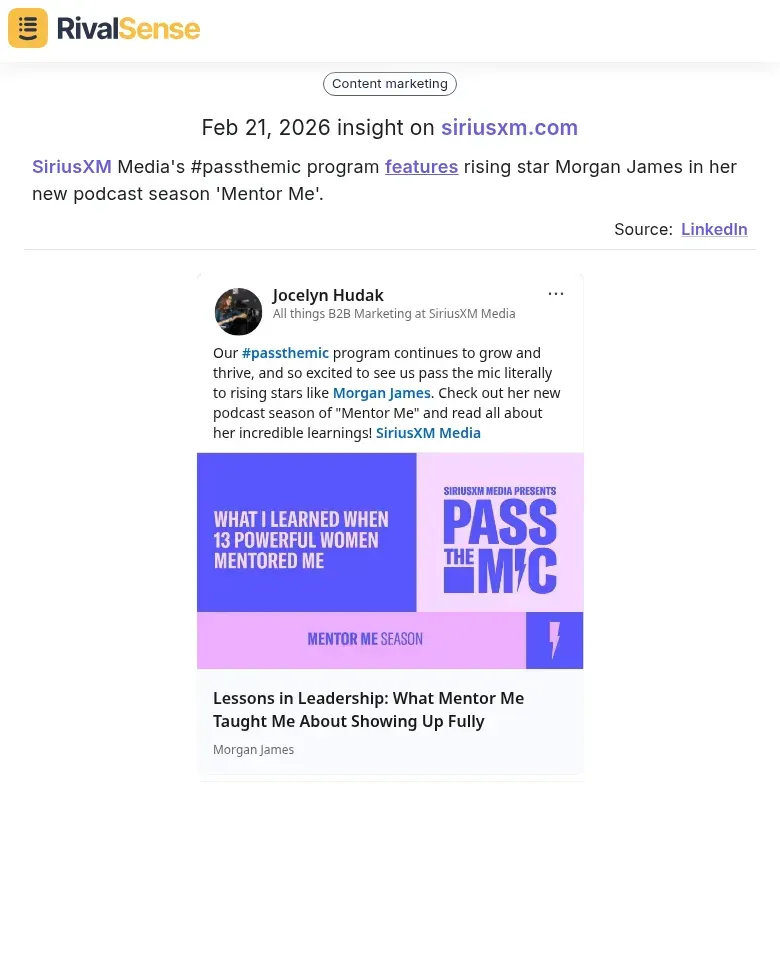
Why this insight is valuable: Monitoring such talent initiatives helps you anticipate competitor strengths in human capital and identify potential partnership or hiring opportunities before they become mainstream. It shows how competitors are building internal capabilities and engaging with emerging voices.
Practical steps to avoid this mistake:
- Monitor competitor talent programs: Track mentions of 'rising star,' 'mentorship,' or 'leadership development' programs in competitor blogs, podcasts, and webinars. These reveal how they're cultivating future leaders.
- Analyze content collaborations: When competitors co-create content with other companies, universities, or industry associations, document these partnerships. They often signal new strategic alliances before formal announcements.
- Create a talent tracking dashboard: Build a simple spreadsheet tracking competitor employees featured in media, speaking at events, or publishing thought leadership. Note their roles, expertise areas, and career progression.
- Set alerts for partnership keywords: Use tools like RivalSense to monitor mentions of 'partnership,' 'collaboration,' 'joint initiative,' or 'strategic alliance' across competitor channels.
- Benchmark talent initiatives quarterly: Compare your talent development programs against competitors' publicly-shared initiatives. Are they investing more in mentorship? Developing specialized expertise you're missing?
Remember: The talent and partnerships competitors showcase today become their competitive advantages tomorrow. By tracking these signals systematically, you can anticipate market shifts and identify opportunities before they become obvious to everyone else.
Mistake #2: Ignoring Sustainability & Corporate Responsibility Signals
Ignoring sustainability and corporate responsibility signals is a critical competitive intelligence mistake. When you neglect competitor sustainability commitments, you miss crucial market positioning insights. Corporate responsibility announcements reveal strategic priorities and target audience values, which can influence B2B purchasing decisions and brand perception.
For example, sustainability insights can highlight how competitors are aligning with global trends. Here's a RivalSense insight: BloombergNEF named Meta the top corporate buyer of clean energy in 2025.
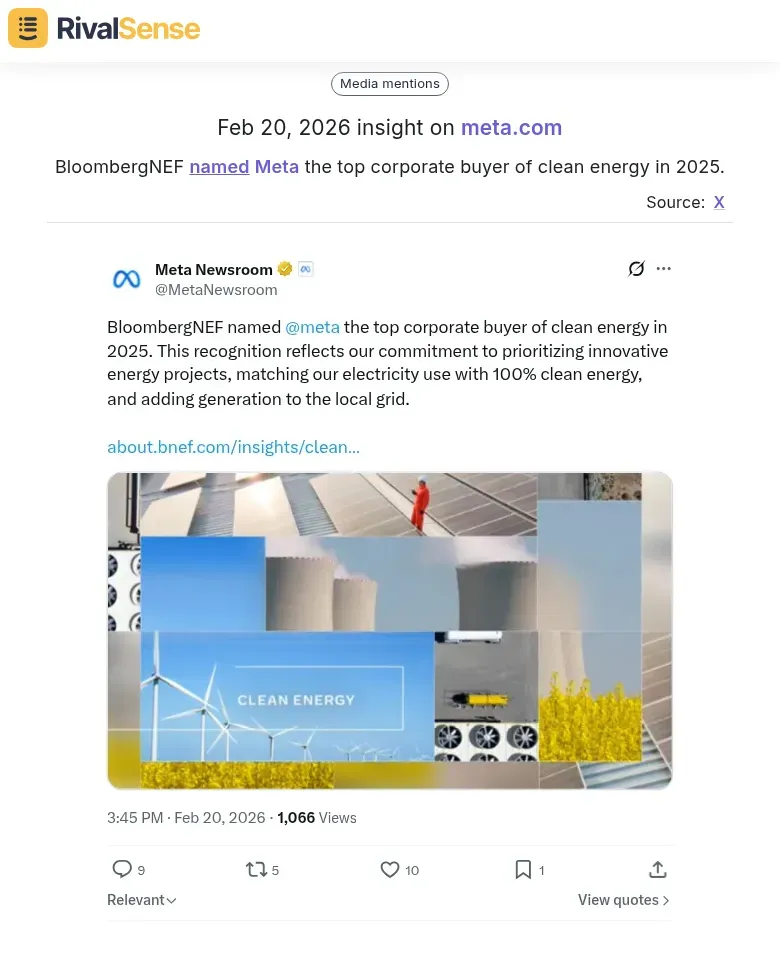
Why this insight is valuable: Tracking such sustainability achievements helps you understand competitor investments in ESG (Environmental, Social, and Governance) factors, which can affect their market reputation, customer loyalty, and regulatory compliance. It enables you to benchmark your own initiatives and identify gaps or opportunities in green positioning.
Practical checklist for tracking sustainability signals:
- ✅ Monitor ESG reports, sustainability pages, and annual responsibility statements
- ✅ Track green product launches, carbon reduction initiatives, and supply chain changes
- ✅ Analyze sustainability-related press releases and leadership statements
- ✅ Assess third-party ESG ratings and sustainability certifications
- ✅ Monitor social media for sustainability messaging and community responses
Brand perception impact analysis is essential. Research shows 73% of B2B buyers consider sustainability in purchasing decisions. Track how competitors' environmental initiatives affect their media coverage, customer reviews, and talent acquisition. Use tools like RivalSense to automate tracking of sustainability announcements across competitors' websites, news outlets, and social platforms. Compare their messaging consistency and implementation timelines to identify genuine commitments versus greenwashing. This intelligence helps you position your brand effectively and anticipate market shifts toward sustainable business practices.
Mistake #3: Underestimating Platform Positioning & Market Differentiation
Many companies track basic competitor activities but miss critical positioning insights. They overlook how competitors align with emerging trends like AI, fail to extract strategic insights from executive interviews, and don't analyze differentiation in crowded markets. This can lead to being blindsided by competitor pivots or missing opportunities to strengthen your own market position.
Platform positioning insights often come from executive statements and media interviews. For instance, consider this RivalSense insight: Reddit COO Jen Wong told Vogue Business on February 17, 2026 that Reddit is emerging as an antidote to AI and traditional social media by offering diverse perspectives from groups of people.
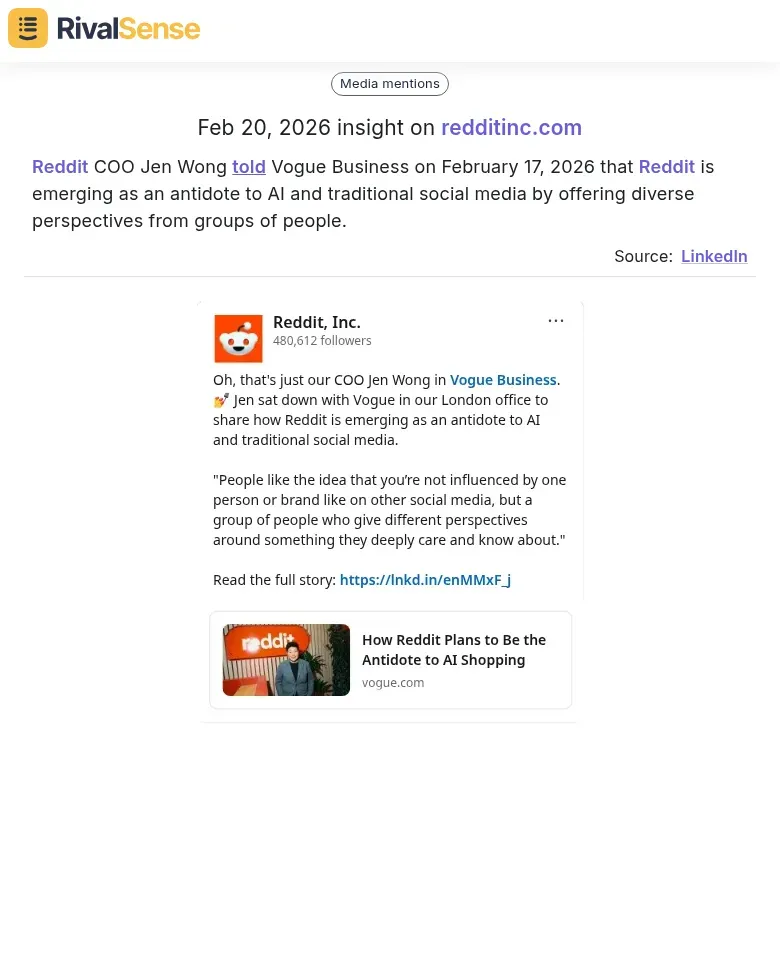
Why this insight is valuable: Analyzing such executive quotes helps you decode competitor strategies around technology trends and market differentiation. It reveals how they are positioning themselves against competitors and adapting to consumer preferences, allowing you to adjust your own messaging and innovation roadmap.
Practical Checklist:
- Track AI positioning: Monitor how competitors frame AI capabilities in marketing materials, product descriptions, and executive statements. Are they positioning as "AI-native" or "AI-enhanced"?
- Analyze executive interviews: Create a database of competitor executive quotes from podcasts, interviews, and conference talks. Look for patterns in strategic language and market vision.
- Map differentiation: Use a positioning matrix comparing features, pricing, and target segments. Identify white space where competitors aren't competing effectively.
- Monitor market signals: Track competitor hiring trends (especially AI/ML roles), patent filings, and partnership announcements for early positioning clues.
Key Insight: Competitors often reveal their strategic direction through subtle positioning language before making major announcements. By analyzing how they differentiate themselves against market trends, you can anticipate their next moves and identify opportunities to strengthen your own market position.
Mistake #4: Surface-Level Analysis Without Strategic Context
Surface-level analysis is the silent killer of competitive intelligence. Many teams track mentions and content output but fail to connect them to strategic context. This mistake leads to fragmented insights that don't inform business decisions, wasting resources and leaving you vulnerable to competitor moves.
For example, a competitor's sudden media blitz about AI integration isn't just PR noise—it signals a strategic pivot toward automation that could impact your market positioning. Without deeper analysis, you might miss the underlying business goals, such as market expansion or funding preparation.
Practical steps to avoid this mistake:
- Map mentions to business objectives: When tracking competitor media, ask: What business goal does this serve? (e.g., Market expansion, funding announcement, talent acquisition)
- Connect content to strategy: Analyze their content themes over time. Are they shifting from product features to thought leadership? This indicates a move up the value chain.
- Decode the narrative: Look beyond individual announcements. A series of executive interviews + technical whitepapers + partnership announcements often reveals a coordinated market entry strategy.
Quick checklist:
- [ ] Identify the strategic goal behind each major mention
- [ ] Track content theme evolution quarterly
- [ ] Note timing patterns (e.g., around funding rounds or product launches)
- [ ] Cross-reference with hiring trends and partnership announcements
Remember: Every media mention is a piece of a larger strategic puzzle. Without connecting these dots, you're collecting data points instead of building intelligence. Integrate analysis into a broader framework to drive actionable insights.
Conclusion: Building a Comprehensive Competitive Intelligence Framework
Building a comprehensive competitive intelligence framework requires integrating media mentions with broader systems. Start by centralizing all intelligence sources—media coverage, competitor content, market data—into a single platform. This creates a unified intelligence hub that ensures consistency and efficiency in analysis.
Develop systematic processes to extract strategic insights: 1) Categorize competitor content by themes and messaging patterns, 2) Track media sentiment trends over time, 3) Identify gaps between competitor claims and market reality. Use AI-powered analysis to connect patterns across sources, enabling proactive decision-making.
Create actionable intelligence by translating insights into specific business actions: weekly competitive briefings for leadership, real-time sales battlecards, quarterly market opportunity reports. Establish feedback loops where teams report how intelligence influenced decisions, then refine collection priorities accordingly.
Practical checklist:
- ✅ Set up automated monitoring for top 5 competitors
- ✅ Create standardized analysis templates
- ✅ Schedule monthly intelligence review meetings
- ✅ Develop role-specific intelligence dashboards
- ✅ Measure impact through win-rate improvements and strategic decision quality
This framework turns scattered data into strategic advantage, ensuring every media mention informs smarter business moves. To assist with these challenges, consider leveraging tools that streamline competitor tracking.
Try RivalSense for Free
Ready to enhance your competitive intelligence? Try out RivalSense for free to track competitor product launches, pricing updates, event participations, partnerships, regulatory aspects, management changes, and media mentions across company websites, social media, and various registries—all delivered in a weekly email report. Get your first competitor report today and start making data-driven decisions! 🚀
📚 Read more
👉 How to Analyze Competitor Events: A Telenor MWC 2026 Case Study
👉 How to Analyze Competitor Websites in 2026: A Practical Guide with Actionable Steps
👉 Industrial Machinery Maintenance: Benchmarking Key Account Advocacy Tracking
👉 From Threat to Opportunity: How Competitor Intelligence on Shure's MXA320 Enabled a Strategic Pivot
👉 Uncover Competitor Influencer Partnerships on Instagram for Strategic Business Advantage