
Advanced Tactics: Monitor Key Account Growth for Commercial Insurance Brokers
For commercial insurance brokers, proactive key account growth monitoring isn't just a best practice—it's a strategic imperative that separates market leaders from reactive competitors. While most brokers focus on policy renewals, forward-thinking firms track client expansion signals: new locations, hiring surges, revenue milestones, and industry awards that indicate growing insurance needs. This intelligence transforms client relationships from transactional policy management to strategic partnerships where you anticipate needs before clients realize them.
Consider this direct correlation: brokers who systematically monitor account growth achieve 30-40% higher retention rates and 2-3x more cross-selling opportunities. When you identify a client opening a new manufacturing facility before their renewal date, you can proactively offer expanded coverage rather than reacting to their request. This positions you as a strategic advisor, not just a policy provider.
Practical steps to implement:
- [ ] Create a quarterly growth checklist for top 20% accounts
- [ ] Monitor business registrations, hiring announcements, and expansion news
- [ ] Set alerts for client industry developments and regulatory changes
- [ ] Schedule strategic reviews 60 days before renewals with growth insights
- [ ] Document expansion opportunities in your CRM with action timelines
Advanced monitoring transforms reactive service into proactive partnership, creating defensible competitive advantages in the commercial insurance landscape.
Defining Key Growth Metrics for Commercial Insurance Accounts
For commercial insurance brokers, tracking key account growth requires moving beyond basic revenue metrics to monitor three critical indicators. These indicators include premium expansion, policy diversification, and risk management evolution, which collectively provide a comprehensive view of client development and strategic alignment.
Establish clear benchmarks: aim for 85%+ retention rates for enterprise accounts, 75%+ for mid-market, and 65%+ for small business clients. Track cross-selling success by monitoring the percentage of clients with 3+ policy types and the average revenue increase from additional coverages.
Differentiate growth signals by client segment:
- Small business: Focus on policy count growth (adding 1-2 additional coverages annually)
- Mid-market: Monitor premium per employee and risk management advisory hours
- Enterprise: Track global policy coordination and captive insurance utilization
Practical Checklist for Growth Metrics:
- [ ] Calculate premium expansion rate quarterly
- [ ] Map each client's policy portfolio diversity
- [ ] Document risk management advisory touchpoints
- [ ] Segment retention metrics by client size tier
- [ ] Track cross-sell conversion rates by product line
💡 Tip: Use competitor tracking tools to benchmark your growth metrics against industry leaders and identify gaps in your account development strategies.
Competitor Intelligence: Monitoring Rival Account Growth Strategies
Monitoring competitor account growth strategies is essential for staying ahead in the commercial insurance market. By understanding how rivals acquire and expand client relationships, you can identify gaps in your own approach and anticipate market shifts effectively.
1. Track Client Acquisition Patterns:
- Monitor which industries competitors are targeting (e.g., manufacturing, healthcare, tech)
- Analyze their geographic expansion patterns and new office openings
- Track their marketing campaigns and lead generation channels
- Use tools like RivalSense to monitor competitor website updates and job postings
Example from RivalSense: Mixam now offers direct international shipping through a dropdown menu in the order details tab, expanding from previous US-only shipping with manual quote requests. 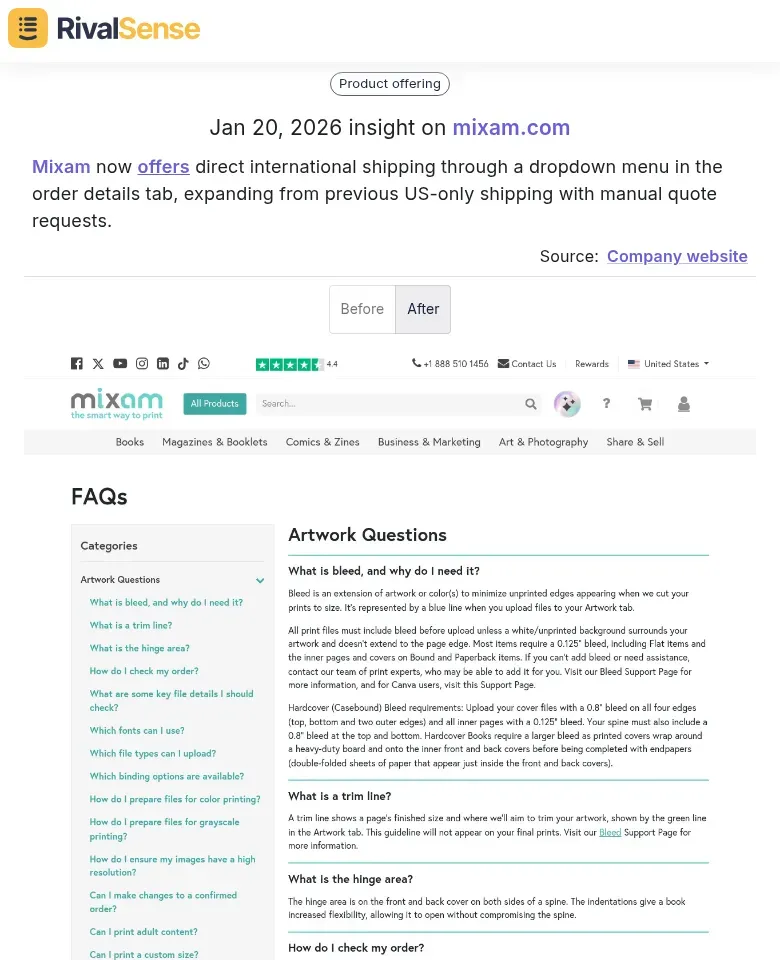 Monitoring such product updates is valuable because it reveals competitor expansions into new markets, allowing you to adjust your offerings proactively.
2. Analyze Cross-Selling & Premium Optimization:
- Identify which coverage lines competitors bundle (e.g., property + cyber + D&O)
- Monitor their premium optimization strategies for different client sizes
- Track their value-added services (risk assessments, claims advocacy)
- Analyze their renewal retention rates and client expansion patterns
3. Monitor Technology & Service Innovations:
- Track AI adoption for risk assessment and policy recommendations
- Monitor digital client portals and mobile app enhancements
- Identify new service offerings (ESG consulting, supply chain risk)
- Watch for partnerships with insurtech platforms
4. Keep an Eye on Management Changes and Events:
- Monitor LinkedIn for competitor team expansions and key hires
- Track industry events and participations to gauge marketing efforts
Example from RivalSense: Ariana Tiwari joins Salesforce as Director of Product Marketing in the United States, previously Director of Product Marketing at PandaDoc.  Tracking management changes like this can indicate strategic shifts and talent acquisitions, helping you understand competitor priorities and potential service enhancements.
Example from RivalSense: Guesty announced that its GuestyVal event returns in Madrid from September 16-18, with ticket sales starting February 16.  Monitoring event announcements helps you anticipate competitor marketing cycles and industry engagement, enabling you to plan your own outreach and event strategies accordingly.
Quick Checklist for Competitor Monitoring:
- [ ] Set up competitor alerts for website changes
- [ ] Monitor LinkedIn for competitor team expansions
- [ ] Track industry awards and recognition
- [ ] Analyze client testimonials and case studies
- [ ] Review competitor whitepapers and thought leadership
🚀 Pro Tip: Focus on mid-market commercial clients (50-500 employees) where growth opportunities are most concentrated. Competitors often reveal expansion strategies through their hiring patterns and service announcements.
Advanced Tools and Technologies for Growth Monitoring
Modern commercial insurance brokers need specialized platforms for growth tracking and predictive analytics. These tools help analyze historical data and forecast account expansion, enabling proactive strategies and informed decision-making.
Specialized Platforms for Growth Tracking & Predictive Analytics
Platforms like Broker Insights Vision, Riskonnect, and advanced AMS systems offer AI-driven scoring to prioritize high-potential accounts. Practical tip: Look for platforms with predictive analytics based on industry trends, client financial health, and coverage gaps.
Integration Strategies for Competitive Intelligence
Connect your policy management systems (like Vertafore or Applied Epic) with competitive intelligence tools through API integrations. This creates a unified dashboard showing both your portfolio data and competitor movements. Checklist:
- [ ] Map your current tech stack
- [ ] Identify API capabilities of each system
- [ ] Use middleware like Zapier for non-native integrations
- [ ] Test data flow before full implementation
Automated Alert Systems for Market Opportunities
Set up automated alerts for competitor movements and market shifts. Configure notifications for when competitors launch new commercial products, adjust pricing strategies, or enter new industry verticals. Actionable steps:
- [ ] Create alert triggers for competitor website changes
- [ ] Monitor social media announcements about commercial insurance offerings
- [ ] Track regulatory filings indicating new market entries
- [ ] Follow industry news about emerging risks requiring specialized coverage
Proactive Growth Intervention Strategies
Proactive growth intervention strategies transform reactive account management into strategic growth engines. By analyzing client growth patterns, you can identify expansion triggers—such as new locations or revenue milestones—and engage clients pre-emptively to secure loyalty and additional business.
Develop customized expansion roadmaps for high-potential accounts:
- Map current coverage gaps against business growth projections
- Schedule risk assessment reviews before major expansions
- Create bundled solutions for multi-location clients
- Establish premium increase targets tied to client revenue growth
Use tools like RivalSense to benchmark against competitor retention rates and cross-selling success, ensuring your strategies are competitive.
Implement competitive counter-strategies when rivals target your key accounts: Monitor competitor hiring patterns in your geographic markets, track their rate filings for new commercial products, and set alerts for competitor client wins in your industry verticals. Create defensive playbooks with value-added services, personalized coverage reviews, and loyalty incentives before renewal periods. 📅 Practical tip: Analyze competitor communication frequency patterns to time your strategic outreach 2-3 weeks ahead of their typical engagement cycles.
Data-Driven Decision Making and Continuous Improvement
Transform growth monitoring data into strategic insights by analyzing patterns in key account expansion. Establishing feedback loops and integrating monitoring alerts with your CRM ensures timely interventions and continuous refinement of your approach.
Measure ROI by tracking key metrics:
- Time saved on manual research vs. automated monitoring
- Revenue increase from proactive interventions
- Client retention rates of monitored vs. unmonitored accounts
Optimize methodologies by A/B testing different monitoring frequencies and data sources monthly. Use a simple checklist to maintain momentum:
Simple Checklist for Continuous Improvement:
- [ ] Review top 5 growing accounts weekly
- [ ] Update tracking parameters quarterly
- [ ] Calculate monitoring ROI bi-annually
- [ ] Share insights across teams in monthly workshops
Leverage Competitive Intelligence with RivalSense
To effectively implement the tactics discussed, consider using a specialized tool like RivalSense. It tracks competitor product launches, pricing updates, event participations, partnerships, regulatory aspects, management changes, and media mentions across company websites, social media, and various registries, delivering all in a weekly email report.
By leveraging RivalSense, you can automate the monitoring of competitor movements and gain actionable insights to inform your growth strategies. The examples highlighted—such as Mixam's shipping update, Ariana Tiwari's appointment, and Guesty's event—demonstrate how tracking such changes can provide strategic advantages in anticipating market shifts and refining your approach.
Ready to enhance your competitor monitoring? Try RivalSense for free at https://rivalsense.co/ and get your first competitor report today to start transforming your account growth strategies.
📚 Read more
👉 How Salesforce's Hoa Sen Partnership Enabled Competitors to Target CRM Gaps
👉 Best Practices: Extract Competitor Insights from Website Changes for Key Account Success
👉 Competitive Edge in Professional Services: A Practical Guide to Monitoring Regulatory Filings
👉 Boost Key Account Win Rates with Competitor Product Intelligence
👉 Turning Competitor Management Changes into Strategic Advantages: A Real-World Example