
Actionable Internet Hacks for Competitive Positioning Insights
In today's hyper-competitive landscape, your competitors' digital footprints—social media posts, job listings, website updates, and press mentions—often reveal strategic moves months before official announcements. This internet intelligence transforms publicly available information into actionable positioning insights, giving you a critical edge over traditional market research that's often outdated by the time it reaches decision-makers.
Practical steps to leverage this advantage:
- Monitor competitor job boards for new roles in emerging technologies or markets
- Track social media for product hints, partnership announcements, or geographic expansion clues
- Set up Google Alerts for competitor names and key executives
- Analyze website changes using tools like Wayback Machine to spot strategic pivots
- Follow industry forums and review sites for customer sentiment shifts
By systematically gathering these real-time signals, you can anticipate competitor moves, identify market gaps, and position your offerings more effectively—turning internet noise into strategic foresight.
Hack #1: Tracking M&A Activity for Market Expansion Signals 📈
Mergers and acquisitions reveal strategic intent before public announcements. By monitoring these activities, you can anticipate market expansion and competitive threats early. When competitors acquire companies in specific regions, they're signaling geographic expansion plans. For example, if a SaaS competitor acquires a European localization firm, they're likely preparing for EU market entry.
Practical Steps:
- Monitor Deal Databases: Use Crunchbase, PitchBook, or Capital IQ to track competitor acquisitions
- Analyze Geographic Patterns: Map acquisitions by region to identify expansion corridors
- Check Integration Signals: Watch for job postings, office openings, and localized marketing in acquired regions
- Time Your Response: If competitors consolidate in a region, consider accelerating your own expansion or forming local partnerships
Quick Checklist:
- [ ] Set up alerts for competitor M&A announcements
- [ ] Analyze acquisition targets' geographic footprint
- [ ] Track post-acquisition hiring in new regions
- [ ] Monitor localized product launches following acquisitions
Pro Tip: Look beyond the headline deal size. Small acquisitions in strategic locations often signal bigger expansion plans than large domestic deals. When you see competitors acquiring companies in emerging markets, it's time to evaluate your own regional strategy before market entry barriers increase.
RivalSense Insight Example:

ERGO Group, a primary insurance arm of Munich Re, completed its acquisition of ADB Gjensidige, the former Lithuanian subsidiary of Norwegian insurer Gjensidige, including branches in Estonia and Latvia. This insight is valuable for business strategy as it signals ERGO's expansion into the Baltic region, allowing competitors to reassess their market positioning and potential partnerships in that area.
Hack #2: Monitoring Business Model Innovations for Niche Domination 💡
Business model innovations often target niche markets for domination. Observing how competitors adapt their offerings can reveal underserved segments and new opportunities. Spotting underserved market segments requires analyzing competitors' specialized service offerings. Look for companies offering premium tiers, industry-specific solutions, or services addressing previously unmet needs. For example, a SaaS company adding HIPAA-compliant features targets the healthcare niche.
To learn how companies create competitive moats, examine their unique value propositions. Track how they bundle services, offer exclusive features, or create switching costs.
Practical Checklist:
- [ ] Analyze pricing page changes monthly
- [ ] Monitor feature announcements for exclusivity claims
- [ ] Track customer testimonials highlighting unique benefits
Identify global expansion patterns by watching successful niche players. Companies that dominate a local market often replicate their model internationally.
Steps to Follow:
- Map their geographic expansion timeline
- Note adaptations for different markets
- Track partnerships with local players
For instance, a European fintech expanding to Asia might partner with regional banks.
Practical Tip: Use social listening tools to monitor discussions about competitors' new offerings in niche communities. This reveals unmet needs and expansion opportunities before they become mainstream.
RivalSense Insight Example:
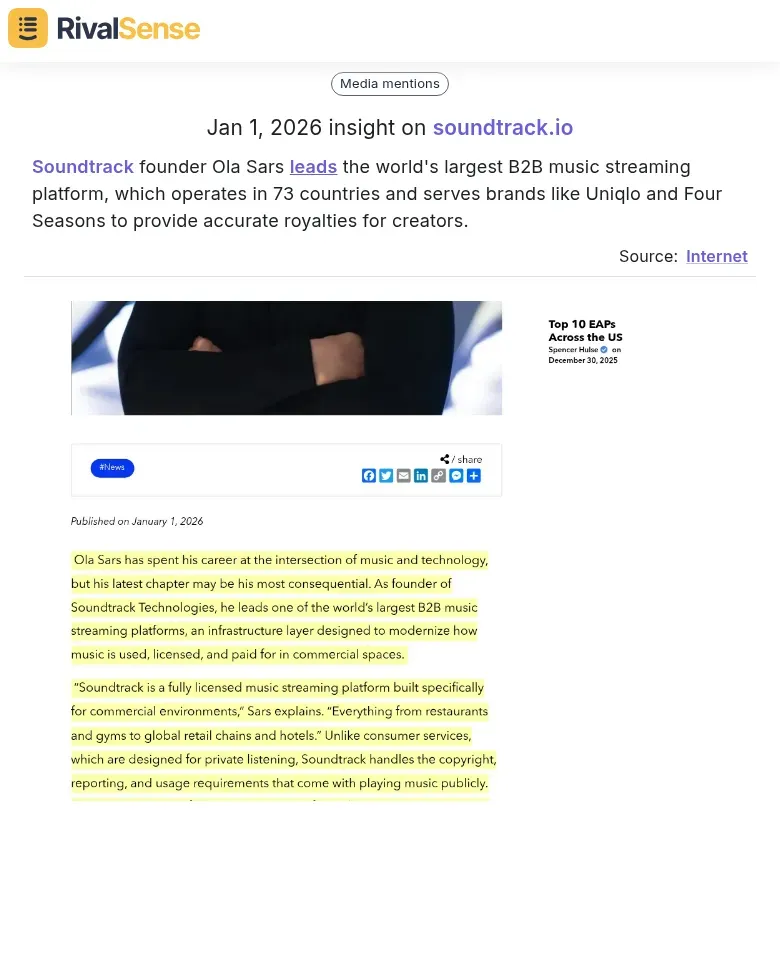
Soundtrack founder Ola Sars leads the world's largest B2B music streaming platform, which operates in 73 countries and serves brands like Uniqlo and Four Seasons to provide accurate royalties for creators. This insight is valuable as it demonstrates how a company can dominate a niche by catering to specific B2B needs, offering lessons in scalability and service differentiation for your own business model innovations.
Hack #3: Analyzing Route and Service Expansions for Strategic Positioning 🛫
Route and service expansions are clear signals of strategic positioning. They often leverage cultural and economic ties to enter new markets effectively. When competitors launch new routes or services, they're revealing their market entry playbook. Track these expansions to decode their strategic priorities. For example, when a logistics company adds a direct route between Vietnam and Germany, they're signaling confidence in the manufacturing-to-Europe corridor.
Practical Steps:
- Monitor competitor press releases and regulatory filings for new route announcements
- Map expansions against cultural/economic connections (e.g., diaspora communities, trade agreements)
- Identify underserved corridors where multiple competitors are expanding simultaneously
- Analyze timing patterns - are expansions seasonal or tied to economic cycles?
Key Insight: Companies often leverage existing cultural ties when entering new markets. A fintech expanding from India to the UAE is likely targeting the large Indian expat community first. This reveals their market entry strategy - start with familiar customer segments before broader expansion.
Checklist for Action:
- [ ] Create a route/service expansion tracking dashboard
- [ ] Note which competitors are first-movers vs. fast-followers
- [ ] Calculate expansion frequency and success rates
- [ ] Identify emerging corridors before they become saturated
Pro Tip: The most valuable insights come from analyzing failed expansions - they reveal market realities competitors discovered too late.
RivalSense Insight Example:
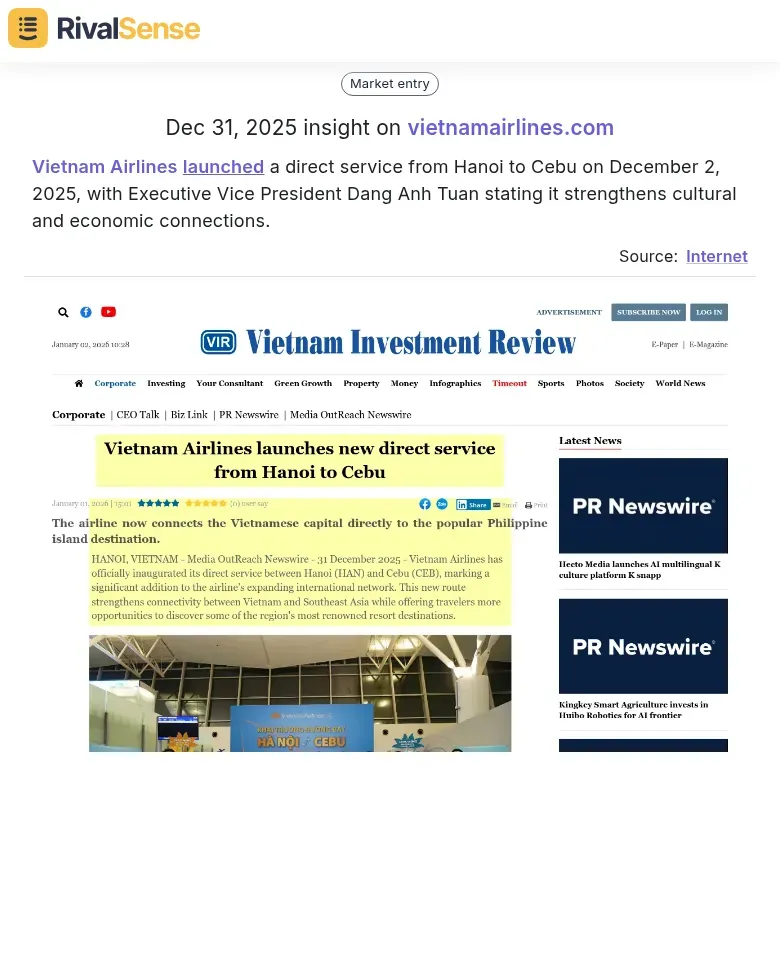
Vietnam Airlines launched a direct service from Hanoi to Cebu on December 2, 2025, with Executive Vice President Dang Anh Tuan stating it strengthens cultural and economic connections. This type of insight is valuable for business strategy as it highlights how competitors use route expansions to tap into cultural and economic synergies, providing clues for your own geographic targeting and partnership opportunities.
Hack #4: Leveraging Digital Tools for Automated Competitive Intelligence 🔧
Manual tracking of competitors is time-consuming and prone to errors. Automated digital tools streamline competitive intelligence, providing real-time insights and patterns. Stop manually tracking competitors and automate your competitive intelligence with these practical tools.
Here's your actionable checklist:
1. Automated Alerts Setup
- Use Google Alerts for competitor news mentions (free)
- Set up RSS feeds for press releases on their newsroom pages
- Monitor SEC filings for public companies via EDGAR alerts
- Pro tip: Create separate alerts for each competitor and their key executives
2. Social Listening Implementation
- Tools like Brandwatch or Mention track sentiment across platforms
- Monitor hashtags, mentions, and industry conversations
- Track customer complaints vs. praise ratios for positioning insights
- Example: If Competitor X gets sudden negative sentiment on Twitter, investigate their recent product changes
3. Website & SEO Monitoring
- Use SEMrush or Ahrefs to track competitor keyword rankings weekly
- Monitor their site structure changes with Screaming Frog
- Set up alerts for new job postings (indicates expansion areas)
- Practical step: Create a spreadsheet tracking their top 20 keywords monthly
Key Insight: Automated tools don't just save time—they reveal patterns manual tracking misses. When Competitor Y suddenly shifts SEO focus from "enterprise software" to "SaaS solutions," that's a strategic repositioning signal worth investigating immediately.
Conclusion: Building Your Competitive Positioning Action Plan
Now that you've mastered these internet hacks, it's time to build a systematic competitive positioning action plan. Start by creating a structured intelligence gathering system: designate team members responsible for monitoring specific competitors, set up automated alerts for key triggers (pricing changes, feature launches, press mentions), and schedule weekly review sessions to analyze findings.
Translate insights into actionable strategies using a simple framework: identify competitor weaknesses you can exploit, spot market gaps they're missing, and benchmark your unique value propositions against theirs. Create a positioning matrix that maps your strengths against their vulnerabilities.
Establish continuous monitoring by implementing a three-tier system: daily automated tracking, weekly manual deep dives into competitor content and customer feedback, and monthly strategic reviews to assess market shifts. Set up key performance indicators to measure your positioning effectiveness.
Action Checklist:
- [ ] Assign competitive intelligence roles
- [ ] Set up automated monitoring systems
- [ ] Create competitor profile templates
- [ ] Schedule regular review meetings
- [ ] Develop positioning response protocols
- [ ] Track positioning KPIs monthly
Remember: Competitive positioning isn't a one-time exercise. The most successful companies build this into their operational DNA, turning market intelligence into sustainable competitive advantage through consistent execution and adaptation.
To implement these hacks efficiently, consider using RivalSense. It tracks competitor product launches, pricing updates, event participations, partnerships, regulatory aspects, management changes, and media mentions across company websites, social media, the internet, and various registries, delivering all in a weekly email report. Try RivalSense for free at https://rivalsense.co/ and get your first competitor report today.
📚 Read more
👉 Airline Competitive Intelligence Checklist: Track Rivals Like AirAsia 🛫
👉 How to Analyze Competitor Partnerships and Client Relationships for Strategic Insights
👉 Decoding Competitor Moves: A Real-World Analysis of Better Stack's Updates
👉 The Ultimate Guide to Competitive Pricing Analysis: Unlocking Benefits and Implementation for 2026
👉 Key Account Health Dashboard Case Study: Influencer Platform Success