
Actionable Audio Tech Key Account Strategies for Competitive Edge
In the high-stakes audio technology sector, the Pareto Principle isn’t just a theory—it’s a daily reality. Approximately 20% of your B2B accounts, typically major studios, broadcast networks, and enterprise integrators, generate 80% of your revenue. This concentration makes key account management not just beneficial, but critical for survival and growth. The competitive landscape is fierce, with players constantly vying for these lucrative partnerships. To succeed, you must move beyond transactional sales of hardware or software licenses. The future lies in cultivating strategic, embedded relationships where you become a trusted advisor on your client’s audio workflow, from production to distribution.
Practical Steps to Begin:
- Identify Your Vital 20%: Analyze your revenue data to pinpoint which clients contribute the most. Don’t just look at past sales; assess their strategic value and growth potential.
- Conduct a Competitor Audit: Use a tool like RivalSense to map the market. Who are your top competitors serving these key accounts? What solutions do they offer, and what gaps can you fill? Understanding their positioning reveals your unique entry points.
- Shift Your Mindset & Metrics: Transition your team’s focus from quarterly sales targets to long-term relationship health. Develop key account plans that address the client’s broader business challenges, not just their immediate tech needs. This evolution from vendor to strategic partner is the ultimate competitive edge in audio tech.
Building Trust Through Industry Recognition and Training Excellence
In the competitive audio tech landscape, building trust with key accounts requires more than just product specs. It demands demonstrated industry credibility through recognized certifications and awards. Credentials like quality seals and training excellence awards serve as powerful third-party validation, instantly elevating your brand’s perceived reliability in sales conversations.
For instance, tracking competitor recognitions can reveal their commitment to quality and training, helping you position your own offerings. Consider this real-world insight from RivalSense:
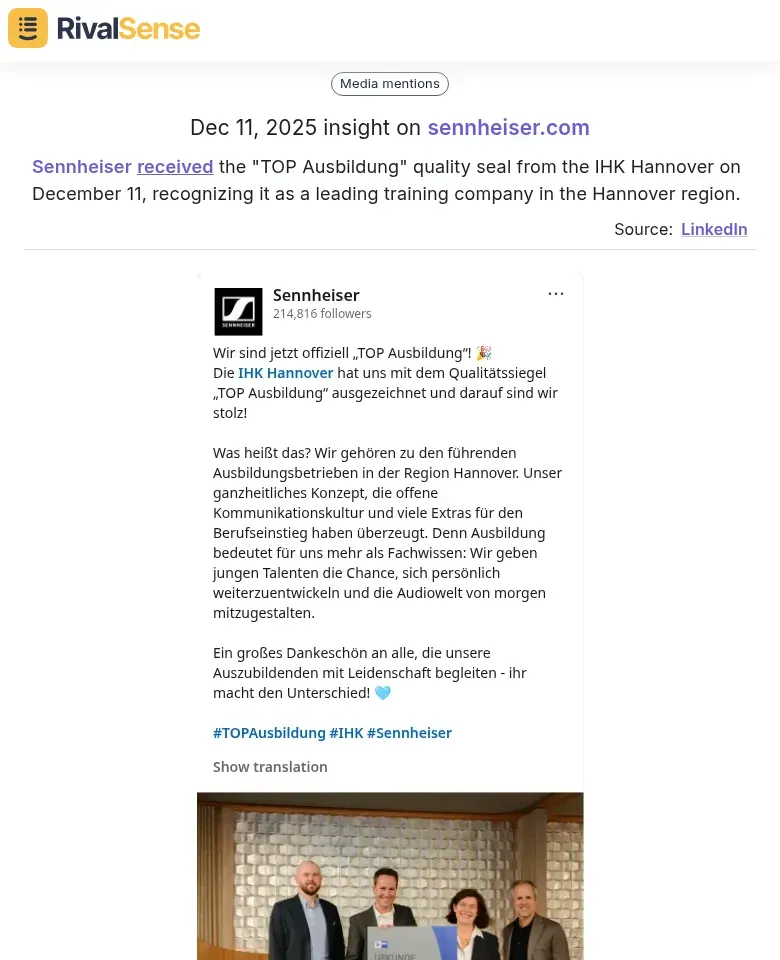
Sennheiser received the "TOP Ausbildung" quality seal from the IHK Hannover on December 11, recognizing it as a leading training company in the Hannover region. Monitoring such industry recognitions is valuable for business strategy as it highlights competitors' investments in credibility, allowing you to benchmark and enhance your own certification efforts.
Practical Steps:
- Audit existing certifications and identify gaps relevant to your target accounts.
- Create a certification roadmap with clear timelines and responsibilities.
- Develop case studies highlighting how credentials helped win enterprise deals.
- Train sales teams to articulate certification benefits in client meetings.
- Display awards prominently in proposals and marketing materials.
Use these credentials as competitive differentiators by quantifying their impact—show how ISO certification reduces product failure rates, or how your training program improves client team efficiency. This transforms abstract credentials into tangible business value that resonates with enterprise decision-makers.
Strategic Partnership Events: Co-Creating Value with Key Accounts
Strategic partnership events transform key account relationships from transactional to collaborative. By co-hosting events with complementary technology partners, you demonstrate integrated solutions that solve real client challenges. These events position your company as an ecosystem leader while creating tangible value for key accounts.
Monitoring competitor partnership events can reveal collaborative strategies and ecosystem expansions. For example, RivalSense captured this insight:

Sennheiser partnered with Lightware Visual Engineering to host an event in Jakarta on November 5th, where participants explored Lightware's Taurus UCX technology. Tracking such partnership events is valuable for business strategy as it uncovers potential alliance opportunities and competitive threats in key markets.
Practical Steps for Success:
- Identify Complementary Partners: Map your technology ecosystem to find partners whose solutions naturally integrate with yours.
- Define Joint Value Proposition: Create clear messaging about how the combined solution addresses specific client pain points.
- Design Hands-On Demos: Build interactive experiences where clients can test the integrated solution in realistic scenarios.
- Invite Strategic Accounts: Target decision-makers from key accounts who would benefit most from the partnership.
- Facilitate Ecosystem Connections: Create networking opportunities that strengthen relationships across the partner ecosystem.
Pro Tips:
- Focus on 2-3 high-impact use cases rather than trying to showcase everything.
- Include client success stories that demonstrate measurable ROI.
- Follow up with personalized implementation roadmaps for interested accounts.
- Measure success through qualified leads, partnership opportunities, and strengthened account relationships.
Industry Presence and Trade Show Intelligence
Mastering trade show presence is essential for audio tech companies. Strategic booth placement and intelligent competitor analysis can significantly impact your visibility and lead generation. Industry gatherings are prime opportunities for key account relationship building and competitive intelligence.
Keeping an eye on competitor trade show invitations helps you gauge their marketing priorities. Here’s an example from RivalSense:
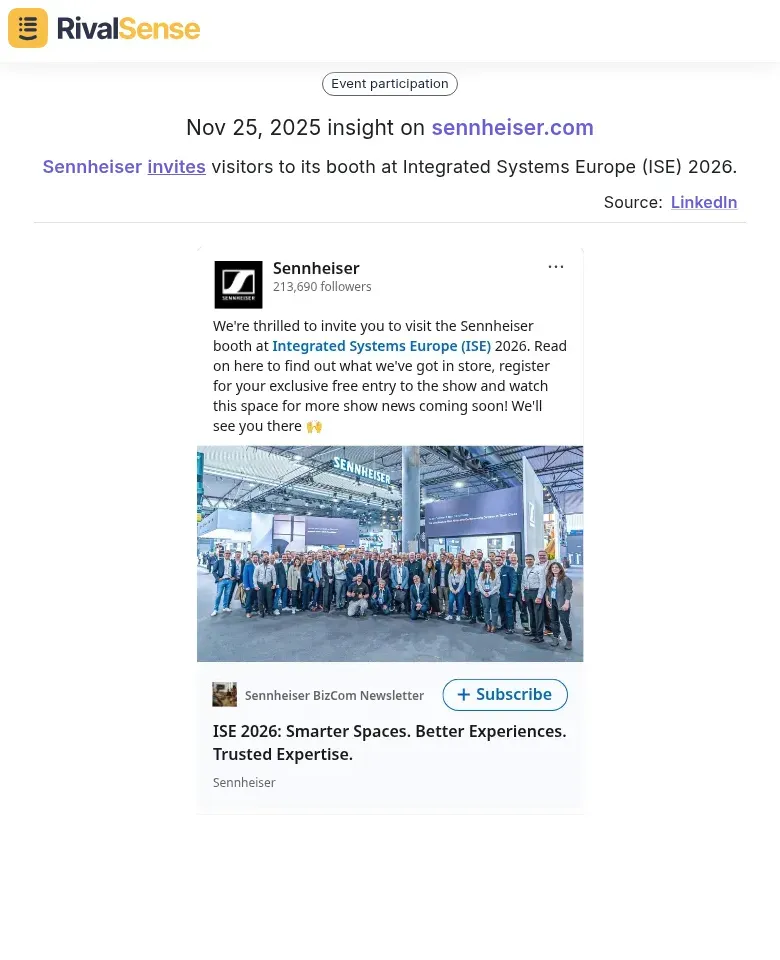
Analyze competitor trade show strategies systematically:
- Pre-event research: Review their booth sizes, locations, and themes from previous years.
- On-site observation: Document their product demos, staffing levels, and attendee engagement.
- Post-event analysis: Compare lead generation tactics and follow-up strategies.
Use industry gatherings for key account relationship building:
- Schedule private demos with target accounts during off-peak hours.
- Host exclusive evening events for top prospects away from the show floor.
- Deploy team members to competitor booths to gather intelligence on new features and pricing.
Practical checklist:
- [ ] Map competitor booth locations and traffic patterns.
- [ ] Document competitor messaging and product positioning.
- [ ] Identify gaps in competitor offerings for targeted conversations.
- [ ] Capture photos/videos of competitor setups for team debrief.
- [ ] Schedule post-show analysis meeting within one week.
Competitive Intelligence-Driven Account Planning
Competitive intelligence transforms account planning from reactive to proactive. By systematically tracking competitor movements, you can anticipate market shifts and tailor your strategies accordingly. Start by monitoring competitor partnerships and certifications—these signal market expansion priorities and reveal underserved segments.
For example, if a rival secures Dolby Atmos certification, they’re likely targeting premium audio production studios. Create a tracking checklist:
- Set up alerts for competitor partnership announcements.
- Map certifications to specific customer segments.
- Identify gaps where your capabilities can fill market needs.
Analyze competitor event strategies to uncover opportunities. Track which trade shows they attend, what demos they showcase, and which customer personas they target. If competitors focus on large enterprise booths at NAMM but skip regional audio engineering meetups, you’ve identified a mid-market opportunity.
Practical tip: Review competitor booth locations and session topics from the past year to predict their future focus areas. Use trade show intelligence to refine targeting and messaging before major events like AES or InfoComm.
Implementation steps:
- Pre-event: Research competitor exhibitor lists and session topics.
- During event: Document their demo themes and attendee engagement.
- Post-event: Update account plans with specific competitive differentiators for each key account.
Implementation Framework: Turning Insights into Actionable Strategies
To transform competitive insights into actionable strategies, implement this three-part framework. This framework ensures that intelligence gathered is systematically applied to drive business decisions and maintain a competitive edge in the audio tech market.
-
Systematic Certification Tracking: Create a centralized database tracking competitor certifications (ISO, SOC2, industry-specific). Use automated alerts for new certifications and analyze their impact on key account credibility. Example: When a rival earns a healthcare compliance certification, adjust your messaging to emphasize your own compliance advantages.
-
Partnership Event Calendar: Map industry events, webinars, and partner announcements to key account decision cycles. Schedule your own strategic announcements 2-4 weeks before competitors’ major events. Tip: Use this calendar to time product launches when competitors are focused on partner events.
-
Real-Time Intelligence Dashboard: Build a dashboard monitoring competitor pricing changes, feature updates, and customer reviews. Include automated alerts for sudden changes. Checklist: Track at least 5 key metrics weekly, review quarterly for strategic adjustments, and share insights with sales teams before key account meetings.
Practical steps: Start with 3-5 key competitors, assign ownership for each tracking area, and conduct monthly review sessions to adjust strategies based on new intelligence.
🚀 Put Your Insights into Action
Leveraging competitive intelligence is key to mastering key account strategies in audio tech. By tracking competitor recognitions, partnership events, and trade show presence, you can stay ahead of market trends and proactively address client needs.
To streamline this process, try RivalSense for free. It tracks competitor product launches, pricing updates, event participations, partnerships, regulatory aspects, management changes, and media mentions—delivering all in a weekly email report. Get your first competitor report today at https://rivalsense.co/ and transform how you manage key accounts for a competitive edge.
📚 Read more
👉 Actionable Pricing Strategies: Uncover Competitor Insights with Strategic Account Tracking
👉 How Media Mentions Unlock Competitor Insights: A Real-World Case
👉 Key Account Management Best Practices 2024: The Strategic Playbook for B2B Growth
👉 Actionable Strategies: Analyze Competitor Laundry Equipment Features to Win
👉 How Roblox's The Block Launch Prompted Rivals' Immersive Strategy Shift