
A Practical Guide to Building a Key Account Management Framework for Software Development
Key Account Management (KAM) in software development is a strategic approach focused on nurturing your most valuable client relationships. Typically, these are the 20% of accounts that generate 80% of your revenue, making them critical for business sustainability and growth. Unlike traditional account management that handles many accounts transactionally, KAM prioritizes deep, long-term partnerships with strategic clients who have complex software needs and significant growth potential.
In tech companies, KAM differs fundamentally from traditional account management: while regular account managers focus on volume and transactions, key account managers build customer-centric relationships, provide personalized solutions, and align with clients' strategic business objectives. This requires face-to-face interactions, customized roadmaps, and proactive value delivery rather than reactive support.
Effective KAM delivers measurable business impact:
- Retention: 33% of SaaS revenue typically comes from key accounts, making retention critical
- Expansion: Strategic partnerships enable cross-selling and upselling opportunities
- Strategic value: KAM transforms clients into advocates who provide referrals and co-innovation opportunities
🔥 Practical tip: Start by identifying your key accounts using criteria like revenue contribution, strategic alignment, and growth potential. Create dedicated account plans with clear milestones and regular stakeholder communication to ensure mutual success.
Step 1: Foundation and Framework Design
Before building your Key Account Management (KAM) framework, start with a solid foundation. Establishing clear objectives aligned with business goals is crucial for driving focused efforts and measurable outcomes. First, define what success looks like by setting specific targets, such as increasing retention by 20% or boosting cross-sell revenue by 15%.
Next, outline your success metrics upfront: track Net Promoter Score (NPS), customer lifetime value (CLV), and account growth rates. 📊 Tip: Use SMART goals and involve stakeholders from sales, marketing, and product teams to ensure alignment and buy-in.
Then, design your organizational structure. Decide between a centralized KAM team or embedded account managers in business units. Create a governance model with roles (e.g., KAM lead, executive sponsor) and regular review cadences (quarterly business reviews).
✅ Checklist for foundation setup:
- Map decision-makers and stakeholders
- Set escalation protocols for issue resolution
- Define communication channels and frequencies
- Develop templates for account plans and onboarding
- Automate processes with CRM tools where possible
Finally, standardize processes and documentation. Develop templates for account plans, onboarding checklists, and risk assessment forms. For example, use a standardized account plan template with sections for goals, SWOT analysis, and action items. 🛠️ Practical advice: Automate where possible with CRM tools and create a central repository for easy access. This foundation ensures consistency and scalability as your KAM program grows.
Step 2: Identifying and Segmenting Key Accounts
Identifying and segmenting key accounts is a critical step in focusing your resources where they matter most. Start by developing clear criteria for identifying key accounts in software development. Look beyond just revenue - consider strategic value (do they influence your market positioning?), growth potential (are they expanding their tech stack?), and partnership alignment (do they champion your product internally?).
Create a scoring system with weighted factors like annual contract value, product usage depth, and reference potential. This systematic approach helps in objectively prioritizing accounts and allocating resources effectively.
Implement segmentation using a tiered approach:
- Tier 1 (Strategic): High revenue + high strategic value
- Tier 2 (Growth): High growth potential + moderate revenue
- Tier 3 (Operational): Stable revenue with limited strategic impact
🔍 Practical checklist for segmentation:
- Calculate Customer Lifetime Value (CLV) for each account
- Assess product adoption metrics (feature usage, user growth)
- Evaluate strategic alignment with your roadmap
- Review competitive landscape (are they using alternatives?)
- Consider reference and case study potential
Prioritize accounts using a 2x2 matrix plotting revenue against strategic value. Allocate resources accordingly: assign your most experienced account managers to Tier 1 accounts, dedicate 70% of your team's time to the top 20% of accounts, and automate routine communications for Tier 3 accounts. Regularly review segmentation quarterly as accounts evolve and market conditions change.
Step 3: Building Strategic Account Plans
Strategic account plans are the blueprint for transforming key accounts from transactional relationships into growth partnerships. These plans ensure that every interaction with the client is aligned with their business objectives and your strategic goals. Start with comprehensive account research: map all stakeholders (decision-makers, influencers, end-users), understand their business objectives, and identify pain points.
Create a stakeholder matrix with influence levels and relationship status. This helps in tailoring communication and engagement strategies for maximum impact.
Develop customized value propositions by aligning your software solutions with the client's strategic goals. For software development accounts, this might mean demonstrating how your tools accelerate their product roadmap or reduce technical debt. Create a 12-18 month growth roadmap with quarterly milestones, showing how you'll help them achieve specific business outcomes.
📝 Practical checklist for account plans:
- Conduct SWOT analysis for each key account
- Map organizational structure and decision-making processes
- Document current solution usage vs. potential expansion areas
- Identify 3-5 strategic initiatives aligned with client goals
- Create quarterly business review templates
Risk mitigation is crucial. Identify potential threats like budget cuts, leadership changes, or competitive displacement. Develop contingency plans for each risk scenario. For example, if a key stakeholder leaves, have a relationship transfer plan ready. Monitor early warning signs like decreased engagement or delayed payments.
💡 Pro tip: Use collaborative tools like Mural or dedicated KAM software to maintain real-time account plans that your entire team can access and update. Schedule quarterly strategy reviews to adapt plans based on changing client needs and market conditions.
Step 4: Implementation and Relationship Building
With your framework designed, it's time to execute and build strong, lasting relationships. Effective implementation requires structured communication and alignment across internal teams to ensure seamless service delivery. Start by establishing structured communication cadences: weekly operational check-ins, monthly progress reviews, and quarterly strategic business reviews with executive stakeholders.
Create a communication matrix documenting preferred channels, frequency, and key topics for each stakeholder level. This ensures that all interactions are purposeful and timely.
Align internal teams through a cross-functional key account council. Hold monthly sync meetings where development shares product roadmaps, support reports on service metrics, and sales discusses expansion opportunities. Use shared dashboards to ensure everyone sees the same account health metrics and strategic objectives.
Implement technology tools systematically: CRM for relationship tracking, project management software for joint initiatives, and competitive intelligence platforms for market insights. For instance, using a tool like RivalSense can provide valuable insights into competitor moves, helping you anticipate client needs.
Example of competitor insight:
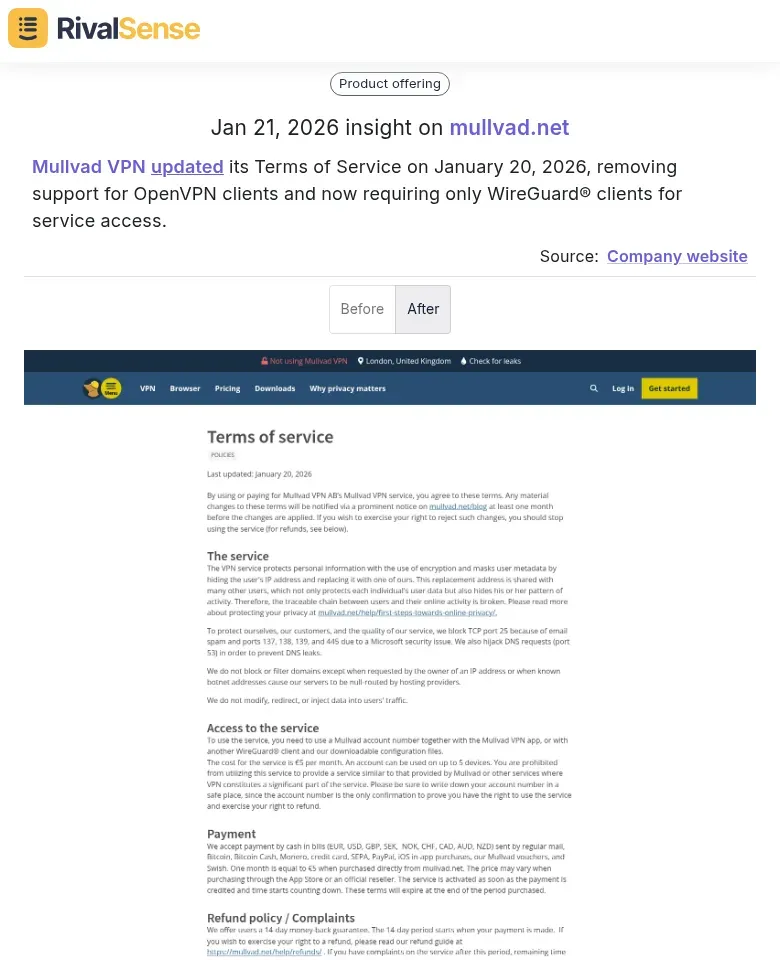
Mullvad VPN updated its Terms of Service on January 20, 2026, removing support for OpenVPN clients and now requiring only WireGuard® clients for service access. Tracking such regulatory or policy changes in competitors can alert you to industry shifts, allowing you to advise clients proactively and strengthen your strategic partnership.
✅ Practical Checklist for Implementation:
- Map all client stakeholders and decision-makers
- Establish regular communication cadence (weekly/monthly/quarterly)
- Create cross-functional account teams with clear roles
- Implement shared dashboards for account health metrics
- Integrate competitive intelligence for proactive insights
- Document relationship-building activities and outcomes
🚀 Pro Tip: Use competitive intelligence to anticipate client needs before they articulate them. When you can advise on emerging market trends or competitor moves, you transition from vendor to strategic partner.
Step 5: Monitoring, Measurement, and Continuous Improvement
Tracking KPIs and measuring ROI are essential to validate your KAM framework's impact and ensure continuous improvement. Regular monitoring helps identify areas for optimization and demonstrates the value of your key account investments. Key metrics include: revenue growth per account, customer satisfaction (NPS/CSAT), retention rates, and expansion opportunities.
Use tools like RivalSense to benchmark against competitors and identify gaps. For example, by monitoring competitor announcements, you can spot trends that might affect your key accounts.
Example of product launch insight:

Printify announced pre-digitized fonts for embroidery that are ready for production without delays or edits, enabling faster launches and smoother personalization. Such product updates from competitors can reveal innovation opportunities or threats, helping you adjust your account strategies to maintain competitive advantage.
Calculate ROI by comparing implementation costs to revenue gains and churn reduction. This financial analysis justifies the KAM program and guides resource allocation.
Conduct quarterly account reviews with structured assessments. Prepare a checklist: review account health scores, analyze usage data, assess relationship strength, and evaluate competitive threats. Involve cross-functional teams (sales, support, product) for holistic insights. Document findings and action items.
Iterate and optimize based on feedback and results. Analyze KPI trends to identify patterns—e.g., if satisfaction dips, adjust communication strategies. Gather feedback from account managers and clients through surveys or interviews. Update playbooks, processes, and training materials accordingly.
Example of growth benchmarking insight:

Langdock's CEO Lennard Schmidt announced on January 21 that the company has grown to 3,000 customers, achieved 10x revenue growth this year, and become profitable with a team of about 30 people. Insights into competitor growth and profitability can serve as benchmarks for your own performance and help in setting realistic goals with key accounts.
Set a cadence for framework reviews (e.g., biannually) to ensure agility. Example: A SaaS company used competitor tracking to spot feature gaps, then prioritized development to retain key accounts, boosting retention by 15%.
📈 Tips for continuous improvement:
- Automate KPI reporting with dashboards
- Use competitor intelligence to anticipate market shifts
- Foster a culture of continuous learning among teams
- Regularly update account plans based on new insights
Leveraging Competitive Intelligence for Key Account Success
To tie it all together, leveraging competitive intelligence can significantly enhance your KAM framework. By staying informed about competitor activities, you can proactively address client concerns and identify new opportunities. The insights provided by tools like RivalSense—tracking product launches, pricing updates, event participations, partnerships, regulatory aspects, management changes, and media mentions—deliver actionable data directly to your inbox weekly.
For instance, the examples above show how different types of insights can inform your strategy: regulatory changes (Mullvad VPN), product innovations (Printify), and growth benchmarks (Langdock). Each type of insight offers unique value for refining your account plans and strengthening client relationships.
Ready to put these strategies into action? Try RivalSense for free at https://rivalsense.co/ to get comprehensive competitor insights that support your key account management efforts. Get your first competitor report today and start transforming your client relationships into strategic partnerships!
📚 Read more
👉 How Revolut's Virtual Card Designs Sparked Competitor Loyalty Program Innovation
👉 The Beginner's Guide to Tracking Competitor Website Changes for Key Account Success
👉 How Fleet Management Leaders Monitor Competitor Regulatory Filings for Strategic Advantage
👉 Predictive Analysis: Forecast Competitor Event Participation for B2B Success
👉 Leveraging Executive Moves for Competitive Edge: A Real-World Example