
5 Quick Hacks to Track Competitor Media Mentions for Smarter SWOT Analysis
Competitor media mentions are your secret weapon for SWOT analysis because they reveal what the market actually thinks about your rivals. While internal data shows what competitors claim about themselves, media coverage exposes their real-world positioning and market perception. Here’s how to connect media mentions to the SWOT framework:
- Strengths: Track positive coverage about competitor innovations, awards, or market leadership. Example: When TechCrunch praises a competitor’s new AI feature, that’s a documented strength you can benchmark against.
- Weaknesses: Monitor negative press about product failures, customer complaints, or leadership issues. Practical tip: Set up Google Alerts for competitor names + “problems” or “issues” to catch critical coverage.
- Opportunities: Identify gaps where competitors aren’t getting coverage. If no one in your space is mentioned in sustainability reports, that’s your opening to own that narrative.
- Threats: Watch for coverage about competitor expansions, funding rounds, or strategic partnerships that could threaten your market position.
Actionable Checklist ✅
- ✅ Set up automated alerts for all major competitors
- ✅ Categorize mentions by sentiment (positive/negative/neutral)
- ✅ Track coverage frequency and media authority
- ✅ Identify recurring themes and narratives
- ✅ Compare your own media presence against competitors
This approach transforms media monitoring from passive observation into active competitive intelligence that directly informs strategic decisions about where to compete and how to differentiate.
Hack #1: Leverage Global Recognition Patterns to Identify Market Expansion Opportunities
Tracking competitor awards and app store recognitions across different regions can unveil their geographic expansion strategies. These patterns are crucial for identifying untapped markets in your SWOT analysis. For example, if a competitor wins “Best Fintech Solution” in Southeast Asia or appears in the “Top Business Apps” section of the German App Store, they’re likely investing in those markets.
Consider this real-world insight: RivalSense tracked that BetterMe’s Health Coaching app became App of the day in over 80 countries, including the UAE and South Africa, in early 2026.
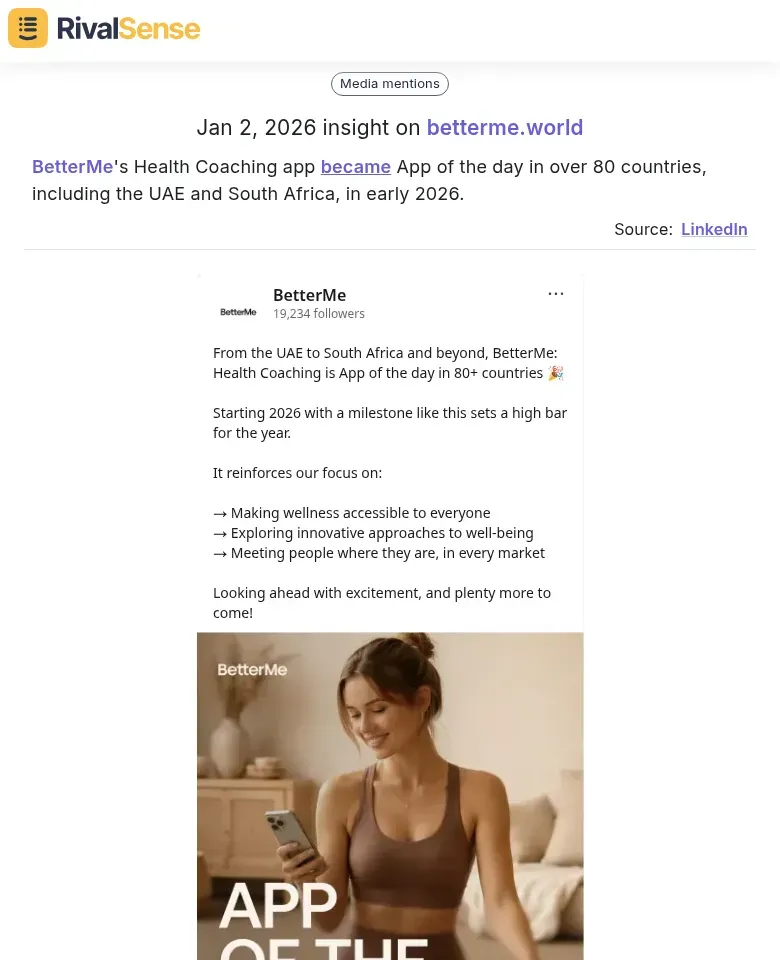
This type of global recognition insight is valuable for business strategy as it highlights where competitors are achieving market validation and user adoption. By monitoring such patterns, you can spot expansion opportunities or threats in specific geographic areas.
Practical Steps:
- Create a spreadsheet tracking competitor awards by region and category
- Monitor app store rankings in different countries using tools like AppTweak
- Set up Google Alerts for “[competitor name] wins award” + country names
- Analyze press releases post-award for localization clues
SWOT Application:
- Opportunities: Identify markets where competitors are gaining traction but you’re absent
- Threats: Spot regions where competitors are establishing dominance
- Strengths: Leverage your existing capabilities in similar markets
- Weaknesses: Address gaps in your international recognition strategy
Pro Tip: Look for year-over-year patterns—if competitors consistently target awards in a region, they’re likely making long-term investments there. This intelligence helps you time your market entry strategically.
Hack #2: Monitor Research Collaborations and Thought Leadership for Innovation Insights
Research partnerships and thought leadership initiatives reveal where competitors are investing their innovation dollars. Tracking academic collaborations, joint studies, and employee contributions to publications can signal R&D priorities and emerging market segments. For example, if a healthcare competitor partners with a top university on AI diagnostics research, that signals R&D priorities in AI-powered healthcare solutions.
Here’s an example from RivalSense: Flo employees YX, YHM, AC, and consultants CP and LZ contributed to a study on perimenopause uncertainty among U.S. women.
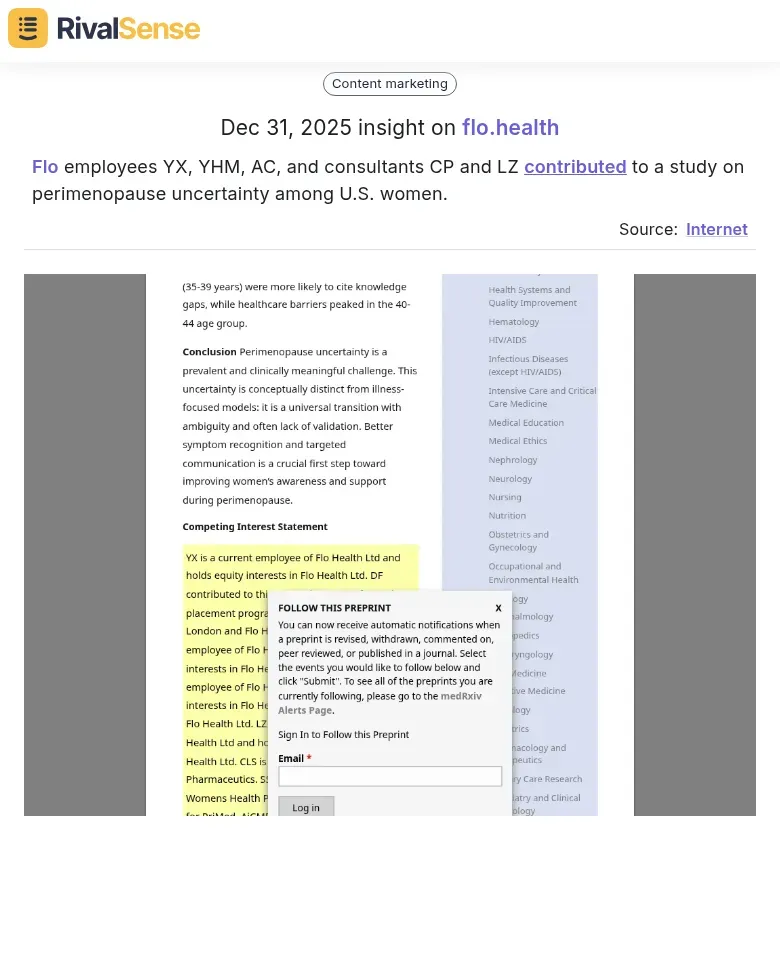
Insights into research collaborations are valuable for business strategy because they uncover areas where competitors are building expertise and authority. This can help you identify innovation trends and potential gaps in your own R&D efforts.
Practical Steps:
- Set up Google Scholar alerts for competitor names + key researchers
- Monitor research databases like PubMed, IEEE Xplore, and SSRN for co-authored papers
- Track conference presentations and academic speaking engagements
- Analyze patent filings that mention university or research institution collaborations
SWOT Application:
- Strengths: Identify where competitors have established research authority
- Weaknesses: Spot gaps in their research portfolio you can exploit
- Opportunities: Discover emerging fields they’re pioneering that you could enter
- Threats: Recognize areas where their research could disrupt your market position
Quick Checklist: ✅
- ✅ Monitor competitor + “research partnership” mentions
- ✅ Track employee publications in academic journals
- ✅ Analyze which conferences they’re presenting at
- ✅ Note which universities they collaborate with most frequently
- ✅ Identify research themes that align with their product roadmap
This approach reveals not just what competitors are doing today, but where they’re betting on tomorrow’s innovations.
Hack #3: Analyze Technical Innovation Coverage to Spot Competitive Advantages
Technical innovation coverage in prestigious publications like The Economist reveals how competitors position their proprietary technologies. Monitoring how they frame solutions—whether as “industry-first” or “market-disrupting”—exposes their unique selling propositions and strategic priorities. This analysis helps you understand their competitive advantages and market validation.
Take this example from RivalSense: Orbital Materials advanced data center infrastructure by proving AI can solve the cooling crisis with its Dual-Use Chiller and Two Phase Direct to Chip Solution, featured in The Economist.
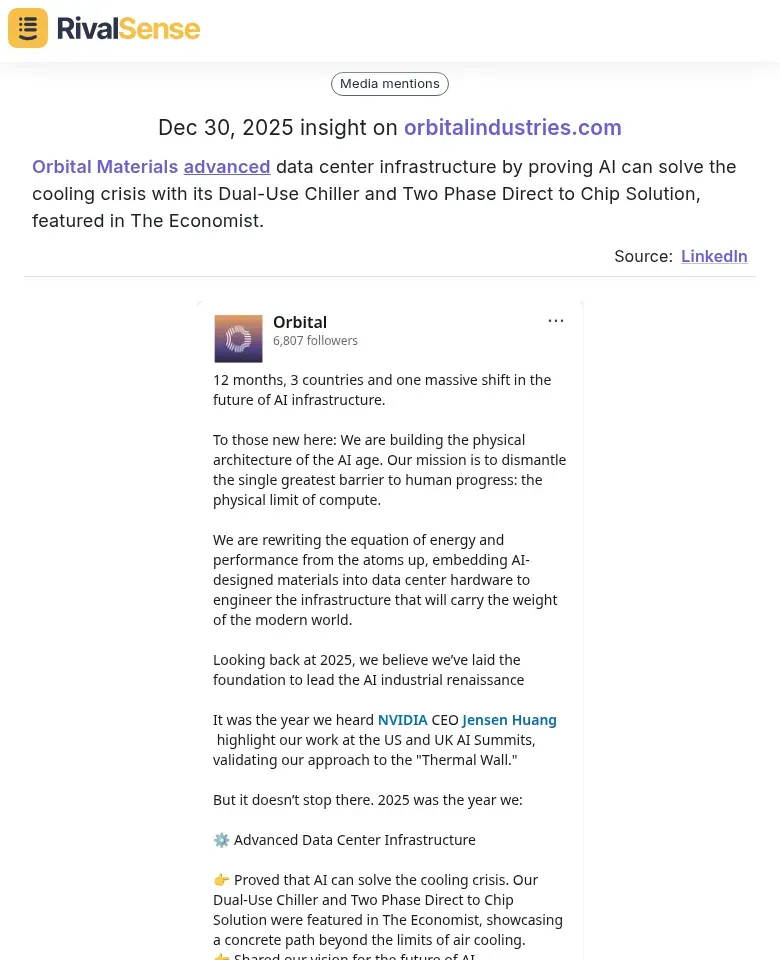
Technical innovation coverage insights are valuable for business strategy as they show how competitors are perceived by influential media and which technologies are gaining traction. This can guide your own innovation narratives and competitive positioning.
Practical Steps:
- Set up alerts for competitor names + “innovation,” “proprietary technology,” or “patent” in business/tech publications
- Analyze language patterns—note terms like “breakthrough,” “exclusive,” or “patent-pending” that signal competitive advantages
- Track media positioning—compare how different outlets frame the same technology (technical vs. business audience)
SWOT Insights Checklist: ✅
- ✅ Strengths: Identify proprietary technologies receiving positive coverage
- ✅ Weaknesses: Spot gaps where competitors lack innovation mentions
- ✅ Opportunities: Find underserved technical areas you can claim
- ✅ Threats: Monitor emerging technologies that could disrupt your market
Pro Tip: Create a spreadsheet tracking innovation mentions by competitor, publication tier, and technical focus area. Look for patterns—consistent coverage in The Economist signals market validation, while trade publication mentions reveal industry-specific advantages.
Actionable Insight: When competitors receive innovation coverage, analyze the journalist’s angle. Is it about technical superiority, market impact, or implementation ease? This reveals what resonates with media and your shared audience, helping you craft more compelling innovation narratives.
Hack #4: Set Up Automated Monitoring Systems for Real-Time Competitive Intelligence
Manual tracking of competitor media mentions is inefficient and prone to missed opportunities. Implementing automated systems ensures you capture every mention in real-time, transforming raw data into actionable intelligence. Start with Google Alerts for basic coverage—set up alerts for competitor names, key executives, and product terms. For comprehensive tracking, use specialized tools like RivalSense that monitor news sites, blogs, social media, and industry publications.
Create systematic categorization to organize mentions effectively. Use tags or folders for categories like product launches, strategic partnerships, awards, and thought leadership content. This structure helps you quickly identify patterns and trends.
Establish a regular review cadence—weekly or bi-weekly—to analyze collected data. During reviews, transform raw mentions into actionable SWOT insights: identify competitor strengths (e.g., positive press coverage), weaknesses (e.g., negative reviews), opportunities (e.g., market gaps they’re addressing), and threats (e.g., new partnerships).
Practical Checklist: ✅
- ✅ Set up Google Alerts for 3-5 key competitor terms
- ✅ Use a tool like RivalSense for deeper media monitoring
- ✅ Create 4-5 categorization buckets (product, partnerships, awards, etc.)
- ✅ Schedule 30-minute weekly review sessions
- ✅ Document insights in a shared SWOT template
Tip: Include industry keywords and adjacent terms in your alerts to catch indirect mentions that reveal broader market movements.
Hack #5: Transform Media Data into Strategic SWOT Action Plans
Transforming raw media mentions into actionable SWOT insights requires a systematic approach. By categorizing each mention into strengths, weaknesses, opportunities, and threats, you can develop targeted response strategies. First, categorize each competitor mention into SWOT quadrants: Strengths (positive coverage of their innovations), Weaknesses (negative reviews or service complaints), Opportunities (market gaps they’re addressing), and Threats (their expansion into your territory).
Create a simple spreadsheet with columns for: Competitor Name, Media Outlet, Mention Type (SWOT category), Key Message, and Strategic Implication. For example, if TechCrunch praises a competitor’s AI feature (Strength), note how you can differentiate with better UX or pricing.
Identify content gaps by analyzing what competitors discuss versus what media covers about your industry. If competitors dominate discussions about sustainability but media shows rising interest in data privacy, that’s your opportunity to lead that conversation.
Develop response strategies: For competitor weaknesses (like poor customer service mentions), create content highlighting your superior support. For their expansion threats, reinforce your unique value proposition through targeted campaigns. Set up quarterly reviews of your SWOT media map to track evolving competitive landscapes and adjust your strategy accordingly.
Put These Hacks into Practice with RivalSense
Tracking competitor media mentions manually can be time-consuming and complex. To streamline this process, consider using a tool like RivalSense. It automates the monitoring of competitor product launches, pricing updates, event participations, partnerships, regulatory aspects, management changes, and media mentions across company websites, social media, and various registries, delivering all insights in a weekly email report.
Ready to enhance your SWOT analysis? Try RivalSense for free today and get your first competitor report to start gaining strategic insights: https://rivalsense.co/
📚 Read more
👉 Actionable Competitor Analysis: Learning from Iute Moldova's Credit Limit Increase
👉 The Strategic Benefits of a Competitor Matrix: Your 2026 Guide to Market Dominance
👉 Strategic Account Tracking Tools: IT Consulting's Competitive Edge Analysis
👉 How Hubstaff's SCIM Move Prompted Competitors to Accelerate Enterprise Security
👉 Actionable Internet Hacks for Competitive Positioning Insights