
2026 Web Data Gathering Industry Awards: Competitive Intelligence Trends
Welcome to the 2026 Web Data Gathering Industry Awards, where we celebrate the pioneers transforming competitive intelligence from reactive monitoring to strategic foresight. This year's awards spotlight how leading companies leverage real-time web data to anticipate market shifts, not just track competitors. The evolution is clear: from basic price monitoring to predictive analytics that forecast competitor moves weeks in advance.
In today's hyper-competitive landscape, real-time data gathering is no longer optional. Companies that wait for quarterly reports risk being blindsided by agile competitors. The 2026 award winners demonstrate how continuous data streams enable proactive strategy adjustments, turning competitive intelligence into a competitive advantage.
🚀 Practical Tip: Start by identifying 3-5 key data points you need in real-time (e.g., pricing changes, feature launches, hiring patterns). Use automated tools to monitor these continuously rather than relying on manual checks. Create a weekly review process to analyze patterns and adjust your strategy accordingly. Remember: the goal isn't just to know what competitors are doing today, but to predict what they'll do tomorrow.
🏆 Leadership and Organizational Intelligence: Tracking Executive Moves
Leadership changes offer powerful insights into organizational strategy. When a competitor appoints a new CTO with AI expertise, it signals a technology pivot. Internal promotions—like a CCO becoming CEO—reveal succession planning and leadership development priorities. These moves often precede major strategic shifts by 6-12 months. Tracking executive appointments is valuable for business strategy because it helps predict strategic directions, such as market expansion or product focus shifts.
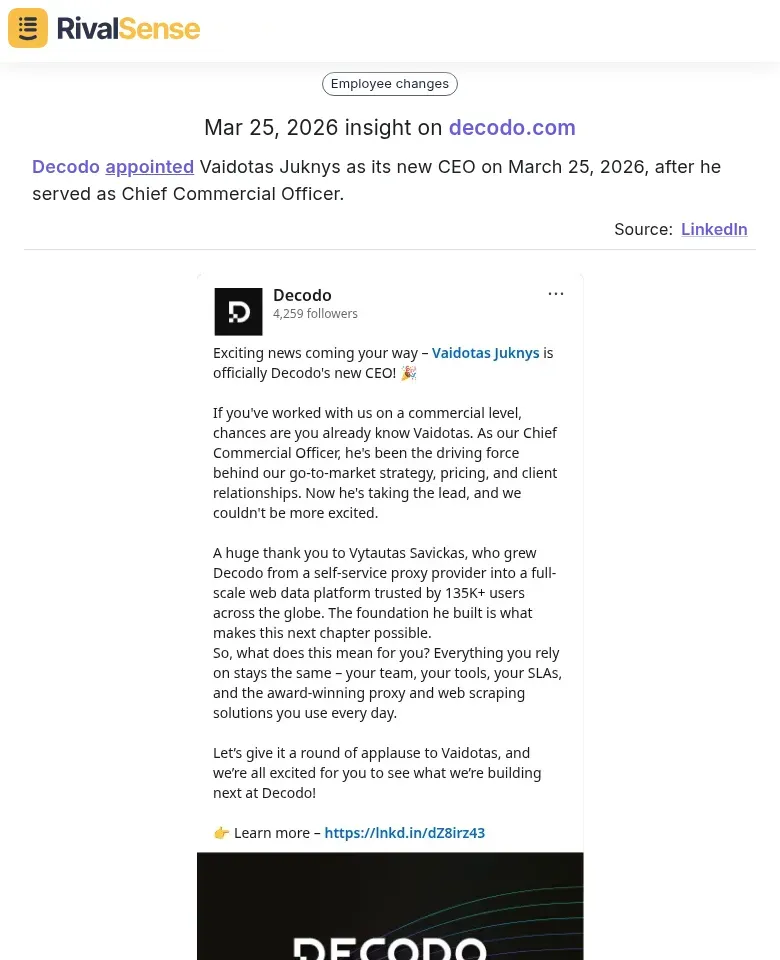
For example, RivalSense tracked that Decodo appointed Vaidotas Juknys as its new CEO on March 25, 2026, after he served as Chief Commercial Officer. This insight indicates a potential shift towards aggressive commercial growth and customer-centric strategies.
✅ Practical Tracking Framework:
- Monitor executive appointments - Track backgrounds of new hires (previous companies, expertise areas).
- Analyze promotion patterns - Note which departments get elevated to C-suite.
- Watch for departures - Key exits often precede strategy changes.
- Map leadership networks - Track where executives previously worked to predict partnership opportunities.
🔍 Early Warning Indicators:
- New CMO from SaaS company = potential product-led growth shift.
- CFO with M&A experience = acquisition strategy likely.
- Multiple AI hires = automation investment incoming.
📋 Action Steps:
- Set up alerts for competitor leadership changes.
- Create an executive background database.
- Quarterly review leadership patterns across your market.
- Use tools like RivalSense to automate tracking across LinkedIn, press releases, and regulatory filings.
Leadership intelligence transforms reactive tracking into predictive strategy. When you see a pattern of data-focused executives joining a competitor, anticipate analytics product launches. When customer experience leaders get promoted, expect service model innovations. These signals help you prepare rather than react.
💰 Pricing Strategy Intelligence: Decoding Market Positioning
In 2026, pricing strategy intelligence reveals how permanent price cuts signal aggressive market positioning. Competitors using deep discounts aren't just chasing revenue—they're sacrificing margins to capture market share and establish dominance. Analyze these moves to understand their long-term strategic intent. Monitoring pricing changes is crucial because it reveals competitors' operational strengths and market ambitions, allowing you to adjust your own pricing and value propositions accordingly.
Take, for instance, RivalSense detected that Decodo permanently cut residential proxy prices to start from $2/GB, offering over 115 million IPs across 195+ locations with a 99.95% success rate. This insight showcases how infrastructure scale enables competitive pricing and highlights the importance of tracking such moves for market positioning.
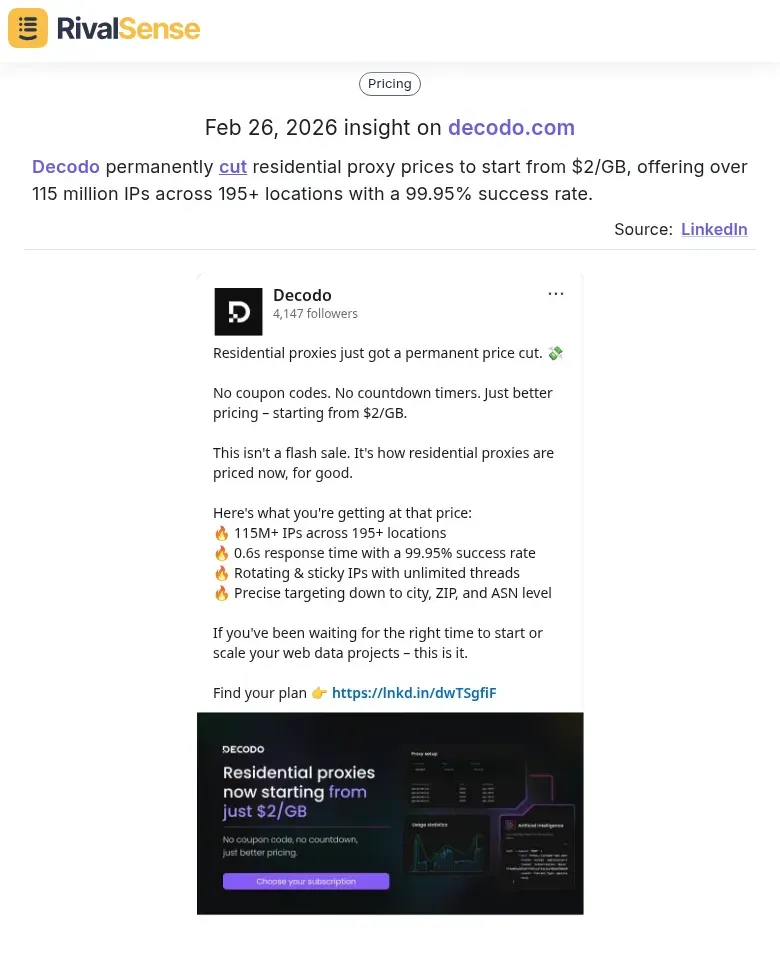
Infrastructure capabilities directly translate to pricing power. Companies with massive proxy networks (115M+ IPs) can offer superior data quality at lower costs, creating sustainable competitive advantages. This scale enables them to absorb price reductions while maintaining profitability—a critical differentiator in crowded markets.
Service reliability metrics (99.95% success rates) indicate operational maturity that justifies premium pricing. Customers pay for consistency, not just features. Track these metrics to identify which competitors can deliver reliable value versus those cutting corners.
📝 Practical Checklist:
- Monitor permanent price reductions across competitor tiers.
- Map infrastructure investments to pricing flexibility.
- Benchmark reliability metrics against pricing structures.
- Identify which competitors use price as a strategic weapon vs. tactical adjustment.
- Calculate the sustainability of aggressive pricing based on operational metrics.
💡 Tip: The most dangerous competitors combine infrastructure scale with strategic pricing—they can afford to be aggressive while maintaining quality.
📊 Content and Thought Leadership Intelligence: Beyond Basic Monitoring
In 2026, content intelligence has evolved beyond basic monitoring to reveal competitors' strategic direction. Leading firms now publish original research on emerging threats like digital squatting—where bad actors register domains similar to your brand—demonstrating deep market expertise and thought leadership. This signals they're not just tracking competitors but shaping industry conversations. Analyzing published research is valuable for business strategy because it uncovers competitors' focus areas and potential new service offerings before they launch.
As an example, RivalSense highlighted that Decodo published new research on January 30 about digital squatting and how it deals with brand impersonators. This insight demonstrates how competitors use content to address customer pain points and position themselves as experts, often previewing future solutions.
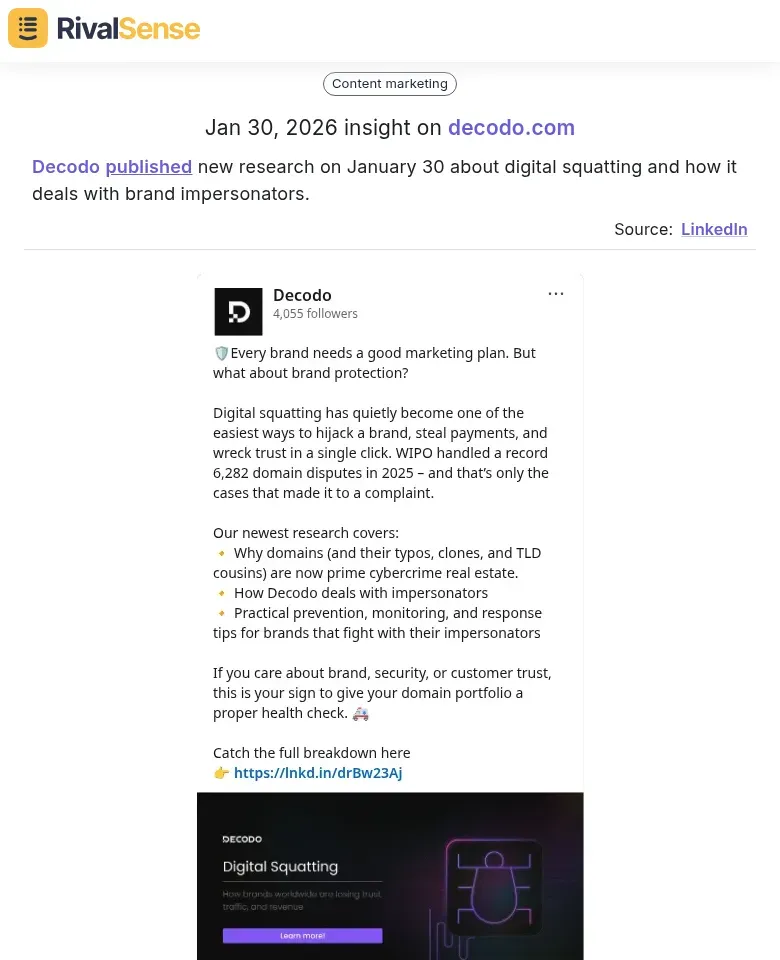
Track how competitors address customer pain points in their content. Are they focusing on AI-driven threat detection or compliance automation? This reveals their market understanding and solution development priorities. For example, if a competitor publishes multiple guides on regulatory compliance, they're likely building related service offerings.
🔧 Practical Steps:
- Monitor research publications for emerging threat analysis.
- Map content themes to customer pain points.
- Identify gaps between published research and current offerings.
- Track frequency of specific topic coverage.
- Analyze citation patterns to gauge influence.
Use this intelligence to anticipate new services before launch. When competitors consistently publish on a topic, they're often testing market interest for upcoming solutions.
🚀 Emerging Trends in 2026 Competitive Intelligence
The competitive intelligence landscape in 2026 is being reshaped by three transformative trends. Staying ahead requires understanding these advancements and how to leverage them effectively for your business strategy. First, AI-driven predictive analytics now goes beyond monitoring to forecast competitor moves with 85%+ accuracy. Practical tip: Implement AI models that analyze historical competitor behavior patterns to predict their next product launch or pricing strategy.
Second, real-time data integration has become non-negotiable. Automated alert systems now process data within minutes, not hours. 📋 Checklist:
- Integrate APIs from multiple data sources.
- Set up automated alerts for competitor website changes.
- Monitor social sentiment in real-time.
- Track pricing fluctuations instantly.
Third, ethical data gathering is paramount with new global regulations. Companies must now document their data collection methodologies and ensure compliance across jurisdictions. Practical step: Create an ethical data gathering policy that includes: transparent sourcing, proper attribution, and regular compliance audits.
🎯 Key implementation advice: Start with a phased approach - begin with real-time monitoring, then layer in AI analytics, while building your ethical framework from day one. The most successful companies in 2026 are those that balance technological sophistication with ethical responsibility in their competitive intelligence operations.
🏆 Strategic Applications: Turning Intelligence into Competitive Advantage
Integrate multiple intelligence streams for comprehensive competitor profiling by creating a unified dashboard that combines leadership insights, pricing intelligence, and content analysis. This holistic approach enables you to see the full picture and make informed strategic decisions. For example, when a competitor hires a new CMO from a premium brand, anticipate pricing increases and premium content shifts.
Develop proactive strategies by implementing a 3-step framework:
- Monitor early signals (job postings, patent filings, regulatory submissions).
- Predict likely moves using pattern recognition.
- Pre-position counter-strategies before competitors act.
This transforms intelligence from reactive monitoring to strategic foresight.
Build competitive intelligence systems that deliver actionable insights through automated alerts and decision frameworks. ✅ Practical checklist:
- Set up real-time alerts for competitor leadership changes.
- Create pricing trend dashboards with anomaly detection.
- Establish content gap analysis to identify messaging opportunities.
- Implement quarterly competitor strategy review sessions.
- Develop "what-if" scenarios for major competitor moves.
The most effective systems translate intelligence into specific actions: When competitor X launches feature Y, we respond with Z within 48 hours. This systematic approach ensures intelligence drives strategic decisions rather than just informing them.
Ready to transform your competitive intelligence? Try out RivalSense for free at https://rivalsense.co/ to automate tracking of competitor product launches, pricing updates, leadership changes, and more—all delivered in a weekly email report. Get your first competitor report today and stay ahead of the curve!
📚 Read more
👉 Quick Market Entry Hacks: Competitor Insights for Startup Key Accounts
👉 How to Leverage Competitor Insights: A Real-World Example from n8n
👉 The Ultimate Guide to Key Account Tracking APIs: Automate Competitive Intelligence in 2026
👉 Mastering Competitor Tracking in Pharma Logistics: A Strategic Guide to Promotional Offers
👉 How Real-Time Competitive Intelligence Enabled a Swift Response to Airalo's Flight Promotion