
2026 Social Media Key Account Monitoring: Essential Checklist for B2B Leaders
In today's hyper-competitive B2B landscape, key account monitoring has evolved from optional tracking to essential strategic intelligence for 2026 market leadership. Proactive monitoring transforms social media intelligence from reactive defense into proactive market advantage. When competitors announce new enterprise features or target your client's industry on platforms like Facebook, you're seeing their strategic playbook unfold in real-time.
Practical Tip: Set up daily alerts for competitor announcements, partnership reveals, and client testimonials. These signals often precede formal sales outreach to your accounts, giving you critical lead time to reinforce your value proposition.
Real-world examples demonstrate the power of systematic tracking. RivalSense captured how Tenable announced AI protection suites, revealing competitors' technology positioning. Similarly, tracking Coty's partnership with Netflix for Bridgerton fragrances showed how brands leverage media collaborations to tap new segments. These insights help identify at-risk accounts before churn and uncover expansion opportunities competitors miss.
Checklist for Getting Started:
- Identify 3-5 primary competitors with active social presence
- Track their content themes, engagement patterns, and client mentions
- Correlate competitor announcements with your account health metrics
- Establish weekly review cadence to spot emerging threats/opportunities
By establishing this systematic approach, you transform reactive account management into proactive strategic advantage, ensuring key relationships remain secure while identifying growth vectors competitors haven't yet discovered.
Essential Monitoring Framework: Building Your 2026 Tracking System
Building an effective 2026 tracking system requires a structured framework that moves beyond basic monitoring. To achieve this, you need to automate alerts and integrate data streams for real-time insights. Start by implementing automated alerts for critical competitor signals: content strategy pivots (new formats, topics, or posting frequency), key personnel changes (social media managers, content leads), and engagement pattern shifts. Use tools that trigger notifications when competitors launch new campaigns or adjust their messaging approach.
Integrate your tracking tools directly with your CRM system to create unified account intelligence. This connection allows you to overlay competitive insights with customer data, identifying which competitor tactics resonate with your target accounts. Set up automated data flows that update competitor profiles within your CRM, ensuring sales teams have real-time competitive intelligence.
Develop visual dashboards that track engagement patterns across key metrics: share of voice, sentiment trends, content performance gaps, and audience growth rates. Create side-by-side comparisons showing where competitors outperform you and where you have advantages. Include trend lines that highlight emerging patterns before they become significant threats. Regularly review these dashboards in team meetings to inform strategy adjustments and identify immediate opportunities.
Strategic Integration Insights: Learning from Platform Partnerships
Platform partnerships transform social media monitoring from fragmented data collection to integrated intelligence. By leveraging these integrations, you can gain a holistic view of competitor activities and customer interactions. Strategic integrations like tracking pixels and API connections provide unprecedented visibility into account performance across channels. For example, connecting your social listening tools with CRM systems reveals how social engagement translates to pipeline movement.
Key implementation steps:
- Audit existing data sources and identify integration gaps
- Prioritize partnerships that offer real-time data sync capabilities
- Implement tracking pixels for cross-platform attribution
- Create unified dashboards that combine social metrics with business outcomes
- Establish automated alerts for integrated data anomalies
Why Integration Insights Matter: Monitoring competitor integrations can reveal their focus on improving user experience and data tracking. For instance, RivalSense captured that Metricool now integrates with Lnk.Bio, allowing creators to track link-in-bio traffic directly in their dashboard. 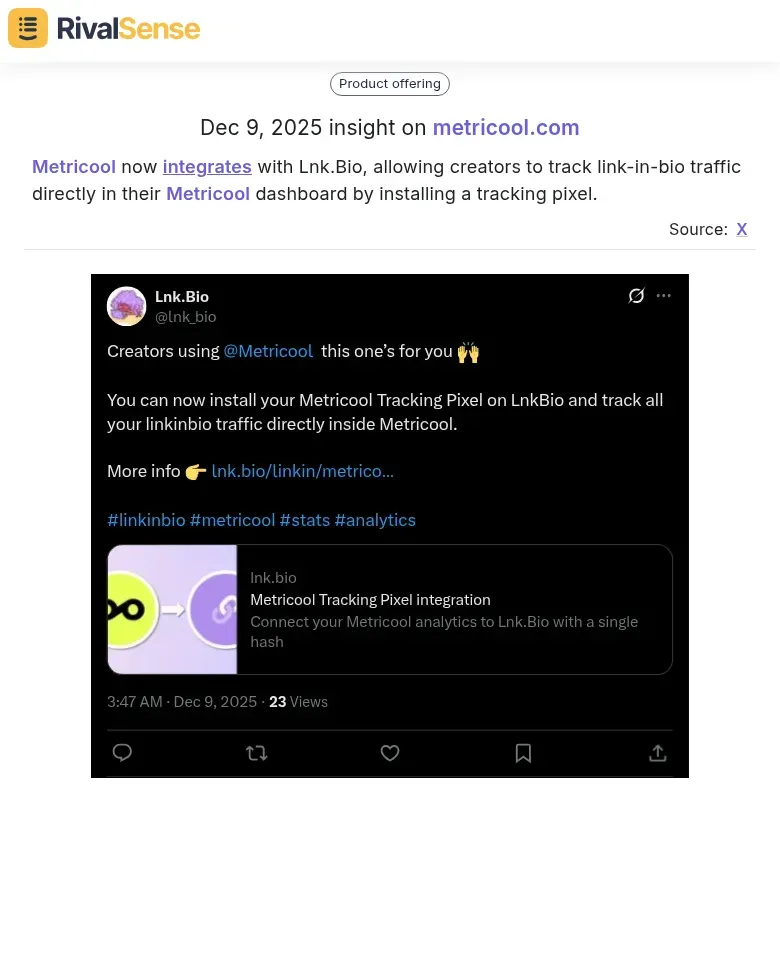
This type of insight is valuable because it shows how competitors are enhancing their product offerings to meet user demands for better analytics, signaling a shift towards more data-driven marketing strategies.
Pro tip: Start with 2-3 core integrations (social-CRM-analytics) before expanding. The most valuable insights emerge when you connect engagement data with conversion metrics and customer feedback. This holistic view enables proactive account management rather than reactive monitoring. Remember to regularly review integration performance and adjust as platform APIs evolve.
Leadership Intelligence: Monitoring Executive Movements and Thought Leadership
Executive movements and thought leadership content provide invaluable clues about market direction and competitive priorities. Tracking C-suite interviews and media appearances for early strategic signals is crucial for staying ahead. When competitors' CEOs discuss "AI governance" or "sustainability measurement" in 2026 interviews, they're signaling upcoming market priorities.
Practical checklist: Set up Google Alerts for competitor executives + keywords like "interview," "panel," and "keynote." Monitor industry podcasts and LinkedIn Live sessions where executives reveal unscripted insights.
Analyze executive content themes to anticipate market priorities and regulatory adaptations. When multiple competitors' CTOs suddenly emphasize "data protection compliance" in their thought leadership, expect regulatory shifts. Track frequency of specific terms in executive posts—rising mentions of "cyber resilience" or "AI oversight" indicate emerging priorities. Use sentiment analysis tools to detect subtle shifts in messaging tone.
Why Executive Participation Insights Matter: Knowing where competitors' leaders are engaging can highlight strategic alliances and market focus. For example, RivalSense noted that Metricool CEO Juan Pablo Tejela participated in the Threads API Summit in London, where Meta discussed its product roadmap and vision. 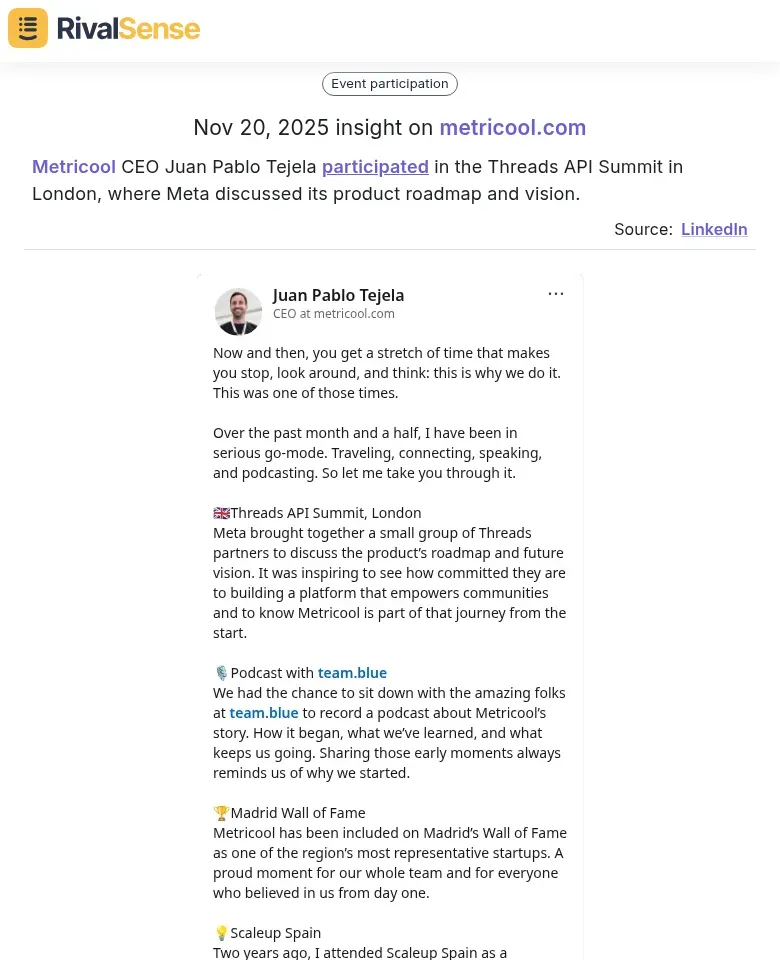
This insight is valuable because it indicates the company's involvement in key industry events, suggesting a focus on platform partnerships and API developments, which can inform your own event participation and partnership strategies.
Monitor talent flow patterns between industries to identify emerging competitive threats. When fintech executives move to healthcare or automotive leaders join AI startups, cross-industry convergence is happening. Create a talent flow map showing executive movements between your top 5 competitors and adjacent industries. Practical step: Quarterly review of LinkedIn executive transitions, noting patterns like "traditional industry → tech" or "established player → startup."
Actionable framework: 1) Weekly scan of executive media appearances, 2) Monthly theme analysis across competitor leadership content, 3) Quarterly talent flow mapping with industry correlation analysis. This systematic approach transforms executive monitoring from passive observation to proactive strategic intelligence.
User-Centric Adaptation: Growing Through Customer Feedback and Market Events
Listening to your users and observing market events helps you anticipate needs and stay ahead of competitors. User-centric adaptation transforms customer feedback into competitive advantage. Monitor social sentiment, support tickets, and feature requests to identify patterns. Create a quarterly feedback analysis report that maps user pain points to your roadmap priorities. For example, if multiple enterprise clients request Slack integration, prioritize it over niche features.
Why Customer Feedback Insights Matter: Insights into how competitors grow through user feedback can reveal their adaptation strategies. RivalSense captured that Juan Pablo Tejela, CEO and co-founder of Metricool, discussed how the company grew by listening to its users in a podcast. 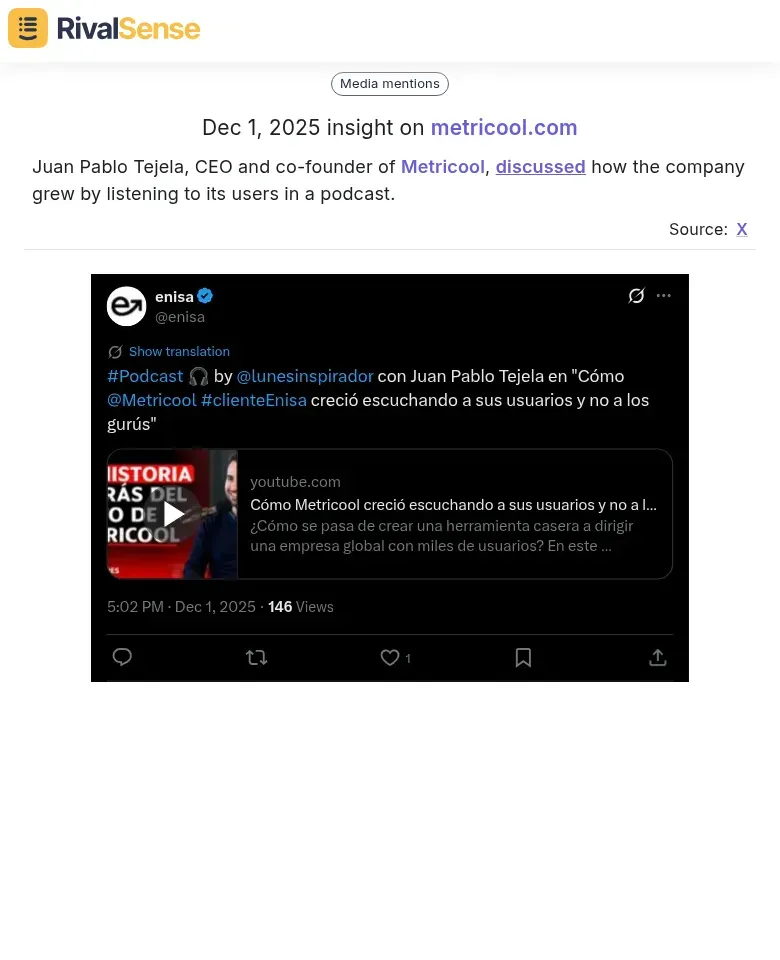
This type of insight is valuable because it highlights the importance of customer-centric growth, reminding you to leverage user feedback for product development and competitive differentiation.
Participate in 3-4 key industry events annually, focusing on API summits and platform partner conferences. Track competitor announcements, partnership reveals, and pricing changes. Use these insights to anticipate market shifts. After each event, conduct a competitive intelligence debrief with your product team.
Implement a continuous adaptation framework:
- Weekly: Review social mentions and support trends
- Monthly: Analyze competitor feature releases and pricing changes
- Quarterly: Attend industry events and update competitive positioning
- Bi-annually: Conduct customer advisory board sessions
Pro tip: Create a "market signals dashboard" that aggregates social listening data, competitor announcements, and customer feedback scores. This single view helps identify when to pivot features or accelerate development. Remember, adaptation isn't reactionary—it's strategic anticipation of market needs before competitors capitalize on them.
Actionable Implementation: Your 2026 Key Account Monitoring Checklist
Implementing a structured checklist ensures that insights lead to tangible business outcomes. Transform competitive intelligence into proactive engagement with this 2026 workflow:
- Weekly Intelligence Digest: Compile key account updates, competitor moves, and market shifts into a 15-minute executive summary
- Vulnerability Mapping: Identify 3-5 specific weaknesses in competitor offerings (pricing gaps, feature limitations, support issues)
- Strategic Response Planning: Develop targeted counter-strategies for each vulnerability (example: when competitor raises prices, launch a price-lock guarantee for key accounts)
- Proactive Outreach Calendar: Schedule 2-3 strategic touchpoints per quarter based on competitor activity patterns
Measure ROI with these metrics:
- Account retention rate improvement (target: +15% year-over-year)
- Competitive displacement wins (track accounts gained from specific competitors)
- Share of wallet growth within existing accounts
- Response time to competitor moves (target: <48 hours)
Create data-driven playbooks:
- Pricing vulnerability playbook: When competitor increases prices >10%, activate tiered discount program for at-risk accounts
- Feature gap playbook: When competitor lacks key integration, launch targeted demo campaign highlighting your superior connectivity
- Support weakness playbook: When competitor has negative reviews about support, offer dedicated account manager trial
Pro tip: Assign competitive intelligence scores (1-10) to each key account based on vulnerability to competitor poaching, and prioritize engagement accordingly.
Conclusion: Turn Insights into Action
By following this comprehensive checklist, you can turn key account monitoring into a powerful competitive edge in 2026. Remember, the goal is to stay proactive, not reactive.
To assist with these challenges, try out RivalSense for free at https://rivalsense.co/. RivalSense tracks competitor product launches, pricing updates, event participations, partnerships, regulatory aspects, management changes, and media mentions across company websites, social media, and various registries, delivering all in a weekly email report. Get your first competitor report today and start gaining strategic insights to protect and grow your key accounts.
📚 Read more
👉 Competitor Financials & M&A Benchmarking: Key Account Growth Insights for 2026
👉 Leveraging Competitor Insights: A Case Study on Spotify's Instagram Feature
👉 Key Account Management for Startups: A Practical Guide to Building Strategic Relationships
👉 A Practical Competitor Sales Tracking Framework for Commercial Insurance Brokers
👉 How Pfizer's Oncology Guide Reveals Patient Accessibility Gaps: A Competitive Intelligence Blueprint