
Website Change Intelligence: A Proactive Framework for Key Account Success
Website change intelligence represents the systematic monitoring of competitor digital footprints—tracking every update, redesign, pricing change, and content shift across their websites. This transforms reactive competitive analysis into proactive strategy, enabling you to anticipate market moves rather than just respond to them. For B2B leaders managing key accounts, this intelligence is critical for revenue protection and relationship management.
Practical steps to implement:
- Identify 3-5 primary competitors and map their key website sections (pricing, features, case studies).
- Set up automated monitoring for specific changes (new product launches, pricing updates, leadership announcements).
- Create alerts for changes affecting your key accounts' industries or pain points.
- Schedule weekly reviews of competitor website changes with your sales team.
When a competitor updates their pricing page targeting your enterprise clients, you'll know immediately—not weeks later. This allows you to proactively address concerns, reinforce your value proposition, and protect key account relationships before competitors gain traction.
Pricing Strategy Intelligence: Decoding Market Positioning Through Tier Analysis
Pricing pages reveal more than just numbers—they're strategic blueprints showing how competitors segment markets and target customers. When analyzing pricing changes, track three key dimensions: tier expansion (adding new plans), feature bundling (what's included/excluded), and value proposition shifts (how benefits are framed). Understanding these elements helps you anticipate competitive moves and adjust your own strategy.
Practical steps for pricing intelligence:
- Monitor quarterly pricing page updates across competitors.
- Map feature allocation across tiers to identify target segments.
- Track price-per-feature ratios to spot value optimization.
- Analyze enterprise vs SMB plan differentiation.
- Document promotional language changes around each tier.
Key insights emerge from patterns: When competitors add mid-tier plans, they're targeting growing SMBs. Enterprise-focused expansions signal vertical specialization. Feature redistribution between tiers reveals changing customer priorities. Price anchoring at premium tiers makes mid-range options appear more valuable.
Actionable tip: Create a pricing matrix comparing your offerings against competitors' tier structures. Identify gaps where you can create unique value bundles or adjust positioning. If competitors shift toward enterprise features, consider strengthening your SMB specialization with simplified pricing and onboarding support.
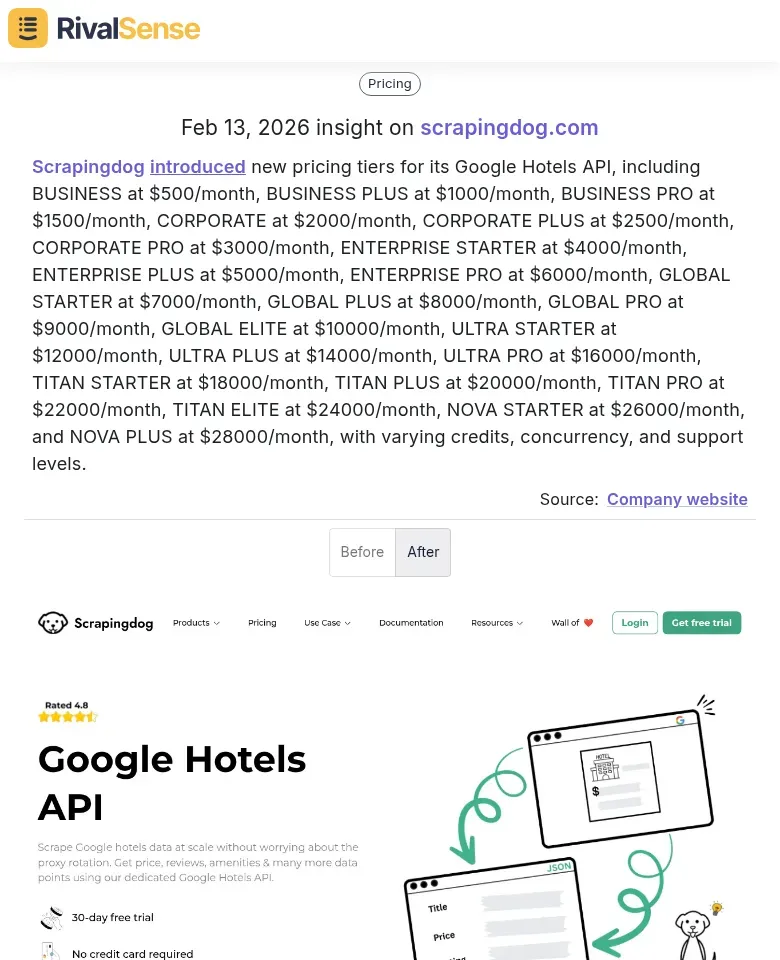
💡 Real-World Example: RivalSense recently tracked how Scrapingdog introduced new pricing tiers for its Google Hotels API, with multiple tiers ranging from $500 to $28,000 per month. This insight into pricing structure evolution is crucial for understanding how competitors segment the market and target different customer segments, allowing you to adjust your own pricing strategy proactively.
Remember: Pricing changes often precede broader market moves. A competitor adding usage-based billing might be preparing for developer-focused expansion. Tier consolidation could signal a pivot toward standardized solutions. Use these signals to anticipate competitive focus areas and adjust your positioning proactively.
Product & Service Evolution: Tracking Feature Development and Market Adaptation
Product and service evolution tracking reveals competitor investment priorities and market adaptation strategies. Monitor service page updates weekly to identify pivots toward emerging threats or opportunities. This proactive approach helps you stay ahead of market shifts and refine your product roadmap based on competitor movements rather than reactive responses.
Practical steps:
- Set up automated monitoring for key competitor service pages.
- Document feature release dates and categorize them (core vs. premium).
- Compare feature gaps between your offerings and theirs.
- Track pricing changes alongside feature additions.
- Monitor customer feedback channels for validation of new features.
Analyze feature additions systematically: create a spreadsheet tracking competitor feature releases, enhancement frequency, and technical depth. Notice patterns—are they investing in mobile optimization, API integrations, or enterprise features? This reveals their R&D priorities and target customer segments.
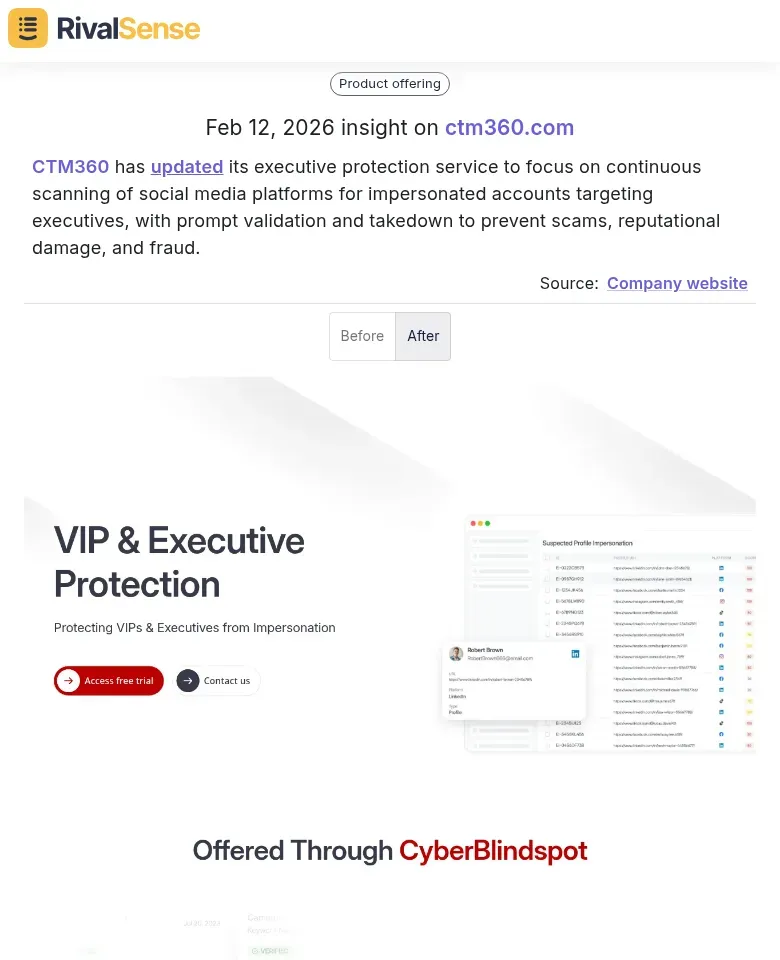
💡 Real-World Example: CTM360 updated its executive protection service to focus on continuous scanning of social media platforms for impersonated accounts targeting executives. Tracking such service enhancements helps you identify competitor investments in emerging areas, like AI-driven security, and adapt your product roadmap to address similar customer pain points.
Use this intelligence to anticipate competitor positioning. If they're adding enterprise-grade compliance features, they're likely targeting regulated industries. Identify gaps in your offerings by comparing feature matrices quarterly.
Marketing & Campaign Intelligence: Uncovering Strategic Initiatives Through Content Analysis
Marketing & Campaign Intelligence transforms website monitoring into strategic foresight. Track competitor campaign launches and seasonal initiatives to understand their marketing investment patterns. By analyzing messaging, offers, and target keywords, you can gauge their budget allocation and strategic priorities, enabling you to counter their moves effectively.
Practical steps:
- Set up alerts for competitor homepage, pricing, and campaign pages.
- Monitor content strategy shifts—when competitors add new blog categories or target different buyer personas, they're expanding their audience focus.
- Track seasonal pattern changes year-over-year to predict future campaign timing.
- Analyze content format evolution (video, webinars, case studies) to identify resource allocation shifts.
Use this intelligence to anticipate market share moves. If competitors are ramping up content about enterprise solutions, they may be targeting larger accounts. Adjust your campaign timing to launch before their initiatives gain momentum or position your messaging to counter their focus areas.
💡 Real-World Example: iSpot.tv launched its Super Bowl 2026 ad center, featuring top commercials with estimated TV spends up to $17.4 million. Monitoring campaign launches like this provides insights into competitor marketing budgets and strategic priorities, enabling you to anticipate market moves and tailor your campaigns for maximum impact.

Create a monthly competitive marketing dashboard tracking:
- Campaign launch dates
- Content volume by category
- New audience targeting
- Seasonal pattern deviations
Building Your Website Change Intelligence Framework
Building a robust Website Change Intelligence framework requires systematic workflows, automated alerts, and actionable analysis. Start by identifying critical competitor touchpoints: pricing pages, product documentation, feature lists, case studies, and key account landing pages. Use tools to monitor these systematically, ensuring no signal is missed for proactive decision-making.
Implement automated alert systems for real-time intelligence. Set up alerts for pricing changes, new product launches, feature updates, and marketing campaign shifts. This enables proactive responses rather than reactive scrambling.
Create analysis frameworks to translate website changes into insights. For example, when a competitor updates pricing, analyze the impact on your key accounts' budget allocations. When product pages change, assess feature gaps or advantages.
📋 Checklist for Effective Intelligence:
- Verify change significance—is it a minor update or a major shift?
- Cross-reference with other data (e.g., social media, news).
- Assess impact on your accounts—which clients are affected?
- Determine response actions—adjust pricing, update messaging, or reach out proactively.
Tips: Prioritize high-value accounts, use historical data for trend analysis, and integrate insights into sales enablement tools for immediate action.
From Intelligence to Action: Driving Key Account Success
Website change intelligence transforms raw data into actionable strategies for key account success. Start by creating a monitoring dashboard that tracks competitor feature updates, pricing changes, and content shifts. When you spot a competitor launching a new integration, proactively reach out to your key accounts with a comparison analysis showing your superior solution.
Practical steps:
- Weekly review of competitor website changes.
- Map changes to specific client pain points.
- Schedule quarterly competitive briefings with key accounts.
- Track account-specific competitive threats.
Use competitor intelligence to anticipate client needs before they arise. If a competitor announces expanded support hours, analyze which accounts would value this and prepare your response strategy.
📊 Measure ROI through:
- Improved retention rates (track churn reduction).
- Expansion opportunities (upsell/cross-sell success).
- Competitive win rates (displacement wins).
Key tip: Assign each key account a competitive threat level (low/medium/high) based on competitor activity in their industry. High-threat accounts get monthly check-ins with customized competitive insights. This proactive approach strengthens relationships by demonstrating deep market understanding and commitment to client success.
Ready to Transform Your Competitor Tracking?
Implementing website change intelligence manually can be time-consuming and prone to errors. RivalSense automates this process by tracking competitor product launches/updates, pricing changes, event participations, partnerships, regulatory aspects, management changes, and media mentions across websites, social media, and various registries—delivering all insights in a weekly email report.
Try out RivalSense for free today at https://rivalsense.co/ and get your first competitor report to start protecting your key accounts and staying ahead of the competition!
📚 Read more
👉 2026 Social Media Key Account Monitoring: Essential Checklist for B2B Leaders
👉 Competitor Financials & M&A Benchmarking: Key Account Growth Insights for 2026
👉 Leveraging Competitor Insights: A Case Study on Spotify's Instagram Feature
👉 Key Account Management for Startups: A Practical Guide to Building Strategic Relationships
👉 A Practical Competitor Sales Tracking Framework for Commercial Insurance Brokers