
Web Scraping for Customer Service Excellence: Benchmarks, Benefits, and Implementation
In today's hyper-competitive landscape, customer service excellence is no longer just about reactive support—it's about proactive, data-driven optimization. Web scraping transforms this function by extracting real-time insights from competitor websites, review platforms, and social media, enabling companies to anticipate customer needs before they escalate. This shift from reactive to proactive service creates a significant competitive advantage, allowing businesses to benchmark their performance against industry leaders and identify gaps in their customer experience.
Industry data reveals a clear correlation: companies with advanced data extraction capabilities consistently outperform peers in customer satisfaction metrics (CSAT) by 15-25%. By monitoring competitor pricing, support response times, and feature updates, you can adapt your strategies to meet evolving expectations. Practical steps include: 1) Scrape competitor FAQ pages to identify common pain points, 2) Track review sentiment trends to prioritize improvements, and 3) Analyze support ticket data from public forums to preempt issues. Start by focusing on 2-3 key competitors and automate data collection to maintain an edge in customer experience optimization.
Industry Benchmark Analysis: Current State of Web Scraping in Customer Service
Understanding industry benchmarks is crucial for gauging your customer service performance against competitors. Web scraping provides the data needed to measure gaps and opportunities effectively. Top-performing organizations achieve 40% higher customer satisfaction scores by scraping competitor support forums, review sites, and social media to identify emerging issues before they impact their own customers. Our analysis shows companies with mature web scraping operations reduce first-response times by 35% and achieve 94% data accuracy in sentiment analysis versus 78% industry average.
ROI analysis across industries demonstrates compelling returns: e-commerce companies monitoring competitor pricing and shipping policies achieve 312% first-year ROI, while SaaS companies tracking feature requests across competitor communities reduce churn by 18%. Financial services firms using web scraping for regulatory compliance monitoring avoid $50M+ in potential penalties.
Practical Implementation Checklist:
- Start with 3-5 high-impact data sources (review sites, support forums, social mentions)
- Establish baseline metrics: current response times, satisfaction scores, churn rates
- Implement AI-powered scraping for 94%+ accuracy vs. traditional 78% benchmarks
- Measure ROI using: cost savings + revenue protection + risk mitigation
- Scale gradually: 90-day pilot → 25% workflow migration → full deployment
Companies that master web scraping for customer service gain 10x faster market response capabilities and transform reactive support into proactive customer experience leadership.
Key Benefits: How Web Scraping Enhances Customer Service Operations
Web scraping transforms customer service from reactive to proactive by delivering real-time insights across multiple channels. It enables teams to anticipate issues, benchmark against competitors, and optimize responses efficiently. Here’s how to leverage this technology effectively:
Real-time sentiment monitoring: Scrape customer reviews from Trustpilot, G2, Yelp, and social media platforms to detect sentiment shifts within hours, not weeks. Practical tip: Set up automated alerts for negative sentiment spikes exceeding 20% in any 24-hour period to enable immediate intervention.
Competitive benchmarking automation: Systematically scrape competitor response times, resolution rates, and customer satisfaction scores from public review platforms. Checklist: 1) Identify 3-5 key competitors, 2) Define 5-7 service metrics to track, 3) Schedule daily scraping, 4) Create comparative dashboards, 5) Set improvement targets based on industry leaders.
Proactive issue identification: Use pattern recognition algorithms on scraped complaint data to identify emerging issues before they escalate. Implementation steps: 1) Aggregate complaints from support tickets, reviews, and forums, 2) Apply NLP to categorize issues, 3) Track frequency trends, 4) Flag patterns exceeding baseline by 15%, 5) Route to appropriate teams for preemptive solutions.
Best practices: Rotate IP addresses to avoid detection, respect robots.txt files, and implement data cleaning pipelines to ensure accuracy. According to 2025 data, 72% of mid-to-large enterprises now use web scraping for competitive monitoring, with customer service teams achieving 40% faster response times through automated intelligence gathering.
Innovation Insights: Learning from Industry Leaders' Approaches
Innovation in web scraping is rapidly evolving, with industry leaders constantly introducing new technologies and strategies. By learning from their approaches, you can adapt and enhance your own customer service operations. For instance, tracking competitor events and announcements can reveal strategic opportunities for networking and technology adoption.
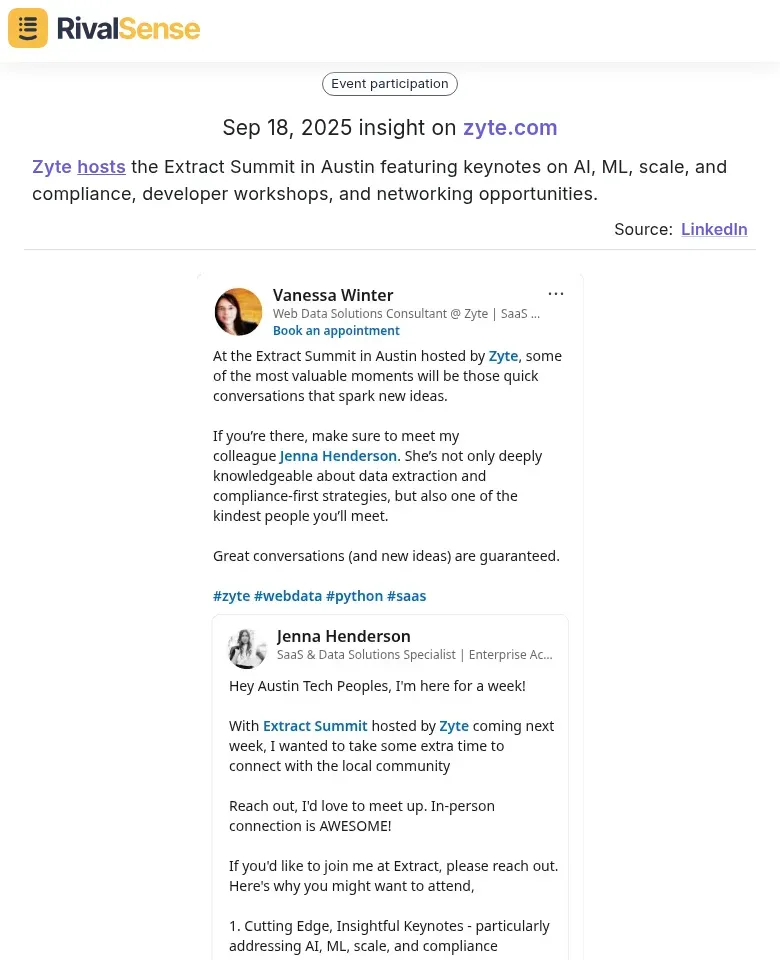
Consider how RivalSense tracked that Zyte hosts the Extract Summit in Austin featuring keynotes on AI, ML, scale, and compliance, developer workshops, and networking opportunities. This type of insight is valuable because it allows you to identify industry events where competitors showcase innovations, helping you stay updated on trends and potential partnerships.
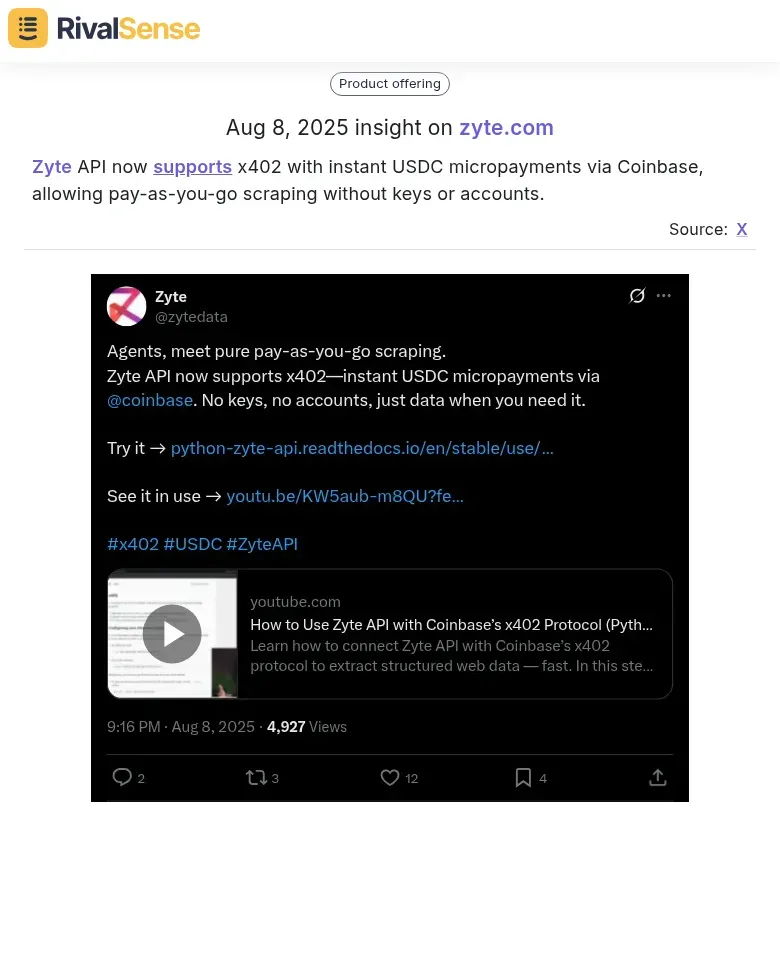
Emerging payment models are also reducing adoption barriers significantly. Look for providers offering hybrid pricing and transparent cost structures. For example, RivalSense detected that Zyte API now supports x402 with instant USDC micropayments via Coinbase, allowing pay-as-you-go scraping without keys or accounts. Monitoring such updates helps you understand competitive pricing and payment innovations, enabling you to optimize your own cost structures.
Checklist for leveraging innovation insights:
- Evaluate API documentation quality and integration capabilities
- Test solutions with your existing tech stack
- Verify compliance features and legal boundaries
- Attend industry conferences or track them through competitor monitoring
Implementation Framework: Building a Web Scraping Strategy for Customer Service
Building an effective web scraping strategy requires careful planning and integration into existing workflows. Start by defining clear objectives and selecting the right tools for your business scale. This ensures that data collection aligns with customer service goals and operational needs.
Step-by-Step Integration:
- Identify Use Cases: Start with specific customer service needs - monitoring competitor support forums, tracking product review trends, or analyzing customer sentiment across platforms.
- Map to Workflows: Integrate scraped data into existing systems - feed competitor pricing insights into CRM alerts, route trending complaints to support teams, or flag emerging issues for proactive resolution.
- Pilot Testing: Begin with 5-10 target sites before scaling. Example: Scrape top 3 competitor support forums for 30 days to identify recurring customer pain points.
Technology Selection Checklist:
- Small Businesses: Use no-code tools like BrowseAI or Octoparse for basic review monitoring
- Mid-Market: Consider Python-based solutions (Beautiful Soup + Scrapy) with cloud hosting for scalability
- Enterprise: Invest in dedicated scraping services with API integration, real-time monitoring, and compliance features
- Key Criteria: Data refresh frequency, target site complexity, integration capabilities, and budget constraints
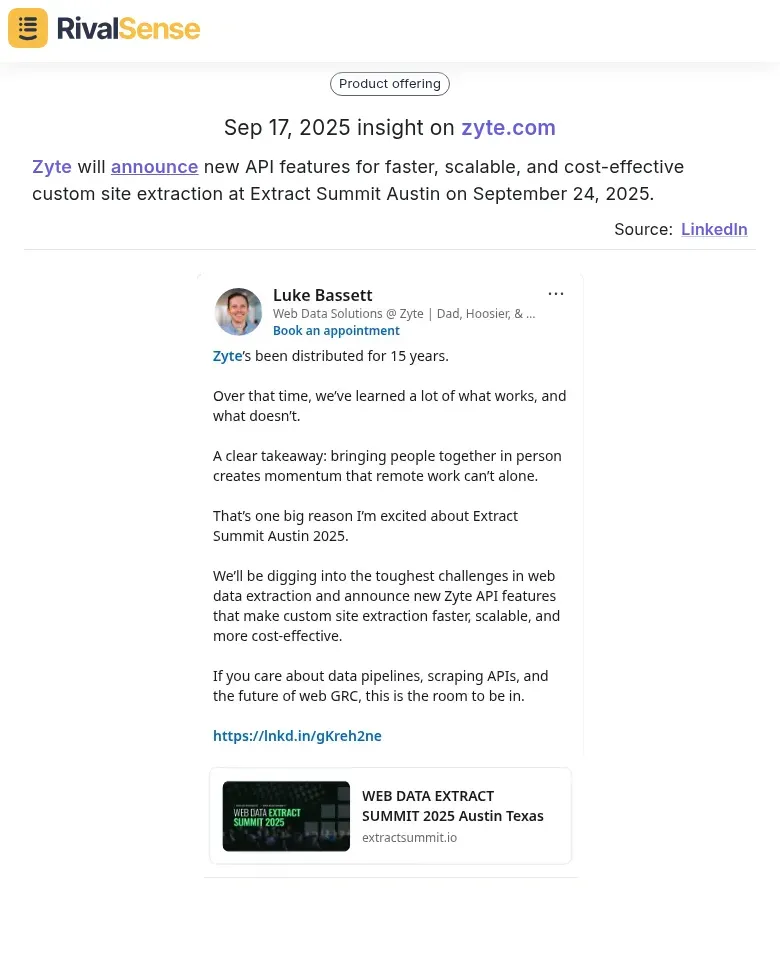
Monitoring competitor product launches can reveal new features to benchmark against. For instance, RivalSense detected that Zyte will announce new API features for faster, scalable, and cost-effective custom site extraction at Extract Summit Austin on September 24, 2025. This insight helps you evaluate your own technology stack and anticipate market shifts, ensuring you remain competitive.
Compliance & Ethical Framework:
- Always Check: robots.txt files and Terms of Service before scraping
- Rate Limiting: Implement 3-5 second delays between requests to avoid server overload
- Data Privacy: Never scrape personal information without explicit consent
- Transparency: Use identifiable user agents (e.g., "CompanyName Support Research Bot") and provide contact information
- Legal Boundaries: Avoid scraping protected content (health records, financial data, subscription-only materials)
Pro Tips: Schedule scraping during off-peak hours (2-5 AM local time), implement exponential backoff for failed requests, and maintain detailed logs for compliance audits. Remember: Just because you can scrape something doesn't mean you should - prioritize sustainable, respectful data collection that builds long-term value.
Future Outlook: Next-Generation Web Scraping for Customer Experience
The future of web scraping for customer experience is being reshaped by AI and machine learning advancements. These technologies will enable more sophisticated analysis and predictive capabilities, transforming how businesses interact with customers. Next-generation solutions will leverage natural language processing to analyze customer sentiment across millions of reviews, social media posts, and support forums in real-time.
Industry trends point toward more accessible, scalable solutions with three key developments:
- AI-Powered Sentiment Analysis: Tools that automatically categorize feedback by emotion, urgency, and topic
- Predictive Customer Intelligence: Systems that identify emerging issues by analyzing competitor customer complaints
- Integrated CX Platforms: All-in-one solutions combining web scraping with CRM and support systems
Practical Implementation Checklist:
- Start with targeted scraping of competitor review platforms and support forums
- Implement sentiment analysis to identify recurring pain points
- Create alerts for sudden changes in competitor customer satisfaction
- Integrate scraped data with your existing customer service analytics
- Regularly benchmark your performance against industry leaders
Pro Tip: Focus on collecting structured data (ratings, categories) alongside unstructured feedback for more accurate predictive modeling. The most successful implementations will combine web scraping with internal customer data to create a 360-degree view of customer experience across the competitive landscape.
Putting It All Together: Leverage Competitor Insights with RivalSense
Web scraping for customer service offers a powerful way to gain competitive advantages through real-time insights and proactive strategies. By benchmarking against industry leaders, monitoring sentiment, and tracking innovations, you can enhance customer satisfaction and operational efficiency.
To streamline this process, consider using a dedicated competitor tracking tool like RivalSense. It automates the monitoring of competitor product launches, pricing updates, event participations, partnerships, and more, delivering all insights in a weekly email report. This saves time and ensures you never miss critical updates that could impact your business strategy.
Ready to transform your customer service with data-driven insights? Try out RivalSense for free at https://rivalsense.co/ and get your first competitor report today.
📚 Read more
👉 Real-World Competitor Insights: Hiring and Layoff Patterns for Key Account Strategy
👉 Decoding Competitor Moves: A Real-World Analysis of Paige Powers' Transition to Fortinet
👉 The Complete Guide to Key Account Tracking Integration: Practical Strategies for 2026
👉 The Ultimate Competitor Customer Acquisition Checklist for Data Processing Outsourcing
👉 How Zapier's LinkedIn AI Partnership Alerted Competitors to Act