
Uncover Competitor Secrets: A Step-by-Step Guide to Twitter Content Marketing Intelligence
Twitter offers unparalleled real-time visibility into competitor strategies, making it a goldmine for content marketing intelligence. Unlike static websites or quarterly reports, Twitter reveals immediate announcements, strategic pivots, and audience reactions as they happen. By monitoring competitor tweets, you can track product launches, content campaigns, and partnership announcements in real-time, giving you a competitive edge to adapt quickly.
This analysis uncovers critical content gaps in your market. Notice which competitor topics generate high engagement versus those that fall flat? These patterns highlight underserved audience interests you can capitalize on. For example, if competitors consistently tweet about "AI automation" but rarely address "implementation challenges," you've identified a content opportunity.
Practical steps to start:
- 🐦 Create Twitter lists for key competitors
- 🔍 Track hashtags they use consistently
- 📊 Monitor engagement metrics (likes, retweets, replies) to identify resonant messaging
- 👥 Analyze their follower interactions to understand audience pain points
This strategic monitoring reveals not just what competitors say, but how their audience responds—providing actionable insights for your own content positioning and engagement strategies.
Step 1: Setting Up Your Twitter Competitor Monitoring Framework
Before diving into Twitter analysis, establish a structured monitoring framework. Start by categorizing competitors: primary (direct market rivals), secondary (indirect competitors in adjacent spaces), and aspirational (industry leaders you admire). This categorization helps prioritize your tracking efforts and focus on the most relevant insights for your business strategy.
Create a spreadsheet with their Twitter handles, follower counts, and content focus areas. Set monitoring parameters: daily checks for primary competitors, weekly for secondary, and monthly for aspirational. Track key metrics: engagement rates (likes, retweets, replies), follower growth, content themes, and posting frequency.
Practical Checklist:
✅ Identify 3-5 primary, 2-3 secondary, and 1-2 aspirational competitors
✅ Document baseline metrics for comparison
✅ Set up automated monitoring alerts for competitor announcements
✅ Schedule regular review sessions (weekly/monthly)
✅ Use browser bookmarks for quick access to competitor profiles
Tip: Don't just track what they post—analyze when they post (optimal timing), who engages (audience demographics), and how content performs over time to uncover strategic advantages.
Step 2: Analyzing Competitor Product and Partnership Announcements
Product and partnership announcements on Twitter reveal competitor innovation cycles and strategic positioning. These tweets often signal market trends and future directions, allowing you to anticipate shifts and adjust your content strategy accordingly. By dissecting these announcements, you can identify gaps in your own offerings and find opportunities for differentiation.
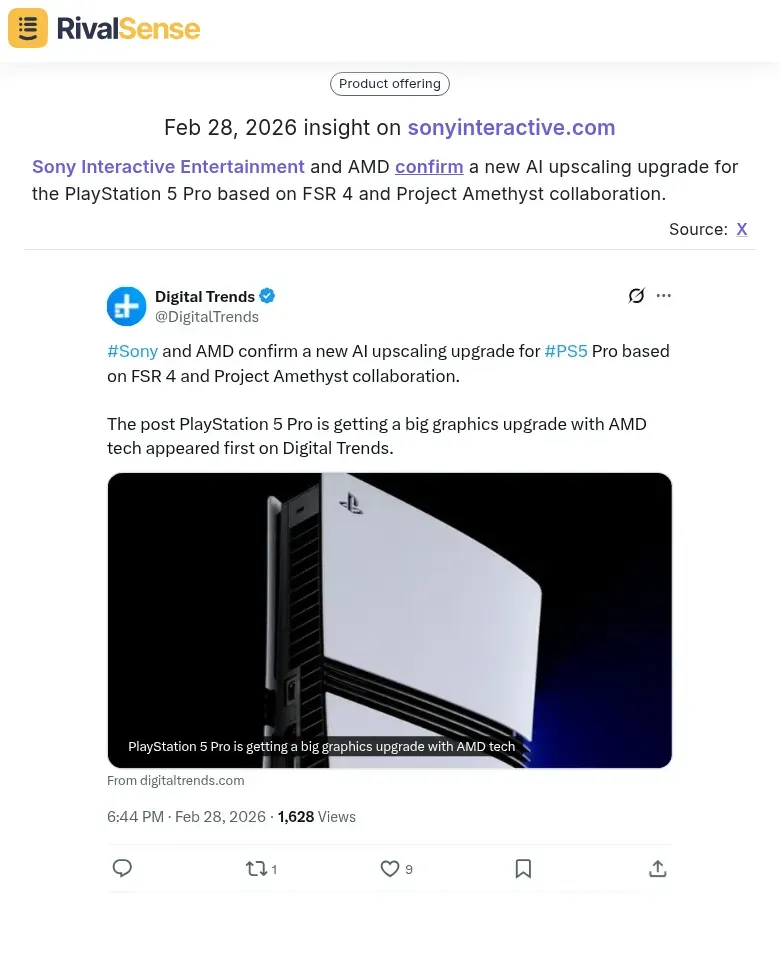
For example, consider this real-world insight from RivalSense: Sony Interactive Entertainment and AMD confirm a new AI upscaling upgrade for the PlayStation 5 Pro based on FSR 4 and Project Amethyst collaboration.
Why this insight matters: Tracking product and partnership announcements allows you to spot emerging technologies and market alliances early. This intelligence helps you anticipate industry shifts, identify content gaps, and position your offerings to address unmet customer needs, ultimately informing your product development and marketing campaigns.
Actionable Steps:
- Feature Gap Analysis: Track competitor product launches to identify features you lack. Create a checklist with release dates, key features, target audience, and customer reactions.
- Partnership Intelligence: Monitor partnership announcements to understand market alliances. Use Boolean searches like "(competitor) AND (partner OR collaborate) AND (company)" on Twitter.
- Roadmap Extraction: Analyze language patterns for terms like "future," "roadmap," or "next-gen" to hint at upcoming releases.
Tip: Set up automated alerts for competitor announcements using tools like RivalSense. When you spot a launch, immediately analyze: What problem does it solve? Who's the target audience? Use this to create counter-content that highlights your strengths or addresses gaps.
Step 3: Monitoring Competitor Service and Platform Enhancements
Service and platform updates are often announced on Twitter with tailored messaging for different audiences. Monitoring these enhancements helps you understand how competitors communicate technical changes and where your content can provide clearer value. This step is crucial for B2B companies aiming to educate clients and stakeholders effectively.
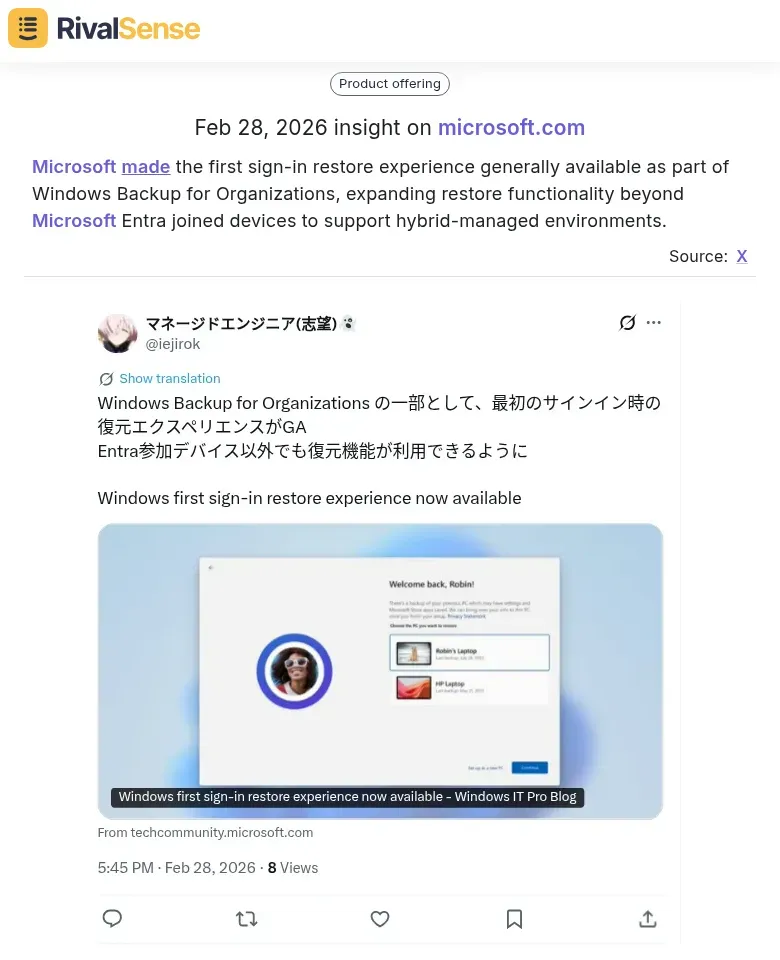
Take this example from RivalSense: Microsoft made the first sign-in restore experience generally available as part of Windows Backup for Organizations, expanding restore functionality beyond Microsoft Entra joined devices to support hybrid-managed environments.
Why this insight matters: Understanding how competitors roll out service enhancements helps you craft better content for your own updates. It reveals their content strategy for different user segments, allowing you to create more targeted and clear explanations that resonate with your audience, thus improving customer adoption and satisfaction.
Practical Steps:
- Monitor Announcements: Follow competitor Twitter accounts and set up alerts for keywords like "update," "launch," or "enhancement."
- Analyze Messaging: Note how they tailor content—basic explainers for general users vs. in-depth guides for enterprise clients.
- Identify Gaps: Look for complex features that lack clear explanations; these are opportunities to create better content.
- Check Engagement: See which posts get high shares or questions—this indicates audience needs.
Tip: Use tools like RivalSense to automate tracking and compare how multiple competitors handle similar updates. Focus on gaps where you can provide clearer, more actionable content to differentiate yourself.
Step 4: Tracking Competitor Financial and Strategic Communications
Financial and strategic communications on Twitter provide critical insights into competitor priorities and market confidence. Earnings announcements, revenue projections, and strategic goals shared publicly can reveal where competitors are investing and how they perceive market opportunities. This information is vital for aligning your content with industry trends and investor interests.
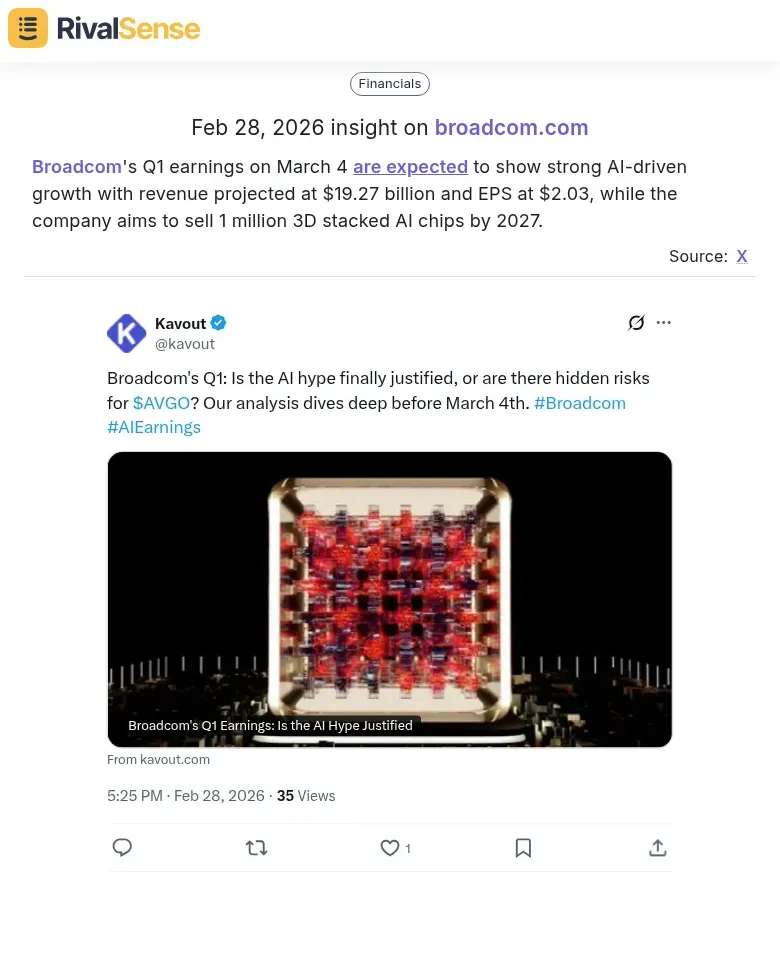
Here's a relevant RivalSense insight: Broadcom's Q1 earnings on March 4 are expected to show strong AI-driven growth with revenue projected at $19.27 billion and EPS at $2.03, while the company aims to sell 1 million 3D stacked AI chips by 2027.
Why this insight matters: Financial communications highlight market trends and strategic focus areas. By analyzing these, you can align your content strategy with emerging trends, such as AI growth, and craft messages that resonate with investor and customer interests, enhancing your credibility and market positioning.
Extract Actionable Insights:
- Track earnings tweets – Note how competitors highlight successes versus downplay weaknesses.
- Analyze narrative framing – Do they emphasize innovation, market share, or customer wins? This signals content themes for your own strategy.
- Monitor forward-looking statements – Projections hint at future content topics (e.g., AI, sustainability).
- Identify leadership messaging – Look for terms like "industry-leading" or "record performance" to understand positioning.
Practical Tip: Use Twitter lists to aggregate financial accounts and set alerts for earnings dates. Create a checklist to capture key metrics, narrative tone, and implied content angles.
Step 5: Synthesizing Insights and Developing Your Content Advantage
Now transform your Twitter intelligence into actionable competitive advantages. First, create a competitive content matrix: Map competitors' content themes against engagement metrics and audience sentiment. Identify gaps where they're underperforming or missing key topics your audience cares about. This synthesis helps you prioritize content creation that directly addresses market needs.
Develop counter-strategies: For high-performing competitor content, create superior versions with deeper insights, better visuals, or interactive elements. For their weak areas, launch targeted content campaigns to dominate those topics. Differentiate by focusing on underserved audience segments or unique angles they've overlooked.
Practical Checklist:
✅ Map 3-5 competitor content themes vs. engagement metrics
✅ Identify 2-3 content gaps to exploit
✅ Create 1-2 "superior version" content pieces monthly
✅ Set weekly monitoring alerts for competitor activity
✅ Schedule quarterly strategy reviews based on fresh intelligence
Conclusion and Next Steps
By systematically monitoring competitors on Twitter, you can uncover valuable insights that drive your content marketing strategy. From product launches to financial communications, each piece of intelligence helps you stay ahead of market trends and address audience needs more effectively. However, manual tracking can be time-consuming and prone to missing key updates.
To streamline this process, consider using a dedicated competitor tracking tool like RivalSense. It automates the monitoring of competitor activities across websites, social media, and various registries, delivering weekly reports straight to your inbox. This saves you time and ensures you never miss critical updates like product launches, pricing changes, or media mentions.
Ready to gain a competitive edge? Try RivalSense for free at https://rivalsense.co/ and get your first competitor report today to start transforming Twitter intelligence into actionable advantages.
📚 Read more
👉 Mastering Key Account KPIs for Enterprise AI Platform Success
👉 Beginner's Guide to Competitor Pricing Insights and Key Account Sentiment Tracking
👉 Leveraging Social Clues for Competitor Analysis: A Case Study on Huel
👉 Mastering Competitor Intelligence: Leveraging Customer Reviews in Systems Software Development