
Uncover Competitor Innovation Advantages Through Twitter Intelligence
Twitter offers a real-time window into competitor activities that traditional market research often misses. While competitors carefully craft official announcements, their Twitter activity reveals strategic moves, innovation patterns, and market testing long before formal releases. Social listening on this platform uncovers early signals—like sudden tweet frequency spikes, new hashtag adoption, or engagement with specific industry topics—that indicate upcoming product launches, strategic pivots, or market expansions.
Practical Steps to Start:
- Create private Twitter lists for primary, secondary, and tertiary competitors
- Use advanced search operators ("from:competitor hiring" or "award") to filter strategic content
- Monitor engagement patterns on competitor posts to identify market resonance
- Track hashtag evolution to spot emerging themes before campaign launches
Early detection through Twitter intelligence provides 2-4 weeks' advantage over traditional market research, enabling proactive strategy adjustments. When competitors test new messaging or showcase innovation partnerships, you can counter with differentiated positioning or accelerate your own development timelines. This real-time insight transforms reactive competition into proactive market leadership.
Detecting Regulatory and Legal Innovation Risks Through Twitter Monitoring ⚖️
Twitter monitoring reveals critical regulatory and legal innovation risks that competitors face, allowing you to anticipate industry-wide challenges. Track mentions of regulatory bodies (FTC, SEC, GDPR), lawsuits, fines, and compliance discussions to identify vulnerabilities that could impact innovation pipelines. For example, when a competitor tweets about "regulatory challenges" or "compliance updates," analyze the context to understand specific issues affecting their market position.
Practical steps:
- Create Twitter lists for competitors' legal teams, compliance officers, and regulatory affairs accounts
- Monitor hashtags like #GDPRviolation, #FTCfine, #compliancefail
- Set alerts for competitor mentions with keywords: "lawsuit," "fine," "regulatory action," "compliance issue"
- Analyze patterns in competitor legal discussions to anticipate industry-wide regulatory shifts
When competitors face fines or legal actions, document the specific violations and innovation impacts. Did a data privacy fine delay their AI product launch? Did an IP lawsuit stall their R&D? Use these insights to audit your own compliance frameworks and avoid similar innovation roadblocks.
Example Insight: Regulatory events can signal broader market risks. For instance, RivalSense tracked that Korean Air and Asiana Airlines were fined $4.4 million by South Korea's competition authorities on December 25. 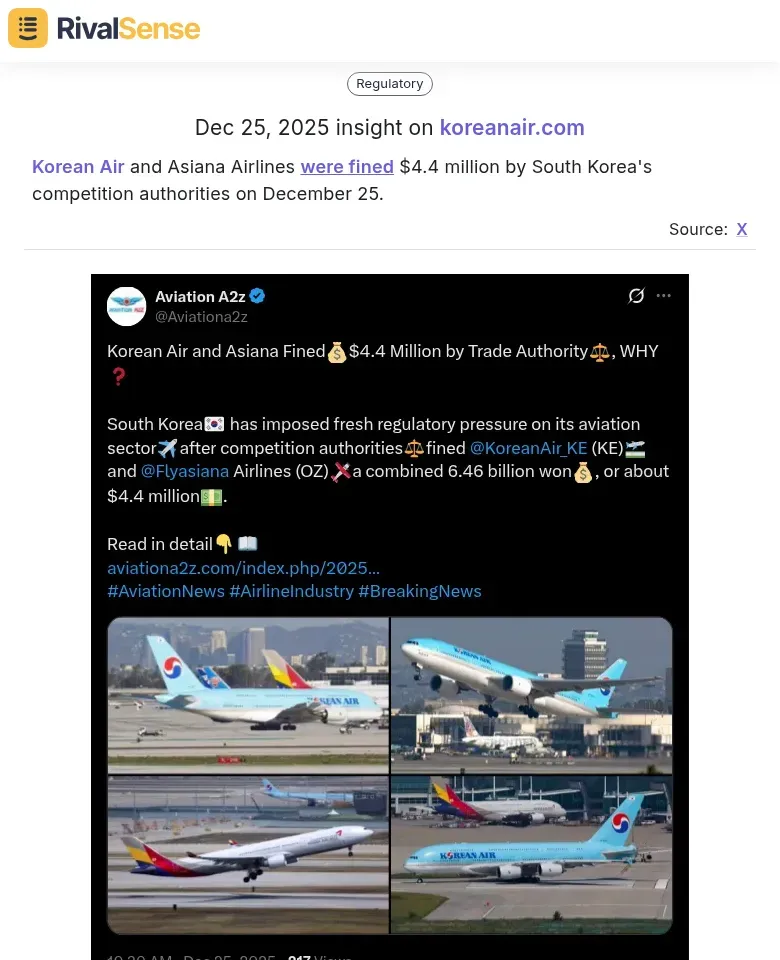 Monitoring such fines helps you understand regulatory pressures in your industry, allowing you to adjust strategies proactively and avoid costly penalties.
Governance issues revealed on Twitter—like executive turnover during regulatory investigations or board changes following compliance failures—signal deeper innovation capability erosion. Track how these events correlate with product delays or market share losses to understand the tangible impact of legal risks on competitive positioning.
Tracking Product and Partnership Innovations via Twitter Announcements 🔍
Twitter serves as a real-time innovation radar where competitors often announce product updates and partnerships before official market launches. By monitoring their accounts, you can detect new feature releases through teaser posts, beta program announcements, and customer feedback threads that provide early signals of market direction. For example, when a SaaS competitor tweets about "exciting integrations coming soon," they're signaling technology priorities that could impact your market position.
Practical steps for tracking product innovations:
- Create private Twitter lists for each major competitor
- Set up keyword alerts for terms like "beta," "launch," "update," and "feature"
- Monitor engagement patterns on announcement posts to gauge market interest
- Use tools like TweetDeck or RivalSense to automate tracking across multiple accounts
Partnership announcements reveal ecosystem expansion strategies. When competitors announce collaborations, analyze the partner types (technology integrations, co-marketing, joint ventures) and engagement metrics. High interaction rates indicate successful alliances worth studying. Track recurring partnership patterns to identify strategic priorities—if a competitor consistently partners with AI companies, they're likely building machine learning capabilities.
Example Insight: Product updates can reveal innovation trends. RivalSense captured that n8n released new nodes for its workflows on December 24, featuring partners like AssemblyAI and Famulor.  Tracking such releases helps you benchmark competitor advancements, identify partnership opportunities, and accelerate your own product roadmap to stay competitive.
Technology integration patterns offer innovation signals. Monitor hashtags competitors use for new initiatives and analyze which integrations they highlight. When multiple competitors adopt similar technologies (like API-first approaches or specific cloud providers), it signals industry-wide innovation trends you should evaluate.
Checklist for actionable intelligence:
- ✅ Document announcement dates and engagement metrics weekly
- ✅ Categorize innovations by type (product features, partnerships, integrations)
- ✅ Compare timing with your own roadmap to identify gaps
- ✅ Set up alerts for competitor mentions of your product categories
- ✅ Share insights with product and marketing teams during weekly strategy sessions
Uncovering Organizational and Leadership Innovation Signals 👥
Twitter intelligence reveals critical organizational innovation signals beyond product announcements, such as leadership changes and governance disputes. Monitor leadership changes through new account follows, role updates, and congratulatory tweets from team members to gauge shifts in strategic direction. When executives join or depart, track their first/last 30 days of activity for innovation priorities and project handoffs that could affect competitor momentum.
Governance disputes surface through subtle signals: increased legal/HR follows, sudden policy tweets, or leadership team unfollows. These disruptions can stall innovation momentum by 3-6 months, giving you a window to capitalize on their instability. Create a dispute impact checklist: (1) Monitor board member activity spikes, (2) Track investor relation tweet patterns, (3) Flag executive team engagement drops.
Example Insight: Governance issues can impact operational stability. RivalSense reported that a court issued a temporary protection order to halt the registration of a new board of directors for Thai Airways and prevent the new board from performing duties until the case is finalized.  Monitoring such events helps you anticipate competitor vulnerabilities, assess risks in your own governance, and make informed strategic decisions.
Talent acquisition patterns reveal innovation focus areas. When competitors hire clusters of AI/ML engineers, data scientists, or UX researchers, they're likely building new capabilities. Practical steps: (1) Set alerts for "welcome to the team" tweets with specific roles, (2) Analyze new hire's previous project mentions, (3) Track which departments are growing fastest through hiring announcements.
Pro tip: Combine these signals. Leadership change + specific talent hires = strategic pivot. Governance tension + hiring freeze = innovation slowdown. Document patterns monthly to predict competitor moves 6-12 months ahead.
Practical Framework for Building Your Twitter Intelligence System 🛠️
Building an effective Twitter intelligence system requires a structured approach to transform data into actionable insights. Start by creating a comprehensive monitoring matrix: track 5-10 key competitor accounts, 3-5 industry thought leaders, and 15-20 strategic keywords (product launches, hiring patterns, partnership announcements). Use Twitter Lists for organization and set up automated alerts for real-time notifications to stay ahead of trends.
Develop a categorization framework to prioritize signals: categorize innovations as 'Immediate Threat' (direct product competition), 'Strategic Shift' (market repositioning), or 'Future Trend' (emerging technologies). Score each signal on impact (1-5) and timeline (immediate/6-12 months/long-term) to focus resources effectively.
Create actionable intelligence reports with this structure:
- Executive Summary (key findings)
- Innovation Dashboard (visual tracking)
- Competitive Moves Analysis
- Strategic Recommendations
Include specific next steps like 'Test competitor's new feature within 2 weeks' or 'Schedule competitive response meeting.'
Pro tip: Dedicate 30 minutes weekly to review signals and update your framework. This systematic approach transforms raw Twitter data into strategic competitive intelligence.
Conclusion: Turning Twitter Intelligence into Competitive Advantage 🏆
To transform Twitter intelligence into sustainable competitive advantage, integrate these insights into your broader competitive intelligence framework for a holistic view. Start by creating a centralized dashboard that combines Twitter data with other sources like product launches, pricing changes, and market reports to reveal patterns that isolated data points miss.
Develop proactive innovation strategies by analyzing competitor Twitter patterns. Track their customer engagement approaches, feature announcements, and pain point discussions. When you notice consistent themes—like repeated complaints about a specific feature—consider developing solutions before your competitors do. Create a quarterly innovation roadmap based on these insights to stay agile.
Measure business impact with clear KPIs: track how Twitter intelligence influences product development timelines, customer acquisition costs, and market share growth. Implement a simple scoring system: assign value to insights based on their potential revenue impact and implementation feasibility. Regularly review which Twitter-derived initiatives delivered the highest ROI.
Practical checklist:
- Establish weekly Twitter intelligence review meetings
- Create competitor Twitter activity heatmaps
- Set up alerts for competitor innovation keywords
- Document insights in your competitive intelligence repository
- Link Twitter findings to specific business outcomes
Remember: The goal isn't just monitoring competitors—it's anticipating their next moves and innovating faster.
Ready to streamline your competitor tracking? Try out RivalSense for free to get automated insights on competitor product launches, pricing updates, regulatory changes, and more—delivered in a weekly email report. Get your first competitor report today and stay ahead of the curve!
📚 Read more
👉 VPN Key Account Management: A Process Optimization Guide for Cybersecurity Leaders
👉 Competitor Product Insights: A Strategic Guide for Key Account Management
👉 Decoding Competitor Strategy: How Safran's Air Show Move Reveals Innovation Priorities
👉 How to Track Competitor Podcast Appearances: The Complete Strategic Guide
👉 How Systems Software Leaders Win with Competitor Feature Gap Analysis