
Uncover Competitor Financial Moves: Monitor Press Releases for M&A Insights
In the fast-paced B2B landscape, staying ahead means understanding not just what competitors do, but why they do it. Press releases serve as official windows into competitor financial strategies, offering unfiltered insights into their strategic direction. When competitors announce mergers, acquisitions, or funding rounds, they're revealing their growth ambitions, market positioning, and financial health in real-time. These announcements go beyond simple news—they're strategic signals about where competitors are investing, what markets they're targeting, and how they're positioning themselves for future growth.
M&A announcements are particularly revealing. A competitor acquiring a complementary technology company signals expansion into new product categories. Acquiring a smaller competitor suggests consolidation moves. Each transaction reveals growth trajectories, market priorities, and financial capacity that traditional financial reports won't show for months.
Practical tip: Create a monitoring checklist:
- Track competitor press release sections daily
- Set alerts for keywords: "acquisition," "merger," "funding," "investment"
- Analyze the strategic rationale in each announcement
- Note deal sizes and valuation metrics
- Map acquisition patterns over time
Real-time monitoring gives you competitive advantage by allowing immediate strategic response rather than reactive catch-up. You'll spot market trends before they become obvious and anticipate competitor moves before they impact your market position.
Decoding M&A Announcements: Strategic Insights from Acquisition Patterns
M&A announcements reveal more than just financial transactions—they expose strategic intent and operational priorities. By analyzing these moves, you can decode competitor roadmaps and identify vulnerabilities. When analyzing competitor press releases, focus on three key patterns:
-
Talent Acquisition vs. Technology Buys: Partial acquisitions or 'acqui-hires' signal talent-focused strategies. Look for phrases like 'key team members joining' or 'select assets acquired'—these indicate competitors are buying expertise, not just products. Track which roles transfer to identify skill gaps they're filling.
Example from RivalSense: Scissero acquired Robin AI's legal services team on December 9, while Robin AI's tech group remains in negotiations with another company.
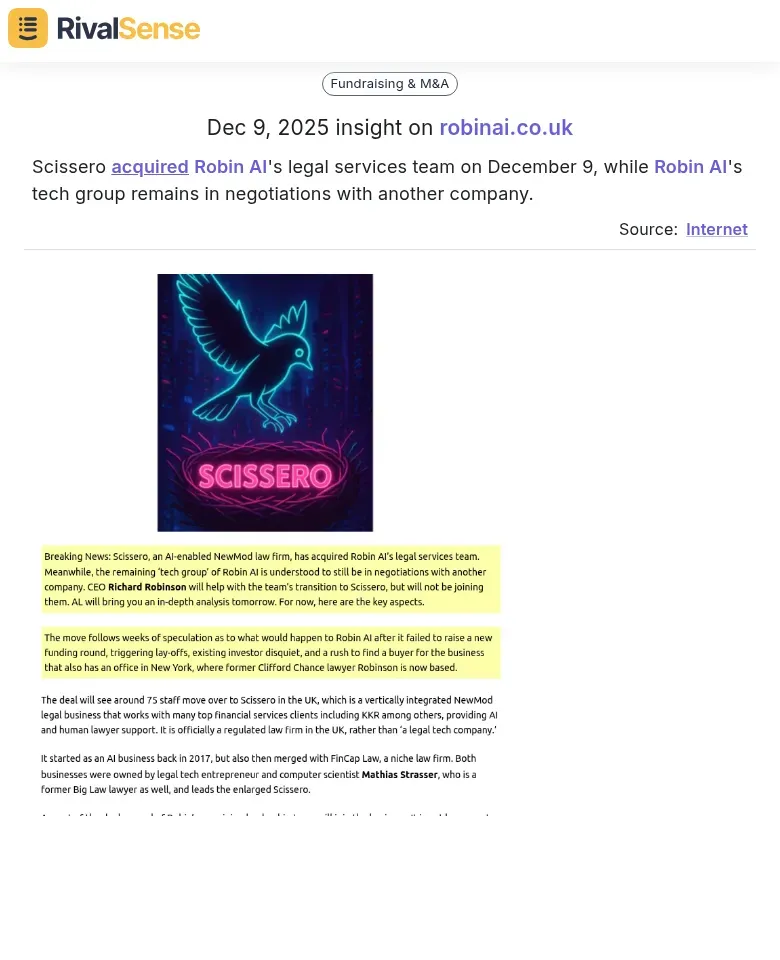
This insight is valuable because it highlights a partial acquisition focused on talent, revealing Scissero's strategy to bolster specific legal expertise. Understanding such moves helps you anticipate skill gaps competitors are filling and adjust your own talent acquisition or partnership strategies accordingly.
-
Strategic Pivot Indicators: Asset purchases versus full company acquisitions reveal different priorities. Buying specific technology suggests market expansion, while acquiring entire companies often signals market consolidation. Compare acquisition targets' core capabilities to the acquirer's existing offerings to spot strategic shifts.
-
Timing Analysis: Cluster M&A announcements by quarter and industry vertical. Multiple acquisitions in a short timeframe often precede market consolidation. Monitor seasonal patterns—Q4 acquisitions frequently aim for year-end market positioning.
Practical Checklist:
- Create a spreadsheet tracking: acquisition type (full/partial/asset), price ranges, key personnel transfers
- Set Google Alerts for competitor names + 'acquires', 'merger', 'investment'
- Analyze 3-5 years of historical M&A data to identify patterns
- Cross-reference with hiring announcements to connect talent strategies
Remember: The most valuable insights come from connecting multiple data points over time, not analyzing single transactions in isolation.
Financial Performance Signals: Reading Between the Lines of Corporate Updates
Financial performance isn't just about revenue numbers; it's about the underlying operational health that drives those results. Personnel performance metrics offer a window into organizational health that financial statements alone can't reveal. Track these key indicators: revenue per employee (benchmark against industry leaders like Netflix's $2.5M vs Microsoft's $939K), profit per FTE, and absenteeism rates (highly engaged teams show 81% lower absenteeism). Correlate individual team results with financial performance by analyzing sales team metrics alongside quarterly revenue trends. For example, declining outbound calls often precede revenue drops by 1-2 quarters.
Example from RivalSense: Millennium's portfolio managers Pratik Pratap Madhvani and Glen Scheinberg, who run large pods, experienced significant drawdowns in November 2025, contributing to the fund's low 0.5% return for the month. 
This type of insight is valuable because it provides early warning signals of financial stress or management challenges within competitors. By monitoring such personnel-related performance dips, you can identify potential vulnerabilities in their operations and exploit them in your strategic planning, such as targeting their key clients or talent during unstable periods.
Benchmarking steps:
- Collect competitor data from press releases and annual reports
- Calculate key ratios like revenue per employee
- Identify performance gaps exceeding 20% as vulnerabilities
- Monitor quarterly changes for early warning signals
Remember: high overtime rates often indicate operational inefficiencies that impact profitability within 6-12 months.
Funding and Emergence Announcements: Tracking Capital Infusion Strategies
Funding rounds and stealth emergence are loud signals of competitor ambition and market confidence. These announcements reveal critical insights into competitor strategies and future market shifts. When a competitor emerges from stealth with significant funding, analyze their timing relative to market cycles and your own product roadmap. This often signals aggressive market entry plans.
Example from RivalSense: Lumia emerged from stealth on December 4 with an $18M seed round backed by Team8 and joined by Admiral Mike Rogers, former Director of the NSA, as an advisor, focusing on AI usage control for employees and agents. 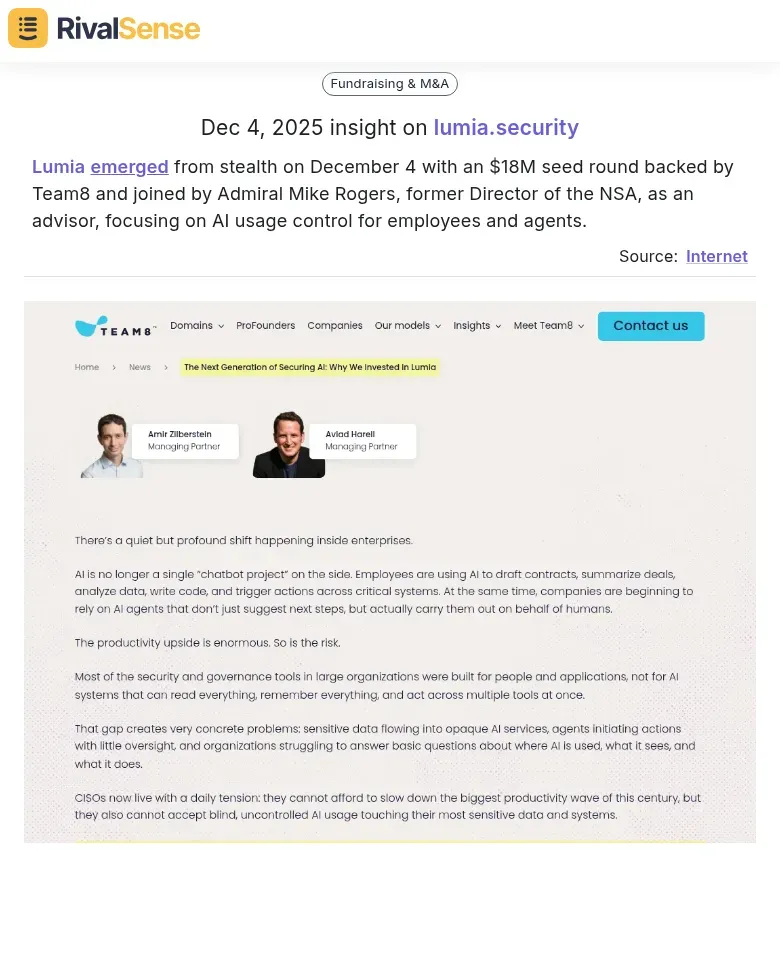
This insight is valuable because it combines funding, advisor recruitment, and strategic focus, indicating Lumia's serious entry into the AI security space. Tracking such emergence helps you assess new competitive threats early, understand investor-backed trends, and adjust your product or marketing strategies to counter their value propositions.
Practical steps for tracking capital infusion strategies:
- Monitor press releases for funding announcements and stealth emergence patterns
- Evaluate investor backing - venture capital firms often indicate strategic direction (e.g., AI-focused VCs backing AI startups)
- Track advisor recruitment - industry veterans joining signals market focus areas
- Connect funding amounts to specific initiatives - $5M for R&D vs. $20M for market expansion
Key analysis checklist:
- Map emergence timing against industry events and product launches
- Research investor portfolios to understand strategic alignment
- Analyze funding allocation between technology development vs. sales/marketing
- Track follow-on funding rounds to gauge execution success
Example: A competitor emerging with $15M from healthcare-focused VCs while recruiting former hospital executives signals a healthcare vertical strategy. Compare their funding timeline to your own capital needs and adjust your competitive response accordingly.
Building Your Press Release Monitoring System: Tools and Methodologies
An effective monitoring system turns raw data into actionable intelligence, saving you time and ensuring you never miss a critical update. To build this system, start with automated alerts using tools like Google Alerts, Mention, or Meltwater. Set up keywords for each competitor including variations of their name plus terms like "acquisition," "merger," "funding," "SEC filing," and "earnings report." Create separate alerts for regulatory filings (SEC EDGAR for US companies) to catch financial disclosures.
Next, build a structured database in Airtable, Notion, or a simple spreadsheet. Track key data points: announcement date, transaction type (M&A, funding round, IPO), amount, involved parties, and strategic rationale. Maintain a timeline for each competitor to identify patterns in their financial moves.
Develop an analysis framework that connects press release data with market intelligence. For each announcement, ask: What market gap does this address? How does it fit their historical M&A pattern? What does the funding amount suggest about their growth stage? Cross-reference with industry reports and competitor website changes to understand the broader strategic context.
Practical checklist:
- Set up automated alerts with 3-5 keyword variations per competitor
- Create database templates before monitoring begins
- Schedule weekly reviews of collected announcements
- Tag announcements by strategic type (defensive, expansion, talent acquisition)
- Track post-announcement performance indicators (stock price, hiring patterns)
Turning Insights into Action: Strategic Responses to Competitor Financial Moves
Spotting competitor moves is only the first step; the real value lies in translating those insights into decisive actions. When you identify financial maneuvers through press releases, transform insights into action with these strategic responses:
Develop Counter-Strategies Based on Acquisition Patterns
- Analyze acquisition targets: Are they buying complementary tech, talent, or market access?
- Create defensive plays: If a competitor acquires a key supplier, secure alternative partnerships
- Example: When a SaaS competitor buys an AI startup, accelerate your own AI roadmap or partner with remaining specialists
Adjust Resource Allocation After Funding Announcements
- Reallocate marketing budgets when competitors secure large funding rounds
- Prioritize R&D investments in areas where newly-funded competitors might innovate
- Checklist: Review quarterly budgets, shift resources to competitive gaps, and accelerate hiring in critical areas
Proactively Position Based on Financial Strengths/Weaknesses
- Exploit weaknesses: If a competitor takes on heavy debt, emphasize your financial stability
- Counter strengths: When competitors gain cash reserves, focus on your unique value propositions
- Tip: Use SWOT analysis to map competitor financial positions against your capabilities
Practical Steps:
- Create a 90-day action plan after each significant competitor financial announcement
- Conduct scenario planning for potential competitor moves
- Establish a cross-functional team to monitor and respond to financial intelligence
- Adjust pricing, marketing, and product strategies based on competitor financial capacity
Remember: The goal isn't just to react, but to anticipate and outmaneuver. Use financial intelligence to stay three moves ahead in the competitive chess game.
Putting It All Together: From Monitoring to Mastery
Consistently monitoring press releases for financial insights requires dedication, but the payoff is a clear competitive edge. By decoding M&A patterns, tracking funding moves, and analyzing performance signals, you can anticipate market shifts and refine your strategy. However, manual monitoring can be time-consuming and prone to missing critical updates.
To streamline this process, consider leveraging automated tools like RivalSense. It tracks competitor product launches, pricing updates, event participations, partnerships, regulatory aspects, management changes, and media mentions across websites, social media, and registries, delivering all in a weekly email report. This ensures you never miss a beat and can focus on strategic decision-making.
Ready to uncover competitor financial moves with ease? Try RivalSense for free and get your first competitor report today to start transforming insights into action!
📚 Read more
👉 Decoding Competitor Strategies: Insights from Russell Reynolds Associates' CFO Event
👉 Key Account Tracking for Mobile Apps: A Strategic Guide to Monitoring Competitors
👉 Aviation Fuel Construction CRM Mistakes: Avoiding Key Account Tracking Pitfalls
👉 How Wialon's Platform Launch Enabled Competitors to Accelerate Innovation
👉 LinkedIn Competitor Insights: Track Key Account Satisfaction with Real-World Examples