
Uncover Competitor Event Strategies for Enterprise Key Accounts
🎯 In the high-stakes world of enterprise key accounts, industry events have become strategic battlegrounds where competitors directly influence decision-makers. These gatherings represent critical touchpoints where your rivals showcase their latest solutions, build relationships with your most valuable clients, and position themselves as thought leaders. Event participation reveals competitor priorities—when they choose to speak, sponsor, or exhibit, they're signaling which market segments and accounts they're targeting most aggressively.
Proactive monitoring of competitor event strategies is essential for protecting valuable client relationships. Start by creating a competitor event tracking checklist:
- Monitor their speaking engagements at major industry conferences
- Track their sponsorship levels and booth locations
- Analyze their event marketing materials and messaging
- Note which accounts they're targeting with VIP sessions
- Watch for post-event follow-up campaigns
This intelligence helps you anticipate competitive moves, prepare counter-strategies, and reinforce your value proposition before competitors can make inroads with your key accounts.
Analyzing Competitor Event Selection and Investment Patterns
📊 Understanding where competitors invest their event budgets reveals their strategic priorities. By monitoring their participation patterns, you can anticipate their market moves and align your own strategy accordingly. To analyze competitor event selection and investment patterns, start by tracking their sponsorship tiers and speaking opportunities. Higher-tier sponsorships at major industry conferences signal strategic priorities and budget allocation.
For example, RivalSense recently tracked that Powerfleet will attend the Leaders in Logistics Summit in Brussels on March 17-18, 2026, showcasing its Unity platform and tools like Pedestrian Proximity Detection, Forklift Gateway, and VisionAI to help logistics teams reduce incidents and improve operations. 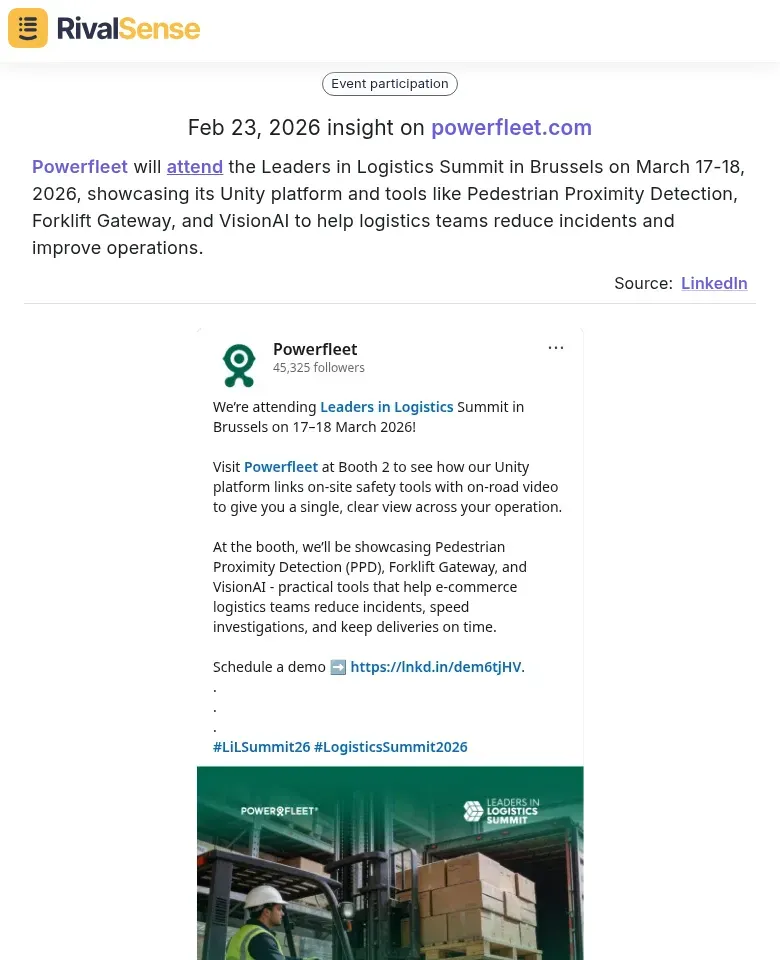
This type of insight is valuable because it shows a competitor's focused investment in a specific vertical (logistics), indicating their target market and product priorities. It helps you understand where they are allocating resources and which accounts they might be pursuing.
Practical steps:
- Create a spreadsheet tracking competitor events, sponsorship levels, and speaking roles
- Note recurring patterns in event types (industry-specific vs. broad tech conferences)
- Analyze audience demographics of each event to understand targeting strategies
Industry-specific event targeting reveals vertical focus. A competitor attending niche logistics summits rather than general SaaS conferences indicates a specialized enterprise approach. Map their event portfolio: trade shows for broad awareness, executive roundtables for key account nurturing, and technical workshops for product adoption.
Checklist for analysis:
- ✅ Identify top 3-5 events per competitor annually
- ✅ Track year-over-year investment changes
- ✅ Note which competitors share speaking stages
- ✅ Analyze post-event content (case studies, announcements)
This reveals whether competitors prioritize thought leadership, lead generation, or partnership building through events, helping you refine your own enterprise key account strategy.
Decoding Competitor Messaging and Positioning at Events
🗣️ At industry events, competitors reveal their strategic priorities through carefully crafted presentations and solution showcases. Their messaging at these events provides clues about their value proposition and how they aim to differentiate themselves in the market. To decode their messaging, start by analyzing presentation themes: What problems do they emphasize? Which solutions get prime stage time?
Consider this RivalSense insight: Figma hosts Design with Pride in Sydney to celebrate diverse voices and inclusive creativity. 
This insight is valuable because it reveals how a competitor uses events to promote brand values like inclusivity, which can attract diverse talent and clients, and signal their market positioning. It helps you understand their messaging strategy beyond just product features.
Practical steps:
- Map competitor value propositions by noting recurring keywords, case studies, and ROI claims in their talks.
- Assess thought leadership positioning: Are they introducing new frameworks or research? This signals market influence ambitions.
- Identify gaps: Where do competitors oversimplify complex issues or ignore emerging customer pain points? These represent differentiation opportunities.
For example, if a competitor focuses heavily on cost savings but neglects security concerns in their fintech demo, you can position your solution as the secure alternative. Create a checklist: track messaging consistency across sessions, note audience engagement levels, and compare their event narrative with their website content for alignment insights.
💡 Tip: Use event recordings and slide decks post-event to analyze messaging nuances you might have missed live. This reveals not just what they say, but how they strategically communicate to enterprise key accounts.
Understanding Competitor Engagement and Relationship Building Tactics
🤝 Effective engagement tactics can make or break relationships with key accounts, so observing how competitors interact with attendees is crucial. To decode competitor event strategies for enterprise key accounts, focus on three tactical areas. First, analyze creative giveaways that capture leads: track what premium items (custom tech accessories, industry-specific tools) competitors offer in exchange for contact details.
Here's an example from RivalSense: Figma held its first pop-up event at Savannah College of Art and Design on February 20, attracting over 100 giveaways and many new users. 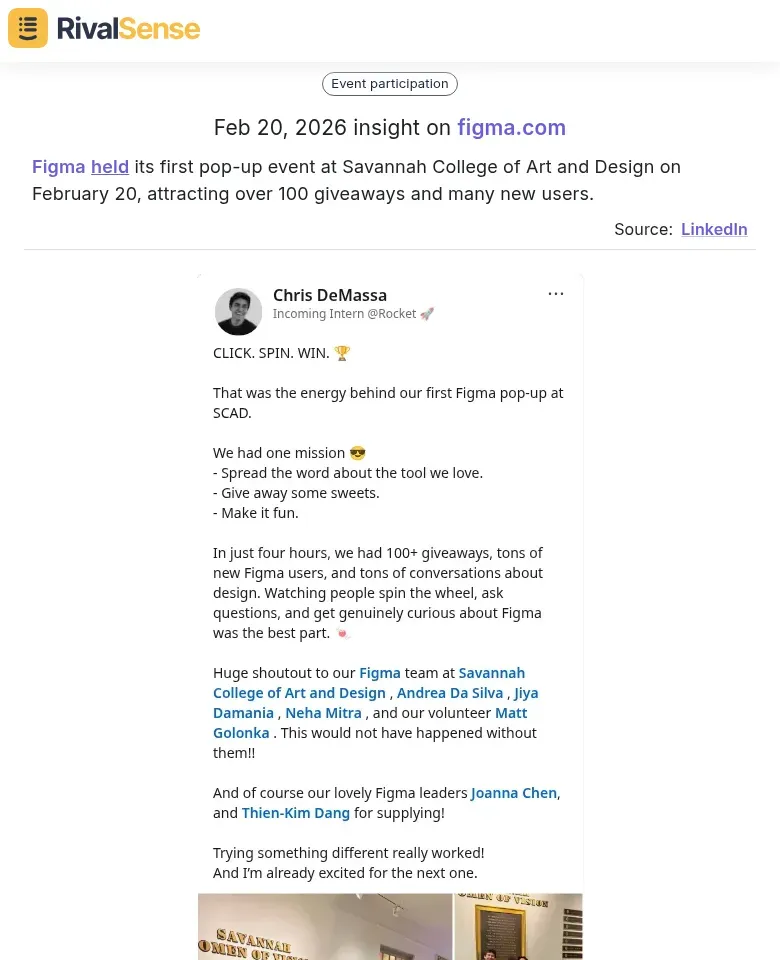
This insight is valuable because it demonstrates how pop-up events with giveaways can effectively generate buzz and acquire new users, especially in educational settings, which can be a strategy for early talent recruitment and brand building.
Create a checklist:
- Document giveaway types and perceived value
- Note lead capture mechanisms (QR codes, registration forms)
- Measure engagement rates through social media mentions
Second, study how competitors use events to build inclusive communities. Look for diversity-focused sessions, accessibility features, and representation in speaker lineups. Practical tip: Monitor event hashtags to see how diverse audiences engage. Track which inclusive initiatives generate the most positive sentiment.
Third, examine VIP treatment for enterprise decision-makers. Map exclusive experiences: private dinners, one-on-one executive meetings, custom demos. Create a competitive matrix comparing:
- Access levels (who gets what)
- Personalization elements
- Post-event follow-up cadence
🔑 Key insight: The most effective competitors create tiered experiences that make enterprise clients feel uniquely valued while collecting strategic intelligence about their needs.
Actionable step: After each competitor event, document three tactical takeaways you can adapt, one relationship-building insight, and one differentiation opportunity for your own enterprise engagement strategy.
Mapping Competitor Networking and Account Targeting Strategies
🌐 Networking at events is where competitors often make direct pitches to potential clients, so understanding their targeting methods can help you safeguard your accounts. To map competitor networking and account targeting strategies at enterprise events, start by tracking executive presence patterns. Monitor which C-level executives from competitor companies attend specific events and note which enterprise accounts they engage with.
Create a spreadsheet tracking competitor executives, their target accounts, and meeting frequency. This reveals which key accounts competitors are prioritizing for relationship-building.
Analyze private meeting formats by observing invitation-only sessions, executive dinners, and VIP experiences. Note how competitors structure these interactions - are they hosting intimate roundtables, one-on-one executive meetings, or exclusive product demos? Document the relationship-building activities, such as golf outings, private receptions, or industry-specific workshops designed for target accounts.
Learn from competitor event strategies for account expansion by tracking cross-selling patterns. Monitor which existing customers competitors bring to events and what new solutions they're introducing to them.
Create a checklist:
- Identify competitor's top 5 enterprise accounts at each event
- Document meeting formats and duration
- Track which solutions are being cross-sold
- Note follow-up activities promised during events
💡 Practical tip: Use event apps and social media monitoring to capture public interactions while respecting privacy boundaries.
Turning Insights into Action: Developing Counter-Strategies
⚡ Proactive measures based on competitive intelligence can prevent client poaching and strengthen your market position. Once you’ve identified competitor event strategies targeting your key accounts, transform insights into decisive action with these counter-strategies:
1. Create Timing Advantages
- Schedule your events 2-4 weeks BEFORE competitor engagements to establish first-mover advantage
- Use competitor event calendars to identify strategic windows for preemptive outreach
- Example: If a competitor hosts a webinar for healthcare accounts in Q3, schedule your healthcare-focused event in late Q2
2. Develop Differentiated Content
- Analyze competitor event topics and identify gaps in their coverage
- Recruit speakers who complement or contrast with competitor presenters
- Create content that addresses pain points competitors overlook
- Checklist: Review competitor event recordings, analyze attendee feedback, identify technical vs. business focus gaps
3. Launch Proactive Outreach Campaigns
- Build targeted campaigns for accounts appearing on competitor attendee lists
- Develop personalized messaging addressing why your solution better serves their needs
- Offer exclusive pre-event consultations to high-value targets
- Tip: Use competitor event registration pages to identify which accounts they’re actively pursuing
Action Steps:
- Map competitor event calendar for next 6 months
- Identify 3-5 content gaps in competitor presentations
- Create preemptive event schedule targeting key accounts
- Develop outreach templates for competitor-targeted accounts
- Establish metrics to measure counter-strategy effectiveness
By implementing these counter-strategies, you transform competitive intelligence into tangible business advantage, ensuring your enterprise accounts remain engaged with your solutions rather than exploring alternatives.
Conclusion: Leverage Tools for Continuous Monitoring
🚀 To effectively implement these strategies, continuous monitoring of competitor activities is essential. Tools like RivalSense automate this process by tracking competitor product launches, pricing updates, event participations, partnerships, regulatory aspects, management changes, and media mentions across company websites, social media, and various registries. All this intelligence is delivered in a weekly email report, saving you time and keeping you informed.
Try RivalSense for free at https://rivalsense.co/ to get your first competitor report today and stay ahead in the competitive landscape.
📚 Read more
👉 How ProxyScrape's Free Trial Change Impacts Your Competitive Strategy
👉 The Ultimate Guide to Tracking Key Account Sentiment in 2026
👉 Mastering Key Account Lifecycles in Semiconductor Design: Actionable Strategies
👉 How BASF's €11B R&D Success Drives Competitor Innovation Acceleration
👉 Facebook Competitor Trend Analysis: Uncover Key Insights for B2B Strategy