
Twitter Competitor Tracking: The Ultimate Checklist for Key Account Engagement
In today's fast-paced B2B landscape, Twitter has emerged as an indispensable tool for competitor tracking. It delivers real-time intelligence 10-15x faster than traditional research methods like quarterly reports or manual web searches. While most companies rely on reactive monitoring, savvy leaders leverage Twitter to transform competitor insights into proactive strategic advantages. This is especially critical for key account engagement, where competitor announcements—such as product launches, pricing changes, or partnership deals—can directly influence decision-making timelines and sway high-stakes deals.
By automating Twitter monitoring, you can track competitor moves as they happen, identify emerging threats, and uncover opportunities to strengthen your position with key accounts. This checklist will guide you through setting up an effective Twitter competitor tracking system, from identifying relevant accounts and keywords to analyzing sentiment and engagement patterns. Start by creating a list of competitor handles, industry influencers, and key account decision-makers, then use tools to monitor mentions, hashtags, and trending topics. Remember: the goal isn't just to gather data but to act on it—whether by adjusting your messaging, timing your outreach, or countering competitor claims before they gain traction. With practical steps like daily alerts and weekly analysis reports, you'll turn Twitter into your secret weapon for staying ahead in competitive markets.
Three Core Types of Twitter Competitor Insights for Account Engagement
To effectively track competitor engagement with key accounts on Twitter, focus on three core insight types. These insights provide a structured way to monitor competitive movements and anticipate their strategies. Here’s a breakdown of each type with actionable steps to implement immediately.
-
Event & Partnership Announcements 📅: Monitor competitor tweets about industry events, sponsorships, and strategic partnerships. These reveal market focus areas and resource allocation strategies. Practical tip: Create a tracking list of competitor handles and set up alerts for partnership keywords (#partner, #collaboration, #sponsor). Note which accounts they tag – these are likely key targets.
-
Executive Thought Leadership 👔: Analyze tweets from competitor executives and leadership teams. Their commentary on industry trends, technology, and market shifts provides early signals of strategic direction and potential alliances. Checklist item: Follow C-suite accounts and track their engagement patterns with industry influencers and potential partners.
-
Creative Campaign Launches 🚀: Observe how competitors launch new campaigns, especially those targeting specific customer segments. These reveal engagement approaches and content innovation strategies. Actionable step: Document campaign hashtags, content formats, and engagement metrics to identify what resonates with target accounts.
Pro tip: Use Twitter Lists to organize competitors by tier and track their interactions with shared target accounts. Look for patterns in who they engage with most frequently – these relationships indicate priority accounts worth monitoring closely.
Beyond Twitter: How Comprehensive Competitor Insights Drive Strategy
While Twitter offers real-time signals, complementing it with broader competitor tracking tools can uncover deeper strategic insights. For example, monitoring product updates, AI innovations, and partnerships across all channels provides a holistic view of competitor moves. Here are real-world insights from RivalSense that demonstrate the value of comprehensive tracking for business strategy.
-
Product Updates for Automation Opportunities: Stripe's managed operations in private preview handle self refunds in the customer portal with refund and retention rules, reducing manual refunds by 75% monthly at Tella. This type of insight is valuable because it reveals efficiency gains and automation trends that can inform your own product development and competitive positioning.
-
AI Tool Launches for Customer Experience Trends: YouTube CEO Neal Mohan announced on February 20 that the company started testing a conversational AI tool on TVs, allowing viewers to ask questions about videos via an Ask button. Tracking such AI launches helps anticipate customer experience innovations and identify gaps where you can differentiate your offerings.
-
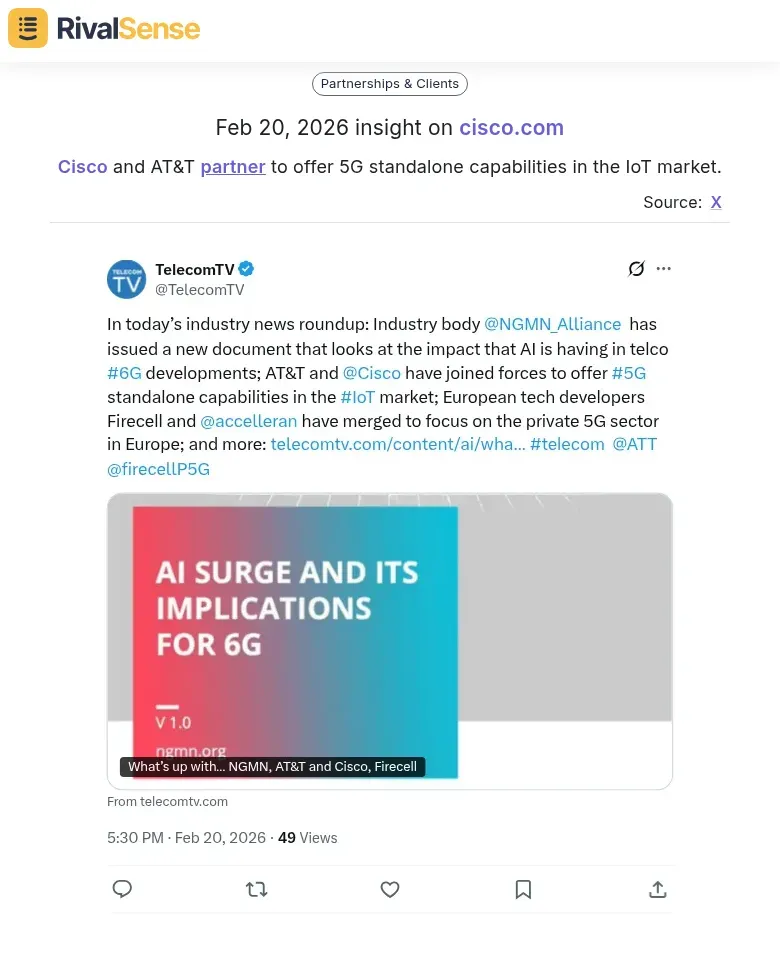
Partnerships for Market Expansion Strategies: Cisco and AT&T partner to offer 5G standalone capabilities in the IoT market. Partnership insights like this are crucial for understanding ecosystem development and market expansion strategies, enabling you to assess competitive alliances and explore similar opportunities.
Integrating these insights from sources beyond Twitter ensures you don't miss critical developments that could impact key account decisions. Tools like RivalSense aggregate such data from company websites, social media, and registries, delivering it in weekly reports for proactive strategy adjustments.
Learning from Real-World Twitter Insights: Strategic Applications
Analyzing Twitter insights requires a methodical approach to extract actionable intelligence. By focusing on specific areas, you can translate observations into strategic advantages. Start by examining product innovation announcements and technology partnerships to identify market shifts.
Analyze product innovation announcements to identify automation opportunities and efficiency gains. When Twitter/X launches new API features or automation tools, track how competitors implement them. Create a checklist:
- ✅ Monitor official Twitter/X developer announcements weekly
- ✅ Identify which automation features competitors adopt first
- ✅ Document implementation timelines
- ✅ Measure engagement impact
- ✅ Test similar automation in your workflow
Monitor technology partnership reveals to understand market expansion strategies and ecosystem development. When Twitter announces integrations with CRM platforms or marketing tools, analyze which competitors leverage these partnerships most effectively. Practical tip: Set up alerts for partnership announcements and track adoption rates across your competitive landscape within 30 days.
Track conversational AI and interactive feature launches to anticipate customer experience trends. As Twitter introduces AI-powered customer service tools or interactive polls, observe how competitors use these features for engagement. Actionable step: Create a quarterly review of competitor AI implementation patterns and correlate with their customer satisfaction metrics to identify emerging CX best practices.
Building Your Twitter Monitoring Framework for Key Accounts
Building an effective Twitter monitoring framework for key accounts requires strategic organization and automation. This framework ensures you capture relevant signals without being overwhelmed by noise. Follow these steps to set up a robust system that delivers timely insights.
Start by creating specialized Twitter Lists: one for direct competitors to track their announcements and customer interactions, another for industry influencers who shape market conversations, and a third for your target accounts to monitor their pain points and interests. This segmentation allows you to focus on high-priority updates and engagement patterns.
Next, set up automated alerts using Boolean operators for refined competitor tracking. Use combinations like "(competitor OR rival) AND (launch OR update) -promotion" to capture meaningful developments while filtering out marketing fluff. Tools like TweetDeck or social listening platforms allow you to create custom columns for these searches, giving you real-time visibility into competitor movements.
Implement sentiment analysis to categorize reactions and identify market validation opportunities. Track how audiences respond to competitor announcements—positive sentiment around a new feature might signal an unmet market need you can address. Negative feedback on competitor pricing or support issues reveals gaps you can exploit. Use this data to refine your messaging and position your solution more effectively.
Practical tip: Schedule weekly reviews of your Twitter monitoring dashboard to identify patterns and adjust your strategy. This systematic approach transforms social listening into actionable competitive intelligence.
Turning Twitter Insights into Actionable Account Engagement Strategies
Transforming Twitter insights into strategic advantage requires a structured framework that aligns with your business goals. By analyzing competitor engagement patterns, you can identify gaps and opportunities to enhance your account engagement. Here’s a practical 3-step process to operationalize these insights.
First, analyze competitor engagement patterns to identify underserved segments—when competitors celebrate enterprise wins but ignore SMB pain points, you’ve found a gap. Create a checklist to track announcement frequency, engagement metrics, and audience responses.
Develop targeted messaging that positions your company as the specialist for these gaps. If competitors focus on large enterprises, craft messaging emphasizing SMB-friendly pricing and support. Use Twitter analytics to validate messaging resonance before full campaigns.
Create competitive battle cards with validated intelligence from Twitter engagement patterns. Include: competitor feature gaps, pricing vulnerabilities, and engagement metrics showing audience dissatisfaction. Practical tip: Document campaign frequency and content gaps where you can offer unique value.
Implement a 3-step validation process to refine positioning:
- Monitor competitor Twitter engagement for 30 days to establish baseline patterns
- Test messaging in targeted Twitter polls and analyze response rates
- Refine positioning based on response patterns and sentiment analysis
Integrate these insights across your organization by creating shared dashboards that visualize real-time data on competitor tweets, engagement metrics, and trending topics. This ensures coordinated responses—marketing crafts counter-messaging, sales addresses prospect concerns, and product prioritizes features based on competitor gaps.
Integrating Twitter Intelligence Across Your Organization for Maximum Impact
To maximize the impact of Twitter competitor intelligence, integrate insights across all relevant departments for a unified competitive response. This cross-functional approach ensures that intelligence drives coordinated actions and strategic decisions. Start by establishing shared processes and tools for seamless collaboration.
Create shared dashboards in tools like RivalSense or Google Sheets with real-time competitor metrics: engagement rates, announcement frequency, sentiment analysis, and key account mentions. Set up automated Slack/Teams alerts for major competitor tweets to ensure coordinated responses across teams.
Establish quarterly review protocols where teams analyze Twitter insights together. Update competitive playbooks based on emerging strategies, customer pain points from replies, and market sentiment shifts. Assign "Twitter intelligence champions" in each department to maintain consistent monitoring and dissemination of insights.
Measure ROI by correlating competitive intelligence with business outcomes. Track alerts that preceded key account wins, calculate time saved versus manual monitoring, and quantify revenue impact from intelligence-driven strategy adjustments. Use this data to justify ongoing investments in competitor tracking tools and processes.
Practical checklist for integration:
- ✅ Build centralized dashboards with color-coded competitors
- ✅ Develop templated counter-messaging for common announcements
- ✅ Define response timelines and approval workflows
- ✅ Document intelligence-to-action workflows for sales teams
- ✅ Conduct quarterly ROI analysis comparing investments to account wins
Take Action with Comprehensive Competitor Tracking
Twitter is a powerful tool for real-time competitor insights, but to stay ahead, you need a holistic view of all competitor activities. Tools like RivalSense complement Twitter monitoring by tracking product launches, pricing updates, event participations, partnerships, regulatory changes, management shifts, and media mentions across company websites, social media, and various registries. This comprehensive data is delivered in a weekly email report, saving you time and ensuring you never miss a critical update.
Ready to transform your competitor tracking strategy? Try RivalSense for free today at https://rivalsense.co/ and get your first competitor report to start identifying opportunities and threats in your market. Don't wait—gain the strategic edge you need to engage key accounts effectively.
📚 Read more
👉 Pro Audio Key Account Management Cheat Sheet: Best Practices
👉 Avoid These Media Mentions & Content Marketing Competitive Intelligence Mistakes
👉 How to Analyze Competitor Events: A Telenor MWC 2026 Case Study
👉 How to Analyze Competitor Websites in 2026: A Practical Guide with Actionable Steps
👉 Industrial Machinery Maintenance: Benchmarking Key Account Advocacy Tracking