
Twitter Competitor Intelligence Framework: Key Account Health Dashboard Template
Twitter delivers competitor insights 10-15x faster than traditional market research methods, making it your real-time competitive intelligence goldmine. While quarterly reports and manual research take weeks, Twitter surfaces competitor announcements, strategic partnerships, and client wins instantly—often before official press releases. This speed advantage transforms how you track key accounts, as purchasing decisions are heavily influenced by competitor news that emerges first on Twitter.
Practical steps to leverage Twitter for account planning:
- Set up automated alerts for competitor mentions, product launches, and partnership announcements using Boolean operators
- Create Twitter Lists organized by competitor tier (direct/indirect) and target accounts
- Monitor key account decision-makers' Twitter activity for vendor evaluation signals
- Track competitor client wins and case studies shared publicly
- Analyze engagement patterns to identify emerging market trends
💡 Pro tip: Integrate Twitter monitoring with your CRM to trigger timely outreach when competitors announce relevant news affecting your key accounts. This transforms reactive tracking into proactive strategic advantage, allowing you to anticipate competitor moves before they impact your deals.
The Twitter Competitor Intelligence Framework: Three Essential Monitoring Streams
The Twitter Competitor Intelligence Framework operates through three essential monitoring streams that transform raw social data into actionable insights. By systematically tracking these streams, you can uncover hidden opportunities and threats in your competitive landscape. First, Event & Partnership Monitoring tracks competitor announcements, webinars, and collaborations. Create private Twitter lists for each competitor and set up alerts for keywords like "partner," "launch," and "event." This reveals market focus areas and investment priorities before they're widely known.
Second, Executive Thought Leadership Analysis monitors C-suite Twitter activity. Follow competitor CEOs, CMOs, and product leaders, noting their content themes, engagement patterns, and industry conversations. Use Twitter's advanced search with "from:[competitor_executive]" to track their posts. This provides early signals of strategic direction shifts and potential market expansions.
Third, Creative Campaign Tracking analyzes competitor marketing launches. Monitor hashtag usage, visual content evolution, and customer engagement metrics. Create a spreadsheet template to document campaign elements, messaging angles, and audience reactions. This helps you understand their customer engagement strategies and identify messaging differentiation opportunities.
Practical tip: Use Twitter Lists to organize these streams separately, enabling focused analysis without information overload. Set weekly review sessions to update your dashboard with fresh insights from all three streams.
Building Your Key Account Health Dashboard: Template and Implementation
Building an effective Key Account Health Dashboard for Twitter competitor intelligence requires a structured approach and consistent execution. Start by creating specialized Twitter Lists: 1) Competitors (direct and indirect), 2) Industry influencers and analysts, and 3) Target account decision-makers. This segmentation ensures focused monitoring and prevents data overload.
Next, set up automated alerts using Boolean operators. For example: "(product launch OR new feature) AND competitor_name" for product announcements, "(partnership OR collaboration) AND competitor_name" for strategic moves, and "(CEO OR CTO) AND (interview OR keynote)" for executive insights. Use tools like TweetDeck or social listening platforms for automation.
Implement sentiment analysis to categorize reactions to competitor announcements. Track mentions around product launches, pricing changes, or service updates, classifying them as positive (praise, excitement), negative (complaints, criticism), or neutral (informational). This helps gauge market reception and identify potential vulnerabilities.
Practical checklist:
- ✅ Create 3 dedicated Twitter Lists
- ✅ Set up 5-7 Boolean alert combinations
- ✅ Monitor sentiment weekly for trending topics
- ✅ Update dashboard monthly with new competitors/key accounts
- ✅ Use color coding (green/red/yellow) for quick health assessment
Tip: Focus on engagement metrics (retweets, replies) alongside sentiment to understand impact depth, not just surface reactions.
Learning from Advanced Competitor Insights: Actionable Patterns from Twitter Intelligence
Transform Twitter intelligence into strategic advantage by tracking three actionable patterns that reveal competitor priorities and capabilities. These patterns provide deep insights into innovation, market focus, and technological alliances. First, monitor autonomous improvement cycles: when competitors detect issues → create evaluations → implement changes → confirm results. This reveals their innovation velocity—track how quickly they iterate on customer feedback. For example, RivalSense captured this insight about Lindy:
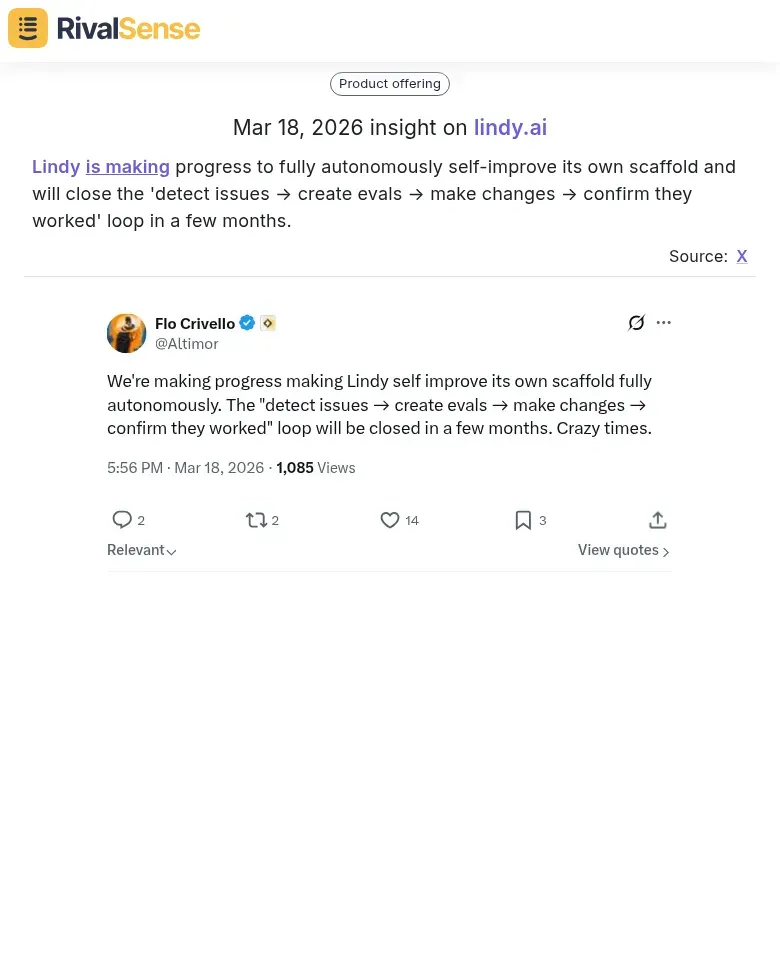
Why it's valuable: Understanding a competitor's improvement cycles helps you assess their R&D agility and anticipate feature enhancements, allowing you to adjust your product roadmap proactively.
Second, analyze event participation patterns. Booth locations at major conferences indicate strategic priorities—prime spots signal higher investment. Track speaking engagements to identify market focus areas. For instance, RivalSense tracked Jumio's participation:
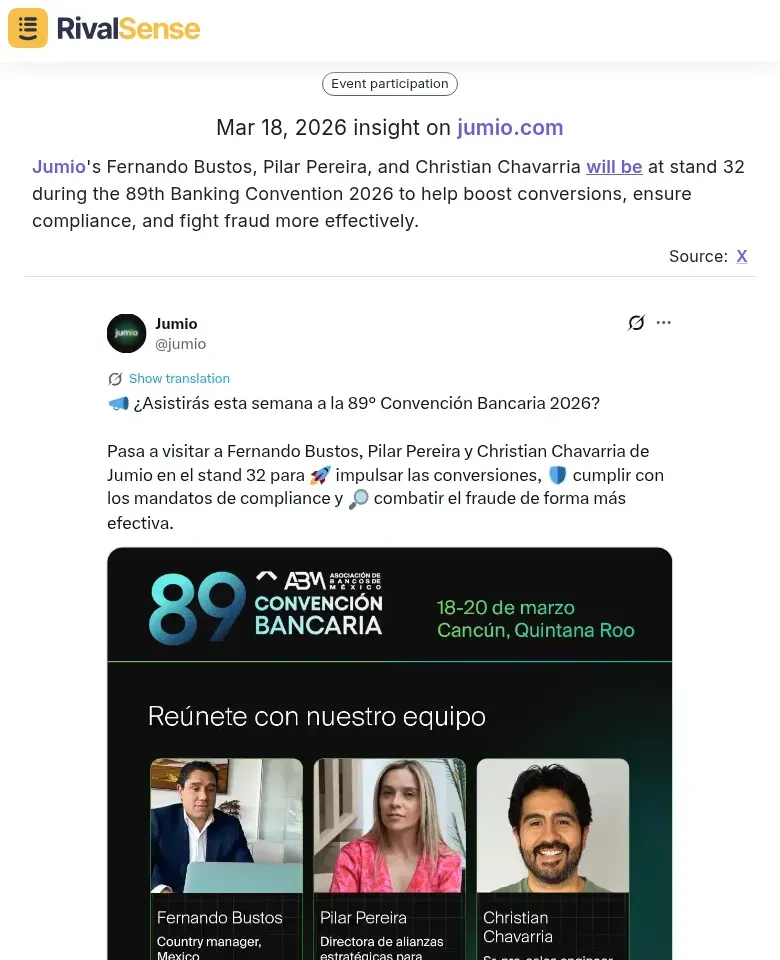
Why it's valuable: Event insights reveal where competitors are allocating resources and networking, helping you identify emerging market trends and plan your own event strategies.
Third, monitor integration announcements with frameworks and SDKs. These reveal technology partnerships and ecosystem expansion plans. When competitors announce integrations, note the partner's market position and technical capabilities. For example, CrewAI's integration was captured by RivalSense:
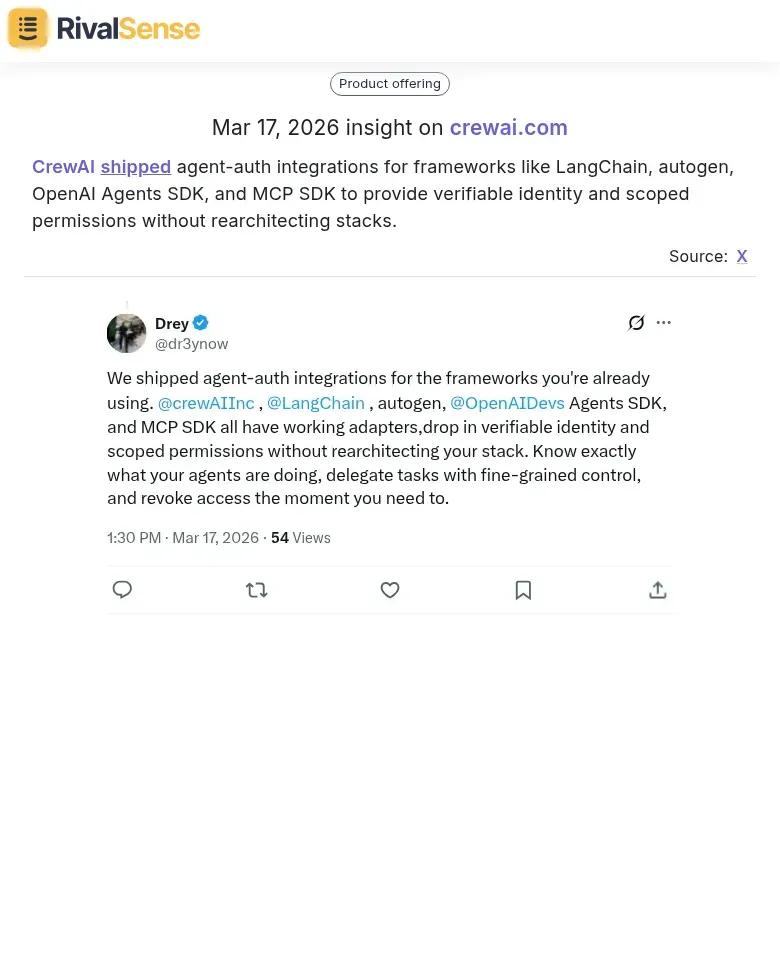
Why it's valuable: Integration insights signal technological alliances and platform expansions, enabling you to evaluate competitive threats in your ecosystem and explore partnership opportunities.
Weekly implementation checklist:
- ✅ Review competitor improvement cycles and note velocity changes
- ✅ Update event participation tracker with new conference data
- ✅ Document integration announcements and partnership significance
- ✅ Analyze engagement patterns around announcements
- ✅ Update competitive battle cards with validated insights
Turning Twitter Intelligence into Actionable Account Strategies
Transform Twitter intelligence into winning account strategies with this actionable framework that bridges insights to execution. By systematically analyzing competitor moves, you can develop targeted responses that protect and grow your key accounts. First, analyze competitor announcements to identify underserved segments. When competitors launch enterprise-focused features, develop targeted messaging for mid-market needs they're neglecting. Create a gap analysis matrix comparing their offerings against customer pain points.
Develop competitive battle cards with validated intelligence. Include feature gap analysis (what competitors lack), pricing vulnerabilities (where they're overcharging), and customer testimonials addressing competitor weaknesses. Use Twitter's advanced search operators to track specific competitor mentions and customer complaints for deeper insights.
Integrate insights across teams by creating shared dashboards in tools like RivalSense or Google Sheets. Establish response protocols: when competitors announce new features, marketing should have counter-messaging ready within 24 hours, sales receive targeted talking points, and product analyzes gaps for roadmap adjustments.
Actionable Checklist:
- Monitor competitor Twitter announcements weekly
- Map competitor focus areas vs. market needs
- Identify 3-5 specific gaps to exploit
- Develop targeted messaging for each gap
- Create account-specific battle cards
- Train sales teams on competitive positioning
- Update strategies quarterly based on new intelligence
Pro Tip: Schedule quarterly cross-functional workshops to review dashboard data, assess what worked, and adjust tracking parameters for agile competitive responses.
Beyond Twitter: Building a Comprehensive Competitor Tracking System
While Twitter monitoring provides valuable signals, true competitive intelligence requires a systematic framework that aggregates data from multiple sources. A holistic approach ensures you don't miss critical insights that could impact your business strategy. Implement a three-tier tracking system: 1) Account-level monitoring of key competitors' social presence, content themes, and engagement metrics; 2) Sentiment analysis across review platforms and industry forums to gauge brand perception; 3) Influencer mapping to identify who's amplifying competitor messages.
Establish correlation metrics to measure ROI: track how competitor insights influence your product roadmap decisions, marketing campaign adjustments, and sales win rates. Document these connections quarterly to demonstrate competitive intelligence's business impact and justify further investment.
Create centralized dashboards that aggregate data from social listening tools, review platforms, and web analytics. Establish weekly review cadences with documented workflows: Monday data collection, Wednesday analysis, Friday action planning. Include checklists for each phase: data validation, trend identification, stakeholder communication, and decision documentation.
Practical tip: Start with 3-5 key competitors and expand gradually. Use automation for data collection but maintain human analysis for strategic insights. Document your framework's evolution to refine processes and demonstrate growing sophistication in competitor tracking.
Putting It All Together: From Insights to Action
Leveraging Twitter for competitor intelligence is just the beginning. To stay ahead, you need a streamlined process that turns data into decisive actions. Tools like RivalSense can automate the tracking of competitor product launches, pricing updates, event participations, partnerships, and more, delivering insights directly to your inbox weekly.
Ready to enhance your competitive strategy? Try RivalSense for free and get your first competitor report today. Start transforming raw data into actionable intelligence that drives your business forward.
📚 Read more
👉 How to Build a Key Account Management Playbook for AML Compliance
👉 Regulatory Compliance Checklist: Uncover Competitor Market Positioning Insights
👉 Analyzing Fanatics' Bundesliga Collection Launch: A Competitor Insight
👉 The Strategic Benefits of Tracking Emerging Competitors: Your Early Warning System
👉 How to Conduct Fleet Management Competitor Analysis for Strategic Advantage