
Twitter Competitor Intelligence: A Step-by-Step Guide for B2B Key Account Success
While traditional competitor research methods can take weeks to surface insights, Twitter delivers real-time intelligence 10-15x faster—making it your secret weapon for key account tracking. In B2B sales, key account decisions are heavily influenced by competitor announcements, strategic partnerships, and client wins that often surface first on Twitter. Automated monitoring transforms reactive tracking into a proactive strategic advantage, allowing you to anticipate competitor moves before they impact your deals.
Practical steps to leverage Twitter for key account intelligence:
- Set up automated alerts for competitor mentions, product launches, and partnership announcements
- Monitor key accounts' Twitter activity for signals of vendor evaluation or dissatisfaction
- Track competitor client wins and case studies shared publicly
- Analyze engagement patterns to identify emerging trends in your market
- Use Twitter Lists to organize competitors, industry influencers, and target accounts
💡 Tip: Combine Twitter monitoring with CRM integration to trigger timely outreach when competitors announce relevant news to your key accounts.
Three Core Types of Twitter Competitor Insights for Account Tracking
When tracking competitors on Twitter for account-based intelligence, focus on three core insight types that reveal strategic priorities and resource allocation. These insights help you stay ahead in competitive landscapes by understanding where competitors are investing and how they engage with the market. First, monitor event and partnership announcements—these signal market focus areas and investment priorities. For example, when a competitor announces a partnership with a specific technology provider, it reveals their integration strategy and target customer segments. Create a tracking list of competitor handles, key executives, and relevant hashtags to catch these announcements early.
Second, analyze executive thought leadership content. C-suite posts about emerging technologies or industry trends provide early signals of strategic direction. Look for patterns in topics they emphasize—these often precede new product launches or market expansions. Set up alerts for mentions of specific technologies or market segments in their tweets.
Third, track creative campaign launches that indicate customer engagement strategies. Notice how competitors position themselves against market leaders or differentiate their messaging. Pay attention to engagement metrics on these campaigns—high interaction rates reveal what resonates with your shared target accounts. Create a simple spreadsheet to document campaign themes, messaging angles, and engagement patterns over time.
Practical tip: Use Twitter Lists to organize competitors by tier (direct, indirect, aspirational) and set aside 15 minutes daily to review these insights systematically. This structured approach transforms random social media monitoring into actionable competitive intelligence for account planning.
Practical Framework: Setting Up Your Twitter Monitoring System
Building an effective Twitter monitoring system requires a structured approach to capture and analyze competitor insights. Start by defining your goals and key metrics to ensure alignment with your account strategies. Here are the three core components to implement:
-
Create specialized Twitter Lists:
- Competitors (direct/indirect)
- Industry influencers and analysts
- Target account decision-makers
Organize these in TweetDeck for real-time monitoring.
-
Set up automated alerts using Boolean operators. Example: "(competitor_name OR @competitor_handle) AND (launch OR partnership OR demo) NOT spam". Configure alerts for product announcements, executive tweets, and industry hashtags. Pro tip: Include common misspellings to catch all mentions.
-
Implement sentiment analysis to categorize reactions. Use tools like Brandwatch or native Twitter analytics to track positive/negative/neutral sentiments around competitor announcements. This reveals market validation opportunities and competitor weaknesses.
📋 Practical Checklist:
- [ ] Create 3 core Twitter Lists and update weekly
- [ ] Set up 5-7 Boolean search alerts per competitor
- [ ] Document sentiment trends in a shared dashboard
- [ ] Review alerts daily, refine queries weekly
- [ ] Conduct quarterly framework audits based on market changes
Turning Twitter Insights into Actionable Account Strategies
Turning Twitter insights into actionable account strategies requires systematic analysis and strategic execution. By methodically interpreting competitor signals, you can identify opportunities to strengthen your position and win key accounts. Here’s how to transform competitor intelligence into winning account plans:
1. Analyze Competitor Announcements for Market Gaps
Monitor competitor product launches, feature updates, and partnership announcements. Look for patterns: Are they focusing on enterprise while neglecting mid-market? Are they emphasizing AI features while ignoring integration capabilities? Create a gap analysis matrix comparing their offerings against customer pain points you’ve identified.
2. Develop Targeted Messaging for Identified Gaps
Craft value propositions that position your company as the specialist for underserved segments. Example: If competitors focus on large enterprises, develop messaging highlighting your mid-market expertise and personalized support. Create content pillars addressing specific gaps you’ve identified.
3. Build Competitive Battle Cards with Validated Intelligence
Create battle cards for key accounts that include:
- Feature gap analysis (what competitors lack)
- Pricing vulnerabilities (where they’re overcharging)
- Customer testimonials addressing competitor weaknesses
- Win/loss analysis from similar accounts
Actionable Checklist:
- [ ] Monitor competitor Twitter announcements weekly
- [ ] Map competitor focus areas vs. market needs
- [ ] Identify 3-5 specific gaps to exploit
- [ ] Develop targeted messaging for each gap
- [ ] Create account-specific battle cards
- [ ] Train sales teams on competitive positioning
- [ ] Update strategies quarterly based on new intelligence
Pro Tip: Use Twitter’s advanced search operators to track specific competitor mentions, product discussions, and customer complaints for deeper insights.
Integrating Twitter Intelligence Across Marketing, Sales, and Product Teams
To maximize Twitter competitor intelligence, integrate insights across marketing, sales, and product teams for a unified competitive response. This cross-functional alignment ensures that every department leverages real-time data to outmaneuver competitors and secure key accounts. Start by creating shared dashboards in tools like RivalSense or Google Sheets that visualize real-time data on competitor tweets, engagement metrics, and trending topics. This ensures all teams access the same information for coordinated responses—marketing can craft counter-messaging, sales can address prospect concerns, and product can prioritize features based on competitor gaps.
Build response protocols for major competitor announcements across organizational functions. When competitors announce new features or client wins, marketing should have templated counter-messaging ready within 24 hours, sales should receive targeted talking points for affected accounts, and product should analyze feature gaps for roadmap adjustments. Create a checklist: assign team leads for monitoring different competitor segments, document escalation procedures, and establish weekly review meetings.
Update competitive playbooks quarterly based on new Twitter insights and market dynamics. Analyze patterns in competitor announcements, engagement trends, and customer sentiment to refine your positioning. Practical tip: Schedule quarterly cross-functional workshops to review dashboard data, assess what worked, identify missed opportunities, and adjust tracking parameters. Document learnings and strategy adjustments to maintain agility in competitive responses.
Beyond Twitter: Building a Comprehensive Competitor Tracking System
While Twitter provides valuable real-time signals, true competitive advantage comes from a holistic tracking system that aggregates data from multiple sources. Combining insights from various channels gives you a complete picture of competitor activities, enabling more informed strategic decisions. Integrate Twitter monitoring with website analysis (product updates, pricing changes), LinkedIn tracking (key personnel moves, company announcements), and business registry data (financial filings, ownership changes) for a 360-degree view of your competitors’ strategies.
Implement a three-tier tracking system:
- Account-Level Monitoring: Track specific target accounts mentioned by competitors, including deal sizes and timelines
- Sentiment Analysis: Gauge market perception through social sentiment, review analysis, and customer feedback
- Influencer Mapping: Identify key decision-makers, industry analysts, and thought leaders engaging with competitors
To measure ROI, correlate competitive intelligence with business outcomes:
- Track how competitor insights influenced specific key account wins
- Monitor win rates against competitors you’re actively tracking
- Calculate time saved in research versus manual monitoring
- Measure pipeline impact from early warning signals
Practical Checklist:
- [ ] Set up automated alerts for competitor mentions across platforms
- [ ] Create competitor dashboards with key metrics updated weekly
- [ ] Schedule monthly competitive intelligence reviews with sales teams
- [ ] Document competitor responses to your key account wins
- [ ] Track competitor pricing changes against your win/loss data
Real-World Examples: How Competitor Insights Drive Business Strategy
Seeing competitor moves in action highlights the value of comprehensive monitoring beyond just Twitter. These insights, gathered from sources like company websites, social media, and registries, can directly inform your strategic planning and execution. Here are real examples from RivalSense that demonstrate different types of valuable competitor intelligence:
-
Partnership Announcements: Turkish Airlines partnered with MTN to offer a round-trip ticket prize in a promotion that users can enter by dialing a code or using the MyMTN App.
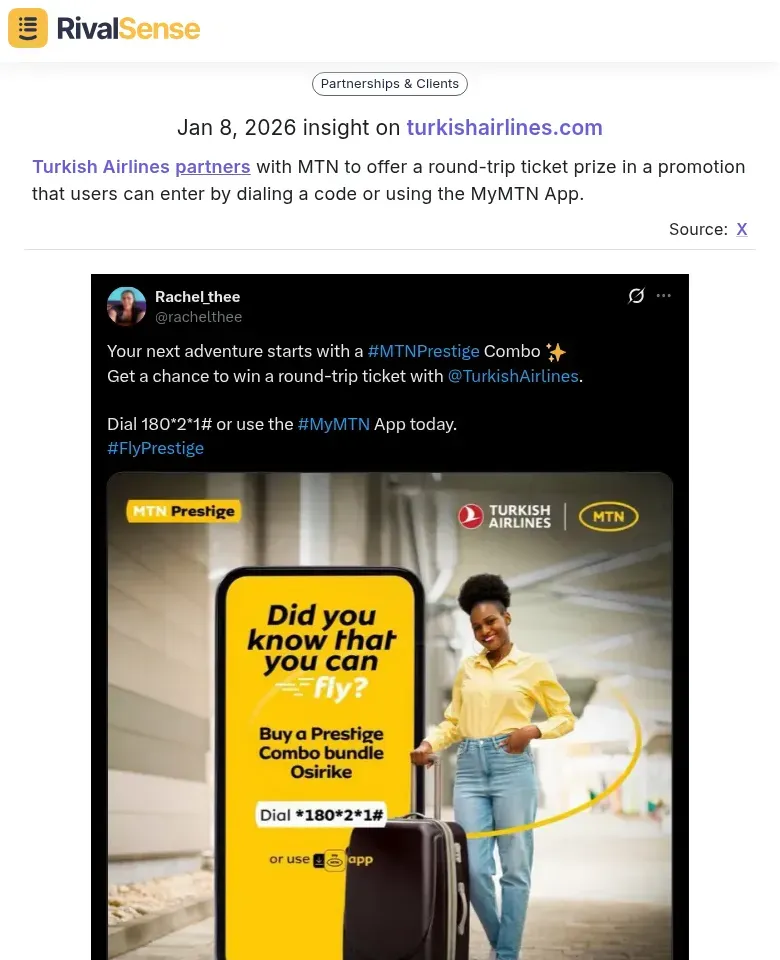 This type of insight reveals how competitors are expanding reach through collaborations, helping you anticipate joint offerings or market expansions that could affect your key accounts.
 -
Product Integrations: Google for Education announced on January 8 that NotebookLM is now accessible directly from Google Classroom, allowing teachers to transform class materials into AI learning experiences.
 Tracking product launches and integrations helps you understand competitor innovation priorities and identify gaps in your own offerings, enabling proactive product roadmap adjustments.
 -
Creative Campaigns: Philippine Airlines released a new inflight safety video in a drama format called #PALSafetynovela, which became popular for its entertaining production.
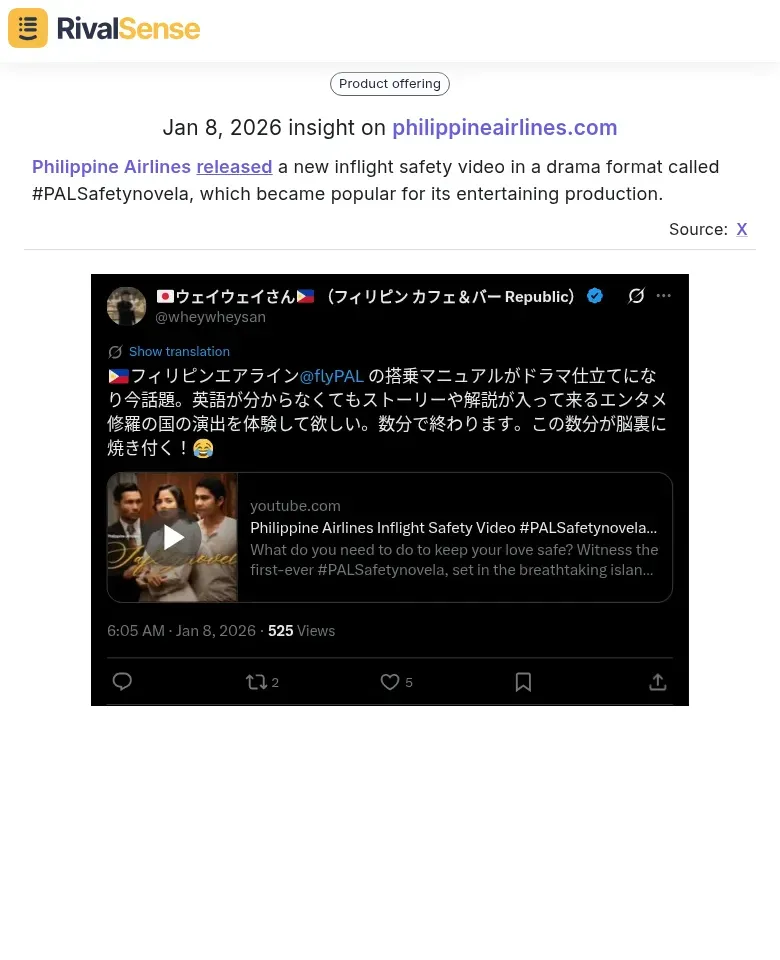 Monitoring creative campaigns provides insights into competitor branding and customer engagement tactics, which can inspire your own marketing strategies and help you differentiate in competitive deals.
Ready to Elevate Your Competitor Tracking?
Mastering Twitter competitor intelligence is a powerful start, but scaling it across all relevant channels can be time-consuming. Tools like RivalSense automate the tracking of competitor product launches, pricing updates, event participations, partnerships, regulatory changes, management moves, and media mentions—delivering concise weekly reports directly to your inbox. This comprehensive approach saves you hours of manual research and ensures you never miss a critical competitor move.
Take action today: Try RivalSense for free at https://rivalsense.co/ and get your first competitor report to start transforming insights into key account wins!
📚 Read more
👉 Data-Driven Key Account Strategies: Actionable Competitive Intelligence
👉 Competitor Ad Analysis: Transforming Regulatory Compliance into Strategic Advantage
👉 Decoding Competitor Moves: Scrapingdog's API Enhancements and What They Mean
👉 How to Identify Key Accounts: A Practical Guide for B2B Leaders
👉 2026 Trend Analysis: Tracking Competitor Glassdoor Reviews for Branding Consultancies