
Twitter Competitor Insights Cheat Sheet for Key Account Tracking
While traditional competitor research methods can take weeks to surface insights, Twitter delivers real-time intelligence 10-15x faster—making it your secret weapon for key account tracking. In B2B sales, key account decisions are heavily influenced by competitor announcements, strategic partnerships, and client wins that often surface first on Twitter. Automated monitoring transforms reactive tracking into a proactive strategic advantage, allowing you to anticipate competitor moves before they impact your deals.
Practical steps to leverage Twitter for key account intelligence:
- Set up automated alerts for competitor mentions, product launches, and partnership announcements
- Monitor key accounts' Twitter activity for signals of vendor evaluation or dissatisfaction
- Track competitor client wins and case studies shared publicly
- Analyze engagement patterns to identify emerging trends in your market
- Use Twitter Lists to organize competitors, industry influencers, and target accounts
💡 Tip: Combine Twitter monitoring with CRM integration to trigger timely outreach when competitors announce relevant news to your key accounts.
Three Core Types of Twitter Competitor Insights for Account Tracking
Mastering Twitter competitor tracking requires focusing on three core insight types that reveal strategic direction. These insights provide early warnings and opportunities to refine your own account strategies. By systematically monitoring these categories, you can stay ahead of market shifts and competitor initiatives.
1. Event and Partnership Announcements 🎯
Monitor live demos, booth participations, and integration partnerships—these signal market focus and resource allocation. This type of insight is valuable because it reveals where competitors are investing resources and which alliances they're forming to expand their reach, helping you anticipate their moves in key accounts.
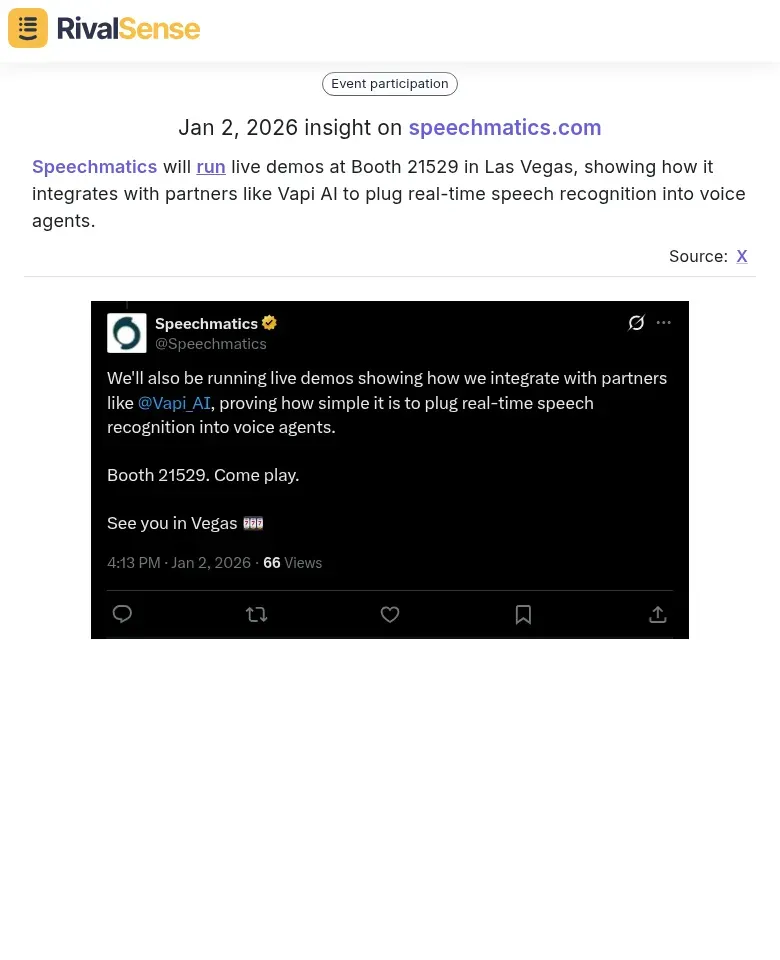
For example, RivalSense tracked that Speechmatics will run live demos at Booth 21529 in Las Vegas, showing how it integrates with partners like Vapi AI to plug real-time speech recognition into voice agents.
Practical tip: Create a Twitter List specifically for competitor event accounts and set calendar alerts for major industry conferences they attend.
2. Executive Thought Leadership 🧠
Monitor senior leadership statements about AI integration, technology partnerships, and strategic direction. Executive thought leadership provides early signals of strategic direction and technology alliances, allowing you to adjust your messaging and offerings before formal announcements impact your deals.
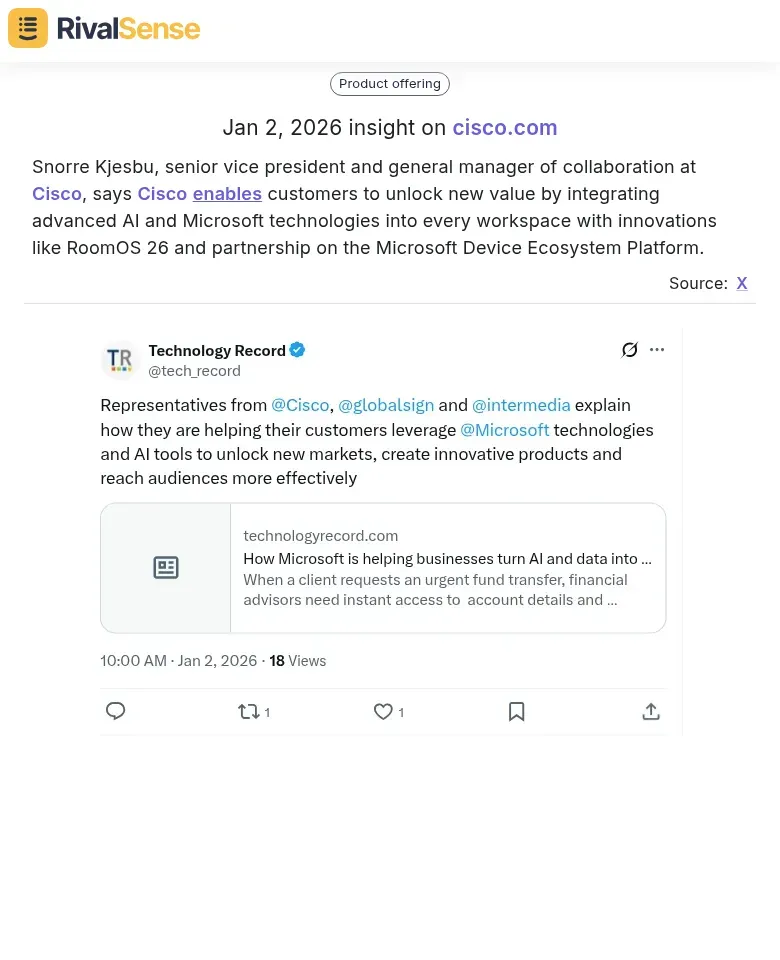
As tracked by RivalSense, Snorre Kjesbu, senior vice president and general manager of collaboration at Cisco, says Cisco enables customers to unlock new value by integrating advanced AI and Microsoft technologies into every workspace with innovations like RoomOS 26 and partnership on the Microsoft Device Ecosystem Platform.
✅ Checklist for tracking executive insights:
- Follow all C-suite accounts from competitor companies
- Track hashtags like #AIstrategy or #partnerships
- Note recurring themes in their messaging for pattern analysis
3. Creative Campaign Launches 🚀
Analyze innovative content formats like safety videos, experiential marketing, and interactive threads. Creative campaigns indicate how competitors are engaging customers and differentiating their brand, highlighting content gaps and innovation opportunities for your own strategies.
RivalSense also captured that Philippine Airlines released a 'Safetynovela' safety video inspired by telenovelas, which debuted on its new Airbus A350-1000 aircraft and will screen on flights starting January 2026.

Practical steps: Document campaign frequency, engagement metrics, and content gaps where you can offer unique value. Use tools like RivalSense to automate tracking of these three insight categories, ensuring you never miss critical competitive intelligence.
Setting Up Your Twitter Monitoring Framework for Key Accounts
To build an effective Twitter monitoring framework for key accounts, start by creating specialized Twitter Lists. Organizing your sources systematically ensures focused tracking and prevents information overload, making your intelligence gathering more efficient and actionable.
Core Twitter Lists to create:
- Competitors (direct and indirect)
- Industry award organizations and analyst firms
- Key influencers within your target accounts
Next, set up automated alerts using tools like TweetDeck or social listening platforms. Configure alerts for competitor mentions (including misspellings), executive tweets, and industry-specific hashtags. Pro tip: Use Boolean operators (AND, OR, NOT) to refine alerts and reduce false positives.
Implement sentiment analysis to categorize reactions to competitor announcements. Track positive, negative, and neutral sentiments to identify market validation opportunities or competitor weaknesses.
📋 Weekly Monitoring Checklist:
- ✅ Update your three core Twitter Lists
- ✅ Review automated alerts and refine search queries
- ✅ Analyze sentiment trends from competitor mentions
- ✅ Document insights in a shared competitive intelligence dashboard
- ✅ Quarterly review and adjustment of framework based on market dynamics
Turning Twitter Insights into Actionable Account Strategies
Transform Twitter insights into strategic advantage with these actionable steps. Moving from data collection to implementation is crucial for impacting your bottom line and securing key accounts.
First, analyze competitor announcements to identify underserved segments. When competitors celebrate enterprise wins but ignore SMB pain points, you've found a gap. Create a checklist to track announcement frequency, engagement patterns, and audience responses.
Develop targeted messaging that positions your company as the specialist for these gaps. If competitors focus on large enterprises, craft messaging emphasizing SMB-friendly pricing and support. Practical tip: Use Twitter analytics to validate messaging resonance before full campaigns.
Create competitive battle cards with validated intelligence. Include: competitor feature gaps, pricing vulnerabilities, and engagement metrics showing audience dissatisfaction.
Actionable 3-step validation process:
- Monitor competitor Twitter engagement for 30 days
- Test messaging in targeted Twitter polls
- Refine positioning based on response patterns
Integrating Twitter Intelligence Across Your Organization
To maximize Twitter competitor intelligence, integrate insights across marketing, sales, and product teams. Siloed information leads to missed opportunities, while shared intelligence fosters coordinated and agile responses to competitor moves.
Start by creating a shared dashboard in tools like RivalSense or Google Sheets that visualizes real-time data on competitor tweets, engagement metrics, and trending topics. This ensures all teams access the same information for coordinated responses—marketing can craft counter-messaging, sales can address prospect concerns, and product can prioritize features based on competitor gaps.
Build dashboards with key metrics: follower growth, engagement rates, top-performing content, and sentiment analysis. Use filters to track specific competitors, keywords, or campaigns.
Quarterly Review Checklist:
- Audit dashboard data weekly for accuracy
- Assign team leads for monitoring different competitor segments
- Document response protocols for major competitor announcements
- Update competitive playbooks based on new insights
Beyond Twitter: Building a Comprehensive Competitor Tracking System
While Twitter provides real-time competitor signals, true competitive intelligence requires a multi-source approach. Relying solely on one platform leaves blind spots in your understanding of the competitive landscape.
Combine Twitter insights with data from company websites (product updates, pricing changes), LinkedIn (hiring patterns, thought leadership), and business registries (funding rounds, executive changes) for a 360-degree view. Tools like RivalSense automate this by tracking competitor activity across websites, social media, and various registries, delivering consolidated weekly reports.
Implement a three-tier tracking system:
- Account-level monitoring: Track competitor mentions, customer complaints, and support interactions
- Sentiment analysis: Analyze customer sentiment trends across social platforms
- Influencer mapping: Identify key industry voices engaging with competitors
Measure ROI by correlating competitive intelligence with business outcomes:
- Track how specific competitor insights influenced key account wins
- Monitor conversion rate improvements after implementing competitive counter-strategies
- Calculate time saved in research vs. manual monitoring
📊 Practical checklist for a comprehensive system:
- Set up automated alerts for competitor mentions across platforms
- Create a centralized dashboard integrating Twitter, LinkedIn, and website data
- Schedule weekly competitive intelligence reviews with sales/marketing teams
- Document competitor responses to market changes for pattern recognition
- Establish KPIs linking competitive insights to revenue metrics
Put Your Insights into Action with RivalSense
Manually tracking competitors across Twitter and other sources is time-consuming and prone to missing critical signals. RivalSense automates this process by monitoring competitor product launches, pricing updates, event participations, partnerships, regulatory changes, management shifts, and media mentions—delivering all insights in a concise weekly email report.
Transform your competitor tracking from a reactive chore into a proactive strategic advantage. Try RivalSense for free today at https://rivalsense.co/ and get your first competitor report to start anticipating moves that affect your key accounts.
📚 Read more
👉 Advanced Semiconductor Competitor Pricing Intelligence Tactics for Strategic Edge
👉 5 Quick Hacks to Track Competitor Media Mentions for Smarter SWOT Analysis
👉 Actionable Competitor Analysis: Learning from Iute Moldova's Credit Limit Increase
👉 The Strategic Benefits of a Competitor Matrix: Your 2026 Guide to Market Dominance
👉 Strategic Account Tracking Tools: IT Consulting's Competitive Edge Analysis