
Turning Event Insights into Competitive Advantage: A Proxima Fusion Case Study
Keeping a pulse on competitor activities is essential for maintaining a strategic edge in fast-moving sectors like fusion energy. Industry events often serve as hotspots for revealing rivals' priorities, innovations, and partnerships. For example, RivalSense recently captured that Proxima Fusion's CEO Francesco Sciortino spoke about magnetic confinement at a fusion school in Munich during FusionXInvest, which started on February 25. This single insight can be a goldmine for informed decision-making.
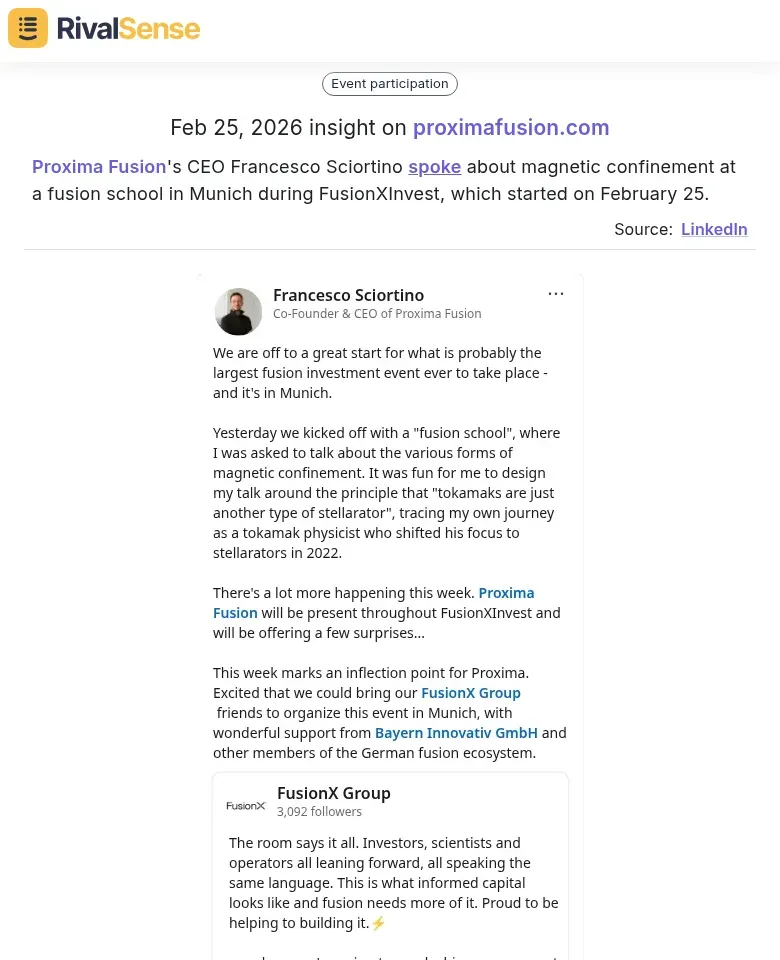
When you uncover a competitor's involvement in a key event, it's time to dig deeper into what it means for the market. Analyzing such moves helps you anticipate shifts in technology, funding, and alliances. Here’s how to break down this insight into actionable steps for your competitor analysis framework.
- 🎯 Decode the Topic: Magnetic confinement is a core fusion technology. Proxima Fusion's focus here signals their R&D direction and potential patent filings. Assess how this aligns or conflicts with your own technological roadmap.
- 🤝 Map the Audience: Events like FusionXInvest attract investors, researchers, and policymakers. Proxima Fusion's engagement suggests networking for funding or collaborations. Identify who else attended to gauge their influence ecosystem.
- 📢 Evaluate Messaging: CEO speaking roles boost brand authority and media visibility. Monitor follow-up coverage to understand how their narrative is shaping industry perception.
Transforming these observations into a strategic plan requires structured comparison and immediate actions. Start by benchmarking your position against the competitor's revealed strengths and opportunities. Use the table below to organize your analysis and response.
| Analysis Dimension | Insight from Proxima Fusion | Your Strategic Response |
|---|---|---|
| Technology Emphasis | Public discussion on magnetic confinement | Review your R&D portfolio for gaps or overlaps in fusion approaches |
| Event Strategy | Participation in FusionXInvest from start date | Audit your event calendar for similar high-impact forums to join or sponsor |
| Leadership Visibility | CEO as speaker enhancing thought leadership | Plan executive engagements to match or exceed this visibility in your niche |
| Partnership Signals | Engagement at a fusion school suggests academic ties | Explore collaborations with research institutions to stay competitive |
To ensure no insight slips through, adopt a regular review process. Here’s a quick checklist to integrate event-based competitor analysis into your routine:
. [ ] Monthly: Scan for competitor event participations using tools like RivalSense
. [ ] Quarterly: Analyze speech topics and attendee lists for trend spotting
. [ ] Bi-annually: Update competitive intelligence dashboards with new findings
. [ ] Annually: Refine your event strategy based on competitor successes and gaps
Leveraging competitor insights consistently can inform product development, marketing campaigns, and partnership pursuits. However, manually tracking such data across websites, social media, and registries is time-consuming. That’s where automated solutions like RivalSense come in—it monitors product launches, pricing updates, event participations, partnerships, regulatory changes, and more, delivering consolidated reports directly to your inbox. To enhance your competitor analysis with real-time insights, try RivalSense for free at https://rivalsense.co/ and get your first report today!
📚 Read more
👉 How to Conduct Competitor Research in 2026: A Step-by-Step Guide with Practical Checklists
👉 How a RivalSense Alert on Jane Street's Lawsuit Delivered Competitive Edge
👉 Twitter Competitor Tracking: The Ultimate Checklist for Key Account Engagement
👉 Pro Audio Key Account Management Cheat Sheet: Best Practices