
Turning Competitor Partnerships into Strategic Insights
Keeping a close eye on competitor partnerships is essential for maintaining a competitive edge in any industry. These collaborations often signal strategic shifts, new capabilities, or market expansions that could impact your business. By proactively analyzing such moves, you can adapt your strategies to mitigate threats or seize opportunities.
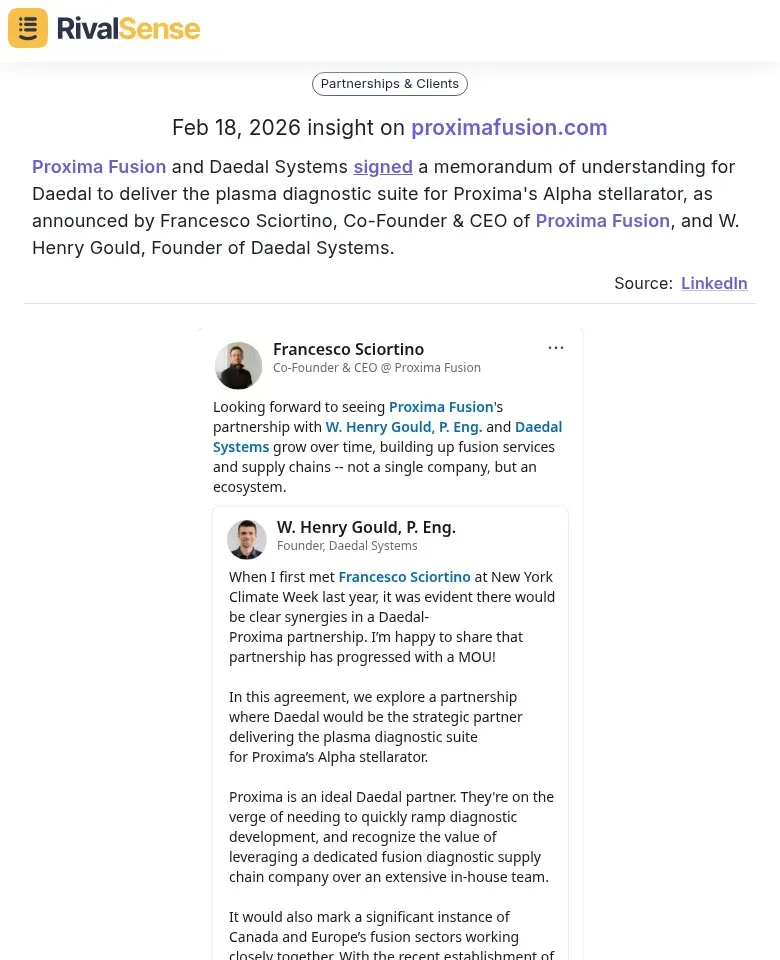
For example, RivalSense recently captured this insight: Proxima Fusion and Daedal Systems signed a memorandum of understanding for Daedal to deliver the plasma diagnostic suite for Proxima's Alpha stellarator, as announced by Francesco Sciortino, Co-Founder & CEO of Proxima Fusion, and W. Henry Gould, Founder of Daedal Systems. This highlights how partnerships in high-tech sectors can drive innovation and project advancement.
To leverage such insights effectively, you need a structured approach to competitor partnership analysis. Start by establishing a routine to track announcements across various sources, including company websites, social media, and industry news. This helps you build a comprehensive view of the competitive landscape and identify emerging trends early.
Here are practical steps to analyze competitor partnerships and derive actionable intelligence:
- Identify Key Players: List your main competitors and their frequent collaborators to anticipate potential alliances.
- Assess Strategic Goals: Determine what each party gains from the partnership, such as technology access, market entry, or resource sharing.
- Evaluate Market Impact: Consider how the collaboration might affect pricing, customer choices, or industry standards.
- Monitor Execution: Follow up on partnership milestones to gauge its success and longevity.
- Benchmark Against Your Strategy: Compare these partnerships with your own initiatives to identify gaps or strengths.
Using a checklist can streamline your evaluation process. Here's a quick reference for assessing any competitor partnership:
- [ ] What is the scope and duration of the agreement?
- [ ] Are there financial or regulatory disclosures involved?
- [ ] How does it align with the competitor's known strategic priorities?
- [ ] What technologies or expertise are being exchanged?
- [ ] Could this partnership create barriers to entry or shift competitive dynamics?
Incorporating tools like RivalSense automates much of this monitoring, delivering regular reports on product launches, pricing updates, events, partnerships, and more. This saves time and ensures you never miss critical developments. For instance, insights like the Proxima Fusion and Daedal Systems memo are captured from websites, social media, and registries, giving you a holistic view.
By consistently analyzing competitor partnerships, you can anticipate market movements and refine your business strategies. To experience this firsthand, try RivalSense for free at https://rivalsense.co/ and get your first report today to start transforming competitor intelligence into actionable plans.
📚 Read more
👉 The Ultimate Key Account Tracking User Guide: Practical Strategies for 2026
👉 Air Freight Case Study: How Competitor Partnerships Build Winning Ecosystems
👉 How RivalSense Empowered Placet Group to Defend Against E-Invoicing Disruption
👉 Competitor Brand Perception Mastery: The Ultimate Internet Insights Guide
👉 Mastering Key Account Management in Kazakhstan's Auto Lending Sector: A Practical Guide