
Track Key Account Team Members: The Complete Guide to Competitive Intelligence for B2B Leaders
Author: Krystal Guerra
Last updated: April 10, 2026
You're managing key accounts, but are you tracking the right people? B2B leaders lose competitive advantage when they miss competitor team changes, hiring patterns, and organizational shifts. The intelligence you track determines whether you anticipate competitor moves or discover them when deals are already lost.
⚡ QUICK START: THE 5-POINT TRACKING FRAMEWORK
Don't have time for comprehensive tracking? Start with these five essential elements that deliver immediate strategic value:
- Key Account Manager Changes → Are competitors rotating their most important relationship builders? (See tracking method)
- Sales Leadership Moves → Who's joining or leaving competitor sales leadership teams? (See tracking method)
- Hiring Pattern Analysis → What roles are competitors aggressively hiring for? (See tracking method)
- Team Expansion Signals → Are competitors scaling specific account teams or territories? (See tracking method)
- Relationship Network Mapping → Who are the key decision-makers and influencers in competitor accounts? (See tracking method)
What's "strategic" varies by industry—enterprise SaaS, manufacturing, financial services, and healthcare all have different team structures. Track your baseline for 30-60 days, then focus on identifying patterns that reveal competitor strategy shifts. Compare competitor movements within your market, not against generic industry averages.
WHAT MAKES KEY ACCOUNT TEAM TRACKING DIFFERENT
Key account team tracking requires different approaches than general competitor monitoring. While traditional competitive intelligence focuses on products and pricing, team tracking reveals organizational strategy and relationship dynamics. Your competitors' key account teams are their frontline relationship builders—tracking their movements gives you early warning of strategic shifts.
That's also what makes this intelligence more valuable. You can't walk into a competitor's office to see their org chart changes, but you can track the signals that reveal their strategic direction. Without team-specific tracking, you can't tell the difference between routine turnover and strategic reorganization that signals market focus changes.
Your tracking also needs to work across multiple platforms—LinkedIn, company websites, regulatory filings, and industry news—not just in isolated databases. 78% of competitive intelligence professionals say team changes provide the earliest signals of strategic shifts, making multi-source tracking non-negotiable.
THE KEY ACCOUNT TEAM TRACKING FRAMEWORK
Effective key account team intelligence breaks down into four core categories. This framework helps you systematically monitor competitor movements. By categorizing intelligence, you can prioritize tracking efforts based on strategic importance.
- Leadership & Management Changes (3 tracking areas): Executive moves that signal strategic direction
- Sales Team Dynamics (4 tracking areas): Frontline team changes that impact customer relationships
- Hiring & Expansion Patterns (3 tracking areas): Recruitment signals that reveal growth priorities
- Relationship Network Intelligence (2 tracking areas): Stakeholder mapping that identifies influence patterns
LEADERSHIP & MANAGEMENT CHANGES
Executive movements provide your clearest view of competitor strategy shifts. These changes often precede major strategic decisions. Tracking them ensures you're not caught off guard by competitor reorganizations.
1. KEY ACCOUNT LEADERSHIP ROTATIONS
Track changes in competitor key account leadership positions separately from general management changes to understand relationship continuity versus strategic realignment.
Tracking Method: Monitor LinkedIn profile updates, company website leadership pages, and press releases for key account leadership positions. Set up alerts for specific job titles like "VP of Key Accounts," "Director of Strategic Accounts," or "Head of Enterprise Sales."
Why it matters: Leadership rotations reveal whether competitors are maintaining relationship continuity or bringing in fresh perspectives. A new key account leader often signals strategy changes—they might bring different industry experience, relationship approaches, or market focus that impacts your competitive landscape.
Implementation tip: Create a competitor leadership matrix tracking tenure, background, and previous companies. Leaders with less than 18 months tenure are often still implementing their vision, while those with 3+ years may be preparing for strategic shifts.
2. SALES EXECUTIVE DEPARTURES AND ARRIVALS
Executive moves at the VP level and above signal significant strategic shifts. These changes often precede product launches, market expansions, or pricing strategy adjustments.
Tracking Method: Combine LinkedIn monitoring with news alerts and regulatory filings. Many public companies must disclose executive changes in SEC filings, providing official confirmation of leadership moves.
Why it matters: Sales executive departures often indicate performance issues or strategic disagreements, while new hires reveal growth priorities. A competitor hiring a sales leader from your industry might signal plans to target your customers more aggressively.
Practical checklist:
- ✅ Set up Google Alerts for competitor names + "joins," "appoints," or "departs"
- ✅ Monitor LinkedIn for connection changes among competitor executives
- ✅ Track executive announcements on competitor websites and press release sections
- ✅ Review quarterly earnings calls for leadership change mentions
3. REGIONAL LEADERSHIP APPOINTMENTS
Regional leadership changes reveal geographic strategy shifts before they impact your market position.
Tracking Method: Monitor job postings for regional leadership roles and track LinkedIn profile updates showing geographic responsibility changes.
Why it matters: New regional leaders often bring expanded budgets and aggressive growth targets. A competitor appointing a strong leader to your region signals increased competitive pressure, while leadership gaps might indicate strategic retreat.
SALES TEAM DYNAMICS
Frontline team changes impact daily competitive dynamics and customer relationships. These four tracking areas ensure you understand competitor capacity and focus.
4. KEY ACCOUNT MANAGER TURNOVER RATES
Account manager stability directly impacts relationship quality and customer retention. High turnover indicates potential relationship vulnerabilities you can exploit.
Tracking Method: Track LinkedIn connection changes and profile updates for key account managers at competitor companies. Calculate turnover as (Number of Account Manager Changes ÷ Total Account Managers) × 100 over a 6-month period.
Why it matters: Account manager turnover rates above 25% annually often indicate compensation issues, poor management, or unrealistic targets. These create relationship gaps where competitors are vulnerable to account poaching.
Advanced tracking: Separate voluntary departures from internal promotions. Voluntary departures to other companies signal deeper issues, while promotions indicate strong internal development.
5. TEAM EXPANSION AND CONTRACTION
Team size changes reveal resource allocation and market focus before revenue impacts become visible.
Tracking Method: Monitor job postings, LinkedIn company page follower growth in specific roles, and team size mentions in earnings calls or investor presentations.
Why it matters: Team expansion signals market confidence and growth investment, while contraction might indicate strategic retreat or efficiency focus. A competitor adding 10 key account managers suggests aggressive growth plans, while reducing team size might create service gaps.
Implementation insight: Track expansion patterns by industry vertical or geographic region. Some competitors might be scaling healthcare teams while reducing manufacturing focus—intelligence that informs your own resource allocation.
6. SPECIALIZATION AND FOCUS AREA SHIFTS
Changes in team specialization reveal evolving competitive strategies and market priorities.
Tracking Method: Analyze job descriptions for evolving skill requirements and track LinkedIn skill endorsements among competitor teams.
Why it matters: Specialization shifts signal market focus changes. A competitor emphasizing "cloud migration expertise" or "digital transformation consulting" in key account roles reveals strategic direction before product announcements.
7. CROSS-FUNCTIONAL TEAM INTEGRATION
Increasing collaboration between sales, product, and customer success teams signals more sophisticated account management approaches.
Tracking Method: Monitor organizational structure mentions in competitor content and track cross-functional team announcements.
Why it matters: Integrated teams deliver more comprehensive solutions and create stronger customer relationships. Recognizing this shift early allows you to adjust your own team structures and value propositions.
HIRING & EXPANSION PATTERNS
Recruitment signals provide early warning of strategic priorities and resource allocation. These three tracking areas reveal competitor intentions before market impacts.
8. AGGRESSIVE HIRING CAMPAIGNS
Sudden hiring spikes signal growth initiatives, market expansions, or new product launches.
Tracking Method: Monitor job board postings, LinkedIn hiring alerts, and recruitment marketing campaigns. Track hiring velocity by counting new positions posted weekly.
Why it matters: Hiring campaigns typically precede revenue growth by 3-6 months. Recognizing these patterns early gives you time to strengthen customer relationships before increased competitive pressure.
Practical checklist:
- ✅ Set up job alert notifications for competitor names on LinkedIn, Indeed, and Glassdoor
- ✅ Track competitor career page updates weekly
- ✅ Monitor recruitment agency partnerships announced by competitors
- ✅ Calculate hiring velocity: (New Positions This Month ÷ Average Monthly Hiring) × 100
9. SKILL AND EXPERIENCE REQUIREMENTS
Evolving job requirements reveal strategic capability building and market focus shifts.
Tracking Method: Analyze job description language changes over time and track emerging skill mentions across multiple postings.
Why it matters: Skill requirements evolve 6-12 months before market impacts. A competitor emphasizing "AI solution selling" or "subscription revenue management" signals future product and pricing strategy directions.
10. GEOGRAPHIC EXPANSION SIGNALS
Regional hiring patterns reveal geographic strategy before physical expansion occurs.
Tracking Method: Map job postings by location and track LinkedIn profile location changes among new hires.
Why it matters: Geographic hiring often precedes office openings by 3-4 months. Recognizing expansion into your key markets allows proactive relationship strengthening with local customers.
RELATIONSHIP NETWORK INTELLIGENCE
Stakeholder mapping reveals influence patterns and relationship vulnerabilities. These two tracking areas provide tactical advantage in account competition.
11. DECISION-MAKER AND INFLUENCER MAPPING
Understanding competitor relationship networks identifies potential champions and vulnerabilities within shared accounts.
Tracking Method: Use LinkedIn Sales Navigator to track relationship connections and analyze mutual connections between competitor teams and your target accounts.
Why it matters: Relationship gaps represent competitive opportunities. If a competitor's key account manager has weak connections to economic buyers at a shared account, you can focus relationship building on those decision-makers.
12. STAKEHOLDER TURNOVER TRACKING
Decision-maker changes at customer accounts create relationship reset opportunities.
Tracking Method: Combine LinkedIn monitoring with news alerts for executive changes at target accounts.
Why it matters: Stakeholder turnover creates 30-60 day windows of opportunity when relationships are being reestablished. Tracking these changes systematically ensures you don't miss relationship reset moments.
HOW TO IMPLEMENT KEY ACCOUNT TEAM TRACKING
START WITH LEADERSHIP FOCUS
Begin with executive tracking immediately. Leadership changes provide the clearest strategic signals while building tracking discipline across your team. Focus on data accuracy before expanding—incorrect intelligence undermines entire decision frameworks.
LAYER TEAM DYNAMICS TRACKING
Add sales team tracking gradually to avoid overwhelming your team with monitoring requirements. Start with key account manager turnover and team expansion signals, then expand based on specific competitive threats.
ESTABLISH INTELLIGENCE REVIEW RHYTHMS
Create structured review cycles that match your business rhythm:
- Weekly: Team changes and hiring pattern updates
- Monthly: Leadership movement analysis and strategic implications
- Quarterly: Comprehensive competitive landscape assessment and strategy adjustment
LEVERAGE AUTOMATED TRACKING SOLUTIONS
Choose platforms that automate intelligence collection rather than requiring manual monitoring. Competitive intelligence teams need solutions that work across multiple sources and deliver insights in actionable formats.
Practical integration example: Solutions like RivalSense track competitor movements across 80+ sources—including management changes, team expansions, and hiring patterns—and deliver this intelligence through weekly email reports and API access. This automation ensures you catch key account team changes without manual monitoring burden.
5-STEP IMPLEMENTATION CHECKLIST
STEP 1: IDENTIFY CRITICAL COMPETITOR TEAMS
- ✅ List 3-5 competitor companies with overlapping key accounts
- ✅ Document their key account team structures and leadership
- ✅ Identify which team changes would impact your business most
- ✅ Map competitor relationships with your strategic accounts
STEP 2: SET UP MONITORING SYSTEMS
- ✅ Configure LinkedIn Sales Navigator for team change alerts
- ✅ Set up Google Alerts for competitor executive movements
- ✅ Monitor competitor career pages and job postings
- ✅ Establish regular review cadence for intelligence updates
STEP 3: INTEGRATE WITH EXISTING TOOLS
- ✅ Connect intelligence to your CRM for account planning
- ✅ Integrate alerts with communication platforms (Slack, Teams)
- ✅ Map competitor team changes to your account strategies
- ✅ Create response protocols for different types of team movements
STEP 4: ESTABLISH ACTION PROCESSES
- ✅ Schedule weekly competitive intelligence reviews
- ✅ Create decision frameworks for responding to team changes
- ✅ Assign team members to monitor specific competitors
- ✅ Document insights and strategic adjustments
STEP 5: MEASURE AND OPTIMIZE
- ✅ Track intelligence-to-action conversion rates
- ✅ Measure impact of team intelligence on deal outcomes
- ✅ Quarterly review of tracking effectiveness
- ✅ Adjust monitoring priorities based on strategic needs
BEYOND TEAM TRACKING: CONNECTING COMPETITOR MOVES TO STRATEGY
While tracking key account teams is crucial, understanding broader competitor activities provides context for strategic decisions. Here are real examples of competitor insights and why they matter for your business strategy.
Example 1: Product Enhancement Signals
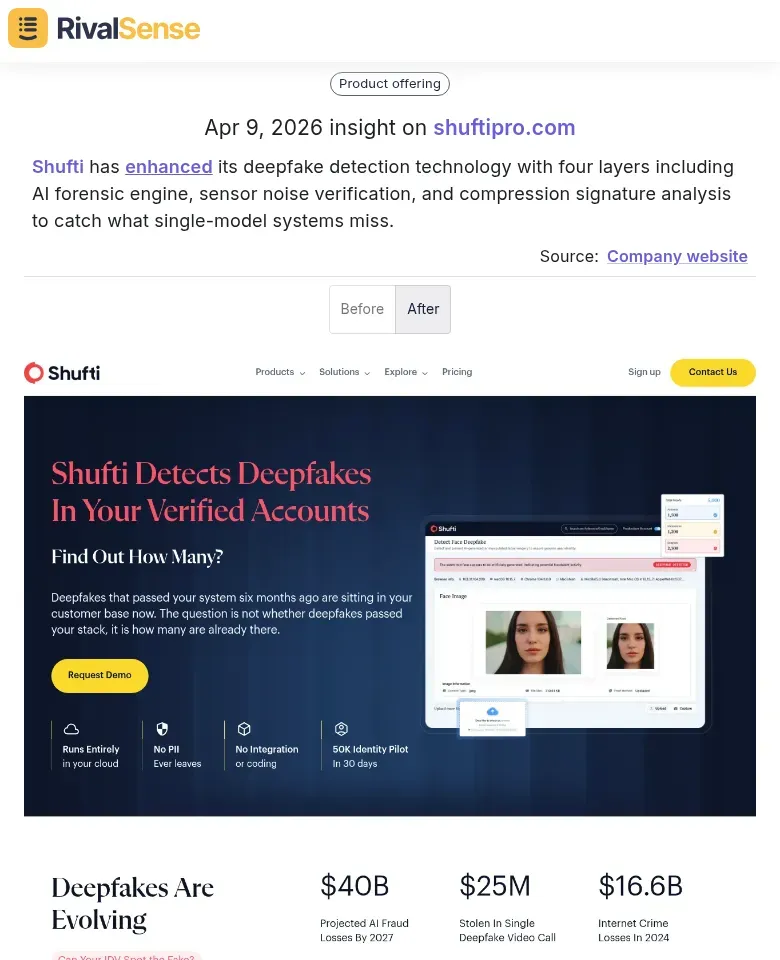
Shufti has enhanced its deepfake detection technology with four layers including AI forensic engine, sensor noise verification, and compression signature analysis to catch what single-model systems miss.
Why it matters: Tracking product enhancements like this reveals competitor innovation priorities and technological advancements. This insight can signal where competitors are investing resources, which may involve new team hires or specialized roles. For business strategy, it helps anticipate market shifts and adjust your own product roadmap or sales messaging.
Example 2: Protocol Support and Technical Updates
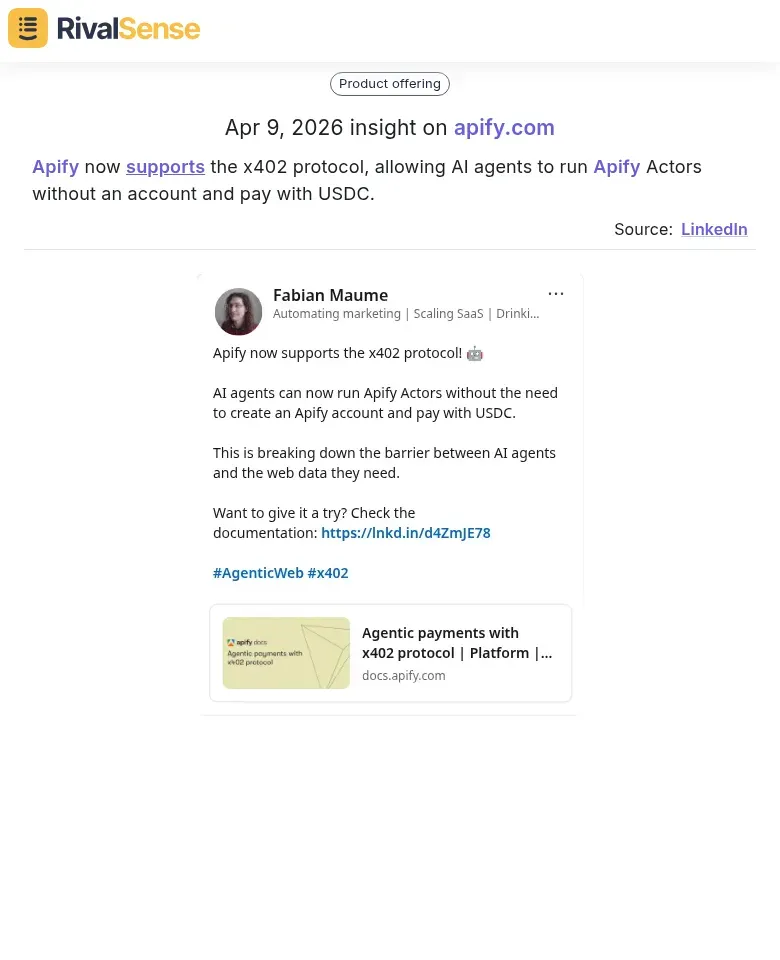
Apify now supports the x402 protocol, allowing AI agents to run Apify Actors without an account and pay with USDC.
Why it matters: Technical updates such as new protocol support indicate competitor focus on interoperability and market expansion. This type of insight can suggest strategic partnerships or targeting new customer segments. For your strategy, it highlights areas where competitors are gaining competitive edges, prompting you to evaluate similar capabilities or differentiation.
Example 3: Sponsorship and Partnership Activities
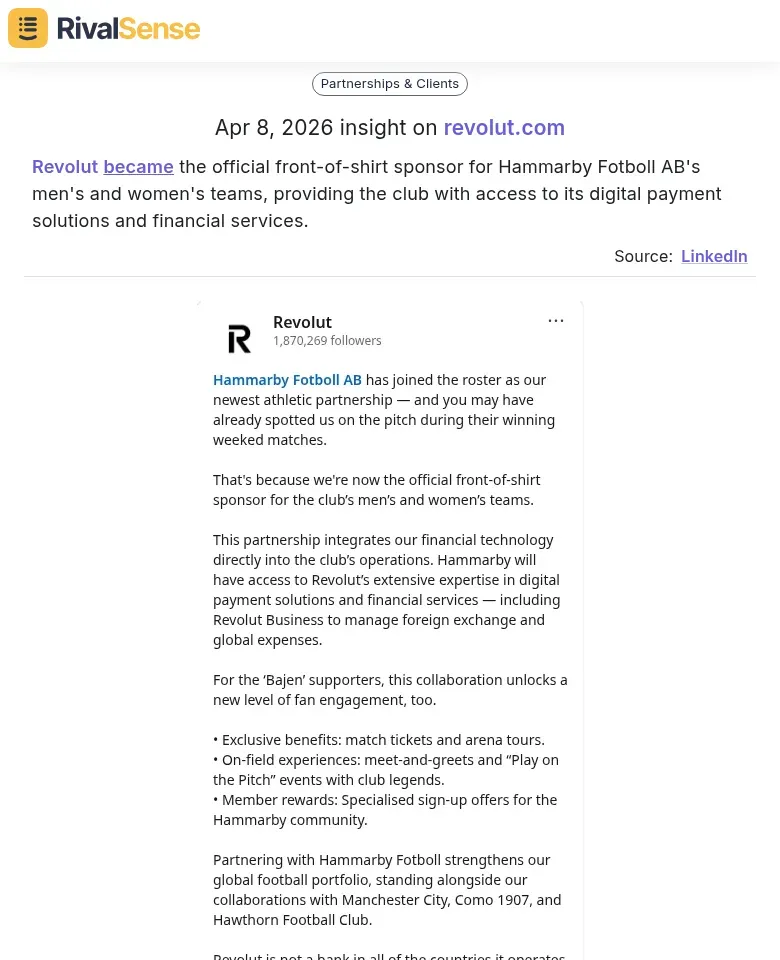
Revolut became the official front-of-shirt sponsor for Hammarby Fotboll AB's men's and women's teams, providing the club with access to its digital payment solutions and financial services.
Why it matters: Sponsorships and partnerships reflect marketing strategies and brand positioning efforts. This insight shows how competitors are building visibility and trust in specific markets or demographics. For business strategy, it reveals competitive approaches to customer acquisition and community engagement, informing your own marketing and partnership decisions.
HOW RIVALSENSE ENHANCES YOUR KEY ACCOUNT TEAM TRACKING
While manual tracking provides limited visibility, automated solutions transform team intelligence into strategic advantage. RivalSense delivers comprehensive competitor tracking across 80+ sources—monitoring product launches, pricing updates, event participations, partnerships, regulatory changes, management moves, and media mentions.
For key account team tracking specifically, RivalSense provides:
- Automated Executive Change Detection: Real-time alerts for competitor leadership movements
- Team Expansion Monitoring: Tracking hiring patterns and organizational growth
- Relationship Network Insights: Intelligence on competitor-customer relationship dynamics
- Weekly Intelligence Reports: Curated summaries delivered directly to your inbox
- API Integration: Programmatic access for CRM and business system integration
This combination ensures you catch critical team changes—like a competitor hiring your former key account manager or expanding their enterprise sales team—before these movements impact your revenue. The platform's automated monitoring across company websites, social media, regulatory databases, and news outlets minimizes blind spots in your competitive intelligence.
FREQUENTLY ASKED QUESTIONS
WHAT ARE THE MOST IMPORTANT KEY ACCOUNT TEAM CHANGES TO TRACK?
Start with leadership movements (VP-level and above), key account manager turnover, and aggressive hiring campaigns. These provide both strategic direction signals and tactical relationship intelligence.
HOW MANY COMPETITOR TEAMS SHOULD WE TRACK?
Track 3-5 competitor companies initially, focusing on those with the most account overlap. Add additional competitors as tracking processes mature and data quality improves.
WHAT'S THE BEST WAY TO TRACK TEAM CHANGES AUTOMATICALLY?
Combine LinkedIn monitoring with automated competitive intelligence platforms. Solutions that monitor 80+ sources—like RivalSense—provide comprehensive coverage without manual effort, delivering team change intelligence through weekly reports and real-time alerts.
HOW DO TEAM CHANGES IMPACT COMPETITIVE DYNAMICS?
Team changes create relationship vulnerabilities and strategic opportunities. New leaders bring different approaches, high turnover indicates instability, and expansion signals growth intentions—all intelligence that informs your account strategy.
WHAT'S THE TIMELINE BETWEEN TEAM CHANGES AND MARKET IMPACT?
Leadership changes impact strategy within 30-90 days, team expansions affect capacity within 60-120 days, and hiring campaigns signal growth 3-6 months before revenue impacts. Early detection provides maximum strategic advantage.
DRIVE COMPETITIVE ADVANTAGE WITH TEAM INTELLIGENCE
Effective key account team tracking goes beyond monitoring—it creates proactive advantage that drives revenue protection and growth. The intelligence you gather determines whether you anticipate competitor moves or discover them when accounts are already at risk.
Focus on automated tracking that provides early warning of strategic shifts. Start with leadership monitoring, add team dynamics tracking deliberately, and integrate intelligence into your account planning processes. This approach builds competitive resilience while providing your team with actionable insights.
Stop guessing about competitor intentions. Start tracking the team movements that actually drive competitive outcomes.
Ready to automate your key account team intelligence? Try RivalSense for free at https://rivalsense.co/ to get your first competitor report today and stay ahead of team changes before they impact your key accounts.
📚 Read more
👉 Data-Driven Insights: Track Key Account Communications in B2B Fintech
👉 How NVIDIA's Nuclear AI Deal Enabled Competitors to Secure Energy Partnerships
👉 Quick Twitter Hacks: Competitor Intelligence for B2B Leaders
👉 Advanced Financial Analysis for Video Editing Software Competitors: Turning Insights into Strategy
👉 Competitor Product Analysis Workflow: From Tracking to Strategic Insights