
The Ultimate Key Account Tracking User Guide: Practical Strategies for 2026
In today's hyper-competitive B2B landscape, your key accounts aren't just customers—they're strategic assets that can make or break your business. With 80% of revenue typically coming from just 20% of customers, effective key account tracking has never been more critical. Yet most companies still rely on outdated methods that leave them vulnerable to competitive threats and missed opportunities.
This comprehensive user guide provides practical steps, checklists, and actionable strategies that transform account management from reactive support to proactive strategic partnership. Whether you're a founder, CEO, or business leader, this guide will help you implement a systematic approach to tracking your most valuable relationships.
The 5-Pillar Framework for Effective Key Account Tracking
Implementing key account tracking requires a structured approach. This framework is built on five essential pillars that ensure comprehensive monitoring and proactive management, helping you stay ahead in a dynamic market.
Pillar 1: Centralized Data Management
Your first step is creating a single source of truth for all account information. This goes beyond basic CRM data to include comprehensive details that paint a full picture of each relationship.
Practical Checklist for Data Centralization:
✅ Contact Intelligence: Track all decision-makers, influencers, and operational contacts with their roles, influence levels, and relationship history
✅ Communication Repository: Log every interaction—emails, calls, meetings, and important conversations—with timestamps and context
✅ Contract Management: Document terms, renewal dates, pricing structures, and service level agreements
✅ Usage Analytics: Monitor product adoption rates, feature utilization, and engagement patterns
✅ Financial Tracking: Record revenue history, profitability metrics, and growth trends
Pro Tip: Don't rely on spreadsheets or basic CRMs. Use dedicated account management platforms that provide the structure needed for comprehensive tracking.
Pillar 2: Real-Time Health Scoring and Automated Alerts
Proactive account management requires instant insights into account health. Implement a scoring system that automatically assesses account health based on multiple data points, allowing you to address issues before they escalate.
Health Scoring Implementation Steps:
- Define Scoring Criteria: Weight factors based on business priorities (e.g., engagement 40%, usage 30%, financial health 30%)
- Set Up Automated Data Feeds: Connect your CRM, support system, and product analytics
- Establish Alert Thresholds: Create triggers for at-risk accounts (e.g., score drops below 70)
- Design Escalation Procedures: Define actions for different risk levels
- Validate with Historical Data: Test the system using past account outcomes
Key Metrics to Track:
- Engagement frequency and quality
- Product adoption and feature utilization
- Customer satisfaction scores and sentiment
- Payment history and contract value trends
- Support ticket volume and resolution times
Pillar 3: Competitive Intelligence Integration
Your key accounts are constantly being courted by competitors. Effective tracking must include monitoring competitive movements that could impact your relationships, ensuring you can proactively defend and grow your accounts.
Why Competitive Monitoring is Non-Negotiable:
- 68% of lost key accounts cite competitor offers as a primary reason for switching
- Early detection of competitive threats allows proactive response
- Understanding competitor strategies helps you anticipate account needs
Practical Implementation Strategy:
Competitive Intelligence Checklist for Your Reports:
✅ Product Innovation Tracking: Monitor competitor launches of features or products that appeal to your accounts' industries
✅ Strategic Moves Monitoring: Track acquisitions, partnerships, or executive changes that signal strategy shifts
✅ Pricing and Service Updates: Watch for competitor pricing adjustments or service term changes
✅ Market Expansion Signals: Monitor geographic expansion and new market entries
✅ Regulatory Changes: Follow industry regulations that impact your competitive landscape
Real-World RivalSense Insights:
-
Product Launch Tracking:

Mary Kay launched a new hydrating cream mask on February 16, based on a third-party independent consumer study involving 160 women. This type of insight is valuable for understanding competitor innovation and marketing strategies that might appeal to your key accounts' demographics or needs. -
Strategic Acquisition Monitoring:

AFRY announced on February 17 that it is acquiring AMC Consultants, a global mining consultancy firm, as a key strategic move to strengthen its team and deliver greater value in the mining and metals sector, according to Nicholas Oksanen, EVP and Head of Global Division Industry at AFRY. Monitoring such acquisitions helps you anticipate competitor expansion into new markets or services that could threaten your account relationships. -
Regulatory Development Tracking:
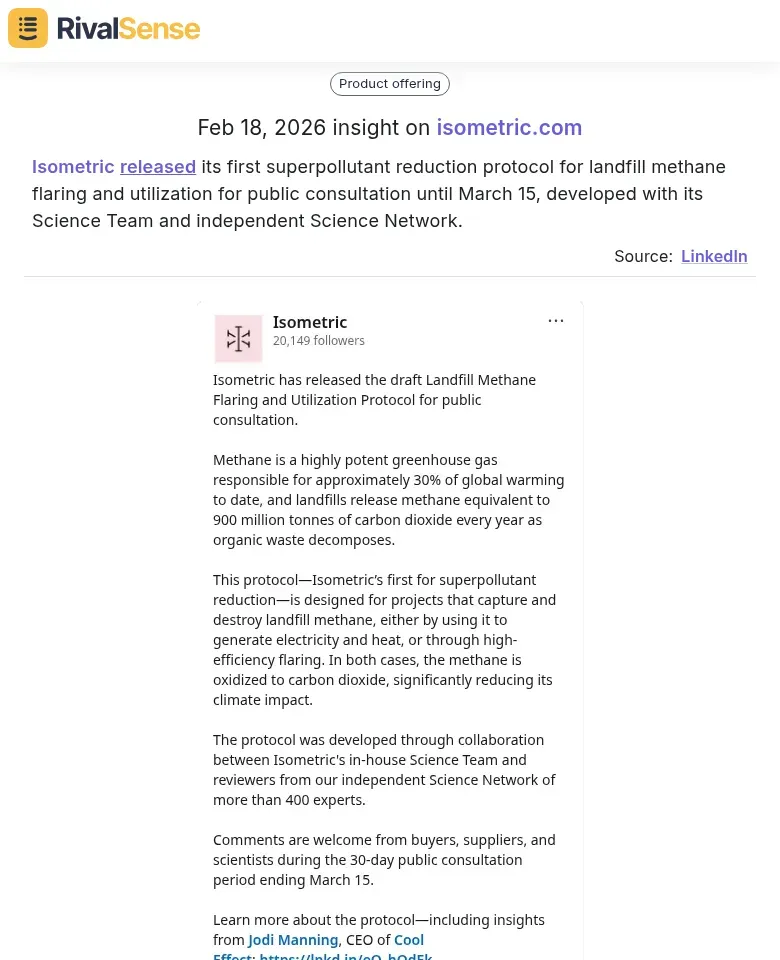
Isometric released its first superpollutant reduction protocol for landfill methane flaring and utilization for public consultation until March 15, developed with its Science Team and independent Science Network. Tracking regulatory developments is crucial for staying compliant and identifying opportunities where competitors might gain an advantage through early adoption.
The RivalSense Advantage: Unlike basic monitoring tools, RivalSense provides comprehensive competitor intelligence across 80+ sources including company websites, social media, regulatory filings, industry registries, and media mentions. All delivered in a consolidated weekly report, saving account managers hours of manual research while providing actionable insights into competitor product launches, pricing changes, executive movements, partnership announcements, and regulatory developments.
Pillar 4: Workflow Automation and CRM Integration
Transform your key account tracking from administrative burden to strategic growth engine through automation. By streamlining processes, you can focus more on building relationships and less on manual tasks.
Workflow Automation Implementation Checklist:
✅ Audit Current Processes: Identify manual bottlenecks in your account tracking workflows
✅ Implement AI-Powered Intelligence: Use conversation analysis to detect early churn signals
✅ Set Up Automated Health Scoring: Configure risk thresholds and intervention triggers
✅ Integrate Whitespace Analytics: Identify expansion opportunities before competitors do
✅ Establish Real-Time Benchmarking: Compare performance against industry standards
Key Advantage: Automated systems save account managers 20+ hours weekly while providing predictive insights.
Pillar 5: Actionable Reporting and Dashboard Design
Create reports that drive action, not just collect data. Different stakeholders need different insights to make informed decisions, so tailoring your dashboards is essential for effectiveness.
Step-by-Step Reporting Framework:
Step 1: Define Your Reporting Objectives
- Strategic Reports: For executive leadership focusing on portfolio health and growth opportunities
- Operational Reports: For account managers tracking day-to-day relationship management
- Tactical Reports: For cross-functional teams needing specific insights
Step 2: Select Key Performance Indicators
Limit your core KPIs to 5-7 per report type to maintain focus:
- Financial KPIs: Account revenue growth rate, customer lifetime value, profitability per account
- Relationship KPIs: Net Promoter Score, stakeholder engagement levels, executive alignment scores
- Operational KPIs: Response time to account issues, opportunity win rates, competitive threat detection time
Step 3: Design Your Reporting Dashboard
Executive Dashboard Example:
- Portfolio Health Overview with color-coded account status
- Revenue Concentration showing distribution across top accounts
- Growth Opportunities with pipeline value by account
- Competitive Landscape tracking recent competitor activities
- Risk Assessment highlighting accounts requiring immediate attention
Account Manager Dashboard Example:
- My Accounts Overview with quick status of all assigned accounts
- Upcoming Activities calendar for renewals and important dates
- Health Score Trends with historical tracking
- Action Items with priority tasks and deadlines
- Competitive Alerts for recent competitor movements
Step 4: Establish Reporting Cadence
- Daily: Real-time alerts for critical issues
- Weekly: Operational updates for account managers
- Monthly: Performance reviews and strategic planning
- Quarterly: Executive business reviews
- Annually: Comprehensive account planning
Practical Implementation Checklist
Tracking key accounts effectively requires consistent effort. Use this checklist to ensure you cover all bases and maintain a proactive approach.
✅ Weekly Tracking Activities
- Review Days Sales Outstanding (DSO) and aging reports for key accounts
- Monitor competitor activity alerts (product launches, pricing changes, executive movements)
- Check customer engagement metrics and response rates
- Update account health scores based on recent interactions
- Scan for regulatory developments affecting key accounts
✅ Monthly Review Tasks
- Analyze Customer Lifetime Value (CLV) trends and identify growth opportunities
- Review competitive positioning across all key accounts
- Assess customer satisfaction scores and identify improvement areas
- Evaluate market share movements and competitive threats
- Track partnership announcements and event participations
✅ Quarterly Strategic Analysis
- Conduct comprehensive account portfolio review
- Update competitive intelligence and market positioning
- Review and adjust account strategies based on KPI trends
- Identify accounts at risk and develop mitigation plans
- Benchmark performance against industry standards
Advanced Techniques for 2026
Staying ahead requires adopting cutting-edge methods. These advanced techniques leverage technology to enhance your tracking capabilities and provide a competitive edge.
Predictive Analytics for Proactive Management
Move beyond reactive tracking to predictive insights. Leveraging historical data and machine learning, you can anticipate account behaviors and outcomes before they happen, enabling preemptive actions.
Implementation Steps:
- Collect historical data on account behaviors and outcomes
- Build predictive models for churn risk and expansion opportunities
- Integrate predictions into your tracking dashboards
- Establish protocols for acting on predictive insights
AI-Powered Relationship Intelligence
Leverage artificial intelligence to enhance your tracking capabilities. AI can process vast amounts of data to uncover patterns and insights that humans might miss.
AI Applications in Key Account Tracking:
- Sentiment Analysis: Automatically assess tone in communications
- Interaction Pattern Recognition: Identify optimal engagement frequencies
- Stakeholder Mapping: Use AI to track influence networks within accounts
- Automated Insight Generation: Have AI highlight important trends and anomalies
Implementation Roadmap: Getting Started
A phased approach ensures smooth adoption and continuous improvement. Follow this roadmap to build a robust key account tracking system step by step.
Phase 1: Foundation (Weeks 1-4)
- Select 5-10 most important accounts to start
- Set up basic tracking and health scoring
- Train your team on the new system
- Establish baseline metrics for comparison
Phase 2: Scaling (Months 2-3)
- Expand tracking to all key accounts
- Integrate data sources (CRM, support, product analytics)
- Implement competitive monitoring tools
- Refine reporting based on initial feedback
Phase 3: Optimization (Months 4-6)
- Add predictive capabilities and AI insights
- Enhance automation to reduce manual work
- Conduct regular reviews and updates
- Scale best practices across the organization
Common Pitfalls to Avoid
Avoiding common mistakes can save time and resources. Here are key pitfalls and how to overcome them for successful key account tracking.
-
Data Overload: Tracking too many metrics without clear purpose
Solution: Focus on actionable KPIs that drive specific decisions -
Siloed Information: Account data scattered across different systems
Solution: Implement centralized platforms that integrate multiple data sources -
Lack of Action Orientation: Reports that don't lead to concrete actions
Solution: Include clear recommendations and next steps in every report -
Ignoring Competitive Context: Tracking account health without considering competitive landscape
Solution: Integrate competitive intelligence into your regular reporting
Essential Features Checklist for Modern Tracking Tools
Choosing the right tools is critical for success. Look for these features to ensure your tracking system is comprehensive and efficient.
✅ Real-time competitor monitoring across multiple sources
✅ Automated alerts for critical account developments
✅ Cross-platform integration with existing CRM systems
✅ Predictive analytics for trend identification
✅ Comprehensive reporting with customizable dashboards
✅ Weekly consolidated reports from 80+ sources
✅ Tracking of product launches, pricing updates, and executive movements
✅ Monitoring of partnerships, events, and regulatory developments
The ROI of Comprehensive Key Account Tracking
Investing in robust tracking yields significant returns. Companies that implement full-spectrum KPI tracking typically see tangible benefits that justify the effort.
- 15-25% improvement in account retention
- 20-30% faster identification of growth opportunities
- 40-50% reduction in competitive surprise incidents
- Significant time savings on manual research
Conclusion: Transforming Account Management in 2026
In 2026, key account management success isn't just about what you know about your accounts—it's about what you know about everything affecting your accounts. The most successful account managers leverage comprehensive tracking that combines financial metrics, relationship health indicators, and competitive intelligence.
By implementing the framework outlined above and leveraging modern tools, you can transform your account management from reactive to proactive, from guesswork to data-driven strategy, and from customer service to strategic partnership.
Ready to transform your key account tracking strategy? Start by implementing one new practice from this guide each week. To seamlessly integrate competitive intelligence, try out RivalSense for free at https://rivalsense.co/ and get your first competitor report today.
Frequently Asked Questions
Addressing common questions helps clarify implementation. Here are answers to frequently asked questions about key account tracking.
How often should we review key account KPIs?
- Weekly: DSO, engagement metrics, competitor alerts
- Monthly: CLV, satisfaction scores, market positioning
- Quarterly: Comprehensive portfolio analysis and strategy adjustment
Can automation improve KPI tracking accuracy?
Absolutely. Modern tools provide real-time dashboard updates, automated competitor monitoring, predictive analytics for trend identification, and integrated CRM synchronization.
How does competitive intelligence enhance account management?
Competitive tracking allows you to anticipate competitor moves before they happen, position your solutions more effectively, identify white space opportunities, and develop more compelling value propositions.
What's the ROI of comprehensive KPI tracking?
Companies see 15-25% improvement in account retention, 20-30% faster identification of growth opportunities, 40-50% reduction in competitive surprise incidents, and significant time savings on manual research.
📚 Read more
👉 Air Freight Case Study: How Competitor Partnerships Build Winning Ecosystems
👉 How RivalSense Empowered Placet Group to Defend Against E-Invoicing Disruption
👉 Competitor Brand Perception Mastery: The Ultimate Internet Insights Guide
👉 Mastering Key Account Management in Kazakhstan's Auto Lending Sector: A Practical Guide
👉 How to Track Competitor Pricing for Key Account Success: A Step-by-Step Guide