
The Ultimate Guide to Tracking Key Account Sentiment in 2026
As a founder or business leader, you know that your most valuable accounts aren't just revenue sources—they're strategic partnerships that can make or break your business. Yet most companies treat account monitoring as a reactive exercise, waiting for complaints or renewal conversations to gauge sentiment. In 2026, this approach is dangerously outdated.
Consider this: By the time a key account expresses dissatisfaction, you've already lost valuable time to course-correct. The real opportunity lies in detecting subtle sentiment shifts before they become visible—tracking the unspoken concerns, the cooling enthusiasm in meeting transcripts, the delayed responses that signal deeper issues.
The Reddit Reality Check: Why Most Social Listening Tools Fail
Social listening tools often promise comprehensive monitoring, but they frequently fall short in critical areas. Understanding where these tools fail can help you choose better solutions. Recently, a revealing discussion on r/DigitalMarketing highlighted a critical gap in current monitoring solutions. A founder asked: "HOW DO YOU MONITOR REDDIT SENTIMENT FOR YOUR BRAND?" The responses were telling:
- Most tools treat Reddit as an afterthought - "Twitter-first architecture with Reddit bolted on"
- Surface-level sentiment analysis misses context - "Sarcasm, inside jokes, and subreddit culture can throw off automated sentiment analysis"
- Volume alerts ≠ velocity alerts - Most tools "alert on volume, not velocity (which is where Reddit threads really signal traction)"
This conversation reveals a broader truth: Most monitoring tools are optimized for public social platforms, not the nuanced, long-form discussions where key account stakeholders actually share honest feedback.
The 4-Pillar Framework for Effective Key Account Sentiment Tracking
Key account sentiment isn't found in one place. It's distributed across multiple channels and contexts. To capture it effectively, you need a structured approach. Here's a four-pillar framework to build a robust sentiment tracking system.
1. Multi-Source Intelligence Gathering
Effective sentiment tracking begins with casting a wide net across diverse information sources. Relying on a single channel leaves you vulnerable to blind spots. Key account sentiment is distributed across:
- Professional networks (LinkedIn discussions, industry forums)
- Technical communities (Reddit, Stack Overflow, GitHub)
- Internal communications (Meeting transcripts, email exchanges)
- Public registries (Regulatory filings, partnership announcements)
- Industry publications (Trade journals, analyst reports)
Practical Checklist: Your Multi-Source Monitoring Setup
- [ ] Identify 3-5 industry-specific forums where your key accounts' technical teams participate
- [ ] Set up alerts for key stakeholders' LinkedIn activity and industry contributions
- [ ] Monitor regulatory databases for your accounts' expansion plans or compliance issues
- [ ] Track competitor mentions within your key accounts' public communications
- [ ] Establish baseline sentiment metrics across all channels for each key account
2. Context-Aware Sentiment Analysis
Traditional sentiment analysis tools often fail because they lack context. They treat mentions as isolated events without understanding the surrounding conversation. Effective key account monitoring requires understanding:
- Conversation context - Is this a technical discussion, a procurement complaint, or strategic planning?
- Relationship dynamics - Who's speaking? What's their influence level within the account?
- Historical patterns - How does this sentiment compare to previous interactions?
- Competitive positioning - Are competitors being mentioned positively or negatively?
Pro Tip: Look for tools that offer semantic matching instead of simple keyword tracking. This catches phrases like "frustrated with [your solution]" rather than just tracking your brand name.
3. Velocity-Based Alerting
Most tools alert you when something happens, but smart monitoring alerts you when something is about to happen. Velocity-based alerting focuses on the pace and trajectory of discussions. Track:
- Comment velocity - How quickly is a discussion gaining traction?
- Unique participant growth - Are new stakeholders joining the conversation?
- Sentiment trajectory - Is sentiment trending positive or negative over time?
- Competitor mention frequency - Are competitors gaining mindshare within your accounts?
Practical Implementation: Set up tiered alerting systems:
- Level 1: Basic mention alerts
- Level 2: Velocity-based alerts (when discussion pace increases 50%+)
- Level 3: Strategic alerts (when C-level stakeholders or competitors enter the conversation)
4. Competitive Intelligence Integration
Your key accounts' sentiment about you is only half the story. To fully understand their mindset, you need to integrate competitive intelligence. This involves monitoring their sentiment about:
- Your competitors - Are they being considered as alternatives?
- Industry trends - What broader shifts are affecting their priorities?
- Regulatory changes - How are compliance requirements impacting their needs?
- Economic factors - Are budget constraints changing their decision criteria?
The RivalSense Advantage: Real-World Insights for Strategic Action
While researching this article, we discovered that most founders struggle with fragmented monitoring solutions. They're using separate tools for social listening, competitor tracking, and regulatory monitoring—creating blind spots and missed opportunities.
At RivalSense, we've built a different approach. Our platform tracks 80+ sources including competitor product launches, pricing changes, event participations, partnerships, regulatory aspects, management changes, and media mentions. All delivered in a consolidated weekly email report that gives you a complete picture of your competitive landscape and key account sentiment.
But don't just take our word for it. Here are real examples of insights that can directly impact your business strategy:
-
Product Launch Insights: When Buffer launched Threads Trending Topics in its composer, it helped users like Michael Eckstein gain 45K views by tapping into a quantum physics trend.
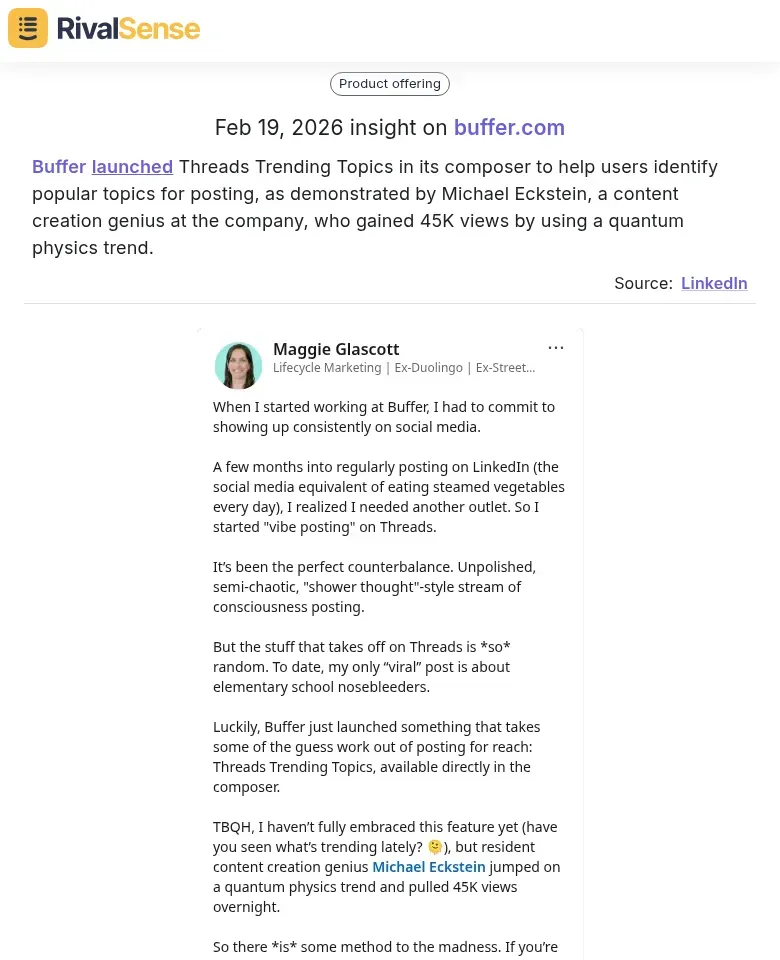 Tracking such product launches is valuable because it reveals how competitors are innovating to capture user attention, allowing you to anticipate market shifts and adjust your own offerings.
 -
Partnership Announcements: Corteva India and BASF India launched the Clearfield Production System for mustard, a non-GM, herbicide-tolerant solution.
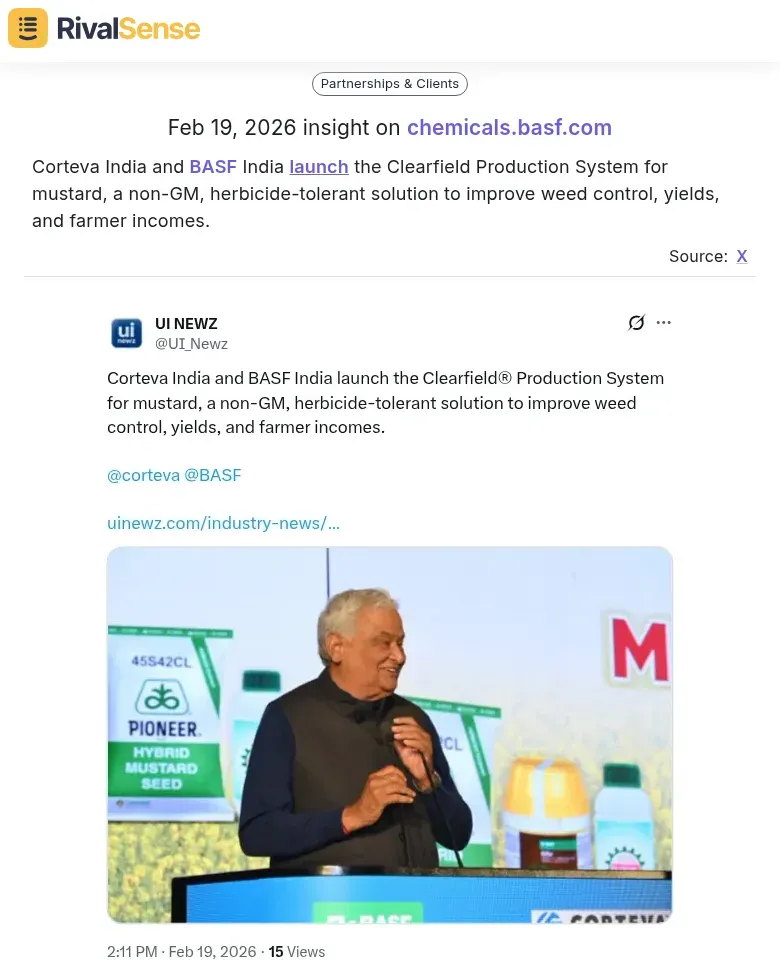 Monitoring partnerships like this is crucial as they can signal new market entries, combined strengths, or responses to regulatory changes, affecting your key accounts' supplier choices and industry dynamics.
 -
Geographical Expansion: IPRoyal launched ISP Proxies in Estonia on February 19, offering residential-level trust with datacenter speed.
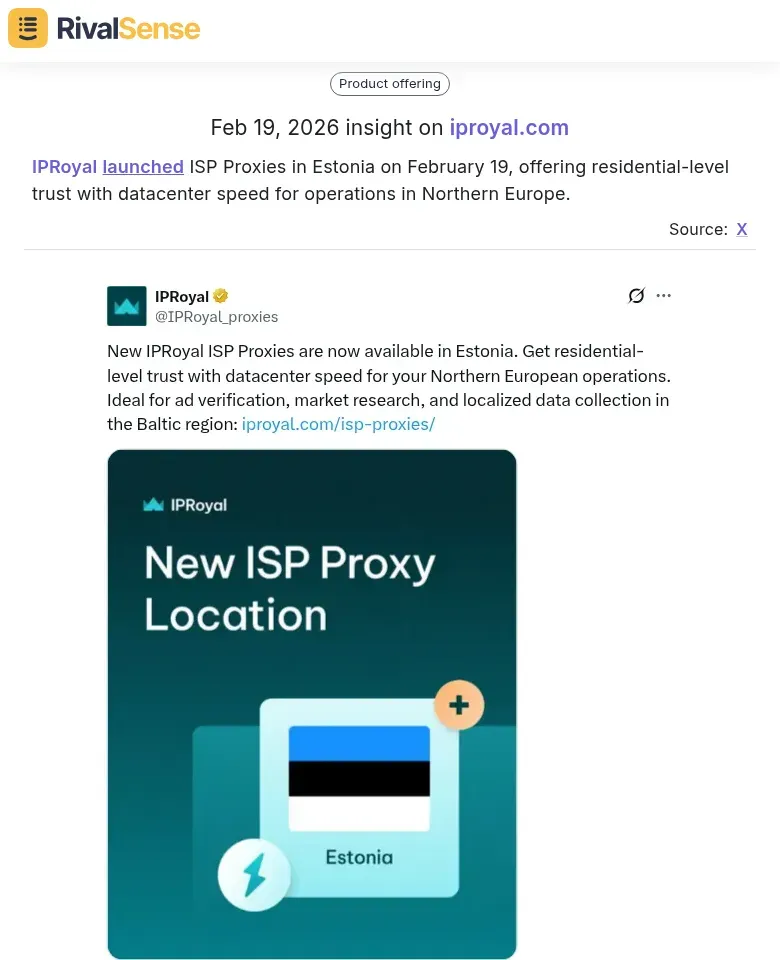 Such expansions indicate where competitors are investing and can reveal emerging markets or service gaps, helping you strategize your own growth or defend your position in key accounts.
These insights demonstrate how comprehensive monitoring can provide early warnings and opportunities, directly influencing your strategic decisions.
Your Actionable 30-Day Implementation Plan
Implementing a robust sentiment tracking system doesn't have to be overwhelming. With a structured plan, you can build momentum quickly. Here's a step-by-step guide to get started in just 30 days.
Week 1: Foundation Building
- Map your key accounts' digital footprint - Identify where they're most active online
- Establish baseline metrics - Document current sentiment levels for each account
- Set up initial monitoring - Start with 3-5 critical channels per account
Week 2-3: Tool Implementation
- Evaluate monitoring solutions - Look for platforms that offer:
- Multi-source tracking (not just social media)
- Context-aware sentiment analysis
- Velocity-based alerting
- Competitive intelligence integration
- Configure your setup - Customize alerts for each key account's unique characteristics
- Train your team - Ensure everyone understands how to interpret and act on insights
Week 4: Optimization & Scaling
- Review initial findings - What patterns are emerging?
- Refine your alerting thresholds - Adjust based on what's actually valuable
- Expand monitoring scope - Add additional accounts and channels
- Establish reporting cadence - Create regular review processes
Common Pitfalls to Avoid
Even with the best tools, mistakes can undermine your efforts. Being aware of common pitfalls helps you navigate them effectively. Here are key mistakes to steer clear of:
- Over-reliance on automated sentiment - Always maintain human review for critical accounts
- Ignoring niche communities - Your most valuable insights often come from specialized forums
- Focusing only on negative sentiment - Positive sentiment trends are equally valuable for expansion opportunities
- Treating all accounts equally - Tier your monitoring intensity based on account value
- Forgetting competitive context - Your accounts' sentiment about competitors directly impacts their relationship with you
The Future of Key Account Intelligence
As AI continues to evolve, we're moving toward truly intelligent account monitoring systems. These advancements will transform how we understand and respond to key account sentiment. Future systems may:
- Predict sentiment shifts before they become visible
- Correlate signals across multiple data sources
- Prescribe specific actions based on sentiment patterns
- Automate relationship mapping within complex organizations
But you don't need to wait for the future. The tools and strategies outlined here are available today—and they're becoming essential for maintaining competitive advantage in an increasingly transparent business environment.
Next Steps for Your Business
Start by conducting a quick audit of your current key account monitoring setup. This will highlight gaps and opportunities for improvement. Ask yourself:
- How many sources are we actively monitoring for each key account?
- What percentage of our insights come from automated vs. manual monitoring?
- How quickly do we detect sentiment shifts?
- What competitive intelligence are we missing?
Remember: In key account management, what you don't know can hurt you more than what you do know. Proactive sentiment tracking isn't just nice-to-have—it's your early warning system for preserving and growing your most valuable relationships.
Ready to transform your key account strategy? Try out RivalSense for free at https://rivalsense.co/ to get comprehensive competitor intelligence and account sentiment insights from 80+ sources. Get your first competitor report today and start making more informed strategic decisions.
📚 Read more
👉 Mastering Key Account Lifecycles in Semiconductor Design: Actionable Strategies
👉 How BASF's €11B R&D Success Drives Competitor Innovation Acceleration
👉 Facebook Competitor Trend Analysis: Uncover Key Insights for B2B Strategy
👉 Data-Driven Competitive Intelligence: Winning in Licensed Pop Culture Apparel
👉 Avoid These Regulatory Competitor Insight Mistakes That Are Hurting Your ROI