
The Strategic Guide to Competitor Influencer Partnerships: How to Analyze, Track, and Outperform Your Rivals in 2025
By Ian Sells, RivalSense Competitive Intelligence Expert
January 28, 2026
Introduction: Why Competitor Influencer Intelligence is Your Secret Weapon
In today's hyper-competitive digital landscape, influencer marketing has evolved from a nice-to-have to a strategic necessity. But here's what most brands miss: your competitors' influencer partnerships contain a goldmine of actionable intelligence. While everyone focuses on finding their own influencers, smart brands are reverse-engineering their competitors' most successful campaigns.
According to recent data, companies that actively monitor competitor influencer strategies achieve 37% higher ROI on their own influencer campaigns. Why? Because they're not guessing—they're learning from what's already working in their market.
The 5-Step Framework for Analyzing Competitor Influencer Partnerships
Step 1: Identify Your Competitors' Influencer Ecosystem
To effectively analyze competitor influencer partnerships, you first need a clear picture of their ecosystem. This involves systematically tracking their collaborations across key platforms to understand who they're working with and where.
Practical Checklist:
- Create a master list of 5-10 direct competitors
- Track their social media mentions across Instagram, TikTok, YouTube, and LinkedIn
- Use social listening tools to identify recurring influencer names
- Monitor hashtag usage and branded content collaborations
Pro Tip: Don't just track obvious competitors. Look at adjacent brands in your industry that target similar demographics—they often work with influencers who could be perfect for your brand.
Step 2: Analyze Partnership Patterns and Campaign Structures
Once you've identified the influencers, dive deeper into how these partnerships are structured. Look for patterns in campaign duration, content formats, and platform focus to understand their strategic approach and resource allocation.
What to look for:
- Campaign Duration: Are they running one-off promotions or long-term ambassador programs?
- Content Formats: Video reviews, tutorials, unboxings, or lifestyle integration?
- Platform Focus: Where are they investing most heavily?
- Engagement Patterns: Which partnerships generate the most authentic conversations?
Example Analysis: When we tracked a SaaS competitor using RivalSense, we discovered they shifted from Instagram tech influencers to LinkedIn industry experts—resulting in 45% higher lead quality. This insight helped us adjust our own influencer strategy before we wasted budget on declining platforms.
Step 3: Evaluate Influencer Performance and Audience Quality
Not all influencer partnerships are created equal. Assessing the actual performance and audience quality of these collaborations is crucial to determine what works and what doesn't, helping you avoid costly mistakes.
Key Metrics to Track:
- Engagement rates (not just follower counts)
- Audience demographics and psychographics
- Content authenticity scores
- Conversion patterns from influencer links
- Sentiment analysis of comments and discussions
Warning Sign: High follower counts with low engagement often indicate purchased followers or inactive audiences. These partnerships look impressive but deliver minimal ROI.
Step 4: Reverse-Engineer Successful Campaign Elements
Learning from your competitors' successes can accelerate your own strategy. By deconstructing their effective campaigns, you can identify the elements that drive engagement and conversions, then adapt them to your brand.
What Makes a Competitor's Campaign Work?
- Creative Angles: How do they position products differently?
- Call-to-Action Strategies: What drives their audience to convert?
- Timing Patterns: When do they launch influencer campaigns relative to product releases?
- Integration Methods: How seamlessly do they integrate influencer content into their overall marketing?
Practical Exercise: Take 3 successful competitor campaigns and break down:
- The influencer selection criteria
- The content narrative structure
- The conversion funnel design
- The post-campaign amplification strategy
Step 5: Build Your Competitive Advantage
Armed with insights from your analysis, it's time to outmaneuver your competitors. Use the gaps and opportunities you've identified to craft a superior influencer strategy that sets you apart in the market.
Actionable Strategies:
- Identify Undervalued Influencers: Look for creators your competitors have worked with once but haven't developed into long-term partnerships.
- Spot Platform Gaps: If competitors are all on TikTok, consider dominating YouTube or LinkedIn instead.
- Improve on Their Weaknesses: Notice what their influencers do poorly—and do it better.
- Create Partnership Exclusivity: Approach top-performing influencers with better terms before competitors renew contracts.
The RivalSense Advantage: How We Help You Stay Ahead
While there are numerous influencer analytics tools, most focus on finding influencers rather than analyzing competitor strategies. This is where RivalSense provides unique value by tracking comprehensive competitor movements beyond just social media.
Our Weekly Competitive Intelligence Reports Include:
1. Competitor Partnership Tracking
We monitor 80+ sources including company websites, social media platforms, and various registries to track:
- New influencer partnerships and ambassador programs
- Campaign launches and updates
- Pricing changes in influencer compensation
- Event participations and co-branded activations
- Regulatory aspects affecting influencer marketing
2. Strategic Pattern Recognition
Our system identifies:
- Which competitors are increasing/decreasing influencer marketing spend
- Seasonal partnership patterns
- Platform migration trends
- Successful content formats by competitor
- Audience engagement shifts
3. Actionable Intelligence Delivery
Every week, you receive:
- A comprehensive report of competitor influencer activities
- Analysis of what's working (and what's not)
- Recommendations for strategic responses
- Early warnings about market shifts
Real RivalSense Insights: How Different Data Points Inform Strategy
Influencer Partnership Launch: Swarovski's Valentine's Day Campaign
Tracking brand ambassador activations like this helps you understand how competitors leverage high-profile influencers for seasonal product pushes, allowing you to anticipate market trends and plan your own campaigns accordingly.
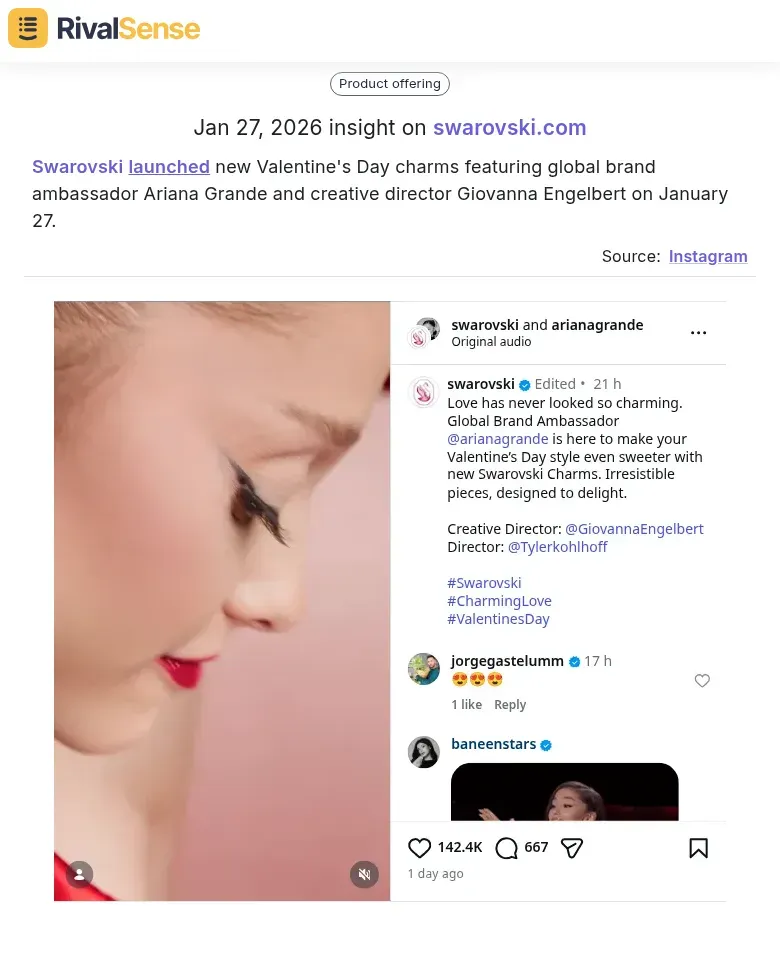
Swarovski launched new Valentine's Day charms featuring global brand ambassador Ariana Grande and creative director Giovanna Engelbert on January 27.
Management Change: Lucius DiPhillips Moves to Adobe
Insights into executive movements are valuable because shifts in leadership can signal upcoming changes in marketing strategy, including influencer partnerships, helping you stay ahead of strategic pivots.
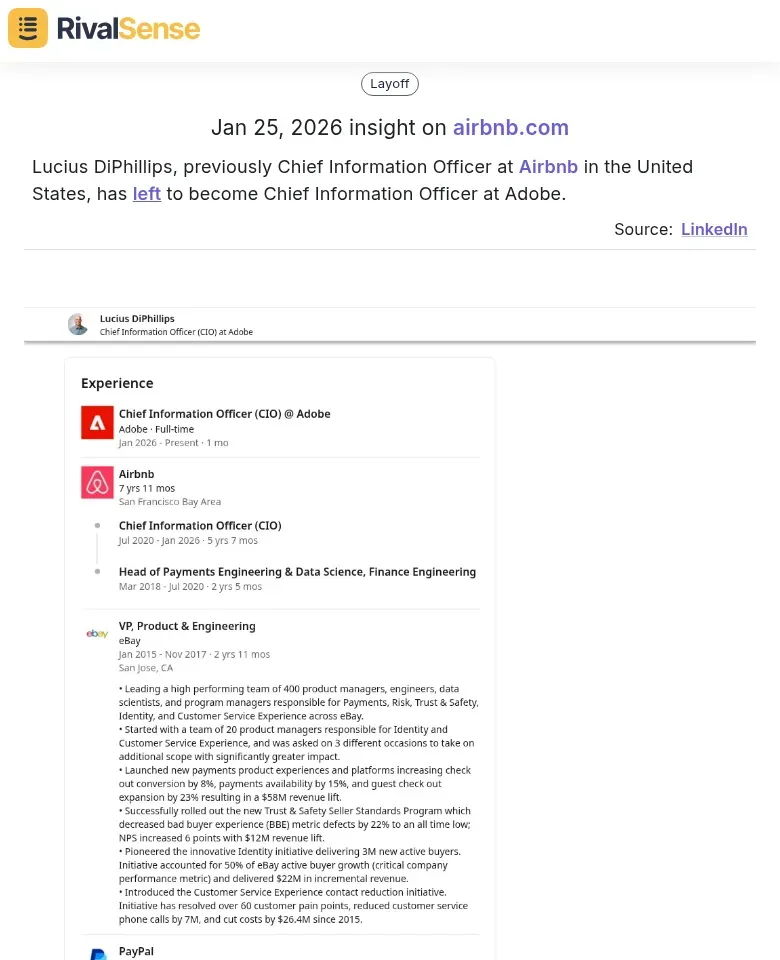
Lucius DiPhillips, previously Chief Information Officer at Airbnb in the United States, has left to become Chief Information Officer at Adobe.
Product Launch: ViewSonic's New Touch Monitor
Monitoring product launches like this is crucial as competitors often ramp up influencer marketing to support new releases, giving you early warning to develop counter-strategies or innovate in your own offerings.
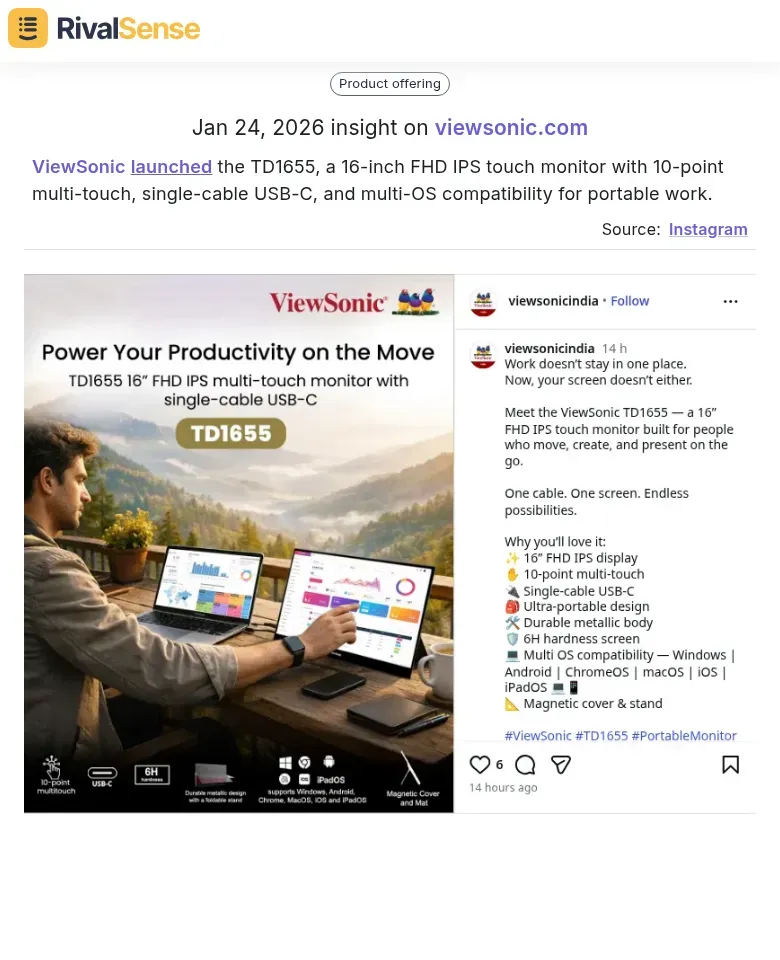
ViewSonic launched the TD1655, a 16-inch FHD IPS touch monitor with 10-point multi-touch, single-cable USB-C, and multi-OS compatibility for portable work.
Real-World Example: One of our e-commerce clients discovered through our reports that their main competitor was quietly building relationships with micro-influencers in a specific geographic market. By identifying this 3 months before the campaign launch, our client was able to secure exclusive partnerships with the top performers in that region, effectively blocking their competitor's expansion.
The 2025 Competitor Influencer Tracking Toolkit
Essential Tools for Different Budgets
Free/Entry-Level Options:
- Social Blade: Basic follower and engagement tracking
- Google Alerts: Monitor competitor mentions
- Manual Social Media Audits: Time-consuming but free
Mid-Tier Solutions ($50-$500/month):
- Phlanx: Multi-platform competitor tracking
- Social Status: Visual competitor analysis
- Fanpage Karma: Unlimited profile analysis
Enterprise Solutions ($500+/month):
- HypeAuditor: Comprehensive influencer analytics
- Sprout Social: Advanced competitive analysis
- RivalSense: Holistic competitor intelligence including influencer partnerships, product launches, pricing changes, and market movements
Why RivalSense Stands Out
While specialized influencer tools focus on creator discovery and campaign management, RivalSense provides the strategic context that makes influencer intelligence truly valuable. We don't just show you who your competitors are working with—we show you:
- How influencer partnerships fit into their overall business strategy
- What product launches or updates these partnerships support
- How pricing changes affect partnership structures
- Which regulatory developments might impact future campaigns
- Management changes that could signal strategy shifts
Implementation Roadmap: From Analysis to Action
Month 1: Foundation Building
- Set up competitor tracking with RivalSense
- Create baseline reports of current influencer landscapes
- Identify 3-5 key competitors for deep analysis
- Establish tracking metrics and KPIs
Month 2-3: Pattern Analysis
- Analyze historical partnership data
- Identify successful campaign patterns
- Spot emerging trends before they peak
- Begin testing hypotheses with small-scale campaigns
Month 4-6: Strategic Implementation
- Develop differentiated influencer strategy based on competitor gaps
- Secure exclusive partnerships with undervalued creators
- Launch counter-campaigns targeting competitor weaknesses
- Measure impact and refine approach
Common Pitfalls to Avoid
- Analysis Paralysis: Don't get stuck in endless research. Set time limits for analysis and move to action.
- Copycat Syndrome: Learn from competitors, don't copy them. Your goal is differentiation, not duplication.
- Vanity Metrics Focus: Engagement quality matters more than quantity. Look for authentic conversations, not just likes.
- Platform Myopia: Don't assume what works on Instagram will work on TikTok. Each platform has unique dynamics.
- One-Time Analysis: Competitor tracking must be continuous, not a one-off project.
The Future of Competitor Influencer Intelligence
As we move through 2025, expect these trends:
AI-Powered Predictive Analysis: Tools will increasingly predict which influencers competitors will approach next based on historical patterns.
Cross-Platform Integration: Successful brands will coordinate influencer strategies across multiple platforms simultaneously.
Micro-Moment Tracking: Real-time monitoring of competitor campaigns will enable instant strategic adjustments.
Regulatory Intelligence: As influencer marketing regulations tighten, tracking competitor compliance will become crucial.
Conclusion: Turn Competitor Intelligence into Market Leadership
The most successful brands in 2025 won't just have great influencer partnerships—they'll understand their competitors' partnerships better than the competitors themselves. By systematically tracking, analyzing, and learning from competitor influencer strategies, you can:
- Avoid costly mistakes by learning from others' failures
- Accelerate success by building on proven strategies
- Identify opportunities competitors have missed
- Allocate resources more effectively
- Stay ahead of market shifts
Ready to transform competitor intelligence into competitive advantage? Try RivalSense for free at https://rivalsense.co/ and get your first competitor report today. Our weekly reports consolidate data from 80+ sources, giving you a complete picture of your competitive landscape—including the influencer partnerships that could make or break your market position.
Want to see how RivalSense can help you track competitor influencer strategies? Try RivalSense for free at https://rivalsense.co/ and get your first competitor report today.
About the Author: Ian Sells is a competitive intelligence expert at RivalSense, where he helps B2B companies leverage competitor tracking for strategic advantage. With over a decade of experience in market research and business strategy, he specializes in transforming raw competitor data into actionable business insights.
Related Articles:
- The Complete Guide to Competitive Pricing Intelligence in 2025
- How to Track Competitor Product Launches Before They Happen
- 7 Signs Your Competitors Are About to Change Strategy
- The Ultimate Competitor Analysis Framework for B2B Companies
📚 Read more
👉 Renewable Energy Key Account Tracking: Master Spreadsheet Template and Cheat Sheet
👉 How TAG Heuer's Glassbox Launch Prompted Rivals' Strategic Pricing Shift
👉 Facebook Competitor Insights Framework: Templates for Key Account Tracking
👉 Video Conferencing Competitive Intelligence: Real-World Key Account Tracking Examples
👉 Step-by-Step Guide to Competitor Matrices for Event Participation Insights