
The Strategic Benefits of Real-Time Competitor Alerts: A Practical Guide for Business Leaders
Updated: December 19, 2025
15 min read
Table of Contents
- Why Real-Time Alerts Beat Periodic Monitoring
- 7 Key Benefits of Real-Time Competitor Alerts
- Practical Implementation Checklist
- Real-World Examples and Case Studies
- How to Choose the Right Alert System
- Integrating Alerts into Your Business Strategy
- Common Pitfalls to Avoid
Introduction: The Speed Advantage in Competitive Intelligence
In today's hyper-competitive business landscape, the difference between reacting to competitor moves and anticipating them can determine market leadership. While many companies conduct periodic competitor analysis, the real competitive edge comes from real-time competitor alerts that transform reactive monitoring into proactive strategy.
Consider this: When a competitor launches a new product, changes pricing, or announces a strategic partnership, the window for effective response is measured in hours—not days or weeks. Real-time alerts give you that crucial time advantage.
Why Real-Time Alerts Beat Periodic Monitoring
Traditional competitor monitoring often involves:
- Monthly or quarterly competitive analysis reports
- Manual website checks
- Occasional social media reviews
- Ad-hoc market research
The problem? By the time you discover a competitor's move through these methods, they've already gained momentum, captured market share, or established new positioning.
Real-time alerts solve this by:
- Immediate notification of competitor activities
- Continuous monitoring across 80+ sources
- Automated intelligence gathering that never sleeps
- Strategic response windows measured in hours, not weeks
7 Key Benefits of Real-Time Competitor Alerts
1. Proactive Rather Than Reactive Strategy
Real-time alerts transform your competitive approach from defensive to offensive. Instead of reacting to established competitor moves, you can anticipate and counter them before they gain traction.
Practical Example: When a SaaS competitor announces a price reduction, real-time alerts allow your sales team to prepare counter-messaging within hours, rather than discovering the change weeks later when deals are already lost.
2. Accelerated Decision-Making
With instant notifications, your leadership team can make strategic decisions based on current market conditions rather than historical data.
Checklist for Decision Acceleration:
- ☐ Establish clear escalation protocols for different alert types
- ☐ Create response playbooks for common competitor moves
- ☐ Set up dedicated Slack/Teams channels for urgent alerts
- ☐ Define decision-making authority levels for different scenarios
3. Early Warning System for Market Shifts
Competitor activities often signal broader market trends. Real-time alerts help you identify these shifts early.
What to Monitor for Early Warnings:
- Multiple competitors launching similar features
- Industry-wide pricing changes
- Regulatory announcement impacts
- New market entries or expansions
4. Competitive Pricing Intelligence
Price changes can happen overnight. Real-time alerts ensure you never get blindsided by competitor pricing strategies.
Practical Tip: Set up alerts for competitor pricing pages, promotional announcements, and marketplace listings. When a competitor changes pricing, you can immediately:
- Analyze the impact on your value proposition
- Adjust your sales messaging
- Consider strategic pricing responses
- Update your competitive positioning
5. Product Development Insights
Competitor product launches and updates provide invaluable intelligence for your own roadmap.
Real-World Example: A fintech company using RivalSense received real-time alerts about a competitor's new API integration. Within 48 hours, they:
- Analyzed the competitor's implementation
- Identified gaps in their own offering
- Accelerated their similar feature development
- Communicated their roadmap to key clients
6. Partnership and Ecosystem Intelligence
Strategic partnerships can reshape competitive landscapes overnight. Real-time alerts keep you informed about competitor alliances.
Monitoring Checklist:
- ☐ Competitor press releases and announcements
- ☐ Partnership page updates
- ☐ Executive speaking engagements
- ☐ Industry event participation
- ☐ Regulatory filings indicating new collaborations
7. Leadership and Talent Movement Tracking
Executive changes often precede strategic shifts. Real-time alerts about competitor leadership changes provide crucial strategic intelligence.
What to Do When You Receive Leadership Change Alerts:
- Immediate Analysis: Research the executive's background and expertise
- Strategic Assessment: Determine what this signals about competitor direction
- Team Briefing: Inform relevant departments (sales, product, marketing)
- Opportunity Identification: Look for potential talent acquisition opportunities
Practical Implementation Checklist
Phase 1: Setup and Configuration
- ☐ Define Your Competitor List: Identify 5-10 key competitors to monitor
- ☐ Select Monitoring Sources: Choose which of the 80+ sources are most relevant
- ☐ Configure Alert Triggers: Set up alerts for:
- Product launches and updates
- Pricing changes
- Leadership changes
- Partnership announcements
- Media mentions
- Regulatory developments
- Event participation
- ☐ Establish Notification Channels: Email, Slack, Teams, or dashboard alerts
Phase 2: Integration and Workflow
- ☐ Create Response Protocols: Define who acts on different alert types
- ☐ Set Up Weekly Digest: Configure RivalSense's weekly email report for comprehensive overview
- ☐ Integrate with Existing Tools: Connect alerts to your CRM, project management, or BI tools
- ☐ Train Your Team: Ensure everyone understands how to use and respond to alerts
Phase 3: Optimization and Scaling
- ☐ Review Alert Effectiveness: Monthly analysis of which alerts drove action
- ☐ Adjust Sensitivity: Fine-tune alert thresholds to reduce noise
- ☐ Expand Monitoring: Add emerging competitors or adjacent markets
- ☐ Measure ROI: Track how alerts impact:
- Deal win rates
- Response times
- Market share
- Product development cycles
Real-World Examples and Case Studies
Here are concrete examples of how real-time competitor alerts provide strategic benefits across different industries. These insights, captured by tools like RivalSense, demonstrate the immediate value of staying informed.
Example 1: Pricing Strategy Adjustment in Aviation
Why it's valuable: Real-time alerts on pricing changes allow businesses to react swiftly to maintain competitiveness and optimize revenue.
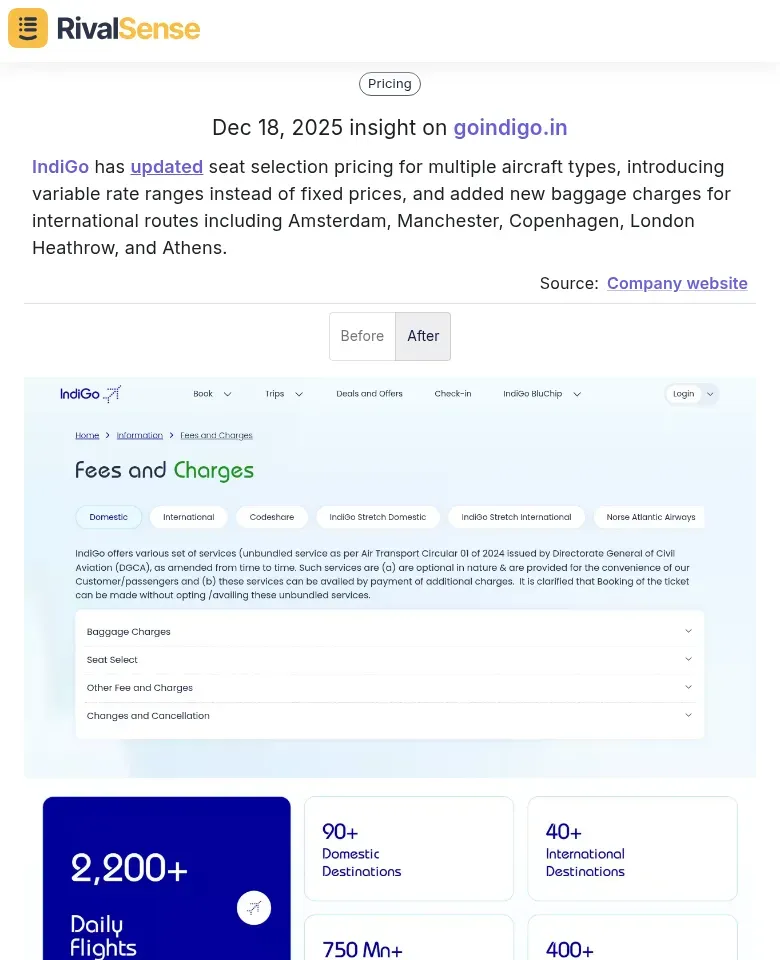
When IndiGo updated its seat selection pricing for multiple aircraft types, introducing variable rate ranges instead of fixed prices, and added new baggage charges for international routes, companies monitoring these changes could immediately analyze the impact. For a competing airline or travel business, this alert enables rapid response in pricing strategies, promotional offers, or customer communication to protect market share.
Example 2: Product Feature Innovation in Travel Tech
Why it's valuable: Alerts on product updates help businesses identify emerging customer needs and accelerate their own innovation cycles.
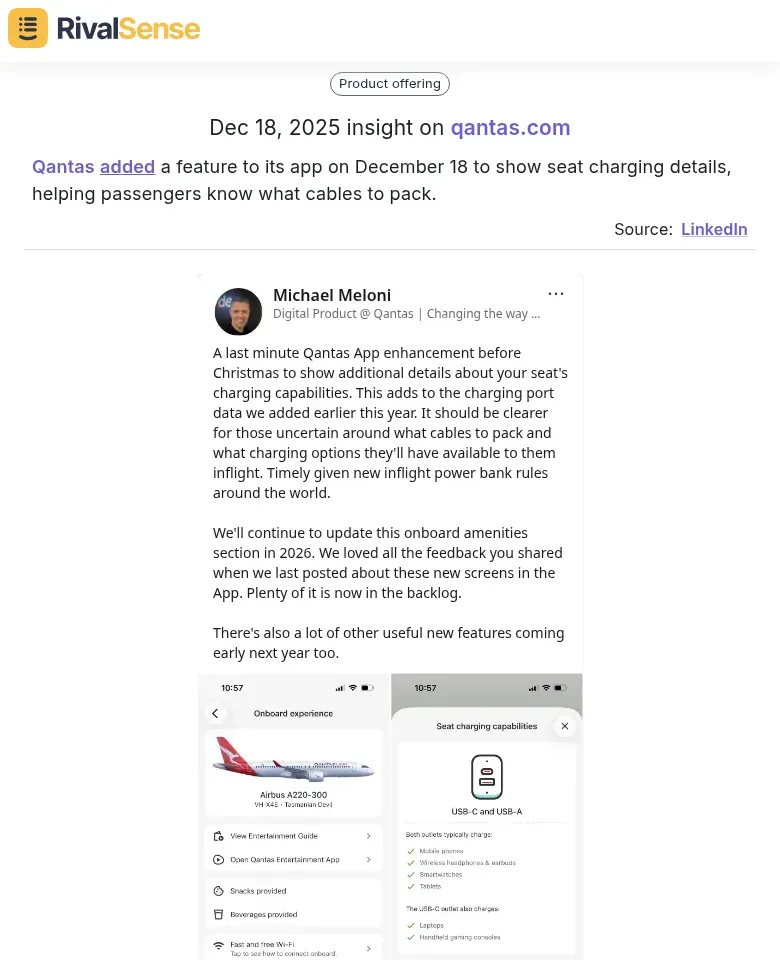
Qantas added a feature to its app on December 18 to show seat charging details, helping passengers know what cables to pack. For a competitor in the travel or tech space, this alert signals a focus on enhancing customer experience through digital tools. It provides insights into feature prioritization and can inspire similar enhancements or differentiations in your own app.
Example 3: Market Positioning in AI Technology
Why it's valuable: Tracking major product launches helps businesses assess competitive threats and opportunities in fast-evolving markets.
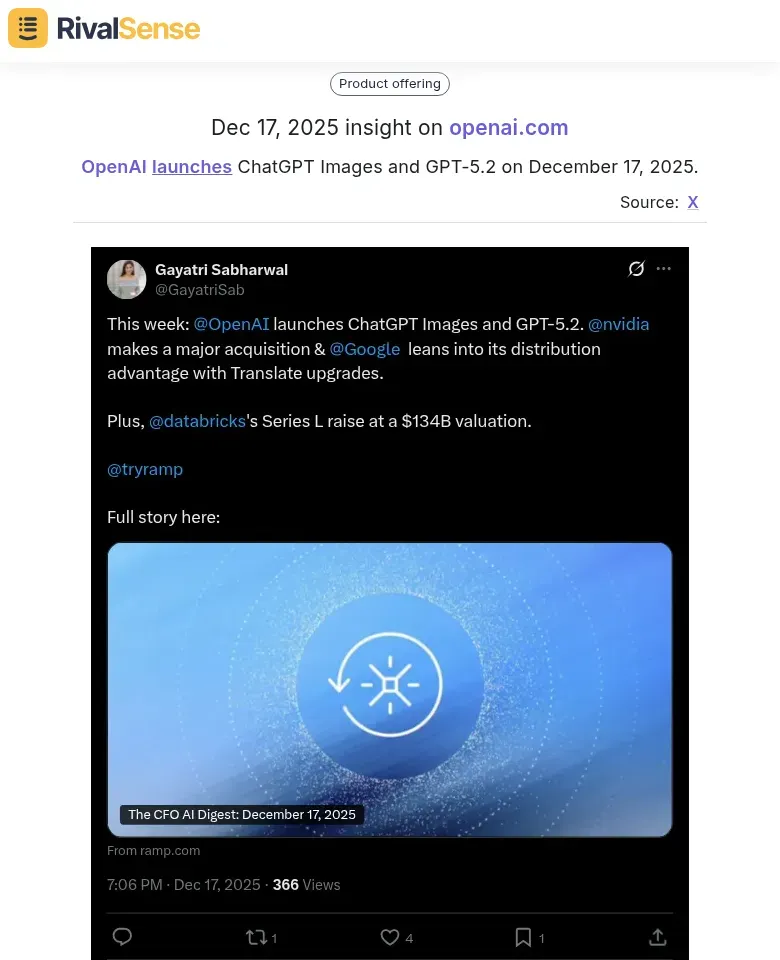
OpenAI launched ChatGPT Images and GPT-5.2 on December 17, 2025. For companies in the AI or adjacent sectors, this alert is crucial for understanding the competitive landscape. It allows for immediate analysis of new capabilities, potential partnerships, or gaps in your own offerings, enabling strategic decisions about product development and marketing.
These examples show how real-time alerts transform raw data into actionable intelligence, driving proactive business strategies.
How to Choose the Right Alert System
When evaluating real-time competitor alert solutions, consider these essential features:
Must-Have Features:
-
Comprehensive Source Coverage: Look for tools monitoring 80+ sources including:
- Company websites and blogs
- Social media platforms
- News and media outlets
- Regulatory databases
- Review sites
- Job boards
- Industry publications
-
Customizable Alert Triggers: Ability to set specific conditions for different types of alerts
-
Weekly Digest Reports: Comprehensive overviews like RivalSense's weekly email report that consolidate all intelligence
-
Integration Capabilities: Seamless connection with your existing business tools
-
Team Collaboration Features: Easy sharing and annotation of alerts
Advanced Features to Consider:
- AI-powered anomaly detection
- Sentiment analysis of competitor mentions
- Predictive trend identification
- Competitive benchmarking tools
- Automated reporting and dashboarding
Integrating Alerts into Your Business Strategy
For Sales Teams:
- Use pricing change alerts to adjust proposals
- Leverage product launch alerts to update competitive positioning
- Share partnership announcements to identify new sales opportunities
For Marketing Teams:
- Monitor competitor content strategies for inspiration
- Track media mentions to identify PR opportunities
- Analyze social media campaigns for competitive insights
For Product Teams:
- Use feature launch alerts to inform roadmap decisions
- Monitor customer reviews of competitor products
- Track regulatory changes affecting your industry
For Executive Leadership:
- Receive summarized intelligence through weekly email reports
- Use leadership change alerts for strategic planning
- Monitor market entry announcements for expansion opportunities
Common Pitfalls to Avoid
1. Alert Fatigue
Problem: Too many alerts leading to important ones being ignored.
Solution: Start with high-priority alerts and expand gradually. Use RivalSense's intelligent filtering to reduce noise.
2. Lack of Action Protocols
Problem: Alerts received but no clear process for response.
Solution: Create response playbooks for common alert types before implementation.
3. Incomplete Competitor List
Problem: Only monitoring obvious competitors while missing emerging threats.
Solution: Regularly review and update your competitor list. Include adjacent market players.
4. Siloed Intelligence
Problem: Alerts only going to specific departments.
Solution: Establish cross-functional alert sharing and regular competitive intelligence meetings.
Conclusion: Turning Intelligence into Advantage
Real-time competitor alerts are no longer a luxury—they're a necessity for businesses that want to maintain competitive advantage in today's fast-moving markets. The benefits extend far beyond simple notification to encompass:
- Strategic foresight rather than hindsight
- Accelerated innovation through competitor intelligence
- Optimized pricing through real-time market awareness
- Enhanced agility in responding to market changes
The most effective implementations combine comprehensive monitoring tools like RivalSense—which tracks competitor product launches, pricing updates, event participations, partnerships, regulatory aspects, management changes, and media mentions across 80+ sources—with well-defined organizational processes for acting on intelligence.
Ready to implement real-time competitor alerts? Start by identifying your critical intelligence needs and testing a solution. Experience the benefits firsthand by trying RivalSense for free at https://rivalsense.co/ and get your first competitor report today to stay ahead of the competition.
About RivalSense: RivalSense provides comprehensive competitor tracking across 80+ sources, delivering real-time alerts and weekly email reports on competitor product launches, pricing updates, event participations, partnerships, regulatory aspects, management changes, and media mentions. Stay ahead of your competition with actionable intelligence delivered directly to your inbox.
📚 Read more
👉 Commercial Laundry Services: Key Account Sentiment Tracking Checklist
👉 How Perplexity's iPad Move Prompted Rivals to Accelerate Mobile Strategy
👉 Data-Driven LinkedIn Competitor Insights for Key Account Tracking
👉 Actionable Audio Tech Key Account Strategies for Competitive Edge
👉 Actionable Pricing Strategies: Uncover Competitor Insights with Strategic Account Tracking