
The Strategic Benefits of a Competitor Matrix: Your 2026 Guide to Market Dominance
Written by the RivalSense Team
Updated January 5, 2026
In today's hyper-competitive business landscape, simply having a great product or service isn't enough. The difference between market leadership and market obscurity often comes down to one critical factor: how well you understand and respond to your competition. That's where a competitor matrix becomes your secret weapon.
What Exactly Is a Competitor Matrix?
A competitor matrix is a strategic visualization tool that allows you to systematically compare your business against key competitors across multiple dimensions. Think of it as a business intelligence dashboard that transforms scattered competitive data into actionable insights.
Unlike basic competitor lists, a well-structured matrix provides:
- Visual clarity: See competitive relationships at a glance
- Multi-dimensional analysis: Compare across features, pricing, marketing, and more
- Strategic prioritization: Identify where to focus your competitive efforts
- Trend identification: Spot market shifts before they become obvious
The 7 Strategic Benefits You Can't Afford to Miss
1. Discover Your True Competitive Edge
Most businesses think they know what makes them unique, but a competitor matrix reveals the reality. By systematically comparing features, you'll discover gaps in the market that competitors have overlooked.
Practical Tip: Create a feature-by-feature comparison table. For each competitor, mark whether they have each feature (✓), don't have it (✗), or have it partially (Δ). The patterns that emerge will surprise you.
2. Optimize Pricing Strategy with Precision
Pricing blind spots can cost you millions. A competitor matrix helps you understand not just what competitors charge, but how they structure their pricing. For instance, tracking pricing updates can alert you to market trends, allowing you to adjust your strategy proactively.
Checklist for Pricing Analysis:
- [ ] Compare base pricing across tiers
- [ ] Analyze add-on and upsell pricing
- [ ] Track pricing changes over time
- [ ] Note any seasonal or promotional pricing
- [ ] Document enterprise vs. SMB pricing differences
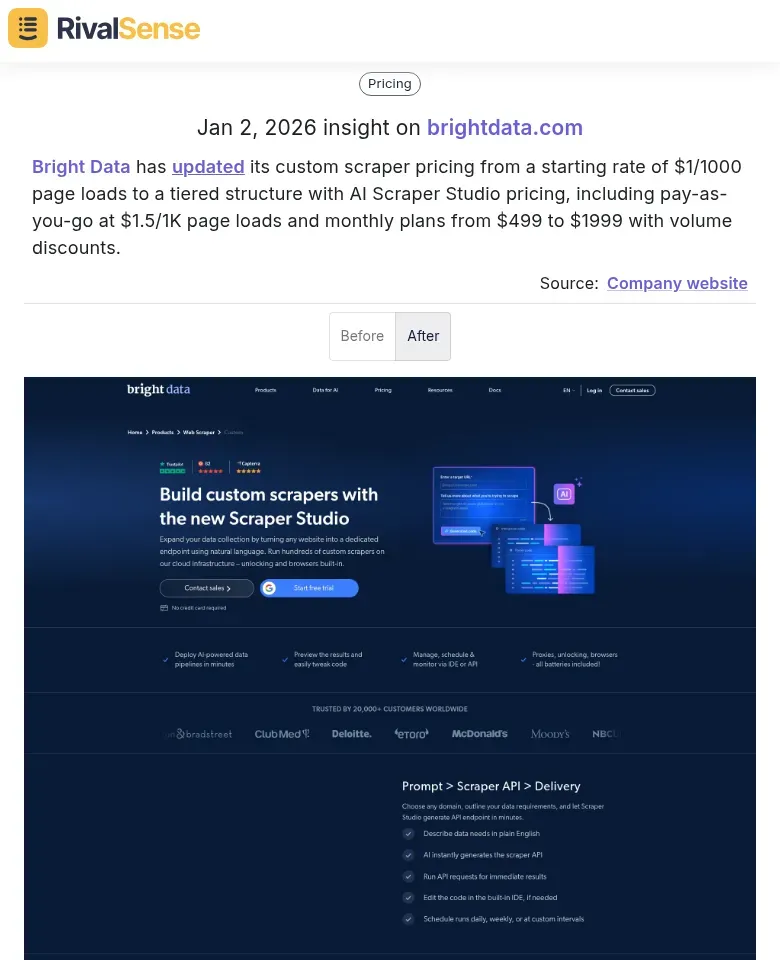
RivalSense Insight Example: Bright Data updated its custom scraper pricing from a starting rate of $1/1000 page loads to a tiered structure with AI Scraper Studio pricing, including pay-as-you-go at $1.5/1K page loads and monthly plans from $499 to $1999 with volume discounts. Monitoring such pricing changes is valuable for business strategy as it helps you avoid undercutting or overpricing, ensuring your offerings remain competitive.
3. Identify Market Gaps Before Your Competitors Do
When FreshFace skincare analyzed their competitors, they discovered they were the only brand offering affordable, eco-friendly packaging without animal testing. This insight became their entire marketing campaign.
Actionable Step: Look for clusters in your matrix. If all competitors are strong in one area but weak in another, you've found a potential market gap.
4. Improve Product Development Decisions
Instead of guessing what features to build next, use your matrix to make data-driven decisions. If three of your five main competitors have launched AI-powered features in the last quarter, that's a market signal you can't ignore. Tracking product updates helps you understand competitor innovation focus and prioritize your roadmap.
Pro Tip: Track not just what features exist, but when they were launched. This helps you understand competitor innovation cycles.
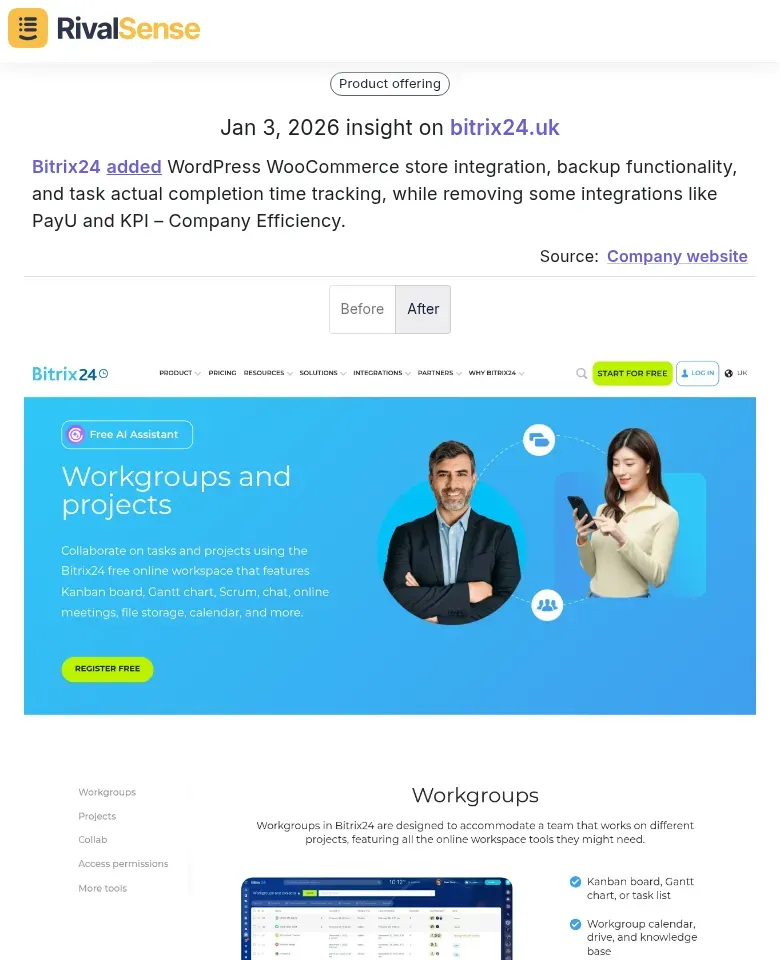
RivalSense Insight Example: Bitrix24 added WordPress WooCommerce store integration, backup functionality, and task actual completion time tracking, while removing some integrations like PayU and KPI – Company Efficiency. This type of insight is valuable for business strategy as it reveals competitor priorities, allowing you to identify feature gaps or trends to capitalize on in your own product development.
5. Enhance Marketing and Positioning
HotPlate grills discovered through their matrix that competitors only targeted young homeowners, completely ignoring retired seniors. By creating content around "grandparent barbecues," they captured an entirely new market segment.
Marketing Matrix Elements to Track:
- Social media engagement rates
- Content marketing frequency and quality
- PR and media coverage
- Event participation
- Partnership announcements
6. Streamline Team Alignment and Collaboration
A shared competitor matrix ensures everyone—from sales to product to marketing—has the same understanding of the competitive landscape. This eliminates internal confusion and creates cohesive strategies.
Implementation Tip: Make your matrix a living document that's reviewed in weekly team meetings. Assign team members to track specific competitors.
7. Anticipate Competitive Moves
By tracking patterns in your matrix over time, you can start predicting competitor behavior. If a competitor consistently launches new features in Q1, you can prepare your response in advance. Monitoring management changes and internal shifts can also signal strategic pivots, giving you early warnings.
RivalSense Insight Example: Meta's outgoing chief AI scientist Yann LeCun acknowledged manipulated Llama 4 benchmark results, leading CEO Mark Zuckerberg to sideline the GenAI department and prompting a wave of departures. Such insights into management changes are valuable for business strategy as they can indicate internal turmoil or strategic redirections, allowing you to anticipate market movements and adjust your plans accordingly.

The Modern Challenge: Keeping Your Matrix Current
Here's the reality most businesses face: creating a competitor matrix is relatively easy. Keeping it updated is where most companies fail.
Competitive intelligence isn't a one-time exercise—it's an ongoing process. Your competitors are constantly:
- Launching new products and features
- Adjusting pricing
- Forming new partnerships
- Participating in industry events
- Making management changes
- Getting media coverage
Manually tracking these changes across dozens of competitors and 80+ potential data sources is a full-time job that most businesses can't afford.
How RivalSense Solves the Competitor Tracking Challenge
This is where modern competitive intelligence tools like RivalSense transform the game. Instead of spending hours each week manually searching for competitor updates, RivalSense does the heavy lifting for you.
Here's how it works:
-
Comprehensive Monitoring: RivalSense tracks 80+ sources including company websites, social media, news outlets, regulatory filings, and industry registries
-
Automated Intelligence: The system automatically detects and categorizes key competitive moves:
- Product launches and updates
- Pricing changes
- Event participation
- Partnership announcements
- Regulatory developments
- Management changes
- Media mentions
-
Weekly Digest: Every week, you receive a curated email report highlighting the most important competitive developments
-
Strategic Integration: Export data directly into your competitor matrix templates
Practical Example: Imagine you're tracking 10 competitors. In a typical week, they might:
- Launch 3 new features
- Announce 2 pricing changes
- Participate in 5 industry events
- Get mentioned in 15 media articles
Manually finding and documenting all this would take days. With RivalSense, it's automatically compiled into a 5-minute weekly read.
Your Step-by-Step Guide to Creating a Dynamic Competitor Matrix
Phase 1: Foundation (Week 1)
Step 1: Identify Your Core Competitors
- List 5-10 direct competitors (similar products/services to same audience)
- Include 3-5 indirect competitors (different products/services to similar audience)
- Don't forget emerging competitors and potential disruptors
Step 2: Define Your Comparison Dimensions
Choose 8-12 key factors that matter most to your customers:
- Core product features
- Pricing structure
- Target customer segments
- Marketing channels
- Customer support quality
- Technology stack
- Company size/funding
- Market presence
- Brand reputation
- Innovation rate
Phase 2: Data Collection (Week 2)
Step 3: Gather Initial Data
- Visit competitor websites
- Analyze their pricing pages
- Review their social media presence
- Check review sites and customer feedback
- Examine their content marketing
Step 4: Set Up Ongoing Monitoring
This is where tools like RivalSense become invaluable. Instead of manual tracking:
- Set up automated competitor tracking
- Configure alerts for key competitive moves
- Establish a weekly review cadence
Phase 3: Analysis and Action (Ongoing)
Step 5: Create Your Visual Matrix
Use a simple spreadsheet with:
- Competitors across the top
- Comparison factors down the side
- Color coding for quick visual analysis
Step 6: Conduct Regular SWOT Analysis
Every quarter, update your SWOT based on matrix insights:
- Strengths: Where you outperform competitors
- Weaknesses: Where competitors have advantages
- Opportunities: Market gaps identified
- Threats: Emerging competitive moves
Step 7: Turn Insights into Action
For each insight from your matrix, create an action item:
- If competitors are weak in customer support → Enhance your support offerings
- If competitors are raising prices → Consider your pricing strategy
- If competitors are expanding to new markets → Evaluate your expansion plans
Advanced Competitor Matrix Templates
1. The Strategic Positioning Matrix
Plot competitors on two key dimensions (like price vs. quality or innovation vs. market share) to visualize market positioning.
2. The Feature Evolution Timeline
Track when competitors launched key features to understand their innovation patterns.
3. The Pricing Strategy Matrix
Compare not just prices, but pricing models, discount strategies, and value propositions.
4. The Content Marketing Scorecard
Analyze competitor content quality, frequency, and engagement across channels.
Common Pitfalls to Avoid
Mistake #1: Static Analysis
Your matrix must be a living document. Set calendar reminders to update it monthly.
Mistake #2: Too Much Data
Focus on the 20% of data that drives 80% of decisions. Don't get lost in minutiae.
Mistake #3: Ignoring Indirect Competitors
Some of your biggest threats come from unexpected directions.
Mistake #4: No Action Follow-through
Insights without action are worthless. Assign owners for each competitive response.
The Future of Competitive Intelligence
As we move through 2026, competitor matrices are evolving from static documents to dynamic intelligence systems. The most successful companies are:
- Automating data collection with tools like RivalSense
- Integrating competitive data into their business intelligence platforms
- Using AI to predict competitor moves based on historical patterns
- Creating real-time dashboards for instant competitive awareness
Your Competitive Advantage Starts Today
A well-maintained competitor matrix isn't just a business tool—it's a competitive weapon. It transforms random competitor observations into strategic intelligence that drives better decisions.
Remember: The goal isn't to copy your competitors, but to understand them well enough to outmaneuver them. Your competitor matrix gives you the clarity to:
- Differentiate where it matters
- Compete where you can win
- Innovate where others haven't
- Grow where opportunities exist
Final Pro Tip: Start simple. Pick your top 3 competitors and 5 key comparison factors. Build your first matrix this week. Then, as you see the value, expand your tracking and consider automation tools to scale your competitive intelligence efforts.
In the race for market leadership, the companies with the clearest view of the competitive landscape are the ones that finish first. Your competitor matrix is how you get that view.
Ready to transform your competitive intelligence? Try RivalSense for free at https://rivalsense.co/ and get your first competitor report today. Automate competitor tracking across 80+ sources, delivering the insights you need in a weekly email report. Focus on strategy while we handle the monitoring.
📚 Read more
👉 Strategic Account Tracking Tools: IT Consulting's Competitive Edge Analysis
👉 How Hubstaff's SCIM Move Prompted Competitors to Accelerate Enterprise Security
👉 Actionable Internet Hacks for Competitive Positioning Insights
👉 Airline Competitive Intelligence Checklist: Track Rivals Like AirAsia 🛫
👉 How to Analyze Competitor Partnerships and Client Relationships for Strategic Insights