
The Complete Guide to Key Account Tracking in Salesforce: Strategies, Tools, and Competitive Intelligence Integration
Last updated March 2, 2026
Written by RivalSense Team
In today's hyper-competitive B2B landscape, key account tracking isn't just about managing relationships—it's about anticipating competitor moves, identifying vulnerabilities, and proactively defending your most valuable revenue streams. While Salesforce provides the foundation for account management, truly strategic key account tracking requires integrating competitive intelligence directly into your workflow.
Why Traditional Salesforce Account Planning Falls Short
Most Salesforce account planning focuses on internal metrics: revenue targets, opportunity pipelines, and relationship mapping. While essential, this approach misses the critical external dimension: what your competitors are doing with those same accounts.
The Competitive Blind Spot: Without competitor intelligence, you're planning in a vacuum. You might have a perfect account strategy, but if a competitor just launched a specialized solution for that industry or hired a key executive from your client, your plan is already outdated.
Practical Checklist: What Your Salesforce Account Plan Must Include Beyond Internal Metrics:
- Competitor Engagement Tracking - Which competitors are actively engaging with your key accounts?
- Market Intelligence Integration - How are industry trends affecting your accounts' priorities?
- Competitive Threat Assessment - What specific threats do competitors pose to each key account?
- External Relationship Mapping - Who at your accounts has relationships with competitors?
- Regulatory Impact Analysis - How are upcoming regulations affecting competitive positioning?
Building a Comprehensive Key Account Tracking System in Salesforce
Step 1: Extend Your Salesforce Data Model
Instead of just creating custom objects for account plans, build a competitive intelligence layer. Here's a practical approach:
Custom Objects to Add:
- Competitor Engagement Log - Track competitor interactions with your accounts
- Competitive Threat Assessment - Document specific competitor threats per account
- Market Intelligence Repository - Store industry trends and regulatory updates
- Competitor Relationship Map - Document connections between account contacts and competitor personnel
Practical Implementation Tip: Use Salesforce's Lightning App Builder to create a "Competitive Intelligence" tab that sits alongside your Account Plan tab. This ensures competitive context is always visible during account reviews.
Step 2: Integrate Real-Time Competitive Intelligence
Manual competitor research is time-consuming and often misses critical developments. The most effective approach integrates automated competitive intelligence directly into Salesforce.
Here's what to look for in a competitive intelligence solution:
- Real-time monitoring of competitor product launches, pricing changes, and feature updates
- Automated tracking of competitor event participation and speaking engagements
- Partnership intelligence - who your competitors are partnering with and why
- Executive movement alerts - when competitors hire key personnel from your industry
- Regulatory compliance tracking - how competitors are adapting to new regulations
Example from RivalSense: We tracked how HUMAN partnered with TollBit in January 2025 to stop unauthorized AI content scraping agents and transform bot traffic into recurring revenue. This type of insight reveals how competitors are creating new revenue streams through strategic partnerships—intelligence that should inform your own account strategies.
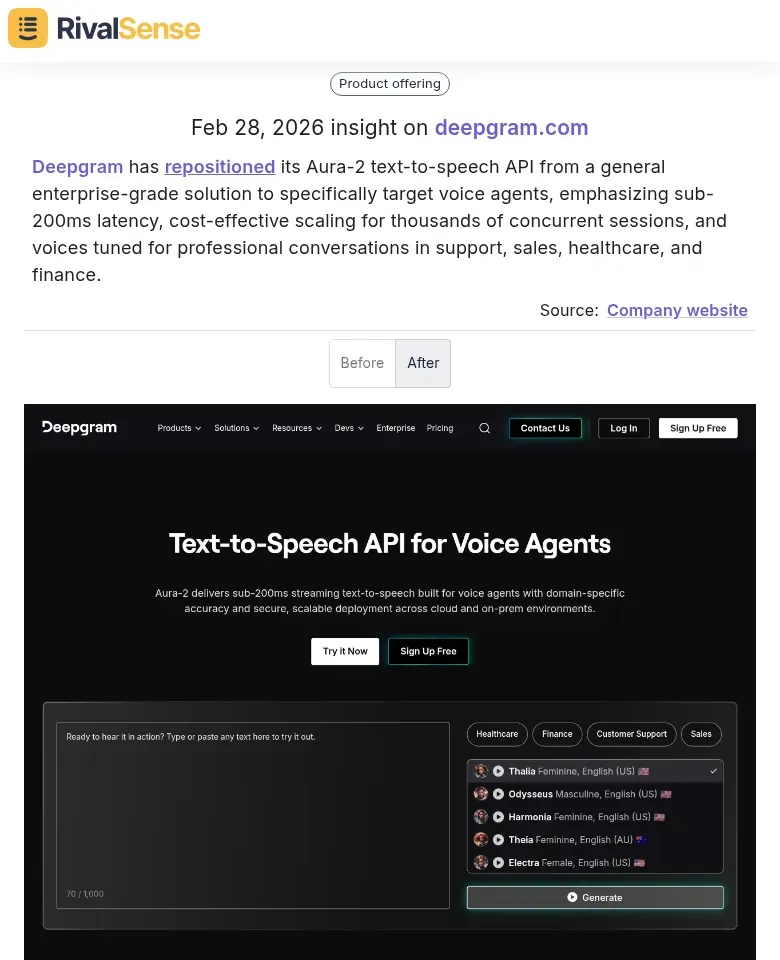
Another key insight: RivalSense tracked that Deepgram repositioned its Aura-2 text-to-speech API from a general enterprise-grade solution to specifically target voice agents, emphasizing sub-200ms latency, cost-effective scaling for thousands of concurrent sessions, and voices tuned for professional conversations. This product repositioning insight is valuable because it shows how competitors are pivoting to capture niche markets, allowing you to reassess your product positioning and messaging for key accounts in those segments.
Step 3: Create Actionable Competitive Dashboards
Transform raw intelligence into actionable insights with Salesforce dashboards that combine internal and external data. These dashboards help visualize competitive threats and opportunities at a glance.
Dashboard Components for Strategic Account Tracking:
- Competitive Threat Heat Map - Visualize which accounts face the highest competitive pressure
- Competitor Engagement Timeline - Track competitor activity patterns with your accounts
- Market Intelligence Integration - Correlate industry trends with account performance
- Executive Movement Tracker - Monitor competitor hiring from your accounts' industries
- Regulatory Impact Assessment - Show how regulatory changes affect competitive dynamics
Practical Implementation: Create a dashboard that shows:
- Accounts where competitors have recently won business
- Competitor product launches relevant to each account's industry
- Executive movements between competitors and your accounts' industries
- Upcoming regulatory changes that competitors are positioning around
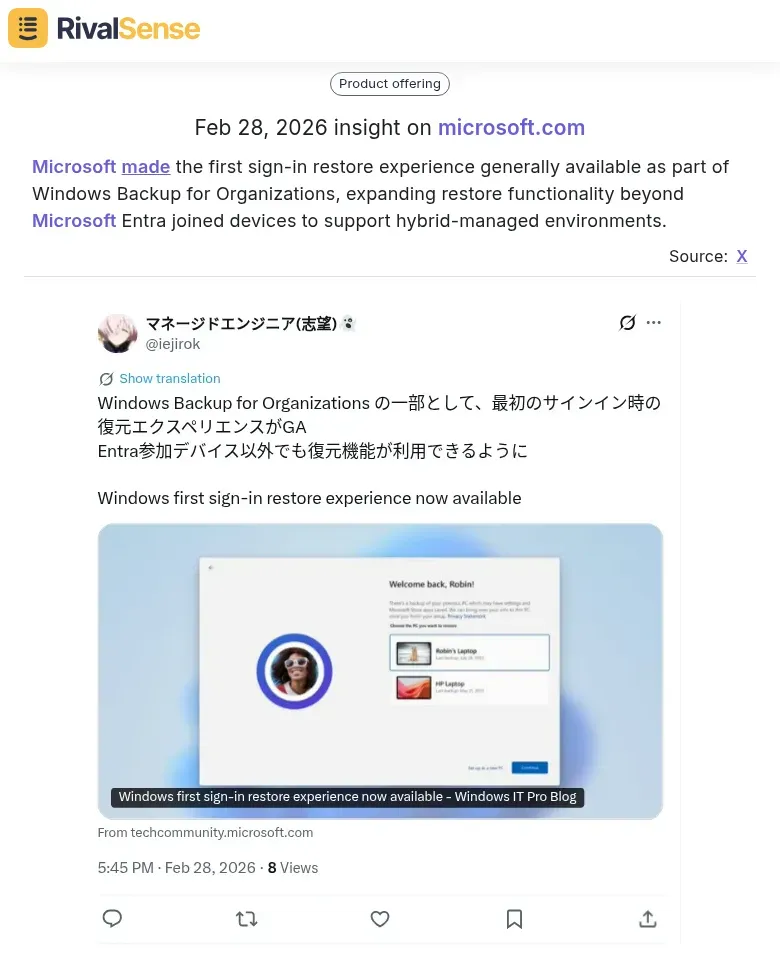
For instance, tracking product updates like when Microsoft made the first sign-in restore experience generally available as part of Windows Backup for Organizations is valuable because it reveals how competitors are enhancing core functionalities to support hybrid environments. This intelligence can guide your own feature development and account-specific solutions.
The LinkedIn Connection: Social Intelligence for Key Account Tracking
LinkedIn has evolved into a critical competitive intelligence platform. Monitoring competitor activity here provides insights into their strategies and engagements. Here's how to integrate LinkedIn insights into your Salesforce key account tracking:
Step-by-Step LinkedIn Monitoring Workflow
1. Automated Competitor Page Monitoring
Set up alerts for competitor company page updates, content strategy shifts, and engagement patterns. When a competitor suddenly increases posting frequency about a specific solution, it signals a strategic focus area.
2. Executive Movement Tracking
Monitor LinkedIn for C-suite, VP, and director-level changes at target competitors. As RivalSense tracked, when Edgars Kokins left DelfinGroup as Chief Revenue Officer to become Managing Director at Bolt, it revealed talent flow between industries—from financial services to mobility—signaling Bolt's potential market expansion.
3. Content Strategy Analysis
Track what content competitors are sharing and how your key accounts engage with it. This reveals competitive messaging effectiveness and account interests.
Practical Checklist for LinkedIn Integration:
✅ Set up automated alerts for competitor job postings and content strategy shifts
✅ Track key executives' activity patterns and content themes
✅ Monitor competitor follower growth and engagement trends
✅ Document competitor content strategy patterns and posting frequency
✅ Integrate LinkedIn insights with Salesforce account records
Regulatory Intelligence: The Often-Overlooked Competitive Factor
Regulatory changes create competitive opportunities and threats. Smart key account tracking includes regulatory intelligence to anticipate how competitors will adapt.
Example: When AddSecure CEO Stefan Albertsson discussed secure IoT, regulations like NIS2 and the Cyber Resilience Act in a Security Technology Trends 2026 interview, it revealed how competitors are positioning around upcoming regulatory changes. This intelligence should inform your account strategies in regulated industries.
Regulatory Tracking Framework:
- Monitor regulatory discussions in competitor executive interviews and content
- Track compliance solution launches from competitors
- Analyze partnership patterns with regulatory technology providers
- Document industry-specific regulatory adaptations
Practical Implementation: The 5-Step Key Account Tracking Workflow
Step 1: Competitive Landscape Assessment
For each key account, document:
- Top 3 competitors actively targeting this account
- Recent competitor wins in this industry
- Competitor solutions most relevant to this account
- Competitor relationships with account decision-makers
Step 2: Intelligence Integration
Integrate automated competitive intelligence tools like RivalSense that track:
- Competitor product launches/updates
- Pricing changes
- Event participations
- Partnerships
- Regulatory aspects
- Management changes
- Media mentions across 80+ sources
Step 3: Salesforce Customization
Extend your Salesforce instance with:
- Competitive intelligence custom objects
- Automated data feeds from intelligence tools
- Competitive dashboards
- Alert workflows for critical competitor moves
Step 4: Process Integration
Establish weekly competitive intelligence reviews where:
- Sales teams discuss competitor threats to key accounts
- Marketing adjusts messaging based on competitor positioning
- Product teams prioritize features based on competitive gaps
- Leadership makes strategic decisions with full competitive context
Step 5: Measurement and Optimization
Track:
- Account retention rates against competitive pressure
- Competitive displacement wins (accounts won from competitors)
- Response time to competitor moves
- Intelligence-to-action conversion rates
The RivalSense Advantage: Automating Competitive Intelligence for Salesforce
While you can build basic competitive tracking in Salesforce, comprehensive intelligence requires specialized tools. RivalSense provides automated competitor tracking that integrates seamlessly with your Salesforce workflow, saving time and ensuring coverage.
What RivalSense Delivers:
- Weekly Competitor Reports - All competitor intelligence delivered in a single email
- 80+ Source Monitoring - Company websites, social media, registries, and more
- Real-time Alerts - Immediate notifications for critical competitor moves
- Salesforce Integration - Direct feed of intelligence into your CRM
- Customizable Intelligence - Focus on competitors and industries that matter to your key accounts
Practical Example: When RivalSense tracked Brightcom Group's subsidiary OMS partnering with HUMAN to combat digital ad fraud, it revealed how competitors use subsidiary partnerships to enter new markets—intelligence that should trigger account strategy reviews for companies in adjacent spaces.
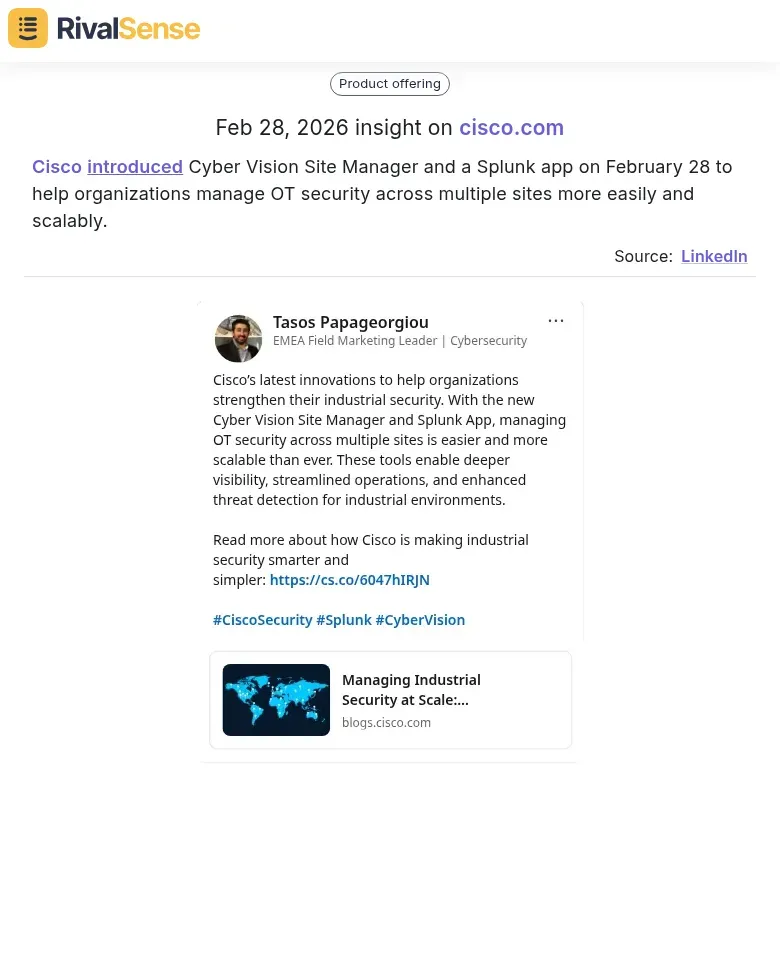
Another insight: RivalSense tracked Cisco introducing Cyber Vision Site Manager and a Splunk app to help organizations manage OT security across multiple sites more easily and scalably. This type of product launch and partnership insight is valuable for understanding how competitors are expanding their portfolios to address scalability needs, prompting you to evaluate your own solutions for key accounts in similar industries.
Key Takeaways and Actionable Next Steps
Immediate Actions You Can Take:
- Audit Your Current Approach - Does your Salesforce account planning include competitive intelligence?
- Identify Intelligence Gaps - What competitor information are you missing about your key accounts?
- Start Small - Pick 3-5 key accounts and build comprehensive competitive profiles
- Automate Intelligence Gathering - Manual research can't keep pace with market changes
- Integrate Intelligence into Processes - Make competitive context part of every account review
Long-term Strategic Recommendations:
- Build a Competitive Intelligence Culture - Make competitor awareness part of your company DNA
- Invest in Specialized Tools - The right intelligence platform pays for itself in protected revenue
- Create Cross-functional Intelligence Teams - Sales, marketing, and product should share competitive insights
- Measure Intelligence ROI - Track how competitive intelligence impacts account retention and growth
- Stay Proactive, Not Reactive - Use intelligence to anticipate competitor moves, not just respond to them
Conclusion: Transforming Key Account Tracking from Defense to Offense
Traditional Salesforce account planning focuses on defending existing relationships. By integrating competitive intelligence, you transform key account tracking into an offensive strategy. You can anticipate competitor moves, identify vulnerabilities before they're exploited, and position your solutions more effectively.
The most successful B2B companies don't just track their accounts—they track their competitors' relationships with those accounts. They understand that key account management is fundamentally competitive, and they arm their teams with the intelligence needed to win.
Ready to enhance your Salesforce key account tracking with competitive intelligence? Try out RivalSense for free at https://rivalsense.co/ to get your first competitor report today and see how automated competitive intelligence can transform your account strategy from reactive to proactive.
About RivalSense: RivalSense tracks competitor product launches/updates, pricing updates, event participations, partnerships, regulatory aspects, management changes, and media mentions across company websites, social media, the internet, and various registries (80+ sources), delivering all in a weekly email report. Perfect for B2B companies looking to integrate competitive intelligence into their Salesforce key account tracking workflows.
📚 Read more
👉 Mastering Competitor Intelligence: Leveraging Customer Reviews in Systems Software Development
👉 How BASF's Fungicide Registration in Italy Enabled Smarter Competitor Strategies
👉 Quick Website Monitoring Hacks for Key Account Intelligence
👉 AI Agent Productivity: Analyzing Competitor UX for Enterprise Advantage
👉 Predictive Analysis: Forecast Competitor Churn via Media & Content Insights