
The Complete Guide to Competitor Patent Analysis: How to Decode Your Rivals' Innovation Strategy
December 5, 2025
In today's hyper-competitive business landscape, your competitors are revealing their next moves long before they make public announcements. While most companies react to competitor launches 6-12 months too late, forward-thinking business leaders are using competitor patent analysis to gain 18-24 months of strategic advantage.
Patent filings represent one of the richest, most reliable sources of competitive intelligence available. Unlike press releases or marketing materials, patents contain detailed technical specifications, reveal R&D priorities, and expose strategic direction—all while being legally required to be publicly disclosed.
Why Competitor Patent Analysis is Non-Negotiable in 2025
Consider this: Global patent filings exceeded 3.8 million applications in 2024, with the patent analytics market projected to grow from $1.26 billion to over $3 billion by 2032. Yet most organizations fail to systematically monitor these disclosures, missing critical insights into:
- R&D priorities and technology roadmaps - What your competitors are investing in
- Product launch timelines - When new offerings will hit the market
- Geographic expansion plans - Where they're targeting growth
- Strategic partnerships - Who they're collaborating with
- White space opportunities - Where innovation gaps exist
The 5-Step Competitor Patent Analysis Framework
Step 1: Define Your Intelligence Objectives
Before diving into patent databases, clarify what you need to learn. Your objectives should align with specific business decisions:
Practical Checklist:
- [ ] Identify emerging competitors in adjacent markets
- [ ] Understand technology roadmaps for your core products
- [ ] Discover potential licensing or acquisition targets
- [ ] Monitor activity near your core intellectual property
- [ ] Spot white space opportunities for innovation
- [ ] Assess freedom-to-operate risks
Step 2: Identify and Monitor Key Competitors
Start with your direct competitors, but don't stop there. Include:
Practical Tips:
- Direct competitors - Companies offering similar products/services
- Adjacent competitors - Companies in related technology spaces
- Potential disruptors - Startups with innovative approaches
- Technology partners - Companies with complementary capabilities
Pro Tip: Use tools like RivalSense to automatically track 80+ sources including patent registries, ensuring you never miss a critical filing from any competitor in your ecosystem.
Step 3: Establish Systematic Monitoring Workflows
Effective competitor patent analysis requires ongoing discipline, not one-time projects.
Weekly Monitoring Checklist:
- [ ] New patent applications from key competitors
- [ ] Filings in your core technology classifications
- [ ] Citations to your existing patents
- [ ] Geographic filing patterns
- [ ] Inventor movements and new research teams
Monthly Analysis Activities:
- [ ] Forward citation reports (who's referencing your patents)
- [ ] Technology trend analysis
- [ ] Competitive positioning updates
- [ ] Strategic partnership identification
Step 4: Analyze Key Intelligence Indicators
Not all patent filings are created equal. Focus on these high-signal indicators:
High-Confidence Launch Indicators:
- Detailed implementation specifications - Not just conceptual descriptions
- Multiple related patents - Suggesting comprehensive product strategies
- Manufacturing process patents - Indicating production readiness
- User interface mockups - Showing customer experience priorities
- Partnership mentions - Revealing strategic relationships
Early-Stage Warning Signals:
- Research patents - Broad, conceptual filings
- University collaborations - Academic partnerships suggesting early investigation
- Defensive filings - Protecting core technologies without immediate product plans
Step 5: Translate Insights into Action
Patent intelligence is worthless unless it informs decisions. Structure your findings around specific actions:
Immediate Actions (1-4 Weeks):
- Accelerate parallel development efforts
- File competing patents to create freedom-to-operate challenges
- Secure trademark protection for alternative strategies
- Begin building technical expertise in identified areas
Medium-Term Strategy (1-6 Months):
- Partner with technology providers before competitors acquire them
- Develop alternative technical approaches
- Build customer education around emerging technologies
- Create strategic partnerships complementing anticipated competitor offerings
Long-Term Positioning (6-24 Months):
- Invest in next-generation technologies beyond current focus
- Build comprehensive patent portfolios
- Establish positions in segments competitors are likely to abandon
- Develop acquisition strategies for complementary patent portfolios
Advanced Patent Analysis Techniques
Patent Citation Network Analysis
Citations reveal influence relationships and strategic priorities:
Practical Application:
- Forward citations - Who's referencing your patents (potential infringement indicators)
- Backward citations - What prior art competitors are building upon
- Cross-citation patterns - Revealing collaboration or competitive relationships
- Citation velocity - How quickly patents are being referenced (indicator of importance)
Geographic Filing Strategy Analysis
Where competitors file reveals commercialization priorities:
Intelligence Indicators:
- Multi-jurisdictional filings - Indicates serious commercial intent
- Emerging market focus - Signals expansion priorities
- Regional clustering - Suggests partnership or manufacturing strategies
- Filing timing patterns - Reveals market entry sequencing
Technology Clustering and White Space Identification
Practical Steps:
- Map patent density across technology areas
- Identify underexplored innovation gaps
- Analyze competitor focus vs. market needs
- Prioritize R&D investments based on strategic opportunity
Integrating Patent Intelligence with Other Signals
While patent analysis provides critical insights, combining it with other intelligence sources creates a complete competitive picture. This is where comprehensive monitoring platforms like RivalSense deliver exceptional value by tracking:
The Complete Intelligence Ecosystem:
- Product launches and updates - Direct market movements
- Pricing changes - Competitive positioning shifts
- Event participations - Industry presence and networking
- Partnership announcements - Strategic relationship developments
- Regulatory aspects - Compliance and market access
- Management changes - Strategic direction indicators
- Media mentions - Brand positioning and market perception
Pro Tip: Look for patterns across multiple data sources. When patent filings align with hiring sprees, trademark applications, and partnership announcements, you're seeing a coordinated strategic move, not isolated activity.
Real-World Examples of Competitive Insights
Here are recent examples of competitive intelligence that, when combined with patent analysis, provide a complete strategic picture:
Investment and Collaboration Announcements

Why it matters: Tracking major investments like Harvey's $160 million round at an $8 billion valuation reveals which competitors are scaling rapidly and where they're doubling down on innovation. This insight helps you anticipate market shifts and potential partnerships or threats, informing your strategic funding and resource allocation.
Product Feature Launches

Why it matters: Monitoring product updates such as Metricool's Smood Rate feature shows how competitors are evolving their offerings to meet customer needs. This allows you to adjust your product roadmap and identify gaps in your own features, ensuring you stay competitive in the market.
Regulatory and Compliance Developments
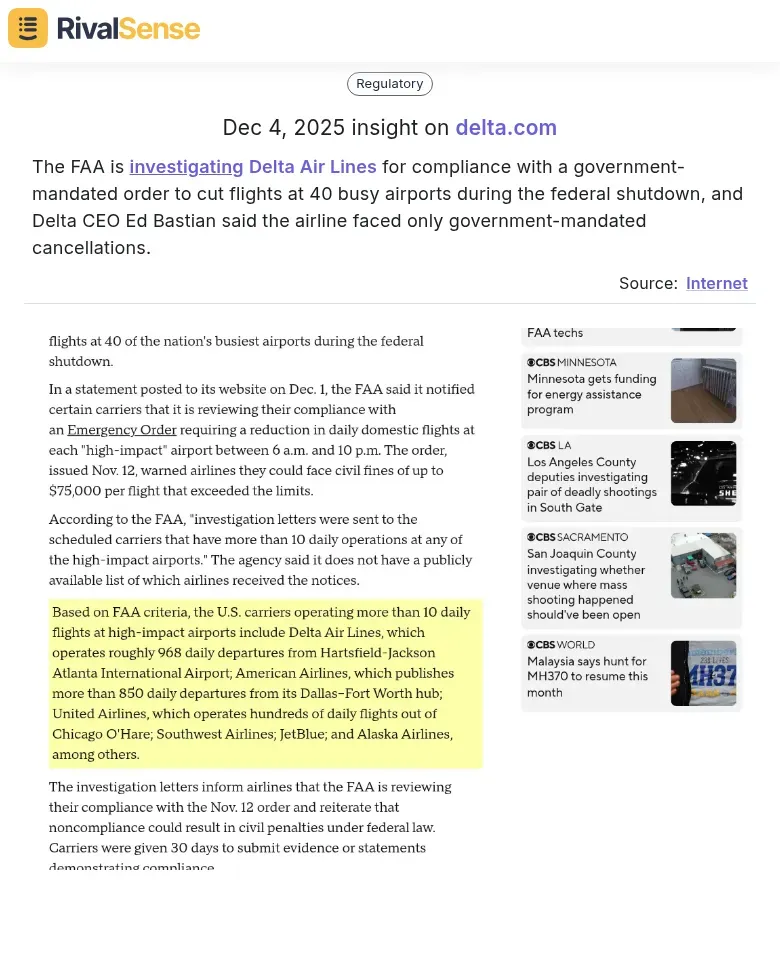
Why it matters: Keeping an eye on regulatory aspects, like the FAA investigating Delta Air Lines, alerts you to compliance risks and operational challenges that could affect your industry. This intelligence can inform your risk management and strategic planning, helping you navigate regulatory landscapes proactively.
By integrating these insights with patent analysis, you gain a holistic view of competitor strategies, enabling more informed business decisions.
Common Pitfalls to Avoid
Mistake #1: Focusing Only on Patent Counts
Quality matters more than quantity. A single strategically important patent can be more valuable than dozens of marginal filings.
Mistake #2: Ignoring International Filings
Competitors often file first in their home countries or key markets. Monitor WIPO, EPO, and other international databases.
Mistake #3: Overlooking Small Competitors
Startups and niche players often file highly innovative patents that disrupt established markets.
Mistake #4: Analysis Paralysis
Don't get stuck in endless analysis. Set clear decision points and act on insights.
Building Your Competitor Patent Intelligence System
Option 1: Manual Monitoring (Time-Intensive)
- USPTO database searches
- Google Patents monitoring
- WIPO Global Brand Database
- Weekly manual review processes
Option 2: Automated Intelligence Platform (Recommended)
For business leaders who need comprehensive, timely intelligence without the manual effort, platforms like RivalSense provide:
Key Advantages:
- Automated tracking across 80+ sources including patent registries
- Weekly email reports with curated competitive intelligence
- Cross-source pattern recognition - Connecting patent filings with other strategic moves
- Executive-friendly summaries - Translating technical details into business insights
- Customizable monitoring - Focus on what matters most to your business
The Strategic Advantage
Consider the case of a wearable tech firm that tracked Apple's patent filings for "augmented reality contact lens display systems." By combining patent intelligence with hiring data, trademark applications, and GitHub activity, they identified Apple's serious commitment to AR contacts 18 months before any public announcement.
The result? They captured 40% of the enterprise AR contact market before Apple's consumer product launch, generating $5M in revenue protection and superior market positioning.
Getting Started: Your 90-Day Implementation Plan
Days 1-30: Foundation Building
- Identify your top 5 competitors
- Set up patent monitoring systems
- Establish baseline understanding of current portfolios
- Create initial intelligence collection workflows
Days 31-60: Pattern Recognition
- Analyze filing patterns and trends
- Identify technology focus areas
- Track timing patterns between filings
- Build initial predictive models
Days 61-90: Strategic Implementation
- Develop competitive response strategies
- Implement product roadmap adjustments
- File defensive patents and trademarks
- Build partnerships to counter expected moves
Conclusion: From Reactive to Predictive
Competitor patent analysis has evolved from a specialized legal function to a core business intelligence capability. In 2025, the most successful companies aren't just reacting to competitor moves—they're predicting them 18-24 months in advance.
While dedicated patent analysis tools provide deep technical capabilities for IP professionals, business leaders need broader competitive intelligence that connects patent signals with product launches, pricing changes, partnerships, and market movements.
This is where comprehensive platforms like RivalSense deliver exceptional value by tracking 80+ sources and delivering curated intelligence in weekly email reports—ensuring you never miss a critical competitive move while freeing your team from manual monitoring drudgery.
The question isn't whether you can afford to invest in competitor patent analysis. It's whether you can afford not to, when your competitors are already revealing their next two years of innovation strategy in public patent databases.
Your Next Step: Start with one competitor. Monitor their patent filings, product updates, and strategic moves for 30 days. You'll never look at competitive intelligence—or your market position—the same way again.
Try RivalSense for Free
Want to stay ahead of every competitor move without manual monitoring? Try RivalSense for free to get your first competitor report today. RivalSense tracks competitor product launches, pricing updates, event participations, partnerships, regulatory aspects, management changes, and media mentions across 80+ sources—delivering all the intelligence you need in a weekly email report. Focus on strategy while we handle the monitoring.
📚 Read more
👉 Maximizing Warehousing & Distribution Competitor Benchmarking: Best Practices for B2B Leaders
👉 How to Counter Competitor Advances Like Xometry's Formlabs SLA Partnership
👉 Track Key Account Team Changes: Website Monitoring Workflow for Competitor Insights
👉 Beginner's Guide to Strategic Account Tracking in Music Streaming
👉 Competitor Partnership & Client Analysis Framework: Strategic Templates