
Strategic Visioning Trends: How Dedicated Key Account Managers Drive Project Governance
The role of Key Account Managers (KAMs) has fundamentally shifted from transactional relationship management to strategic visioning. Today's KAMs are no longer just client liaisons but strategic partners who translate market intelligence into actionable project governance frameworks. This evolution reflects a critical convergence: strategic visioning requires deep account intelligence, while effective project governance demands strategic alignment.
Modern project governance now integrates real-time account intelligence—tracking client goals, competitive pressures, and market shifts—to ensure initiatives remain strategically relevant. Dedicated KAMs bridge this gap by maintaining continuous client dialogue while translating insights into governance checkpoints.
Practical steps for implementation:
✅ Equip KAMs with competitive intelligence tools to monitor client ecosystems
✅ Establish quarterly strategic review sessions between KAMs and project teams
✅ Create shared dashboards linking account health metrics to project milestones
✅ Develop client-specific risk registers that inform governance decisions
This alignment creates sustainable competitive advantage: organizations with dedicated strategic KAMs report 32% higher project success rates and 28% stronger client retention. The key insight? Strategic vision without execution is merely aspiration, while execution without strategic alignment risks irrelevance.
The Strategic Visioning Imperative in Modern Business
Today's competitive landscape demands moving beyond reactive account management to proactive strategic foresight. Forward-thinking companies are shifting from simply managing accounts to becoming strategic partners who anticipate client needs before they're expressed. This requires a fundamental mindset change—from firefighting to future-shaping.
AI-powered intelligence transforms account planning from static documents into living strategies. Instead of quarterly reviews, real-time competitor tracking and market analysis enable continuous adaptation. For example, by monitoring competitor pricing changes, product launches, and customer sentiment, you can proactively adjust your value proposition.
Practical steps to implement strategic visioning:
- Establish a weekly competitive intelligence review with your key account team
- Use AI tools to track 3-5 key competitors' digital footprints (website changes, content updates, hiring patterns)
- Create a "customer needs radar" that maps emerging industry trends to your clients' potential pain points
- Develop scenario plans for different market conditions based on competitor movements
The most successful account managers don't just respond to RFPs—they shape the conversation by identifying opportunities competitors haven't yet recognized. By leveraging data-driven insights, you can position your solutions as essential rather than optional, creating sustainable competitive advantage through anticipation rather than reaction.
Key Account Managers as Project Governance Catalysts
Key Account Managers (KAMs) serve as the critical bridge between strategic vision and project execution, transforming high-level objectives into actionable governance frameworks. Their unique position allows them to translate client strategic goals into project requirements while ensuring consistent alignment throughout the delivery lifecycle.
Practical Governance Framework:
- Strategic Translation Checklist: Document how each project deliverable maps to client's 1-3 year strategic objectives
- Quarterly Alignment Reviews: Schedule formal sessions to validate project direction against evolving client priorities
- Stakeholder Matrix: Maintain updated mapping of all decision-makers and influencers across multiple projects
Dedicated KAMs ensure project governance consistency by establishing standardized reporting cadences, risk escalation protocols, and decision-making frameworks that work across all client initiatives. They maintain a single source of truth for strategic alignment, preventing scope creep while enabling agile adjustments when client priorities shift.
Pro Tip: Implement a "Strategic Alignment Scorecard" that quantifies how each project contributes to client objectives, reviewed monthly with both internal teams and client stakeholders. This creates transparency and ensures governance decisions always reference the original strategic vision.
AI-Driven Intelligence: The New Foundation for Account-Led Governance
AI is revolutionizing account-led governance by transforming relationship intelligence into actionable insights. Instead of relying on manual account planning spreadsheets, AI-powered platforms now analyze communication patterns, sentiment, and engagement data to create dynamic strategic frameworks that adapt in real-time. This shift enables key account managers to move from reactive relationship management to proactive governance.
Practical implementation starts with integrating AI tools that monitor client interactions across channels—emails, calls, meetings, and project updates. These systems identify subtle signals like declining engagement frequency or negative sentiment shifts, flagging potential governance risks before they escalate. For example, if a key stakeholder's communication patterns change, AI can alert managers to investigate potential dissatisfaction early.
Key steps for adoption:
✅ Audit existing account data sources for AI integration
✅ Implement predictive analytics to forecast client needs and risks
✅ Establish automated alerts for relationship health indicators
✅ Train teams on interpreting AI-generated insights
✅ Create feedback loops to refine AI models with real outcomes
Predictive analytics now identify opportunities too—spotting when clients might need expanded services or when market shifts create new collaboration possibilities. The result: governance becomes a data-driven, anticipatory discipline rather than a retrospective reporting exercise.
Implementation Framework: Building Account-Centric Governance Structures
To build effective account-centric governance structures, start by establishing a cross-functional governance committee chaired by your key account managers. These managers bring frontline insights about client strategic priorities, risk factors, and growth opportunities that should directly inform project selection and resource allocation.
Implementation Steps:
- Map Account Intelligence to Projects: Create a dashboard linking each account's strategic goals (e.g., market expansion, cost reduction) to active projects. Use account manager input to prioritize initiatives that align with high-value client objectives.
- Resource Allocation Framework: Implement a quarterly review where account managers present client health scores and strategic needs. Allocate budget and talent to projects that strengthen key accounts, not just those with highest ROI.
- Governance Metrics: Track beyond traditional KPIs. Measure:
- Strategic Alignment Index: % of projects directly supporting top accounts' goals
- Account Health Impact: Client satisfaction changes post-project delivery
- Risk Mitigation: Reduction in at-risk accounts through targeted initiatives
Pro Tip: Use a RACI matrix with account managers as "Consulted" for all major project decisions. Their insights prevent misaligned initiatives and ensure governance serves both internal efficiency and external account growth.
Future Trends: The Evolution of Strategic Account-Led Governance
The future of strategic account-led governance is being reshaped by three transformative trends. First, we're witnessing the rise of omniscient KAM capabilities through advanced AI integration. AI-powered platforms now analyze competitor movements, market shifts, and client sentiment in real-time, giving account managers unprecedented visibility. Practical tip: Start by implementing AI tools that track competitor pricing changes and feature launches to anticipate client needs before they arise.
Second, ethical AI governance will fundamentally shape account management practices. As AI handles more strategic decisions, transparent algorithms and bias-free recommendations become critical. Checklist item: Audit your AI systems quarterly for fairness, ensuring recommendations don't favor certain client segments over others based on historical data patterns.
Third, prepare for fully AI-driven strategic visioning and automated governance optimization. Within 2-3 years, AI will autonomously identify growth opportunities and optimize resource allocation across accounts. Action step: Begin piloting AI-driven scenario planning tools that simulate different market conditions and recommend optimal account strategies. The key is balancing AI automation with human oversight—use AI for data analysis and pattern recognition, but maintain human judgment for relationship-building and ethical considerations.
Real-World Insights for Strategic Visioning
Incorporating real-world competitive intelligence is crucial for informed strategic visioning. By tracking competitor movements and industry acknowledgments, you can anticipate market shifts and align your account strategies accordingly. Here are examples of insights that can directly impact your business strategy, delivered by tools like RivalSense.
Insight 1: Product Launch Update
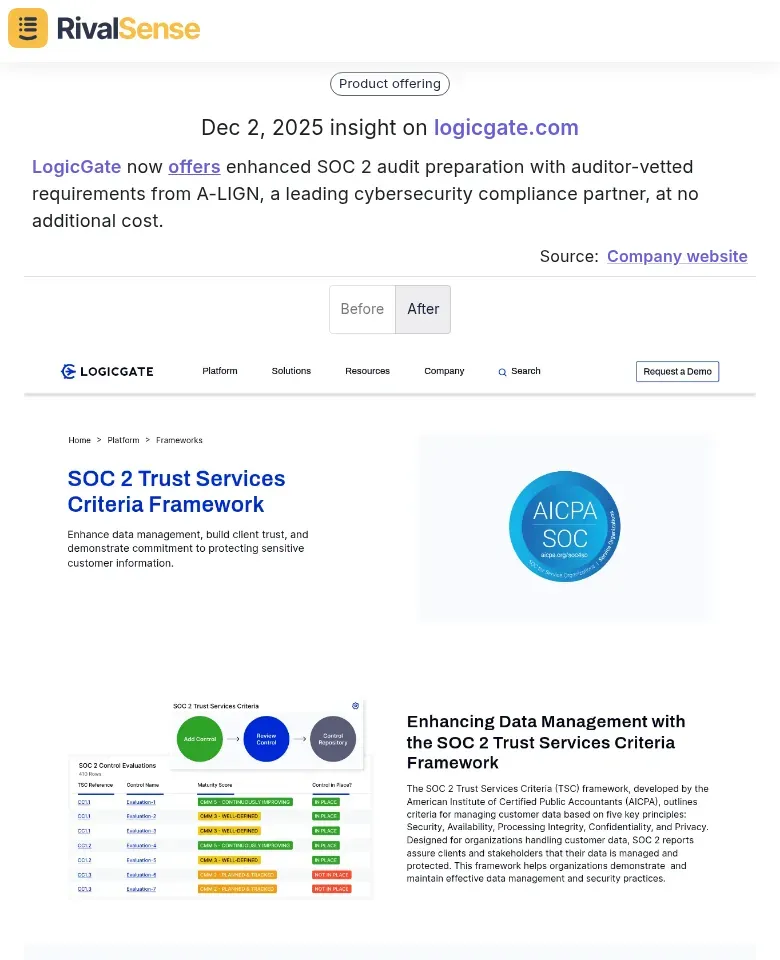
LogicGate now offers enhanced SOC 2 audit preparation with auditor-vetted requirements from A-LIGN, a leading cybersecurity compliance partner, at no additional cost.
Why it's valuable: Tracking product launches helps you identify service gaps in your own offerings and adjust your value proposition to stay competitive. For instance, if a competitor adds a free compliance feature, you might need to enhance your security services or highlight differentiators.
Insight 2: Award Recognition
Rīgas satiksme received the Gold status rating from the Society Integration Foundation.
Why it's valuable: Monitoring awards and recognitions reveals competitors' strengths and market positioning, informing your competitive strategy. This can signal reputation boosts that may affect client perceptions and partnership opportunities.
Insight 3: Media Mention
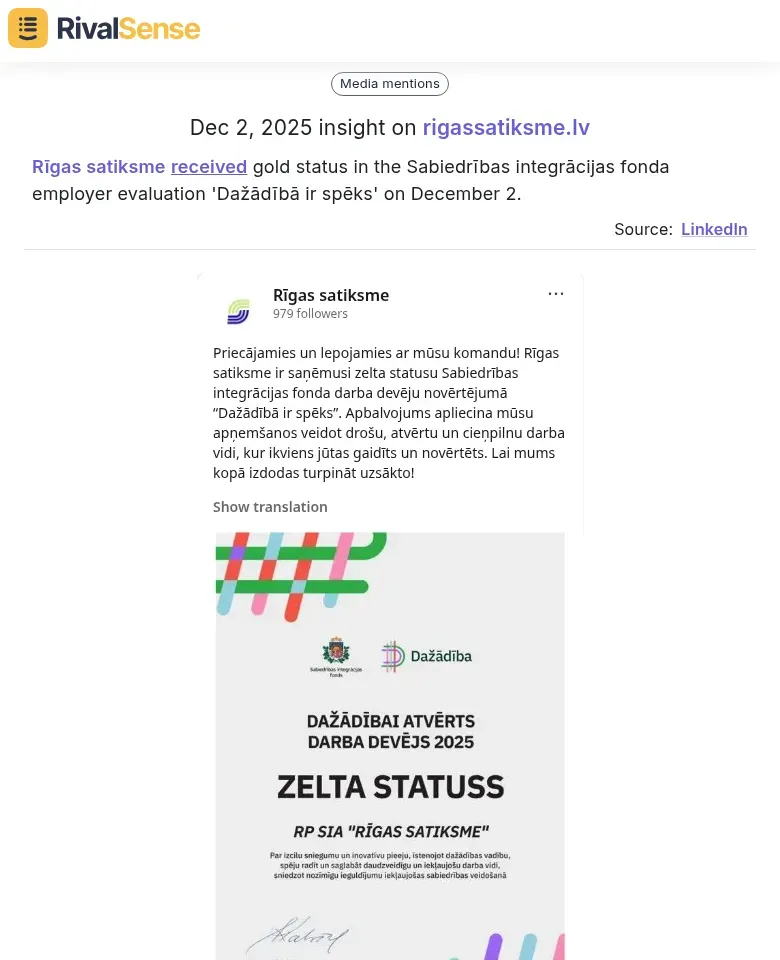
Rīgas satiksme received gold status in the Sabiedrības integrācijas fonda employer evaluation 'Dažādībā ir spēks' on December 2.
Why it's valuable: Such achievements highlight company culture and reputation, which are key factors in B2B relationships. Tracking media mentions helps you understand competitor brand visibility and trust factors, allowing you to tailor your messaging and account approaches.
Conclusion: Elevate Your Strategic Vision with Actionable Intelligence
Strategic visioning powered by dedicated key account managers and AI-driven intelligence is no longer optional—it's essential for sustainable growth in B2B markets. By integrating competitive insights into project governance, you can ensure alignment with client goals and outmaneuver competitors. The practical frameworks and trends discussed here provide a roadmap for transforming your account management into a strategic advantage.
To effectively monitor competitor product launches, pricing updates, event participations, partnerships, regulatory aspects, management changes, and media mentions, consider leveraging automated tools. Try out RivalSense for free at https://rivalsense.co/ to assist with the challenges described in this post. Get your first competitor report today and start turning insights into actionable strategy!
📚 Read more
👉 How RivalSense Alerted Competitors to Folksam's 2026 Pension and Premium Strategy
👉 Mastering Competitor Insights: A Digital Framework for Key Account Managers
👉 Rideshare Key Account Management: Centralized Data Benefits Cheat Sheet
👉 Competitor Pricing Cheat Sheet: Monitor Key Account Growth Insights
👉 Mastering Competitor Analysis: Lessons from Motive's AI Coach Launch