
Step-by-Step Guide: Track Competitor Partnerships, Clients, and Executive Moves
In today's hyper-competitive B2B landscape, staying ahead requires more than just monitoring your own performance. Tracking competitor partnerships, clients, and executive moves provides strategic intelligence that reveals what's happening behind the scenes. Competitor partnerships expose their strategic direction and market positioning—when a SaaS company partners with a major cloud provider, they’re signaling enterprise ambitions. Client relationships show real-world capabilities beyond marketing claims—seeing which Fortune 500 companies actually use their services reveals true enterprise readiness. Executive moves signal organizational priorities—when a competitor hires a VP of AI, they’re investing in that technology.
Practical tip: Start with a simple spreadsheet tracking these three categories. For partnerships, note the type (technology, distribution, strategic) and date announced. For clients, record industry, company size, and use case. For executive moves, track role, previous company, and specialization. Set up Google Alerts for competitor names plus keywords like 'partnership,' 'client win,' and 'appoints.' Check LinkedIn for executive changes weekly. This systematic approach transforms random observations into actionable competitive intelligence that informs your own strategic decisions.
Step 1: Setting Up Your Competitor Intelligence Framework
A robust competitor intelligence framework is the foundation for effective tracking. Before diving into competitor tracking, establish a systematic intelligence framework. Start by creating a centralized tracking system—use a spreadsheet or dedicated tool like RivalSense to log partnership announcements, client wins, and executive changes. Create separate tabs for each category with columns for date, source, competitor name, and key details.
Set up automated alerts using Google Alerts, RSS feeds, or competitor tracking tools. Configure alerts for each competitor's name plus keywords like "partnership," "client win," "appoints," and "joins." This ensures you catch news in real-time without manual searching.
Develop categorization methods to organize findings effectively. For partnerships, create categories like:
- Strategic alliances 🤝
- Technology integrations ⚙️
- Channel partnerships 📈
- Joint ventures 🤲
For client wins, categorize by industry (e.g., healthcare, finance, retail) and deal size (enterprise, mid-market, SMB). This structured approach helps identify patterns and competitive strengths. Pro tip: Schedule weekly reviews of your tracking system to update records and analyze trends.
Step 2: Analyzing Partnership Announcements for Strategic Insights
Partnership announcements are strategic goldmines that reveal your competitors' technology adoption, market expansion plans, and competitive positioning. Start by categorizing each partnership type: technology integrations signal AI/cloud adoption, distribution deals indicate geographic expansion, and co-marketing alliances target specific customer segments.
Practical Checklist for Analysis: 📋
- Document every partnership announcement with dates and partner details
- Categorize by type (technology, distribution, co-marketing, R&D)
- Note strategic objectives and target markets mentioned
- Analyze partner prestige and announcement prominence
- Track geographic patterns and industry verticals
Learning from Examples: Cross-industry collaborations like a SaaS company partnering with a healthcare provider reveal targeting of specific customer segments. When you see competitors forming multiple AI partnerships, they’re signaling heavy investment in that technology stack. Monitor partnership clusters in specific regions—concentrated activity often precedes market entry.
Identifying Patterns: Create a partnership matrix comparing your alliances against competitors'. Look for gaps in technology platforms or geographic coverage. Track partnership longevity and success metrics through case studies. Use automated tools like RivalSense to monitor announcements and spot emerging trends before they become obvious market shifts.
Pro Tip: Look beyond formal announcements—examine LinkedIn connections between executives, joint conference appearances, and shared client references for hidden relationships that signal deeper strategic alliances.
For instance, RivalSense tracked that Tinder Australia's Senior Marketing Manager Rory Turley shared on February 27 that the company partnered with Netflix for a regency-inspired romance campaign during Pride season and the summer dating season. This type of partnership insight is valuable as it reveals how competitors are leveraging cultural moments and collaborations to enhance brand visibility and target specific customer segments. 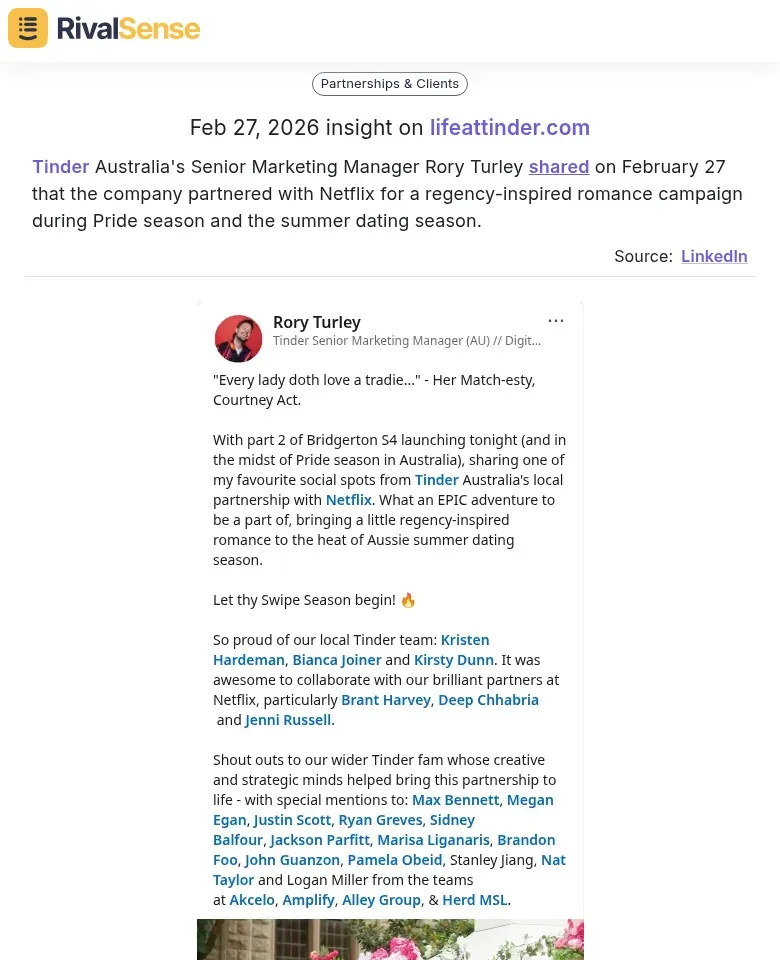
Step 3: Tracking Client Relationships and Case Studies
Client case studies reveal your competitors' implementation expertise and service capabilities. Start by collecting 5-10 recent case studies from each competitor's website. Create a spreadsheet tracking: client industry, project scope, implementation timeline, results achieved, and technology stack mentioned. Look for patterns in how they solve specific problems.
Pay special attention to partnerships supporting social impact or diversity initiatives. These reveal strategic positioning beyond pure business metrics. Track which competitors highlight ESG partnerships, diversity supplier programs, or community impact projects. These initiatives often signal long-term client relationships and brand differentiation.
Consider how RivalSense identified that Telenor Pakistan recently onboarded Naya Aghaaz Associates to support women returning to the workforce after a career break. Tracking such partnerships is crucial as it highlights competitors' commitment to social responsibility and diversity, which can strengthen brand loyalty and open up new market segments. 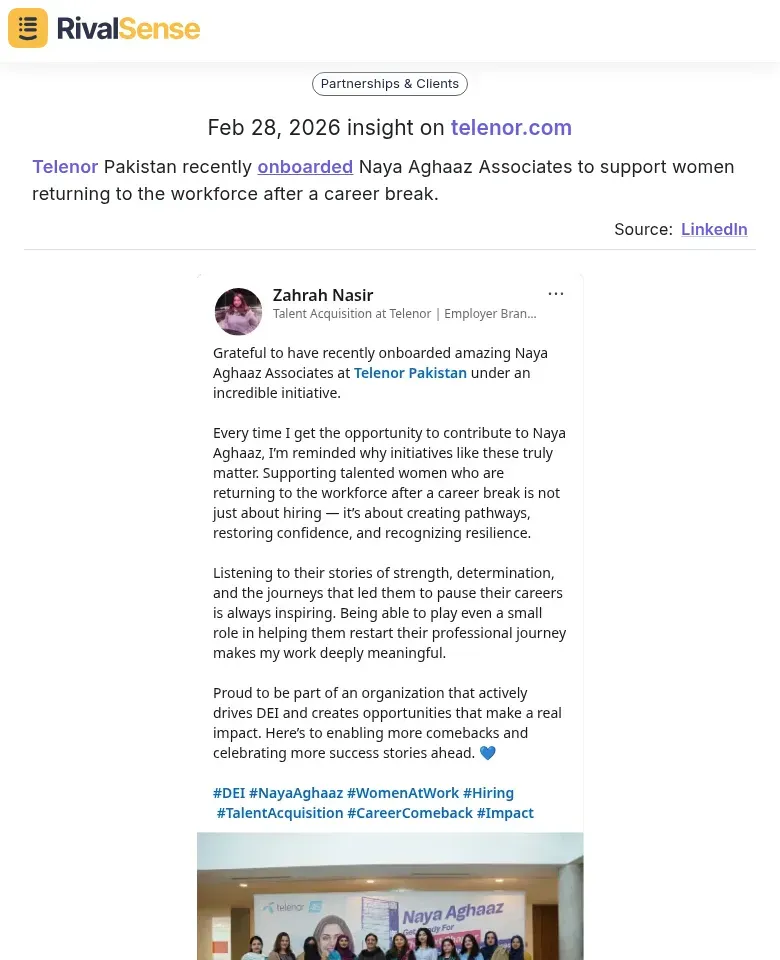
Map client industry concentration to identify market penetration strategies. Calculate what percentage of case studies come from each industry vertical. Competitors with 60%+ concentration in one industry are likely using vertical specialization strategies, while balanced portfolios suggest horizontal expansion. Use this data to anticipate which markets they’ll target next.
Practical checklist: 📊
- Collect 5-10 recent case studies per competitor
- Document implementation details and results
- Note any social impact or diversity partnerships
- Calculate industry concentration percentages
- Identify patterns in client acquisition timing
Tip: Look beyond the featured case studies - check press releases and LinkedIn posts for additional client wins that might not be formalized as case studies yet.
Step 4: Monitoring Executive Moves and Organizational Changes
Executive moves reveal strategic priorities before they're publicly announced. Tracking leadership changes provides early warnings of shifts in direction. Start by tracking competitor leadership changes through LinkedIn, press releases, and industry publications. Set up alerts for key executives and monitor their career transitions.
Practical Steps: 👥
- Create a spreadsheet tracking competitor executives, roles, and tenure
- Set up Google Alerts for "[Competitor Name] hires" and "[Competitor Name] executive"
- Monitor LinkedIn for profile updates and new connections
- Subscribe to industry newsletters covering executive moves
Analyze Leadership Backgrounds: When a competitor hires a former SaaS sales leader, anticipate new go-to-market strategies. If they bring in AI experts, expect product innovation in that direction. Document previous companies and industries of new hires to predict strategic focus areas.
Identify Patterns: Multiple hires from a specific company may signal partnership or acquisition interest. Sudden departures of key executives often precede organizational restructuring. Track movement between competitors to understand talent flow and competitive dynamics.
Pro Tip: Use tools like RivalSense to automate executive tracking and receive alerts when competitors make leadership changes. This gives you early warning of strategic shifts before they impact the market.
Step 5: Turning Insights into Actionable Business Strategy
Now that you've gathered intelligence on competitor partnerships, clients, and executive moves, it's time to transform insights into strategic action. Here's your actionable framework to drive business decisions.
1. Identify Partnership Gaps & Opportunities 🎯
- Create a matrix comparing your current partnerships vs. competitors' alliances
- Look for patterns: Are competitors targeting specific industries, technologies, or geographic markets you're missing?
- Identify potential partners in underserved segments where competitors have established relationships
For example, RivalSense insight showed that Sana partnered with B Lab to power their learning for expanding how they inspire companies to be a force for good. This educational partnership insight demonstrates how competitors are investing in thought leadership and corporate social responsibility, which can influence client perceptions and industry standing. 
2. Develop Competitive Responses ⚔️
- Defensive moves: Strengthen relationships with shared clients when competitors poach key executives
- Offensive plays: Approach competitors' weaker partners with better value propositions
- Strategic pivots: If competitors are forming alliances in emerging technologies, consider accelerating your own R&D or acquisition strategy
3. Establish Systematic Monitoring 🔄
- Set up quarterly review cycles to assess partnership intelligence
- Create alert triggers for key events: competitor executive departures, major client wins/losses, new alliance announcements
- Assign ownership: Designate team members responsible for tracking specific competitors or partnership categories
Pro Tip: Build a "partnership opportunity pipeline" document that ranks potential alliances based on strategic fit, competitor vulnerability, and implementation feasibility. Review this quarterly alongside your competitive intelligence updates to ensure your partnership strategy remains dynamic and responsive to market shifts.
To streamline your competitor tracking and gain insights like these, try RivalSense for free at https://rivalsense.co/. Get your first competitor report today and start transforming intelligence into strategy!
📚 Read more
👉 How to Analyze Competitor Innovations: A Case Study on IXI's Autofocus Eyewear
👉 The Ultimate Guide to Key Account Management Forums: Practical Strategies for 2026
👉 Analyzing Competitor Loyalty Programs to Boost Warehouse Productivity
👉 How LinkedIn's AI Hiring Insight Helped Competitors Accelerate Recruitment Innovation
👉 Uncover Competitor Secrets: A Step-by-Step Guide to Twitter Content Marketing Intelligence