
Step-by-Step Guide to Tracking Competitor Partnerships in Public Transportation
In the public transportation sector, tracking competitor partnerships isn't just about monitoring business deals—it's about decoding strategic blueprints. When a transit operator announces a partnership with a technology provider or expands into new geographic markets, they're revealing their expansion roadmap and market positioning strategy. For example, a partnership with an autonomous vehicle company signals a move toward next-generation mobility services.
Funding reallocations provide critical intelligence about infrastructure priorities. When competitors shift capital from traditional bus fleets to electric vehicle charging infrastructure or smart transit hubs, they're signaling where they believe competitive advantages will emerge. Tip: Monitor public procurement databases and grant announcements to identify these strategic shifts before they become operational realities.
Testing phases and service launch timelines offer windows into operational readiness. A competitor's pilot program for contactless payment systems or microtransit services indicates their market entry timeline and operational capabilities. Practical step: Create a timeline tracker for each competitor's testing phases, noting the duration between pilot announcements and full-scale launches—this reveals their implementation efficiency and risk tolerance.
By systematically tracking these three dimensions, you can anticipate market shifts, identify emerging competitive threats, and position your organization strategically in the evolving public transportation landscape.
Identifying Key Partnership Types in Public Transportation
Understanding the types of partnerships your competitors engage in is crucial for effective tracking. By categorizing partnerships, you can prioritize monitoring efforts and glean strategic insights. Here are three key partnership types to watch:
Government-Agency Partnerships: Monitor federal, state, and local government collaborations for infrastructure funding and expansion projects. Track RFP announcements, grant awards, and joint press releases about new transit lines, station upgrades, or system expansions. Practical tip: Set up alerts for DOT, FTA, and local transit authority websites to catch early partnership signals.
Technology Partnerships: Watch for equipment testing and modernization collaborations with tech companies. These often involve pilot programs for fare collection systems, real-time tracking apps, electric buses, or autonomous vehicles. Checklist item: Monitor tech company press releases and transit agency board meeting minutes for testing agreements.
Inter-Agency Collaborations: Track route extensions and service integration between neighboring transit systems. Look for fare reciprocity agreements, shared scheduling platforms, and coordinated service announcements. Hint: Cross-reference competitor service maps quarterly to identify new overlapping routes or transfer points.
For each partnership type, document the scope, timeline, funding sources, and strategic objectives. This structured approach reveals competitors' expansion priorities and modernization roadmaps, giving you actionable intelligence for your own partnership strategy.
Sources and Methods for Tracking Partnership Announcements
Tracking competitor partnerships in public transportation requires systematic monitoring of key information sources. Here’s a practical guide to gathering actionable intelligence from various channels.
Government & Regulatory Sources:
- Meeting Minutes: Regularly check municipal, regional, and national transportation authority websites for board meeting minutes and funding allocation decisions. These reveal budget priorities and partnership approvals before public announcements.
- Funding Databases: Monitor government procurement portals and grant allocation databases for transportation infrastructure projects.
Official Announcements:
- Press Release Monitoring: Set up Google Alerts for key competitors plus terms like "partnership," "collaboration," and "joint venture" in public transportation.
- Service Launch Timelines: Track official announcements from transit agencies and operators for new routes, fare integration, or technology partnerships. For example, RivalSense captured this insight: Rīgas satiksme announces that the extended line 7 tram will start operating in late May, with most of the tracks, bike lanes, and roadways already built in the Ķengarags project.

This type of insight is valuable because it provides concrete timelines for competitor actions, allowing you to anticipate service launches and adjust your market strategies accordingly.
Operational Intelligence:
- Construction Reports: Follow local planning department websites and construction permit databases for physical infrastructure projects.
- Testing Updates: Monitor regulatory filings for safety certifications and testing phase approvals of new vehicles or systems.
Practical Checklist:
✓ Create a spreadsheet of key government agencies and competitor websites
✓ Set weekly calendar reminders to check meeting minutes
✓ Use RSS feeds for transportation news outlets
✓ Follow key transportation officials on professional networks
✓ Document partnership patterns by competitor over time
Pro Tip: Cross-reference multiple sources—a construction permit combined with a funding announcement often signals an upcoming partnership before official press releases.
Analyzing Partnership Data for Competitive Insights
Once you've gathered partnership data, the next step is analysis to extract competitive insights. Proper analysis can reveal competitors' strategic moves and market timing, enabling proactive decision-making. Let's explore key areas to focus on.
Interpreting funding reallocations reveals competitor priorities. When a rival shifts funds from maintenance to new technology partnerships, they're signaling strategic focus. Track these patterns quarterly using public procurement databases and grant announcements. Tip: Create a funding reallocation matrix comparing budget categories year-over-year.
Evaluating testing schedules predicts market entry timing. Analyze pilot program timelines and testing phases. If a competitor completes Phase 2 testing in Q3, expect service launch 6-9 months later. For instance, RivalSense tracked this insight: Rīgas satiksme tested a pantograph-equipped training wagon on the new extension of tram line 7 in March 2026, with further testing planned to start passenger service in May.
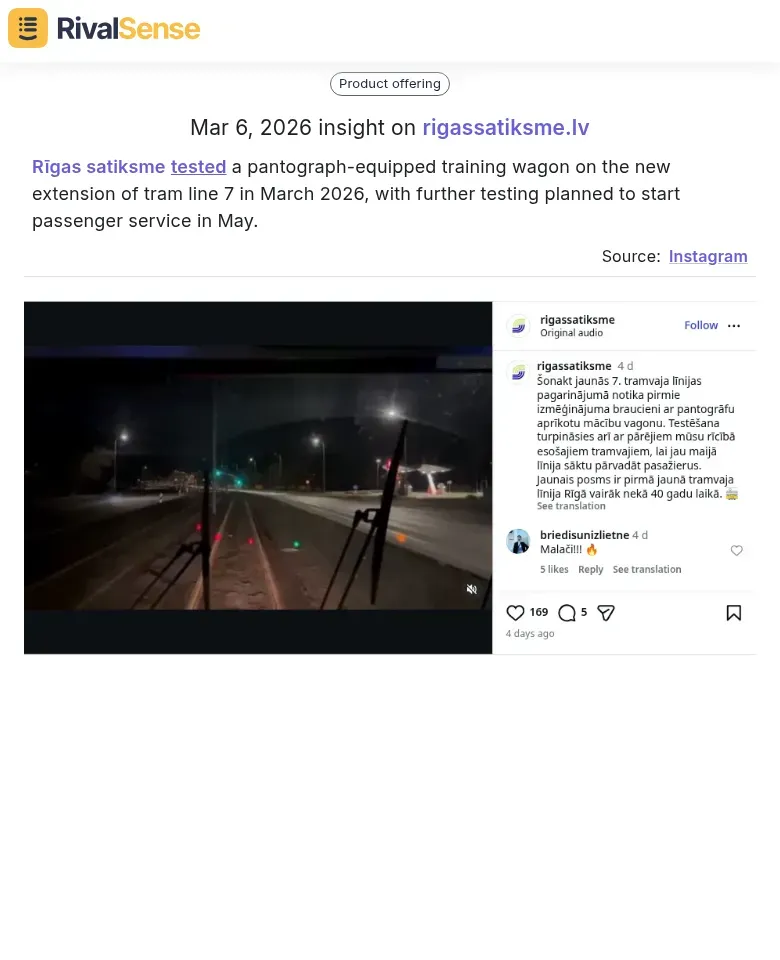
Monitoring testing phases like this is valuable because it helps predict when competitors will launch new services, giving you insights into their operational readiness and risk tolerance for strategic planning.
Checklist for testing analysis:
- Monitor testing completion percentages
- Track regulatory approval status
- Note public demonstration schedules
Assessing infrastructure completion gauges competitive readiness. Track construction milestones, equipment installation, and certification processes. A competitor with 80% infrastructure completion can launch within 3-4 months. Practical step: Create a competitor readiness scorecard with weighted factors including infrastructure (40%), testing (30%), and funding (30%).
Key insight: Competitors delaying infrastructure investments while accelerating testing may be preparing for asset-light partnerships rather than full-scale deployment. Cross-reference these data points to anticipate their market strategy and timing.
Strategic Applications of Partnership Intelligence
Applying partnership intelligence to your business strategy can yield significant competitive advantages. By translating data into actionable plans, you can stay ahead of market shifts and identify opportunities. Here are three strategic applications to consider:
-
Competitor Partnership Timelines for Strategic Planning: Track when competitors announce partnerships with technology providers, municipalities, or mobility platforms. Create a timeline visualization showing partnership frequency and types. Use this to identify market positioning patterns—if competitors are focusing on electric vehicle charging partnerships, consider alternative positioning in micro-mobility or integrated payment systems. Practical tip: Set up alerts for competitor partnership announcements and categorize them by type (technology, government, commercial).
-
Funding Allocation Insights for Market Anticipation: Monitor how competitors allocate funds for infrastructure projects. For example, RivalSense identified this insight: Rīgas satiksme reallocates 1.374 million euros to extend the 7th tram line, increasing total funding to 29.449 million euros, as decided by the government on Tuesday.
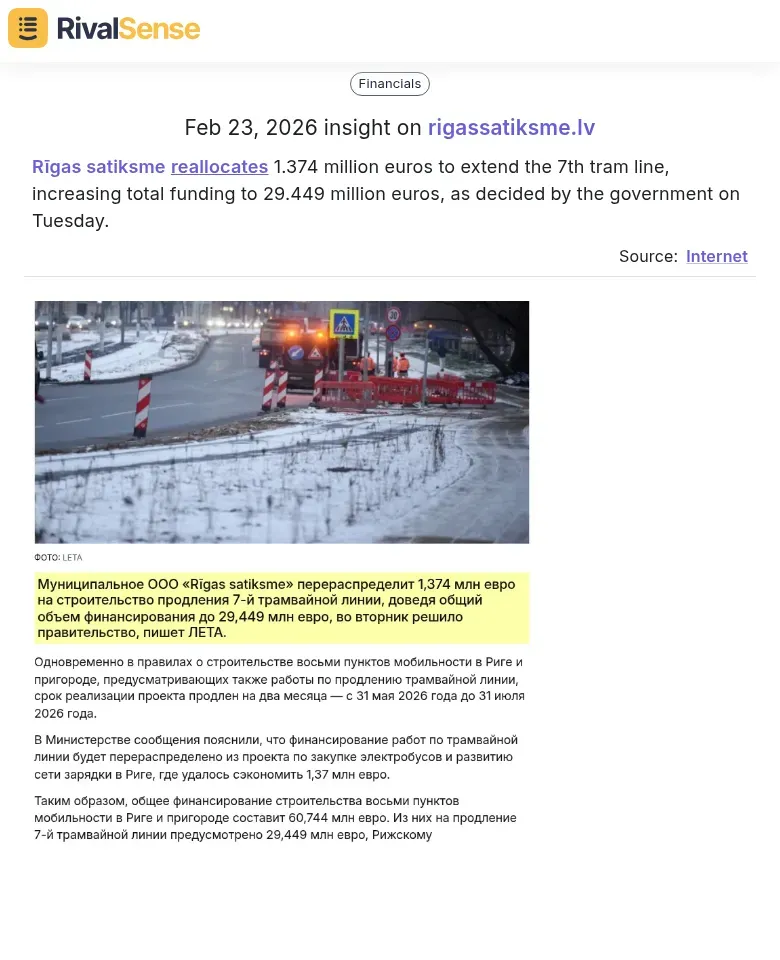
Tracking funding reallocations like this is valuable because it reveals competitor priorities and market trends, helping you anticipate where investments will flow and adjust your own funding strategies accordingly.
Checklist for funding insights:
- Monthly review of competitor grant announcements
- Track obligation rates and project types
- Benchmark funding allocation against market averages
- Infrastructure Progress Intelligence for Opportunity Identification: Use public data on infrastructure project completion rates to identify market gaps. If competitors are 80% complete with electrification projects in urban areas, focus on suburban/rural gaps or complementary services like maintenance partnerships. Monitor competitor project delays—these represent immediate opportunities. Practical step: Create a dashboard tracking competitor infrastructure milestones versus planned timelines.
Key Action Items:
- Map competitor partnership ecosystems quarterly
- Identify infrastructure completion gaps >30 days as priority opportunities
- Use partnership intelligence to time your own strategic announcements
Best Practices for Ongoing Partnership Monitoring
Consistent and ongoing monitoring is key to maintaining competitive intelligence. Implementing best practices ensures you don't miss critical partnership developments that could impact your business. Follow these guidelines to stay informed and agile.
Establish systematic tracking by creating a centralized database with fields for government agency, decision type, funding amount, and timeline. Set up Google Alerts for key terms like "RFP announcement," "grant award," and "public-private partnership" with your competitors' names. Monitor Federal Register, DOT websites, and local transit authority portals weekly.
Create alert systems for testing phases by tracking pilot program announcements and beta testing timelines. Set calendar reminders 30-60 days before expected service launches based on typical public transportation implementation cycles. Monitor social media for soft launch indicators and employee hiring patterns.
Develop analysis frameworks using a three-tier approach: 1) Tactical (immediate service impacts), 2) Strategic (market positioning shifts), 3) Long-term (regulatory implications). Create a partnership impact matrix that maps each competitor partnership against market share, revenue potential, and technological advantage. Use this data to identify gaps in your own strategy and anticipate future competitive moves.
Practical checklist:
• Subscribe to Federal Transit Administration RSS feeds
• Create competitor partnership timeline visualizations
• Set quarterly competitive intelligence review meetings
• Document partnership patterns by competitor type (tech vs. infrastructure)
• Track funding sources (federal vs. state vs. municipal)
• Monitor testing duration to predict full-scale rollout timelines
Leverage Tools for Enhanced Competitor Tracking
Manually tracking all these data points can be time-consuming and prone to errors. To streamline the process, consider using automated tools designed for competitor intelligence. For example, RivalSense tracks competitor product launches/updates, pricing updates, event participations, partnerships, regulatory aspects, management changes, and media mentions across company websites, social media, the internet, and various registries, delivering all in a weekly email report.
By leveraging such tools, you can save valuable time and ensure you never miss a critical update. Ready to enhance your competitor tracking? Try out RivalSense for free at https://rivalsense.co/ and get your first competitor report today to start gaining actionable insights for your business strategy.
📚 Read more
👉 How to Conduct a Regulatory Competitor SWOT Analysis for Strategic Insights
👉 Decoding Competitor Moves: Lessons from Sennheiser's Audio Update
👉 The Ultimate Guide to Tracking Key Client Activity: Software Solutions & Strategic Insights for 2026
👉 Advanced Tactics: Track Competitor Sales for Supply Chain Optimization
👉 How LinkedIn's Product Shift Revealed a $2B Market Gap for Competitors