
Step-by-Step Guide to Facebook Competitor Insights for Key Account Management
In today's hyper-competitive B2B landscape, Facebook competitor insights have evolved from optional monitoring to essential strategic intelligence for key account management. Real-time Facebook data reveals more than just competitor posts—it uncovers strategic shifts, product launches, and market positioning that directly impact your key accounts. When a competitor announces a new enterprise feature or targets your client's industry, you're seeing their playbook unfold in real-time.
Practical Tip: Set up daily alerts for competitor Facebook announcements, partnership reveals, and client testimonials. These signals often precede formal sales outreach to your accounts.
This intelligence directly connects to account retention and growth. When you spot a competitor targeting your key client's pain points, you gain critical lead time to reinforce your value proposition. Systematic monitoring transforms social media noise into actionable outcomes: identify at-risk accounts before they churn, uncover expansion opportunities when competitors miss market needs, and anticipate pricing pressures before negotiations.
Checklist for Getting Started:
- Identify 3-5 primary competitors with active Facebook presence
- Track their content themes, engagement patterns, and client mentions
- Correlate competitor announcements with your account health metrics
- Establish weekly review cadence to spot emerging threats/opportunities
By establishing this systematic approach, you transform reactive account management into proactive strategic advantage, ensuring your key relationships remain secure while identifying new growth vectors competitors haven't yet discovered.
Step 1: Setting Up Your Facebook Competitor Monitoring Framework
Establishing a robust monitoring framework is crucial for systematic competitor tracking. This foundation ensures you capture all relevant data points that inform your key account strategies. Begin by identifying 5-10 key competitors relevant to your key accounts. Create a spreadsheet listing their official Facebook business pages, ensuring you include both direct competitors and aspirational market leaders.
Develop standardized templates for consistent data capture. Include columns for: post frequency (daily/weekly), content themes (promotions, educational, partnerships), engagement metrics (likes, shares, comments), and ad campaign patterns. Track these weekly to identify trends.
Implement automated alerts for real-time updates. Set up notifications for new posts, ad launches, significant follower changes, and partnership announcements. This eliminates manual checking and ensures you never miss critical competitor moves. Pro tip: Schedule monthly reviews of your tracking data to adjust strategies based on emerging patterns.
Step 2: Analyzing Product Launches and Innovation Announcements
Analyzing product launches and innovation announcements on Facebook reveals competitors' strategic positioning and market timing. These insights help you anticipate shifts in the competitive landscape and prepare proactive responses for your key accounts. Start by tracking how competitors unify offerings—like AI protection suites—to understand their market positioning.
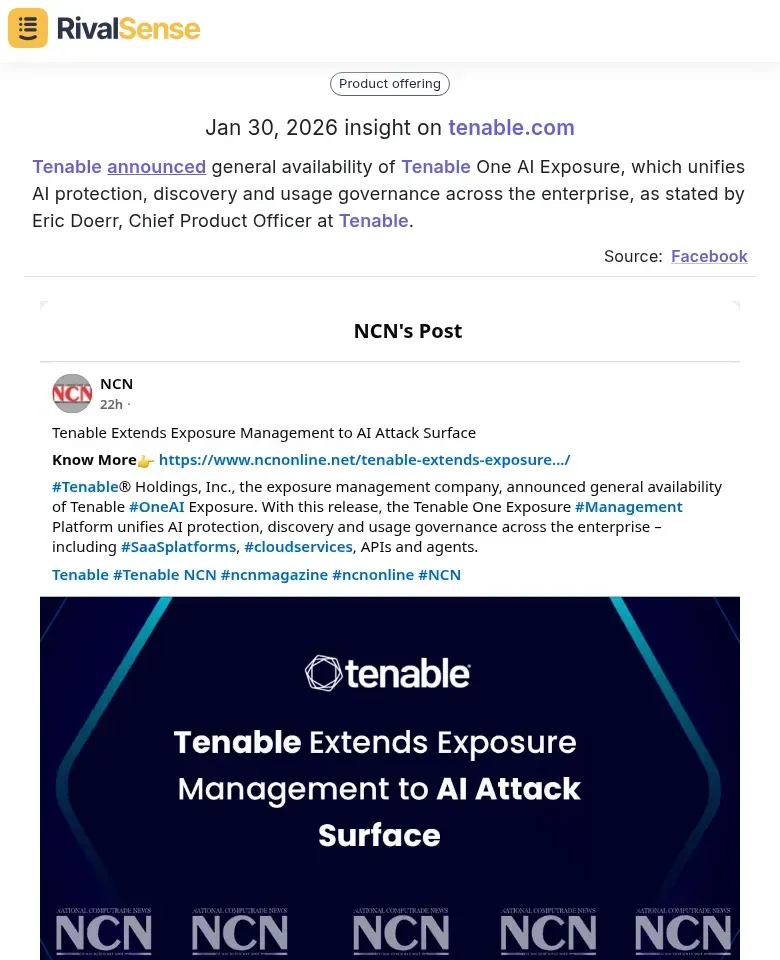
For example, RivalSense tracked that Tenable announced general availability of Tenable One AI Exposure, which unifies AI protection, discovery and usage governance across the enterprise. This type of product launch insight is valuable because it shows how competitors are leveraging emerging technologies like AI to address enterprise needs, allowing you to assess if your key accounts require similar solutions and adjust your value proposition accordingly.
Practical steps for key account managers:
- Create a launch tracking spreadsheet with columns for: announcement date, product type, key messaging, engagement metrics, and target audience
- Set up Facebook alerts for competitor pages to catch announcements in real-time
- Analyze comment sentiment to gauge market reception
- Note recurring themes in innovation announcements to anticipate market trends
Checklist for actionable insights:
- [ ] Identify competitors' innovation cycles (quarterly, biannual)
- [ ] Track how they position new features against existing offerings
- [ ] Monitor customer reactions to gauge market readiness
- [ ] Document messaging evolution across multiple launches
- [ ] Compare your account strategy gaps against competitor innovations
Pro tip: Use Facebook's Ad Library to see how competitors promote new features to different audience segments. This reveals their targeting priorities and helps you adjust account strategies accordingly.
Step 3: Decoding Partnership and Collaboration Strategies
Partnerships reveal how competitors expand reach and position themselves strategically in the market. Understanding these collaborations can highlight gaps in your own key account coverage or inspire new alliance opportunities. Start by analyzing their Facebook collaborations—media partnerships, co-branded campaigns, or influencer tie-ups—to see how they amplify messaging to new audiences.
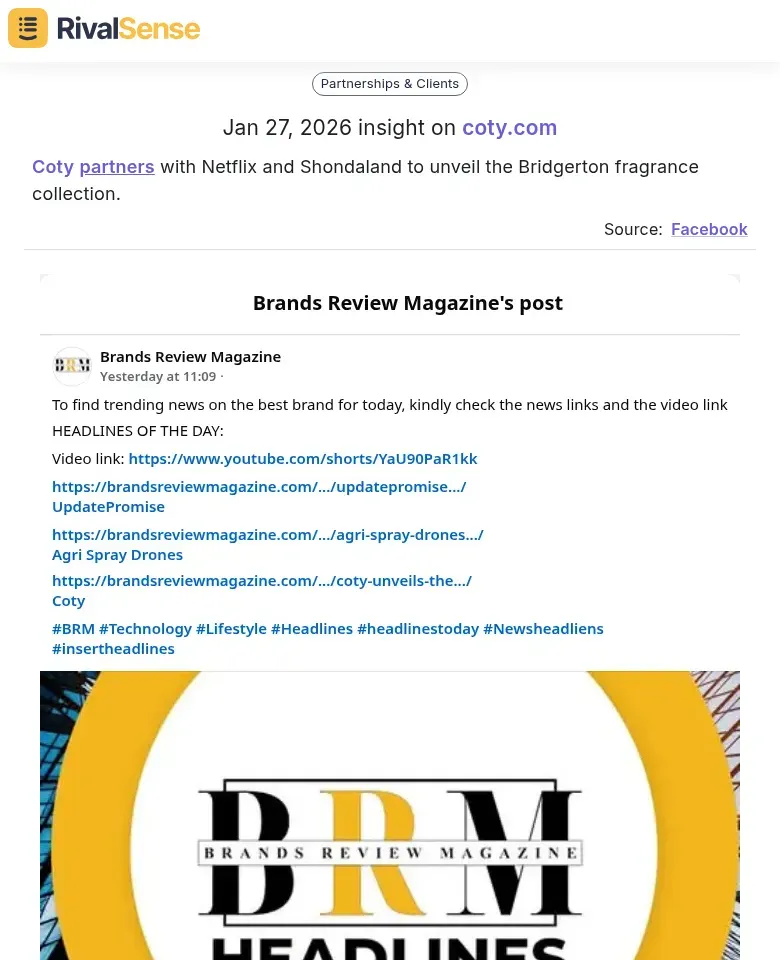
Take the Coty partnership with Netflix and Shondaland to unveil the Bridgerton fragrance collection as an example. RivalSense captured this collaboration, demonstrating how brands leverage popular media to tap into new customer segments. Such partnership insights are valuable for business strategy as they reveal cross-promotional tactics and audience expansion efforts, helping you identify potential partners or counter-strategies for your key accounts.
Practical Checklist for Partnership Analysis:
✅ Categorize partnerships by type (media, technology, distribution)
✅ Map each partnership to specific audience segments or regions
✅ Track announcement frequency and engagement metrics
✅ Identify gaps where competitors lack coverage in your key accounts' markets
Actionable Steps:
- Create a partnership matrix with columns for partner type, target audience, geographic focus, and value proposition
- Monitor competitor Facebook pages for co-branded content and joint announcements
- Compare partnership strategies across competitors to spot underserved niches
- Use tools like RivalSense for automated alerts on new collaborations
Pro Tip: Look for patterns—if competitors consistently partner with tech influencers but ignore sustainability advocates, you can fill that gap to differentiate your key account offerings.
Step 4: Monitoring Platform Integration and Feature Updates
Platform integration and feature updates reveal how competitors enhance user experience and create stickiness for key accounts. Keeping track of these developments helps you stay ahead in offering value-added services to your clients. Start by creating a monitoring checklist: track competitors' social media tool features, API integrations, and third-party platform connections.
Consider Metricool's update allowing TikTok Business account users to add trending music to their posts directly from its Planner. RivalSense highlighted this feature enhancement, which is crucial for business strategy as it shows how competitors are simplifying workflows for users. Insights like these help you understand evolving customer expectations and prioritize your own integration roadmap to better serve enterprise clients.

Practical steps:
- Set up alerts for competitor product announcements and integration partnerships
- Document feature release frequency and positioning
- Compare integration depth across competitors (basic vs. deep platform connections)
- Identify gaps in your own offerings by mapping competitor features against your key accounts' needs
Key insight: Competitors often use platform integrations to create "sticky" experiences that make switching costly for key accounts. Look for patterns where they bundle integrations with premium support or custom workflows.
Step 5: Implementing Insights into Key Account Strategy and Measurement
Now that you've gathered competitor intelligence, it's time to operationalize it for maximum impact on your key accounts. Effective implementation ensures that insights translate into tangible business outcomes, from retention to revenue growth. Here's how to implement insights strategically:
1. Map Competitor Weaknesses to Account Opportunities
Create a matrix linking each competitor vulnerability to specific key accounts where you can exploit it. For example, if a competitor has poor post-sales support, target accounts where service quality is a priority. Develop counter-strategies like offering premium support packages or faster response SLAs.
2. Build Response Playbooks
Document intelligence patterns and create action plans. When you detect competitor price changes, product launches, or negative reviews, have pre-approved responses ready. Include escalation paths, messaging templates, and resource allocation guidelines for swift execution.
3. Establish Measurement Frameworks
Track KPIs that connect competitor insights to business outcomes:
- Account retention rate changes after implementing counter-strategies
- Revenue growth in accounts where competitor weaknesses were exploited
- Win/loss ratios against specific competitors
- Customer satisfaction scores in targeted accounts
Pro Tip: Use a quarterly review cycle to assess what's working. Adjust your playbooks based on what drives the best results in your key accounts.
Streamline Your Competitor Monitoring with RivalSense
Manually tracking Facebook and other channels for competitor insights can be time-consuming and prone to oversight. To automate this process and gain comprehensive intelligence like the examples above, try RivalSense for free at https://rivalsense.co/. RivalSense tracks competitor product launches, pricing updates, partnerships, feature updates, and more across websites, social media, and registries, delivering weekly email reports. Get your first competitor report today and proactively safeguard your key accounts while uncovering growth opportunities.
📚 Read more
👉 Web Scraping for Customer Service Excellence: Benchmarks, Benefits, and Implementation
👉 Real-World Competitor Insights: Hiring and Layoff Patterns for Key Account Strategy
👉 Decoding Competitor Moves: A Real-World Analysis of Paige Powers' Transition to Fortinet
👉 The Complete Guide to Key Account Tracking Integration: Practical Strategies for 2026
👉 The Ultimate Competitor Customer Acquisition Checklist for Data Processing Outsourcing