
Step-by-Step Guide: Extract Competitor Insights from Instagram for Strategic Advantage
In today's hyper-competitive landscape, Instagram competitor intelligence transforms reactive marketing into proactive strategy. By systematically analyzing your rivals' Instagram presence, you move from guessing what works to knowing what drives results in your market. This approach gives you four types of actionable insights: 1) Content strategy patterns (what formats, topics, and posting cadences resonate), 2) Audience engagement tactics (how competitors build community and drive interactions), 3) Product and messaging evolution (how offerings and positioning change over time), and 4) Campaign performance indicators (what promotions and partnerships deliver ROI).
Practical tip: Start with a simple competitor tracking spreadsheet. Document 3-5 key competitors, their follower counts, posting frequency, and engagement rates. Track their top-performing content types weekly.
Ethical boundaries are crucial: Focus on publicly available information only. Never create fake accounts, engage in deceptive practices, or scrape data against platform terms. Your competitive intelligence should inform strategy, not replicate content. The goal is to understand market patterns, not copy individual posts. This ethical approach builds sustainable competitive advantage while maintaining professional integrity.
Setting Up Your Instagram Competitor Monitoring Framework
To build an effective Instagram competitor monitoring framework, start by identifying your true competitors. Look beyond follower counts to analyze engagement rates, content quality, and audience overlap. Use Instagram's "Suggested Accounts" feature and search relevant hashtags to discover niche players who might be targeting your exact audience.
Next, select the right tools for systematic tracking. Consider using RivalSense for automated competitor monitoring across websites, social media, and registries, delivering insights in weekly reports. For example, RivalSense tracked that CapCut awarded its prize to 11 finalists at the World AI Film Festival on March 27. This type of insight into event participation and awards is valuable for understanding how competitors build credibility and industry recognition, helping you plan your own event strategies. 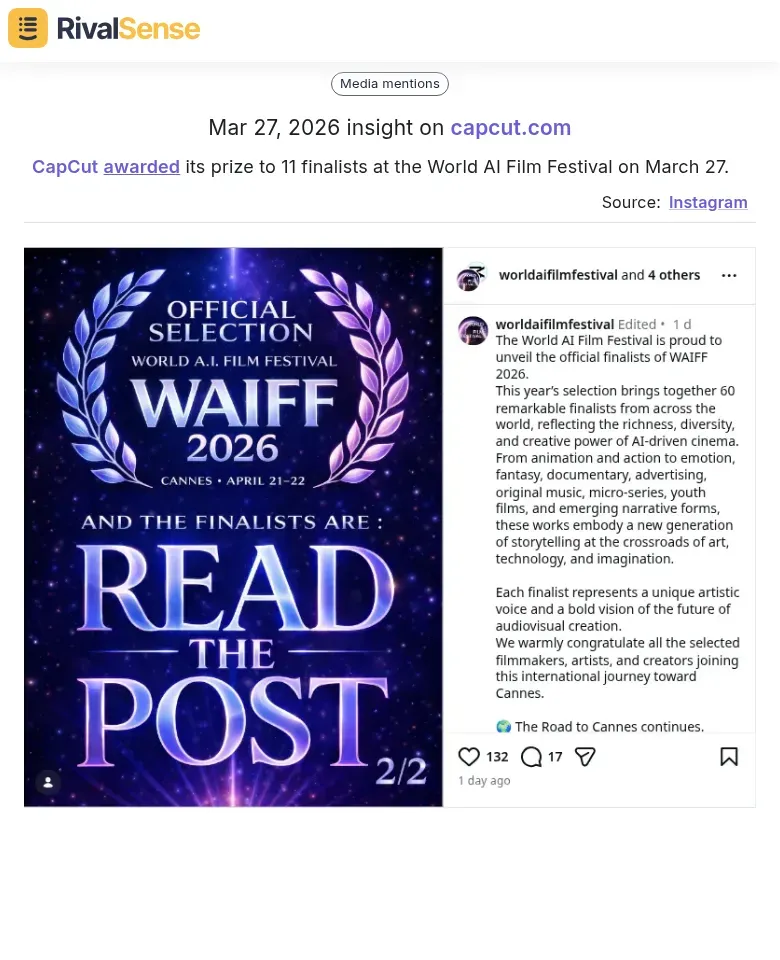
Alternatively, combine Instagram's native analytics with social listening tools like Brandwatch or Sprout Social. For smaller budgets, manual tracking with Google Sheets can work—just ensure you capture key metrics consistently.
Create a structured competitor analysis spreadsheet with these columns: Competitor Name, Follower Count, Engagement Rate (likes + comments ÷ followers), Post Frequency, Content Themes, Hashtag Strategy, and Key Campaigns. Update this weekly to spot trends.
Pro tip: Set up Google Alerts for competitor mentions and use Instagram's "Save" feature to create competitor inspiration folders. Track at least 3-5 competitors minimum, but don't exceed 10 to maintain focus. Remember to monitor both direct competitors (similar products/services) and indirect competitors (alternative solutions for your audience).
Extracting Strategic Insights from Competitor Content Patterns
Instagram offers a goldmine of strategic competitor intelligence beyond basic metrics. Here's how to extract actionable insights from content patterns to refine your marketing approach.
-
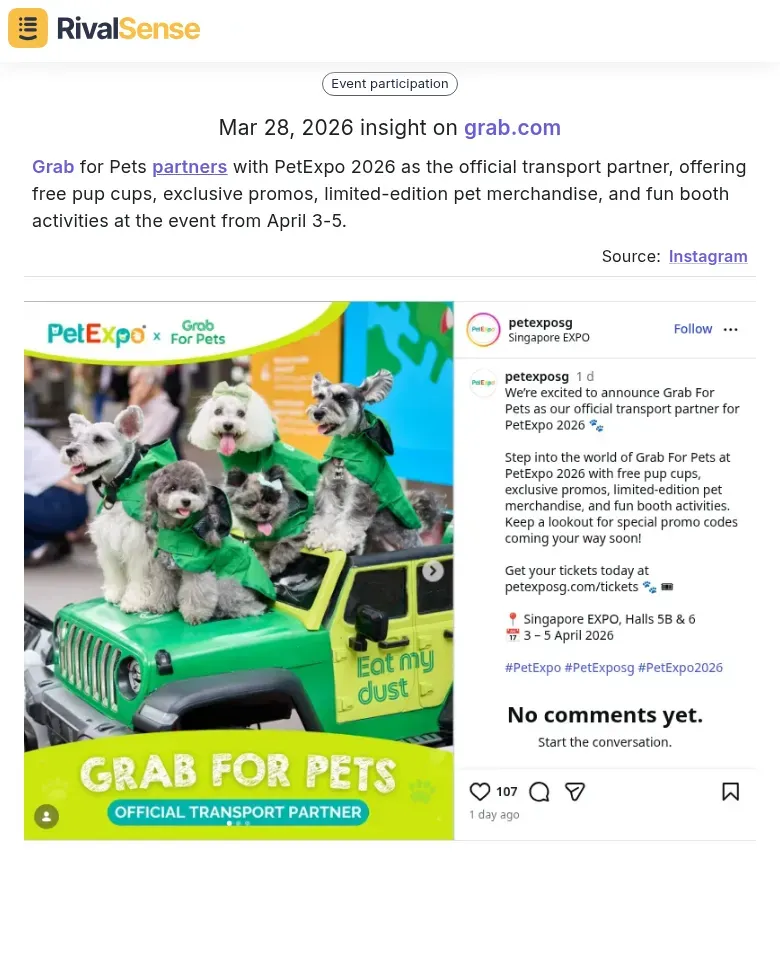
Analyze Partnership Strategies: Track which brands your competitors collaborate with and how they position these partnerships. Look for patterns in event sponsorships, influencer collaborations, and co-branded content. This reveals their market positioning strategy and target audience segments. For instance, RivalSense identified that Grab for Pets partnered with PetExpo 2026 as the official transport partner, offering free pup cups, exclusive promos, and more. Insights into partnerships like this are valuable for spotting alliance opportunities and understanding competitive positioning in events, enabling you to craft strategic counter-moves.
Tip: Create a spreadsheet tracking partnership frequency, partner types, and engagement metrics to identify strategic alliances.
-
Decode Content Pillars: Identify recurring themes in competitor posts over 3-6 months. Categorize content into pillars (educational, inspirational, promotional, community-focused). Notice which pillars drive highest engagement and when they're posted. Practical step: Use Instagram's Insights or third-party tools to track post performance by category and timing.
-
Reverse-Engineer Viral Elements: When competitors have viral posts, analyze the common elements: specific visuals, storytelling formats, CTAs, or emotional triggers. Look for patterns in comments to understand audience sentiment. Checklist: Document viral post characteristics, engagement patterns, and audience reactions to identify what resonates with shared audiences.
Key insight: Competitors' most successful content reveals what your shared audience values most. Track these patterns monthly to anticipate market trends and refine your own content strategy.
Learning from Competitor Innovation and Product Announcements
Instagram has become a primary platform for product launches and feature updates. Monitor competitors' Instagram activity to gain market timing intelligence and stay ahead of industry shifts. Track their posting patterns before major announcements - increased frequency, teaser content, or countdown stories often precede launches by 7-14 days.
Analyze how competitors showcase innovation through visual storytelling techniques. Look for these patterns:
- Problem-solution narratives in Reels showing customer pain points
- Before-after transformations demonstrating product impact
- Behind-the-scenes content revealing development processes
- User-generated content showcasing real-world applications
Extract insights from how competitors demonstrate real-time product usage and benefits. For example, RivalSense reported that Roam introduced Claude Code on the Map, which lights up an office in real-time when a team member uses Claude to code. Tracking such product updates is crucial for staying ahead of technological advancements and identifying gaps in your own offerings, allowing you to innovate proactively. 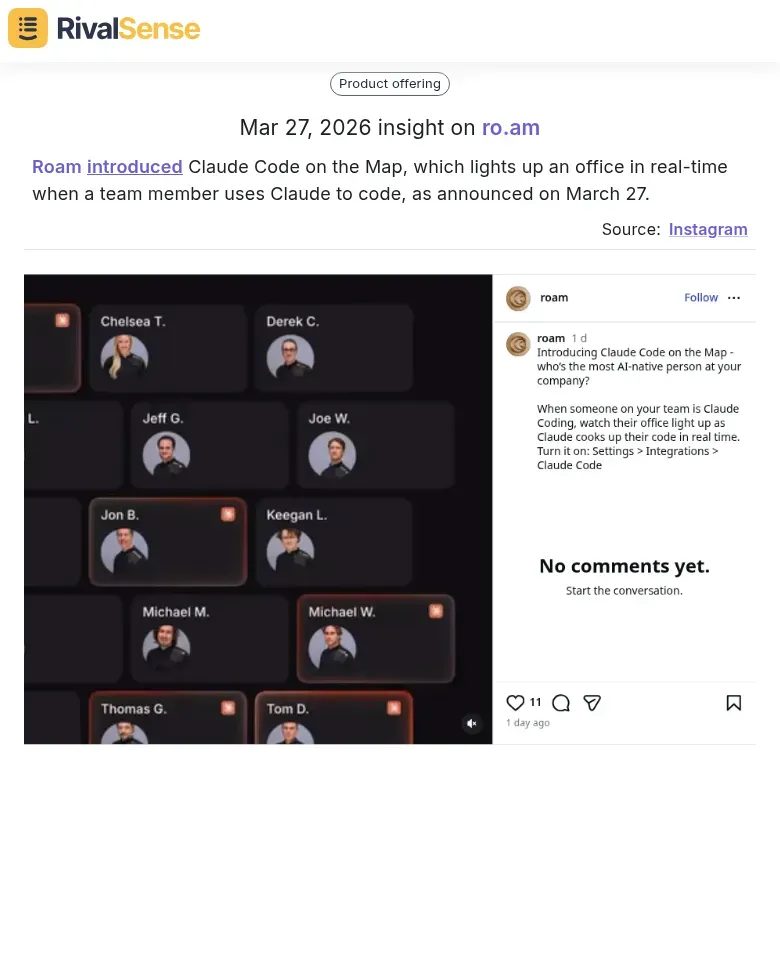
Pay attention to:
- Tutorial Reels showing step-by-step implementation
- Customer testimonial carousels with measurable results
- Interactive Stories with polls asking about feature preferences
- Live demonstrations addressing common user questions
Practical Checklist:
✓ Set up Instagram Competitive Insights (available since Nov 2025) to track 10 competitors
✓ Monitor posting frequency spikes indicating launch preparation
✓ Analyze engagement patterns on different content formats
✓ Track which visual storytelling techniques generate highest saves and shares
✓ Document competitor's product demonstration approaches
✓ Note timing gaps between announcement and availability
✓ Identify common customer questions addressed in comments
Pro Tip: Instagram's algorithm now prioritizes "sends per reach" (DM shares) over follower counts. Focus on content that competitors' audiences actively share via direct messages, as this indicates high-value innovation content worth analyzing for your own strategy.
Turning Competitor Insights into Actionable Strategy
Now that you've gathered competitor insights from Instagram, it's time to transform data into strategic action. Follow this systematic approach to outmaneuver your rivals and capture market share.
1. Identify Content Gaps & Differentiation Opportunities
- Create a spreadsheet comparing your content pillars vs. competitors'
- Note topics they consistently cover that you don't (opportunity areas)
- Identify what they're missing that aligns with your unique expertise (differentiation)
- Tip: Look for engagement patterns - high-performing content types they're underutilizing
2. Develop Counter-Strategies
- Map competitor weaknesses (poor engagement, inconsistent posting, weak CTAs)
- Position your brand as the solution to their shortcomings
- Example: If competitors focus on product features, emphasize customer success stories
- Create a "competitive response matrix" - for each competitor strength, develop your counter-positioning
3. Systematic Implementation Plan
- Integrate insights into your content calendar with specific dates
- Assign team members to execute each strategic initiative
- Set measurable KPIs for each competitive response
- Monthly review: Track performance against competitor benchmarks
- Pro tip: Use a 70-20-10 rule - 70% proven content types, 20% competitive responses, 10% experimental
Quick Checklist:
☐ Content gap analysis completed
☐ Competitive positioning matrix created
☐ Calendar integration with specific dates
☐ Team responsibilities assigned
☐ Measurement framework established
☐ Monthly competitive review scheduled
Advanced Techniques: Predictive Analysis and Trend Forecasting
Transform competitor Instagram data into predictive intelligence with these advanced techniques. First, analyze historical patterns to forecast market trends: track when competitors launch seasonal campaigns, noting timing and content themes. For example, if competitors consistently promote holiday products 6 weeks before major events, you can anticipate and preempt their moves.
Create an early warning system by monitoring these key indicators: sudden increases in posting frequency, new hashtag adoption, engagement spikes on specific content types, and follower growth acceleration. Set up automated alerts for these triggers using platforms like Sprout Social or Hootsuite's predictive AI features.
Develop competitive benchmarks that drive continuous improvement: track 5-7 core metrics (engagement rate, saves, shares, reach, follower growth rate, content mix, posting frequency) across your top 3-5 competitors monthly. Create a dashboard comparing your performance against industry leaders. When competitors outperform you in specific areas, analyze their tactics and implement A/B tests to adapt their successful strategies to your brand.
Practical checklist:
- Document competitor seasonal patterns quarterly, 2) Set up automated alerts for competitor campaign launches, 3) Maintain a benchmark dashboard updated monthly, 4) Conduct quarterly gap analysis against top performers, 5) Test at least one competitor-validated tactic monthly. Remember: predictive analysis works best when combined with human intuition—use AI insights as guidance, not gospel.
Conclusion: Put Insights into Action with RivalSense
By following this guide, you can systematically extract competitor insights from Instagram to inform your strategy and drive business growth. However, manual tracking across multiple platforms can be time-consuming and prone to oversight.
To streamline this process and gain comprehensive competitor intelligence, try RivalSense for free at https://rivalsense.co/. RivalSense tracks competitor product launches, pricing updates, event participations, partnerships, regulatory aspects, management changes, and media mentions across company websites, social media, and various registries, delivering all in a weekly email report. Get your first competitor report today and gain a strategic edge in your market.
📚 Read more
👉 Auto Lending Competitors: Strategic Marketing Analysis for Financial Services
👉 Quick Tips: Uncover Competitor Partnerships to Win Key Accounts
👉 Strategic Competitor Analysis in 2026: Mastering Media Mentions and Content Marketing Trends
👉 Competitor Analysis in Action: Decoding Web Scraper's Marketplace Expansion
👉 Key Account Tracking Permissions: The Complete Guide for B2B Leaders in 2026