
Smart Building KAM vs Customer Success: Strategic Framework & Templates
In today's competitive B2B landscape, managing customer relationships in the smart building sector is more critical than ever. As technology advances, the roles of Key Account Management (KAM) and Customer Success must evolve to keep pace. The smart building revolution has fundamentally transformed customer relationship management. As buildings evolve into complex ecosystems of IoT sensors, AI-driven analytics, and integrated systems, traditional siloed approaches to customer management are failing. Key Account Management (KAM) and Customer Success teams often operate in isolation, creating friction in delivering cohesive smart building solutions.
Why Traditional Models Fail:
- Complexity Gap: Single-point contacts can't navigate the multi-stakeholder decision matrix of smart buildings (facility managers, IT, sustainability officers, finance) 🏢
- Implementation Disconnect: Sales teams sell the vision, but Customer Success inherits the technical reality without proper handoff 🔄
- Value Realization Lag: Without integrated oversight, ROI tracking becomes fragmented across departments 📉
The Business Case for Integration:
- Practical Step: Create a joint KAM-Customer Success dashboard tracking both commercial metrics (upsell potential) and operational success (system uptime, energy savings) 📊
- Checklist Item: Map all customer stakeholders and their success metrics before implementation begins ✅
- Tip: Establish monthly cross-functional reviews where KAM shares commercial insights while Customer Success reports on adoption patterns 💡
Integrating KAM and Customer Success isn't just organizational alignment—it's a strategic imperative for capturing recurring revenue streams and preventing churn in the high-stakes smart building market.
Understanding the Core Differences: KAM vs Customer Success in Smart Building Context
To effectively integrate KAM and Customer Success, it's essential to first understand their distinct roles. Both functions are pivotal but serve different aspects of the customer lifecycle in smart buildings. In smart building technology, Key Account Management (KAM) and Customer Success serve distinct but complementary functions. KAM focuses on strategic growth, revenue expansion, and enterprise relationship building with high-value clients like property developers and facility management firms. Their role involves negotiating multi-year contracts, identifying cross-sell opportunities across building systems (HVAC, security, IoT platforms), and aligning your roadmap with client's long-term portfolio strategy.
Customer Success emphasizes product adoption, value realization, and customer outcomes. In smart buildings, this means ensuring building operators achieve energy efficiency targets, occupants experience comfort improvements, and IoT integrations deliver promised ROI. CS teams track adoption metrics across building subsystems and demonstrate tangible outcomes like 15-25% energy savings.
Smart building complexity amplifies the need for both functions to work in tandem. Practical integration framework:
- Joint Account Planning: KAM and CS co-create quarterly success plans mapping strategic goals to adoption metrics 🤝
- Handoff Checklist: Sales-to-CS-to-KAM transition document covering system integrations, stakeholder maps, and success criteria 📋
- Shared Dashboard: Unified view showing contract value (KAM) alongside adoption rates and ROI metrics (CS) 🖥️
- Escalation Protocol: Clear process for CS to flag adoption challenges that require KAM's strategic intervention 🚨
💡 Tip: Implement monthly "Building Health Reviews" where KAM presents expansion opportunities while CS demonstrates achieved outcomes using building performance data.
The Smart Building Strategic Framework: Integrating KAM and Customer Success
A structured approach is key to merging KAM and Customer Success seamlessly. This framework ensures that from implementation to long-term partnership, both teams work in harmony to drive customer value. The Smart Building Strategic Framework integrates Key Account Management (KAM) and Customer Success through a phased approach that evolves from implementation to long-term partnership. Phase 1 (0-6 months) focuses on seamless deployment with joint technical teams ensuring system integration and user adoption. Phase 2 (6-18 months) shifts to value realization, where KAM identifies expansion opportunities while Customer Success tracks usage metrics and ROI. Phase 3 (18+ months) cultivates strategic partnerships through innovation councils and co-development projects.
Cross-functional collaboration is essential: establish a Smart Building Steering Committee with representatives from sales (KAM), customer success, product, and engineering. Weekly syncs align on account health, technical issues, and expansion opportunities. Use shared dashboards to monitor building performance data alongside customer satisfaction scores.
Key metrics bridge revenue and value:
| Metric | KAM Focus | Customer Success Focus |
|---|---|---|
| Revenue Growth Rate | Expansion from existing accounts | N/A |
| Customer Health Score | N/A | Usage frequency + feature adoption + support tickets |
| Value Realization Index | N/A | Energy savings + operational efficiency gains |
| Partnership Depth | Co-innovation projects | N/A |
Practical checklist:
• Create joint account plans with 90-day implementation milestones 🗓️
• Implement quarterly business reviews with ROI dashboards 📈
• Develop escalation protocols for technical issues within 24 hours ⏱️
• Track expansion pipeline velocity from identified use cases 🚀
• Measure customer advocacy through referral rates and case studies 🌟
Essential Templates for Smart Building Customer Relationship Management
Practical tools can streamline the integration of KAM and Customer Success. These templates provide a standardized way to manage smart building client relationships, ensuring consistency and efficiency. Below are essential templates designed for the unique challenges of smart building technology.
Strategic Account Planning Template for High-Value Smart Building Clients
Create a comprehensive template with these sections: 1) Client Business Overview (facility portfolio, energy consumption patterns, sustainability goals), 2) Stakeholder Mapping (facility managers, IT directors, sustainability officers), 3) Technology Stack Analysis (existing building systems, integration points), 4) Value Realization Metrics (energy savings, occupant comfort scores, operational efficiency gains). Pro tip: Include a "Smart Building Maturity Assessment" checklist to identify where clients are on their digital transformation journey. 📊
Customer Success Journey Map Template for Smart Building Technology Adoption
Map the 5-phase journey: 1) Discovery & Assessment (30-60 days), 2) Implementation & Integration (60-90 days), 3) Optimization & Training (30-60 days), 4) Value Realization (ongoing), 5) Expansion & Renewal. Practical step: Create "Adoption Milestones" for each phase - for example, "Phase 2 complete when 80% of building systems are integrated and reporting data." Include specific smart building KPIs like energy consumption reduction percentage, occupant satisfaction scores, and maintenance response time improvements. 🗺️
Quarterly Business Review Template Combining KAM & CSM Perspectives
Structure your QBR with four key sections: 1) Business Outcomes Review (KAM focus on contract value, CSM focus on usage metrics), 2) Technology Adoption Dashboard (system uptime, integration health, feature adoption rates), 3) Value Realization Scorecard (energy savings, operational efficiencies, ROI calculations), 4) Strategic Roadmap Alignment (upcoming building projects, technology upgrades, expansion opportunities). Essential checklist: Include pre-meeting preparation items like gathering building performance data, user feedback surveys, and identifying 1-2 specific expansion opportunities to discuss. 📝
Implementation Strategies: Making the Framework Work in Your Organization
Putting the framework into action requires careful planning and execution. Here are strategies to make the integration work within your organization, tailored for smart building providers. Start by assessing your current structure and technology stack to identify gaps and opportunities for alignment.
Organizational Structure: For smart building providers, implement a hybrid model where Key Account Managers (KAMs) focus on strategic enterprise clients while Customer Success Managers (CSMs) handle broader adoption. Create a unified reporting structure under a Chief Customer Officer to align goals. Use tiered segmentation: Tier 1 (Enterprise) = dedicated KAM + CSM pairs; Tier 2 (Mid-market) = CSM-led with KAM support; Tier 3 (SMB) = digital-first CS with pooled resources. 🏗️
Technology Stack: Integrate IoT data platforms with CRM (Salesforce/HubSpot) and CS platforms (Gainsight/ChurnZero). Key metrics to track: KAMs monitor contract value growth, strategic partnership depth, and solution expansion; CSMs track adoption rates, system uptime, and ROI realization. Use BI tools (Tableau/Power BI) for unified dashboards showing both strategic and operational metrics. 💻
Change Management: Start with a pilot program for 3-5 key accounts. Checklist: 1) Define shared KPIs, 2) Establish communication protocols, 3) Create joint account plans, 4) Implement weekly sync meetings. Tips: Use phased rollout over 6-9 months; provide cross-training on both roles; celebrate early wins to build momentum. Address resistance by showing data on improved customer retention and expansion rates. 🔄
Competitor Intelligence: Informing Your Strategy with Real-World Insights
In the dynamic smart building market, staying ahead requires not only internal alignment but also external awareness. Tracking competitor moves can provide strategic insights that inform product development, partnership opportunities, and market expansion. Tools like RivalSense help you monitor competitor activities across product launches, pricing updates, events, and more, delivering weekly reports to keep you informed.
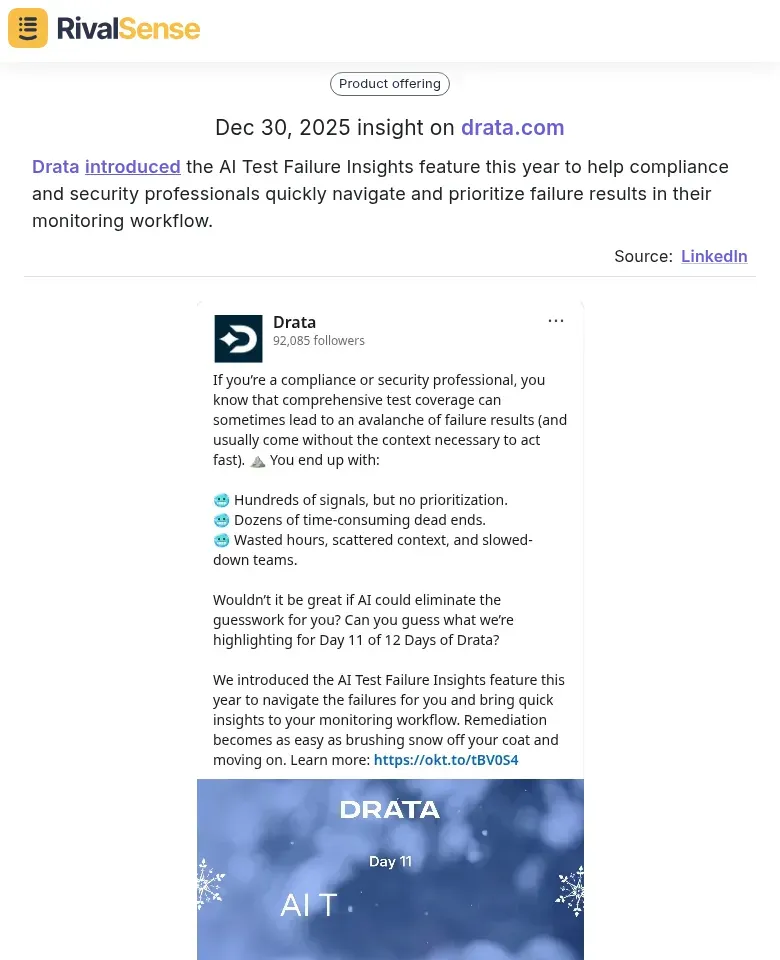
For example, monitoring product launches helps you understand emerging trends and customer needs. RivalSense tracked that Drata introduced the AI Test Failure Insights feature this year to help compliance and security professionals quickly navigate and prioritize failure results in their monitoring workflow. This type of insight is valuable for assessing how competitors are enhancing their offerings with AI, which can inspire your own innovation or highlight gaps in the market.
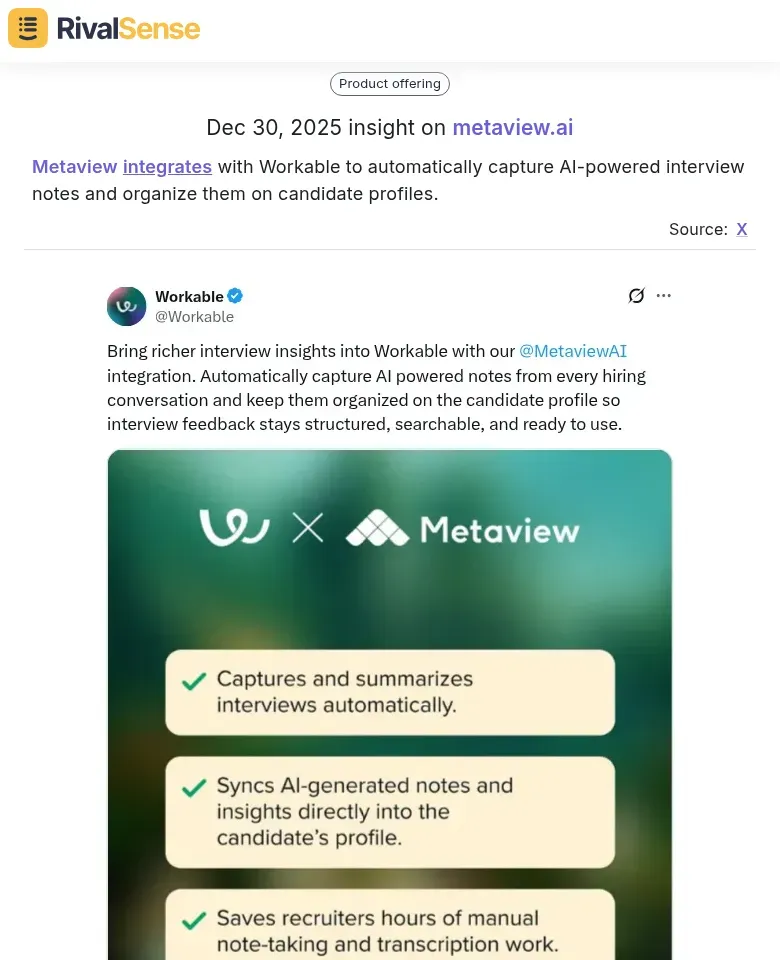
Similarly, tracking partnerships and integrations can reveal collaboration strategies that drive customer success. RivalSense observed that Metaview integrates with Workable to automatically capture AI-powered interview notes and organize them on candidate profiles. Understanding such integrations can help you identify potential partners or improve your own technology stack to enhance user experience.
Finally, keeping an eye on geographical expansions informs your global strategy. RivalSense reported that Citadel plans to open an office in Dubai next year, marking its 18th international location and expanding its global footprint. This insight is crucial for benchmarking your expansion plans against competitors and identifying new market opportunities.

By leveraging competitor intelligence, you can make informed decisions that align with market dynamics and customer expectations, giving you a competitive edge in the smart building industry.
Conclusion: Future-Proofing Your Smart Building Customer Relationships
As smart building technology evolves, balancing strategic growth with customer value delivery requires an integrated approach. Key takeaways: 1) Align KAM's expansion goals with Customer Success's retention focus through shared metrics, 2) Use quarterly business reviews to identify upsell opportunities while addressing pain points, and 3) Develop cross-functional teams where KAMs handle contract negotiations and Customer Success ensures smooth implementation.
Measure ROI by tracking: Customer Lifetime Value (CLV) growth, expansion revenue from existing accounts, churn reduction rates, and implementation success scores. For example, if integrated efforts increase CLV by 20% while reducing churn by 15%, the ROI becomes clear through higher net revenue retention.
Next steps: Start with a pilot program selecting 3-5 key accounts. Create a shared dashboard for real-time tracking of customer health scores and expansion opportunities. Use templates like a joint account plan template and quarterly review checklist to standardize processes. Train teams on collaborative communication and set up monthly alignment meetings to review progress and adjust strategies based on customer feedback.
🚀 Ready to enhance your strategy with competitor insights? Try RivalSense for free at https://rivalsense.co/ and get your first competitor report today!
📚 Read more
👉 How Competitive Intelligence Uncovered Toggl's Mobile Gap and Created a Market Opportunity
👉 7 Website Change Monitoring Mistakes That Sabotage Competitor SWOT Analysis
👉 Healthcare AI Scribe Competitive Analysis: Gaining Strategic Advantage
👉 The Essential Guide to Tracking Competitor Media Mentions and Content Strategy
👉 How Executive Moves Like Rebecca Kaplan's Reveal Competitive Strategies