
Rideshare Key Account Management: Centralized Data Benefits Cheat Sheet
In the high-stakes world of rideshare partnerships, key account management has evolved from reactive relationship maintenance to proactive strategic partnership. The catalyst? Centralized data systems that transform fragmented information into actionable intelligence.
Unified data platforms enable rideshare companies to move beyond basic metrics to predictive analytics. Instead of reacting to partner concerns, you can anticipate needs based on historical patterns, seasonal trends, and market signals. This shift creates a powerful competitive advantage—while competitors scramble with spreadsheets, you're making data-driven decisions about holiday safety initiatives, surge pricing strategies, and market expansion opportunities.
Practical Implementation:
- Consolidate partner performance metrics, payment data, and communication logs into a single dashboard
- Establish automated alerts for performance deviations or partnership risks
- Create standardized reporting templates for consistent partner communication
- Implement data governance protocols to ensure accuracy and accessibility
Real-world impact: When a major holiday weekend approaches, centralized data helps you proactively coordinate safety initiatives with partners. When considering market expansion, unified systems provide clear visibility into which partnerships deliver the highest ROI. The result? Stronger partnerships, better decisions, and sustainable competitive advantage in the dynamic rideshare ecosystem.
Strategic Partnership Development: Leveraging Data for Targeted Initiatives
In today's competitive rideshare landscape, developing strategic partnerships requires more than just goodwill—it demands data-driven insights. Centralized data systems empower you to move beyond transactional relationships to create value-added initiatives that resonate with partners' core objectives.
For instance, by analyzing partnership data, you can identify seasonal opportunities for collaboration. Consider how RivalSense tracked that The Delaware Office of Highway Safety partners with Lyft to offer $20 ride vouchers for sober rides during the Thanksgiving holiday.
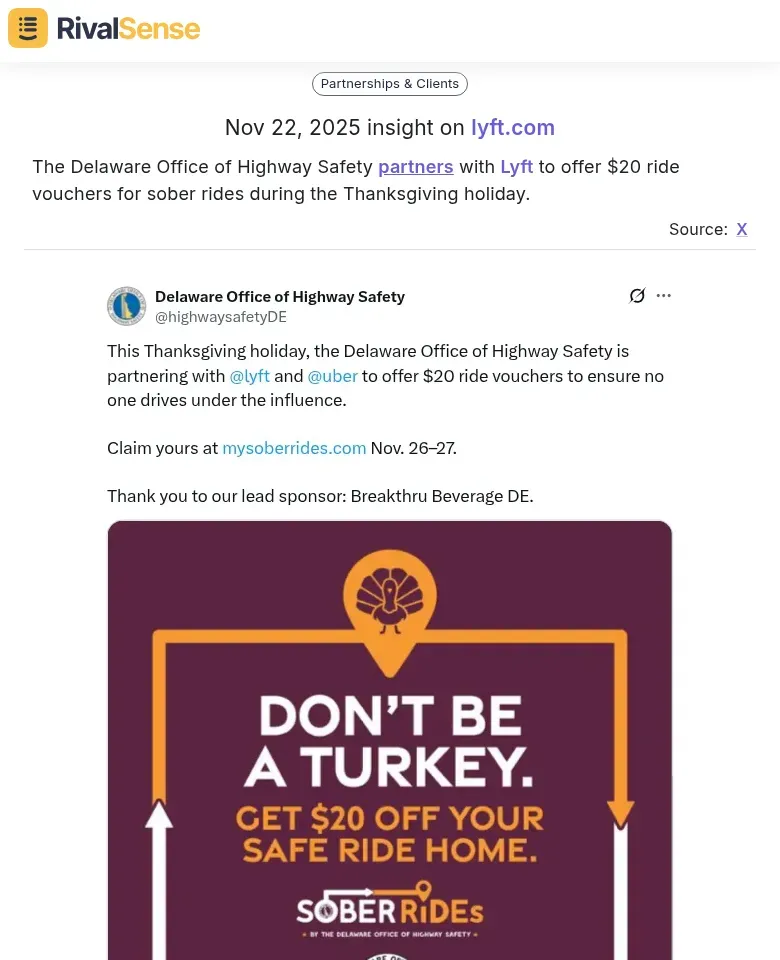
Why this insight matters: Tracking partnership announcements helps you understand how competitors are leveraging collaborations for brand enhancement and public safety, inspiring similar data-driven initiatives for your key accounts.
Identifying Seasonal Opportunities: Analyze 12+ months of historical usage data to pinpoint recurring patterns. For example, corporate accounts show 40% higher ride volume during Q4 holiday seasons and 25% lower usage in Q3 vacation months. Create a seasonal opportunity checklist:
- Map partner-specific peak/valley periods
- Identify location-based patterns (airport rides surge 60% during business travel seasons)
- Cross-reference with partner business calendars
Creating Value-Added Services: Develop targeted initiatives based on partner objectives. For cost-focused partners, implement dynamic pricing alerts when rates drop 15% below average. For employee satisfaction-focused partners, create premium ride programs during high-stress periods. Practical tip: Use data to identify 3-5 specific pain points per partner and build solutions addressing each.
Measuring Partnership Success: Implement integrated performance dashboards tracking:
- Monthly active users (MAU) growth
- Cost-per-ride efficiency metrics
- Employee satisfaction scores
- ROI calculations
Establish quarterly review cadences comparing actual performance against historical benchmarks. Key insight: Partnerships showing 20%+ improvement across 3+ metrics typically renew at 95%+ rates.
Actionable Checklist:
- ✅ Weekly: Monitor usage anomalies and emerging patterns
- ✅ Monthly: Review partner-specific KPIs against benchmarks
- ✅ Quarterly: Present data-driven partnership health reports
- ✅ Annually: Conduct comprehensive partnership ROI analysis
Service Innovation and Product Development: Data-Driven Customer Solutions
Centralized data is the backbone of innovative service offerings in the rideshare industry. By aggregating customer behavior and usage patterns, you can pinpoint unmet needs and develop solutions that drive loyalty and revenue.
A prime example is how RivalSense captured Lyft launched XXL Rides to fit up to 6 people and 4-6 bags.

Why this insight matters: Monitoring product launches allows you to stay ahead of market trends, identify gaps in your own offerings, and accelerate your innovation cycle based on real competitor moves.
To leverage data for innovation, start by analyzing usage patterns to identify unmet needs and service gaps. Track metrics like peak demand times, frequent routes, and cancellation reasons across your partner network. For example, if data shows consistent airport ride cancellations during bad weather, this signals a service gap for reliable premium airport transfers.
Develop specialized offerings based on aggregated customer behavior data. Use centralized data to spot trends: if corporate accounts show high usage for client meetings, create a 'Business Class' tier with dedicated vehicles and receipt automation. Aggregate data from multiple partners helps identify common pain points that individual partners might miss.
Test and scale new services through controlled partner deployments. Start with a pilot program among 3-5 trusted partners, using A/B testing to compare new offerings against existing services. Monitor KPIs like adoption rate, customer satisfaction, and revenue impact. Once validated, create a rollout checklist: partner training materials, marketing collateral, and performance tracking dashboards.
Practical Steps:
- Create a centralized dashboard showing usage patterns across all partners
- Identify top 3 service gaps through data analysis
- Develop MVP for one specialized offering
- Select pilot partners based on reliability and data quality
- Define success metrics before testing
- Scale successful services with partner onboarding kits
Market Expansion and Growth Strategy: Centralized Intelligence for Global Scaling
Expanding into new markets is a complex endeavor that benefits immensely from centralized intelligence. With a unified view of competitor activities, regulatory changes, and local demand, you can make informed decisions about where and when to scale.
Take, for example, how RivalSense reported Lyft plans to open a new technology hub in downtown Toronto in the second half of 2026 to expand beyond the U.S. market.

Why this insight matters: Insights into competitors' expansion plans provide early warnings about new market entries, helping you assess competitive threats and identify strategic opportunities for your own growth.
Centralized data transforms market expansion from guesswork to precision strategy. By consolidating competitor intelligence, pricing trends, and regulatory landscapes into a single dashboard, you can identify high-potential international markets with surgical accuracy. Start by creating a market scoring matrix that weighs factors like competitor density, regulatory friendliness, and local mobility demand—prioritize markets where competitors are underperforming but demand is rising.
Practical Checklist for Resource Allocation:
- ✅ Map competitor geographic footprints against your expansion targets
- ✅ Analyze local pricing elasticity using historical ride data
- ✅ Calculate driver acquisition costs per region using centralized benchmarks
- ✅ Identify regulatory bottlenecks before market entry
- ✅ Allocate marketing budgets based on competitor ad spend patterns
Maintain consistent service quality through data standardization. Implement unified KPIs across all markets: average wait times, driver ratings, and cancellation rates must be measured identically. Create a global playbook that adapts core service standards to local preferences—like payment methods or peak hours—while preserving your brand promise. Centralized intelligence ensures you scale efficiently without diluting the customer experience that built your success.
Operational Excellence: Streamlining Management with Unified Data Systems
Achieving operational excellence in rideshare key account management requires moving beyond fragmented spreadsheets to unified data systems. These systems streamline processes, reduce overhead, and enhance decision-making through real-time insights.
Here's how centralized data delivers tangible benefits:
1. Reduce Administrative Overhead
- Automate reporting: Set up dashboards that auto-generate weekly performance reports for each partner
- Eliminate manual data entry: Integrate APIs from your rideshare platform to pull trip data, earnings, and ratings automatically
- Create standardized templates: Develop one-click report templates for common partner requests (monthly reviews, compliance checks)
2. Accelerate Decision-Making
- Implement real-time alerts: Configure notifications for critical metrics (driver churn spikes, service quality drops)
- Centralize key metrics: Display partner health scores, utilization rates, and profitability in a single dashboard
- Enable self-service analytics: Provide partners with secure portal access to their performance data
3. Enhance Partner Communication
- Share transparent dashboards: Offer partners read-only access to their performance metrics
- Use data in reviews: Base quarterly business reviews on objective metrics rather than anecdotal feedback
- Proactively address issues: Use trend analysis to identify problems before partners report them
Practical Checklist:
- [ ] Integrate all data sources (trips, payments, ratings) into a single platform
- [ ] Create automated weekly performance reports
- [ ] Set up real-time alerts for critical thresholds
- [ ] Develop partner-facing dashboards with key metrics
- [ ] Train account managers on data interpretation and storytelling
By implementing these steps, you'll transform from reactive relationship management to proactive partnership optimization, building stronger, more profitable relationships through data transparency and operational efficiency.
Implementation Framework: Building Your Centralized Data Advantage
Building a centralized data advantage requires a structured implementation framework. This framework ensures that data systems are integrated, scalable, and deliver measurable ROI for your rideshare key account management.
An effective system requires three core components: a unified partner dashboard, automated data ingestion pipelines, and real-time analytics capabilities. Start by consolidating partner performance metrics, contract terms, and communication logs into a single source of truth.
For integration, use API-first connectors to sync existing CRM, billing, and operational systems. Implement data validation rules to ensure accuracy across platforms. Create a standardized taxonomy for partner segmentation and performance categories.
To measure ROI, establish baseline KPIs before implementation, then track: (1) time saved on manual data aggregation, (2) improved partner retention rates, (3) increased upsell conversion from data-driven insights. Build a continuous improvement loop by setting quarterly reviews of data quality, user adoption metrics, and business impact analysis.
Practical Checklist:
- Map all existing partner data sources
- Define 5-7 critical partner success metrics
- Implement automated weekly performance reports
- Create alert system for partner health indicators
- Schedule monthly data governance reviews
Pro tip: Start with your top 20% of partners to validate the system, then scale based on learnings.
🚀 Take Your Strategy to the Next Level with RivalSense
The insights and strategies discussed here highlight the power of centralized data in rideshare key account management. To stay ahead of competitors, you need timely intelligence on their moves—from product launches and partnerships to market expansions.
RivalSense tracks competitor activities across websites, social media, and registries, delivering actionable insights in a weekly email report. This helps you anticipate market shifts, identify opportunities, and make data-driven decisions with confidence.
Ready to transform your competitor tracking? Try RivalSense for free today and get your first competitor report to start leveraging these insights for your business growth!
📚 Read more
👉 Competitor Pricing Cheat Sheet: Monitor Key Account Growth Insights
👉 Mastering Competitor Analysis: Lessons from Motive's AI Coach Launch
👉 How to Track Key Account Lifecycle: A Strategic Guide for B2B Leaders
👉 Data Processing Competitive Advantage Cheat Sheet: Outsmart Rivals
👉 How Bright Data's Price Cut Revealed Competitor Growth Strategy