
Renewable Energy Key Account Tracking: Master Spreadsheet Template and Cheat Sheet
Managing key accounts in renewable energy presents unique challenges that generic CRMs can't address. Unlike traditional sectors, renewable energy deals involve complex project timelines spanning years, intricate regulatory compliance requirements, evolving technology specifications, and multi-stakeholder decision-making processes. Systematic tracking transforms this complexity into competitive advantage. By monitoring account health across dimensions like project milestones, regulatory approvals, equipment delivery schedules, and stakeholder sentiment, you can anticipate needs before they become problems.
This proactive approach reduces churn by 30-40% while identifying upsell opportunities during natural expansion points like capacity additions or technology upgrades. Generic CRM tools fail because they lack renewable energy-specific fields: no place to track PPA (Power Purchase Agreement) expiration dates, interconnection queue positions, REC (Renewable Energy Certificate) generation forecasts, or equipment warranty timelines. Spreadsheets become necessary but quickly become unmanageable.
Practical steps to start:
- Map all stakeholders per account (developer, EPC, financier, utility)
- Track regulatory milestones (permits, approvals, interconnection studies)
- Monitor equipment lifecycles (warranties, maintenance schedules, technology refresh cycles)
- Set alerts for contract renewal windows (typically 6-12 months before expiration)
- Document decision-making processes and key influencers
This structured approach turns account management from reactive firefighting to strategic revenue growth.
Essential Components of a Renewable Energy Key Account Spreadsheet
Effective renewable energy key account management requires a purpose-built spreadsheet with these essential components. In this section, we'll break down the must-have elements for your tracking system. These components ensure you capture all critical data points specific to the renewable energy sector.
Key Account Identification & Segmentation
- Segment by project type: utility-scale solar/wind, commercial/industrial rooftop, community solar, storage-plus-renewables
- Prioritize accounts by: project pipeline value ($5M+), strategic partnership potential, regulatory influence, geographic concentration
- Tag accounts with: developer vs. owner-operator, public vs. private funding, grid interconnection status
Critical Data Fields
- Project timelines: RFP dates, permitting milestones, PPA execution, construction start/end, commercial operation date
- Contract tracking: PPA terms (price escalators, term length), EPC contract value, O&M agreements
- Deliverables: interconnection studies, environmental permits, land leases, equipment procurement status
- Financials: LCOE calculations, tax equity structure, incentive capture (ITC/PTC)
Renewable-Specific KPIs & Integration
- Capacity metrics: MWac/MWdc, capacity factor, annual generation (MWh)
- Performance: availability rate, PR (performance ratio), curtailment percentage
- Market alignment: REC pricing, carbon offset value, grid service revenues
- Risk indicators: interconnection queue position, offtaker credit rating, commodity price exposure
Pro Tips:
- ✅ Use conditional formatting to highlight delayed milestones (red) and completed items (green)
- ✅ Create dropdown menus for standardized entries (project status, region, technology)
- ✅ Link cells to external data sources for real-time REC prices and interconnection queue updates
- ✅ Set up automated alerts for contract renewal dates 90 days in advance
- ✅ Include a dashboard tab summarizing: total pipeline value, weighted average LCOE, portfolio capacity factor
Template Structure: Building Your Tracking Framework
A well-organized template saves time and improves accuracy in key account management. Let's explore how to structure your tracking framework effectively with a dashboard that provides at-a-glance account health monitoring. Start with a summary view showing key metrics: contract value, renewal dates, service level compliance, and customer satisfaction scores.
Use color-coded status indicators (green/yellow/red) for quick visual assessment of account health. Organize data by renewable energy segments for targeted insights:
- Solar: Track panel efficiency metrics, maintenance schedules, and seasonal performance patterns
- Wind: Monitor turbine uptime, wind speed correlations, and component replacement cycles
- Storage: Follow battery degradation rates, charge/discharge cycles, and grid integration metrics
Implement automation features to reduce manual work:
- Set up data import templates for utility bill analysis and performance reports
- Create automated alerts for contract renewals (90/60/30-day reminders)
- Use formulas to calculate ROI metrics and performance benchmarks automatically
- Establish standardized data entry protocols to ensure consistency across teams
Practical checklist:
✓ Design dashboard with color-coded status indicators
✓ Segment tracking sheets by technology type
✓ Set up automated renewal alerts
✓ Create standardized data import templates
✓ Include performance benchmark calculations
✓ Establish data validation rules for accuracy
Implementation Guide: From Setup to Daily Use
Implementing your tracking system requires a methodical approach to ensure long-term success. Follow this guide to set up and maintain your key account spreadsheet for daily use, turning data into actionable insights.
Step-by-Step Setup Process
- Template Customization: Download our renewable energy key account tracking spreadsheet template and customize columns for your specific needs (account size, contract dates, decision-makers, competitive positioning, renewal probability).
- Data Import: Populate initial data from CRM, sales records, and market research. Include key metrics like annual energy consumption, contract terms, and competitor activity.
- Automation Setup: Configure automated data feeds for news alerts, regulatory changes, and competitor announcements using tools like Google Alerts or RSS feeds.
Best Practices for Data Maintenance
- Daily Routine: Dedicate 15 minutes each morning to update account status changes, new contacts, and competitive intelligence.
- Weekly Review: Every Friday, analyze trends across accounts, flag at-risk relationships, and update renewal forecasts.
- Monthly Audit: Clean up outdated information, verify contact details, and assess data accuracy.
Team Collaboration & Permissions
- Role-Based Access: Set view-only permissions for junior team members, edit access for account managers, and admin rights for sales leaders.
- Shared Workspace: Use Google Sheets or Microsoft 365 for real-time collaboration with comment threads for strategy discussions.
- Integration Tips: Connect your spreadsheet to Slack/Teams for automated notifications about critical account changes or upcoming renewals.
Pro Tip: 🎯 Color-code accounts by risk level (green=secure, yellow=monitor, red=at-risk) for instant visual assessment during team meetings.
Advanced Tracking Techniques for Renewable Energy Accounts
To stay ahead in the competitive renewable energy market, you need more than basic tracking methods. Advanced techniques provide strategic insights that drive growth, mitigate risks, and enhance decision-making for your key accounts.
Competitive Intelligence Integration
Embed competitor analysis directly into your tracking by creating dedicated columns for: competitor pricing trends, market share changes, new project announcements, and strategic partnership moves. Use automated alerts for competitor website updates, press releases, and regulatory filings. Example: Track how competitors are positioning themselves in emerging markets like offshore wind or green hydrogen to identify gaps in your own strategy.
Risk Assessment & Mitigation Tracking
Create a dynamic risk matrix for each long-term project, tracking: regulatory changes, supply chain vulnerabilities, technology obsolescence risks, and stakeholder opposition. Implement color-coded status indicators (green/yellow/red) and assign mitigation owners with deadlines. Tip: Link risk factors to financial impact projections to prioritize mitigation efforts.
Performance Benchmarking
Go beyond internal metrics by benchmarking against: industry standards (IRENA, IEA reports), competitor project completion rates, customer satisfaction scores, and innovation adoption timelines. Create a quarterly comparison dashboard showing your position relative to top 3 competitors across key performance indicators.
Practical Checklist:
- [ ] Set up automated competitor news monitoring
- [ ] Create risk probability/impact scoring system
- [ ] Establish quarterly benchmarking review process
- [ ] Link tracking data to strategic planning sessions
- [ ] Implement stakeholder sentiment tracking for each account
These advanced techniques turn your spreadsheet from a passive record into an active strategic tool for renewable energy account management.
Competitor Intelligence in Action: Learning from Management Changes
Tracking competitor movements goes beyond products and pricing—personnel changes can signal strategic shifts. For instance, monitoring management hires or departures helps anticipate new market entries, operational focus, or partnership strategies. This type of insight is valuable for adjusting your own business strategy to stay competitive.
Consider these real-world examples detected by RivalSense:
-
Anna Petrova left Coty as Vice-President of Global Logistics in Canada to join Fresenius Kabi as Vice President - Global Distribution and Logistics CoE.
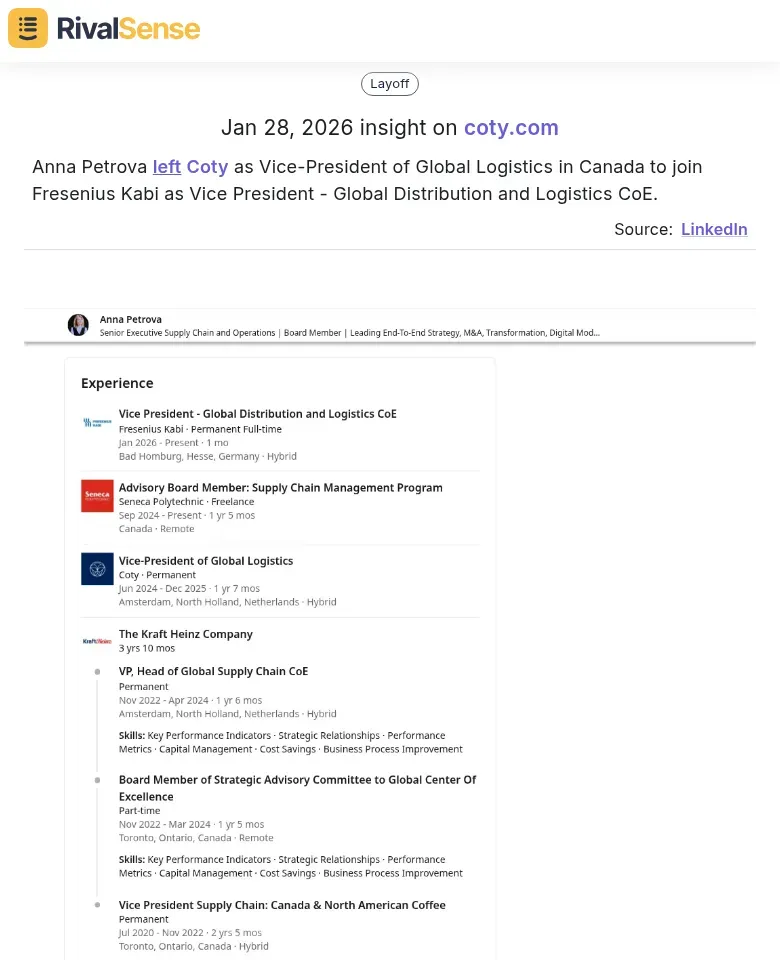
This move could indicate Fresenius Kabi's emphasis on strengthening global logistics, potentially affecting supply chain dynamics in healthcare and adjacent sectors. -
Jasmeet Singh joined Kenvue as Director of Ecommerce in India, previously unspecified.
Such appointments often reveal a company's focus on digital expansion in key regions, hinting at increased competition in e-commerce channels. -
Madhav Nayak joins Kenvue as Vice President and CMO Asia-Pacific in Singapore.
A high-level marketing hire in Asia-Pacific suggests strategic investments in brand building and customer acquisition, useful for benchmarking your own regional efforts.
By integrating such insights into your tracking, you can proactively respond to competitor moves and identify opportunities in your renewable energy accounts.
Cheat Sheet: Quick Reference Guide and Pro Tips
Use this cheat sheet as a quick reference for efficient key account tracking in renewable energy. These pro tips and shortcuts will help you maximize your spreadsheet's effectiveness, saving time and improving accuracy.
Time-Saving Shortcuts & Formulas:
• Use =XLOOKUP() to auto-populate account details from your master database
• Set up conditional formatting rules to flag accounts with >30 days since last touch
• Create pivot tables to analyze revenue trends by account type (utility, commercial, residential)
• Use =IFS() formulas to categorize accounts by engagement level automatically
Common Pitfalls to Avoid:
• Don't track everything manually—automate data imports from your CRM
• Avoid siloed tracking—ensure sales, support, and technical teams access the same data
• Don't neglect regulatory compliance tracking for different regions/states
• Stop using static spreadsheets—implement version control to prevent data loss
Scaling Strategies:
• Phase 1 (1-10 accounts): Master basic tracking with standardized columns
• Phase 2 (11-50 accounts): Implement automated reporting dashboards
• Phase 3 (51+ accounts): Migrate to dedicated tracking software with API integrations
• Pro Tip: Create account tiering (A/B/C) based on revenue potential and allocate resources accordingly
Quick Checklist:
✓ Set up automated renewal date alerts
✓ Track regulatory changes affecting each account
✓ Monitor competitor activity in key accounts
✓ Document decision-makers and their priorities
✓ Measure customer health scores monthly
Put Your Tracking into Practice
Effective key account management in renewable energy requires continuous monitoring and adaptation. By leveraging the spreadsheet template and techniques outlined here, you can transform complex data into strategic advantages. However, manually tracking competitors and market changes can be time-consuming.
To streamline this process, try out RivalSense for free at https://rivalsense.co/. It tracks competitor product launches, pricing updates, event participations, partnerships, regulatory aspects, management changes, and media mentions—delivering all in a weekly email report. Get your first competitor report today to stay ahead in the renewable energy sector!
📚 Read more
👉 How TAG Heuer's Glassbox Launch Prompted Rivals' Strategic Pricing Shift
👉 Facebook Competitor Insights Framework: Templates for Key Account Tracking
👉 Video Conferencing Competitive Intelligence: Real-World Key Account Tracking Examples
👉 Step-by-Step Guide to Competitor Matrices for Event Participation Insights