
Regulatory Intelligence Workflow: Uncover Competitor Technology Stack Advantages
In today's regulated markets, compliance has transformed from a mere cost center into a powerful strategic differentiator. 🚀 Companies that master regulatory intelligence workflows gain a significant competitive edge by anticipating regulatory changes, adapting faster than competitors, and leveraging compliance as a market entry barrier. This strategic intersection allows businesses to not only avoid penalties but to uncover hidden opportunities within regulatory frameworks.
Practical Steps to Begin:
- Map your regulatory landscape – identify key agencies, upcoming regulations, and compliance deadlines.
- Establish a continuous monitoring system for regulatory updates across jurisdictions.
- Analyze competitor technology stacks through public filings, job postings, and patent applications.
- Benchmark your compliance capabilities against industry leaders.
By analyzing competitor technology stacks, you can reveal how they're optimizing for regulatory requirements—whether through specialized compliance software, automated reporting systems, or AI-driven risk assessment tools. This intelligence helps you identify gaps in your own stack and prioritize investments that deliver both compliance efficiency and competitive advantage.
Building Your Regulatory Intelligence Framework: From Monitoring to Action
Building an effective regulatory intelligence framework requires moving beyond passive monitoring to proactive action. Start by establishing continuous monitoring systems that track regulatory changes across all relevant jurisdictions. Use automated tools to monitor government portals, regulatory bodies, and industry publications, setting up alerts for specific keywords and regulatory topics that impact your industry.
Next, develop systematic risk analysis and control mapping methodologies. Create a compliance matrix that maps each regulation to your internal controls, identifying gaps and overlaps. For each regulatory change, assess:
- Impact level (high/medium/low)
- Implementation timeline
- Required process changes
- Resource requirements
This structured approach ensures you prioritize effectively. Finally, implement vendor due diligence processes to extend compliance across your ecosystem.
Vendor Assessment Checklist:
- [ ] Regulatory certifications (e.g., SOC 2, ISO 27001)
- [ ] Audit reports and compliance histories
- [ ] Data handling practices and security protocols
- [ ] Compliance training programs for staff
🔍 Practical tip: Establish a cross-functional regulatory intelligence team with representatives from legal, compliance, product, and operations to ensure comprehensive coverage and rapid response capability. Maintain a centralized regulatory database with version control to track changes over time.
Analyzing Competitor Technology Stacks Through a Regulatory Lens
To analyze competitor technology stacks through a regulatory lens, start by identifying key partnerships and certifications. Look for technology alliances with compliance-focused vendors (like Vanta or Drata) and industry-specific certifications (SOC 2, ISO 27001, HIPAA). These signal advanced regulatory readiness beyond basic requirements.
Next, map workflow automation capabilities. Examine how competitors integrate compliance tracking into their platforms—do they offer automated audit trails, real-time monitoring dashboards, or built-in compliance reporting? Tools like automated data retention policies and consent management systems indicate sophisticated regulatory infrastructure.
Assess AI and automation advantages by analyzing how competitors use machine learning for regulatory tasks. Look for AI-powered risk assessment tools, automated compliance gap analysis, or predictive regulatory change monitoring. Companies leveraging AI for real-time compliance validation gain significant competitive advantage.
Practical Steps for Analysis:
- Create a competitor technology matrix tracking compliance tools, certifications, and AI capabilities.
- Monitor regulatory technology partnerships through press releases and integration announcements.
- Analyze product documentation for compliance automation features.
- Track regulatory technology patent filings for innovation insights.
- Benchmark your own regulatory tech stack against identified competitor advantages.
Learning from Industry Examples: Strategic Moves in Regulated Markets
Industry associations like ISPE and IAGR demonstrate how membership facilitates regulatory intelligence sharing. Join relevant associations to access working groups where competitors inadvertently reveal their technology approaches during collaborative regulatory discussions. For instance, tracking competitor participation in key industry committees can help anticipate their regulatory strategies. Here’s a real-world example:
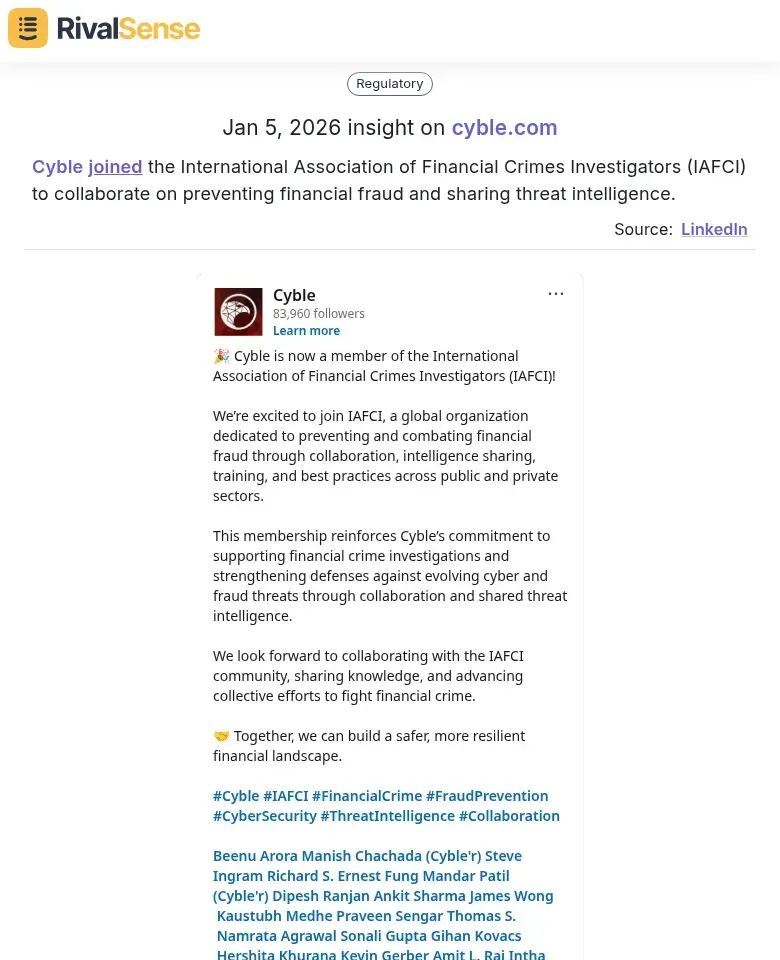
Insight: Cyble joined the International Association of Financial Crimes Investigators (IAFCI) to collaborate on preventing financial fraud and sharing threat intelligence. Why this matters: Monitoring competitor associations reveals their strategic focus on collaboration and threat intelligence, helping you anticipate regulatory alliances and market positioning. 🏛️
Security certifications (ISO 27001, SOC 2, HITRUST) create competitive moats. Analyze which certifications your competitors pursue—these reveal their target markets and technology maturity. For example:
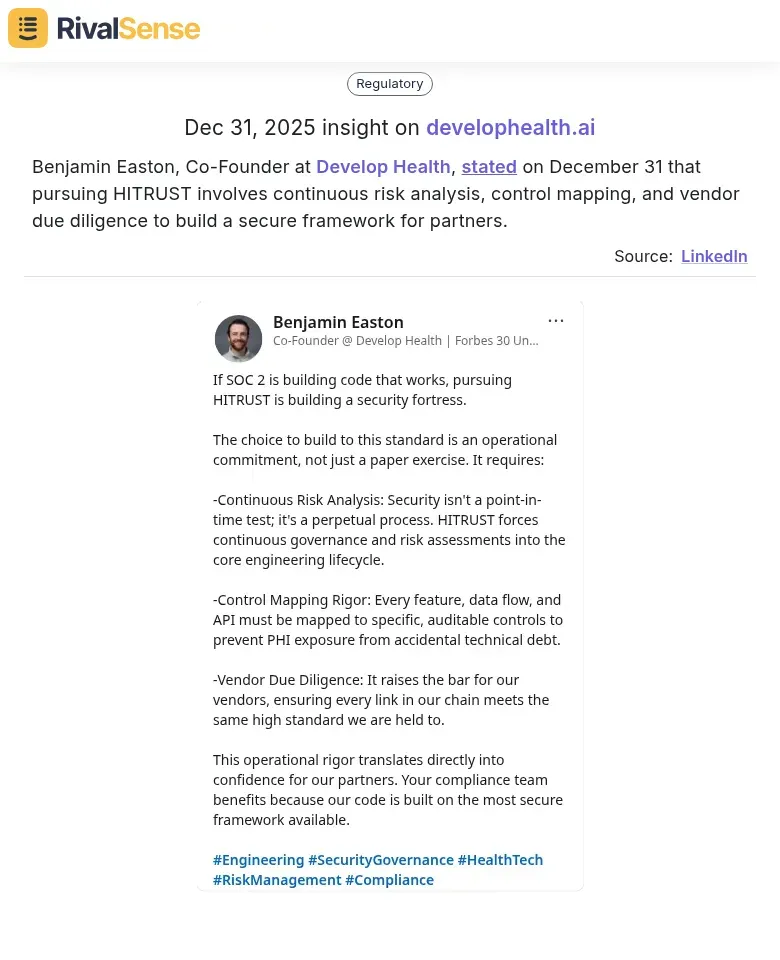
Insight: Benjamin Easton, Co-Founder at Develop Health, stated that pursuing HITRUST involves continuous risk analysis, control mapping, and vendor due diligence to build a secure framework for partners. Why this matters: Insights into competitor certifications highlight their compliance maturity and commitment to security frameworks, indicating trustworthiness and competitive barriers. 🛡️
Regulatory authorization strategies differ by market. In pharmaceuticals, companies use the FDA's 510(k) pathway by demonstrating equivalence to predicate devices—revealing their technology benchmarking approach. In fintech, observe how competitors leverage regulatory sandboxes for market testing. Actionable insight: Monitor competitor regulatory submissions to identify their geographic expansion patterns and technology adaptation requirements. Example:

Insight: Waymo received authorization from Nevada and began autonomous testing with a driver at the wheel in Las Vegas. Why this matters: Tracking regulatory authorizations helps understand competitor expansion plans and technology testing phases, crucial for benchmarking and timing your own market entries. 🚗
Checklist for Industry Learning:
- [ ] Track competitor certification announcements
- [ ] Benchmark your certification timeline against theirs
- [ ] Use certifications as market entry validation
- [ ] Monitor competitor regulatory submissions for geographic insights
Implementing Your Competitive Regulatory Intelligence Workflow
To implement an effective competitive regulatory intelligence workflow, start by integrating regulatory data into your existing competitive analysis framework. Create a centralized dashboard that maps competitors' regulatory filings, certifications, and compliance timelines against their technology stack components. This reveals which technologies are compliance-ready versus those requiring adaptation.
Develop three key metrics:
- Regulatory Advantage Score (time-to-compliance vs. industry average)
- Compliance Maturity Index (breadth of certifications across jurisdictions)
- Technology Gap Analysis (compliance-ready features vs. market requirements)
Track these quarterly to identify trends. Create action plans using this checklist:
- [ ] Prioritize technology gaps based on regulatory deadlines and competitive impact
- [ ] Allocate resources for compliance engineering vs. competitive feature development
- [ ] Establish cross-functional teams (legal, engineering, product) for rapid response
- [ ] Build competitive moats by targeting emerging regulations where you can establish early compliance
🔧 Practical tip: Use regulatory intelligence to anticipate competitor pivots—companies often announce technology changes 6-12 months before major regulatory deadlines. Monitor patent filings and certification applications for early signals.
Future-Proofing Your Regulatory Advantage: Emerging Trends and Technologies
As regulatory landscapes evolve, forward-thinking companies are leveraging AI-driven intelligence to gain competitive edges. AI-powered regulatory monitoring can process thousands of regulatory documents in real-time, identifying emerging requirements 6-12 months before competitors. For example, a fintech firm using AI detected upcoming EU payment regulations early, allowing them to adjust their technology stack while competitors scrambled.
Cross-border regulatory harmonization presents both challenges and opportunities. Companies should map regulatory overlaps across key markets (US, EU, APAC) and identify common technical requirements. This enables building modular compliance components that work across jurisdictions, reducing development costs by 30-40% while accelerating market entry.
Practical Steps for Future-Proofing:
- Implement AI monitoring tools that track regulatory changes in your top 5 markets.
- Create a "regulatory technology roadmap" updated quarterly.
- Build modular APIs for compliance functions that can be swapped as regulations change.
- Conduct quarterly "regulatory stress tests" on your tech stack.
- Establish cross-functional regulatory intelligence teams (legal, tech, product).
Agile technology stacks should feature containerized compliance modules, API-first architectures, and automated testing frameworks. Companies that master this approach can adapt to new regulations in weeks rather than months, turning regulatory compliance from a cost center into a competitive advantage. ⚡
Take Action with Real-Time Insights
Mastering regulatory intelligence requires continuous monitoring and actionable data. Tools like RivalSense can automate competitor tracking across product launches, pricing updates, event participations, partnerships, regulatory aspects, management changes, and media mentions—delivering insights in a weekly email report.
🚀 Ready to uncover competitor advantages? Try RivalSense for free at https://rivalsense.co/ and get your first competitor report today to stay ahead in regulated markets!
📚 Read more
👉 Competitor Analysis in Action: Decoding WeightWatchers' Strategic Event
👉 The Strategic Benefits of Tracking Industry Leaders: Your 2026 Guide to Competitive Advantage
👉 2026 Warehousing Financial Trends: Competitor Analysis for Distribution Leaders
👉 Twitter Competitor Intelligence: A Step-by-Step Guide for B2B Key Account Success