
Regulatory Compliance Checklist: Uncover Competitor Market Positioning Insights
Most companies view regulatory compliance as a defensive cost center—a necessary evil to avoid penalties. But what if we told you it's actually your secret weapon for market positioning? By tracking competitor compliance activities, you transform regulatory intelligence from a reactive burden into an offensive growth strategy.
Here’s why: When you monitor competitors' regulatory filings, approvals, and compliance timelines, you gain a 3-6 month advantage. You see where they're investing resources, which markets they're entering, and what products they're launching—long before public announcements. This early visibility lets you identify market gaps before competitors do.
Practical steps to leverage this advantage:
✅ Set up alerts for competitor regulatory filings in key markets
✅ Track approval timelines to predict competitor launch dates
✅ Analyze compliance patterns to spot emerging market trends
✅ Use regulatory insights to inform your own product roadmap
For example, if you notice a competitor securing approvals for a new product category in Europe, you can either accelerate your own entry or pivot to underserved adjacent markets. Regulatory tracking isn't just about avoiding fines—it's about uncovering strategic opportunities that competitors haven't even announced yet.
Monitoring Regulatory Inquiries and Consumer Protection Actions
Monitoring regulatory inquiries and consumer protection actions provides invaluable competitive intelligence. When competitors face scrutiny from agencies, their market positioning vulnerabilities become transparent. This visibility allows you to anticipate market shifts and adjust your strategy accordingly.
For example, RivalSense recently tracked this insight: Alex Turley questioned Urząd Ochrony Konkurencji i Konsumentów on March 17 about whether mandatory service fees in small print on menus violate pricing regulations and consumer collective interests.
Why this insight is valuable: It highlights competitor vulnerabilities in pricing transparency. By understanding such regulatory challenges, you can position your brand as more consumer-friendly and compliant, attracting customers who value honesty.
Practical Steps for Analysis:
-
Track Pricing Transparency Issues: Subscribe to consumer protection agency alerts for your industry. When competitors receive citations for hidden fees or misleading pricing, analyze the specific violations. These gaps reveal market opportunities for transparent pricing models.
-
Map Disclosure Failures: Create a compliance failure matrix documenting competitor violations. Note patterns in fee structures, contract terms, or subscription practices that regulators target. These become your "do not repeat" checklist while identifying underserved customer segments.
-
Learn from Measurement Compliance: When competitors face weight/measurement violations, document the specific products and testing methodologies. Use this intelligence to implement superior quality control and prominently feature compliance certifications in your marketing.
Actionable Checklist:
- Subscribe to regulatory agency enforcement databases
- Quarterly review competitor consent decrees and settlements
- Document violation patterns by product category
- Convert compliance failures into trust-building marketing opportunities
- Implement "regulatory gap analysis" in product development
By systematically monitoring these actions, you transform regulatory scrutiny into strategic advantage, positioning your brand as the trustworthy alternative in markets where competitors struggle with compliance.
Tracking Financial Regulatory Warnings and Fraud Prevention
Tracking financial regulatory warnings and fraud prevention activities reveals critical competitor vulnerabilities. Monitor unauthorized use of regulatory names and credentials in competitor marketing materials—these red flags indicate compliance gaps. Checking registration databases for missing licenses can signal market entry opportunities for your business.
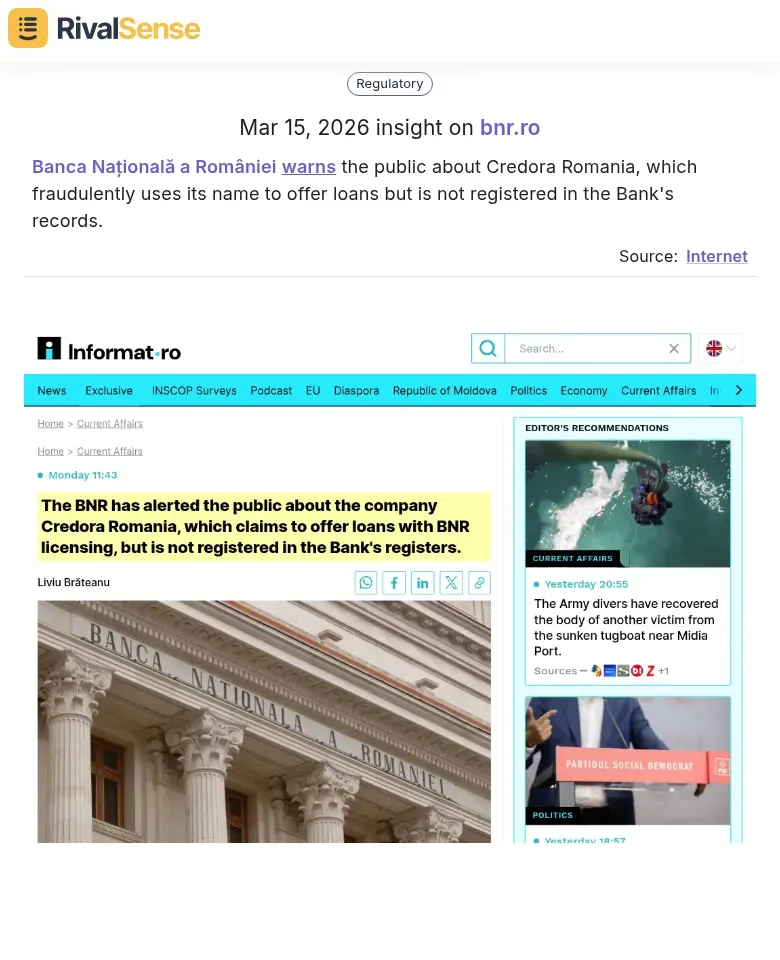
Consider this RivalSense insight: Banca Națională a României warns the public about Credora Romania, which fraudulently uses its name to offer loans but is not registered in the Bank's records.
Why this insight is valuable: It exposes competitors with serious compliance issues, such as unauthorized use of regulatory names. This allows you to highlight your own verified credentials and target customers seeking trustworthy financial partners.
Practical Checklist:
✅ Weekly scan of FINRA/SEC enforcement actions for competitor mentions
✅ Verify competitor registrations against FINRA BrokerCheck and SEC EDGAR
✅ Document unauthorized regulatory logo usage in marketing collateral
✅ Track regulatory warning letters issued to competitors
✅ Monitor social media for misleading compliance claims
When competitors receive regulatory warnings, position your company as the verified alternative. Highlight your complete licensing, transparent compliance documentation, and clean regulatory history. Use these insights to target clients seeking trustworthy partners, emphasizing your adherence to financial regulations versus competitors' compliance gaps.
Analyzing Product Compliance Failures and Quality Control Issues
When competitors face regulatory compliance failures, you gain a strategic window into market positioning. Start by analyzing their packaging and measurement violations—these often reveal systemic quality control issues. For example, if a competitor's product labeling shows inaccurate net weight or missing allergen warnings, document these violations systematically.
Here's a RivalSense insight to illustrate: ANPC stopped 140 tons of sugar from marketing on March 10 due to weight differences exceeding 70 grams per package, affecting consumers with an estimated damage of 30,000 lei.
Why this insight is valuable: It quantifies the impact of product compliance failures, helping you estimate consumer damage and reputational risk. By tracking such issues, you can develop superior quality control protocols and market your products as more reliable.
Quantify the market impact by estimating consumer damage: calculate affected customer segments, potential recall costs, and brand reputation erosion. A competitor's 5% underweight packaging across 100,000 units translates to significant consumer trust damage.
Turn these insights into positioning opportunities:
- Conduct regular compliance audits of competitor products
- Document violations with photographic evidence and regulatory citations
- Calculate the financial and reputational impact of each failure
- Develop superior quality control protocols addressing identified gaps
- Position your brand as the compliance leader in marketing materials
Practical tip: Create a compliance violation tracking spreadsheet with columns for violation type, regulatory body, affected SKUs, estimated consumer impact, and your corresponding quality control improvement. This transforms competitor failures into your competitive advantage by demonstrating superior standards and reliability to customers who've been burned by compliance issues.
Building Your Regulatory Intelligence Dashboard
Building an effective regulatory intelligence dashboard requires systematic automation and strategic prioritization. Start by creating automated monitoring systems that track competitor regulatory filings across key agencies. This proactive approach ensures you never miss critical updates that could impact your market position.
Set up multi-tiered alerts: immediate notifications for enforcement actions and product recalls, daily digests for new filings, and weekly summaries for compliance trend analysis. Configure alerts by competitor, regulatory body, and violation type to filter noise and focus on what matters most.
Develop a scoring matrix to prioritize regulatory opportunities for market positioning. Score each competitor action on three dimensions: Market Impact (high=product recalls, low=minor labeling changes), Regulatory Severity (high=enforcement actions, low=routine filings), and Timing Advantage (immediate vs. long-term opportunities). Weight scores based on your strategic goals.
Practical checklist:
- Identify top 5 regulatory agencies in your industry
- Map competitor regulatory submission calendars
- Set up Google Alerts for "[competitor] + [agency] + warning"
- Create a shared dashboard with color-coded risk levels
- Schedule monthly reviews to adjust scoring weights based on market changes
Tip: Cross-reference regulatory data with competitor marketing claims to identify compliance gaps you can leverage for competitive advantage.
Turning Regulatory Insights into Competitive Advantage
Transform regulatory compliance from a cost center into a competitive weapon. Start by developing marketing messaging that highlights your robust compliance framework while subtly contrasting it with competitor failures. This strategy helps build trust and differentiate your brand in crowded markets.
Build targeted sales playbooks for accounts affected by competitor regulatory issues. Identify companies in your target market that have faced compliance challenges with competing solutions, then develop specific outreach sequences addressing their pain points. Include objection-handling scripts for common concerns about switching vendors.
Implement quarterly regulatory audits to stay ahead of market shifts. Create a checklist:
✅ Review competitor regulatory filings and enforcement actions
✅ Analyze industry compliance trends and upcoming regulations
✅ Assess your positioning against new compliance requirements
✅ Update marketing collateral with fresh compliance differentiators
✅ Train sales teams on new regulatory talking points
Pro tip: Monitor regulatory bodies' websites and industry publications for early warning signs of compliance changes affecting your competitors. This allows you to proactively adjust your positioning before market shifts occur.
Leverage Regulatory Intelligence with RivalSense
Manually tracking all these regulatory insights can be overwhelming. That's where tools like RivalSense come in. RivalSense automates competitor tracking, delivering weekly reports on product launches, pricing updates, event participations, partnerships, regulatory aspects, management changes, and media mentions across company websites, social media, and various registries.
By using RivalSense, you can effortlessly stay informed about competitor activities, including regulatory inquiries, warnings, and compliance failures. This allows you to focus on strategic decision-making rather than data collection.
Ready to turn regulatory compliance into your competitive advantage? Try RivalSense for free today at https://rivalsense.co/ and get your first competitor report to start uncovering valuable market insights!
📚 Read more
👉 Analyzing Fanatics' Bundesliga Collection Launch: A Competitor Insight
👉 The Strategic Benefits of Tracking Emerging Competitors: Your Early Warning System
👉 How to Conduct Fleet Management Competitor Analysis for Strategic Advantage
👉 How RivalSense Alerted Competitors to BoursoBank’s Rate Hike for Strategic Response
👉 Competitor Website Changes Cheat Sheet for Key Account Managers